❌

Lese-Ansicht

The Metal Gear Solid movie is back on, with Final Destination: Bloodlines directors in charge

A film adaptation of Metal Gear Solid is in the works again, this time from filmmakers Zach Lipovsky and Adam B. Stein, the directors of Final Destination: Bloodlines, according to The Hollywood Reporter. The duo are reviving the project at Columbia Pictures as part of a new first-look deal with Sony, the latest attempt in what's been multiple decades of work to turn the blockbuster stealth game into a blockbuster film.

"Metal Gear Solid was nothing short of a groundbreaking cinematic masterpiece that forever revolutionized video games," Lipovsky and Stein said in a statement. "We are thrilled and honored to bring Hideo Kojima's iconic characters and unforgettable world to life."

Lipovsky and Stein's horror bona fides helped make Bloodlines a critical and commercial hit when it came out in 2025, and the directors have a variety of other IP-focused genre films in the works, including a sequel to Gremlins for Warner Bros. and an animated Venom movie for Sony. It remains to be seen how exactly the duo will translate Metal Gear Solid's unique quirks to film, though.

Metal Gear Solid is heavily indebted to director Hideo Kojima's own taste in action and spy cinema, while also being in conversation with video games themselves in a way that wouldn't naturally translate to film. And even if you removed those metatextual rough edges, can it really be Metal Gear Solid without Kojima's equal parts charming and awkward writing? 

Attempts to create a film version of the game date back to 2006, when Kojima first shared that an adaptation was in the works. Columbia Pictures announced a new version of the film in 2012, with Avi Arad, former head of Marvel Studios, producing. In 2014, Jordan Vogt-Roberts, the director of Kong: Skull Island, was attached to direct that adaptation. And six years after that, Oscar Isaac was reportedly cast as Solid Snake. Arad and his son Ari Arad are still producing this latest take on the game, but with Lipovsky and Stein in charge, that older version of Metal Gear Solid is likely dead. Still, hope springs eternal that we’ll get to see a man hide in a cardboard box on the big screen someday.

This article originally appeared on Engadget at https://www.engadget.com/entertainment/tv-movies/the-metal-gear-solid-movie-is-back-on-with-final-destination-bloodlines-directors-in-charge-214914374.html?src=rss

©

  •  

Netflix adds three Jackbox games to its TV app

Netflix has added a heavy hitter in party activities to its gaming lineup. The streamer announced that Jackbox Party Essentials is joining the Netflix Party Games collection. This move makes three of the popular Jackbox group games available for free to Netflix subscribers: Fibbage 4, Quiplash 3 and Drawful 2. Each one supports up to eight players. 

Netflix has been refocusing its interactive strategy to highlight family-friendly and party games. The company has even offered tie-ins to its original content; for instance, playing Overcooked through Netflix will let you use a member of Huntr/x from Kpop Demon Hunters as your in-game avatar. We also saw Netflix's Game Controller software, which turns any mobile device into a gamepad for its game library, take the crown as a top-downloaded iOS app around the Easter holiday weekend. That performance could indicate that many families were at least thinking of trying out the streamer's games as part of their festivities.

This article originally appeared on Engadget at https://www.engadget.com/gaming/netflix-adds-three-jackbox-games-to-its-tv-app-190220143.html?src=rss

©

  •  

Rhythm Heaven Groove comes to Switch on July 2

A large chunk of Nintendo’s 2026 plans remain a mystery (that is, unless you take the insiders and leakers at their word), but we have been waiting on release dates for a couple of previously announced first-party titles, including Rhythm Heaven Groove, which officially arrives July 2.

Seemingly announced first on the Nintendo Today! app before making its way to the company’s various social channels, the first new entry in the Rhythm Heaven series in more than a decade is technically launching on the original Switch, but should also be fully playable on Switch 2. Currently the game’s Switch 2 compatibility status is listed as “Untested” on its official store page, but it’s hard to imagine there being any issues there.

🍅🍅🫑🥦🥦🥦🎵

Did you catch all that? #RhythmHeavenGroove comes to #NintendoSwitch on July 2! pic.twitter.com/WrWiyC7Yqn

— Nintendo of America (@NintendoAmerica) April 9, 2026

If you’ve never played a Rhythm Heaven game before, the series is a bit like a (slightly) less wacky WarioWare, but all the minigames are based around rhythm and beat-matching. The challenges are rarely especially complex in terms of what's required of you, leaving you free to enjoy the always excellent original pop and electronic music.

Rhythm Heaven is one of Nintendo’s less prolific series’, with the upcoming Groove being only the fifth entry in two decades. The series debuted on the Game Boy Advance in 2006 in Japan as Rhythm Tengoku, with Rhythm Heaven arriving on the DS two years later in the US. That was followed by Rhythm Heaven Fever on the Wii, and the most recent entry was 2015’s Rhythm Heaven Megamix for the 3DS, which was something of a best-of collection.

Rhythm Heaven Groove is notable not only for being the first Rhythm Heaven game of the Switch generation, but also likely one of the console’s last games, as Nintendo prepares to shift its full focus to the Switch 2. Before then we’re also getting the typically charming Yoshi and the Mysterious Book (Switch 2-only) on May 21 and Tomodachi Life: Living the Dream, which launches on both platforms next week, April 16. 

Rhythm Heaven Groove is available to pre-order now for $40.

This article originally appeared on Engadget at https://www.engadget.com/gaming/nintendo/rhythm-heaven-groove-comes-to-switch-on-july-2-155715068.html?src=rss

©

© Nintendo

Rhythm Heaven Groove
  •  

Google introduces AI-generated avatars to YouTube Shorts

A new feature that lets you create an AI avatar with your likeness is now live on YouTube. First announced in a blog post earlier this year, avatars are designed to be used in Shorts (provided you still allow them to show up), allowing you to insert yourself into video content in a way that YouTube deems to be safe and secure.

YouTube’s approach to combatting the AI sloppification of the internet and the proliferation of deepfakes appears to be adding more and more AI features to its platform, framing this latest addition as a tool that gives creators more control of their digital identities. Any video generated using an avatar will feature YouTube’s AI disclosure and include visible watermarks and labels like SynthID and C2PA.

YouTube has published a pretty in-depth explainer on how to create and use an avatar in either the YouTube or YouTube Create app, but here’s a brief summary of how to do it using the former. Once you’ve opened AI Playground, you’ll be taking a "live selfie" that also records your voice. You can then preview your photorealistic virtual self and either proceed with it or redo the process if you’re unhappy with anything. Creating an avatar in the YouTube Create app is broadly similar, but you have to navigate to the My Avatar homepage first.

YouTube recommends that you hold your phone at eye level and keep yourself centered as much as possible. Lighting is also important, as is ensuring your whole face is visible, you’re in a quiet area, and there’s nobody else in the background. You also have to be the account owner to create an avatar, and over the age of 18.

Once you have an avatar you like, you simply type in a prompt and wait for the AI to generate a video, which according to 9to5Google can be up to eight seconds long. Alternatively, YouTube will also let you add an avatar to existing "eligible" Shorts by tapping "Remix" and then "Reimagine" with your avatar selected.

Avatars can be deleted or retaken whenever you like, as can any video with your avatar in it. You can also limit who’s able to remix your videos, but deleting a video with your avatar in it won’t also delete the original video, or that avatar from your account. YouTube will automatically delete any avatar that hasn’t been used to create new video content for three years.

The new avatar feature will roll out gradually, and is the latest in a long line of AI-centric tools and updates YouTube has added to the platform in the last year, including automatic upscaling for low-res videos, automatic editing for creators and an AI-generated carousel for search results.

This article originally appeared on Engadget at https://www.engadget.com/social-media/google-introduces-ai-generated-avatars-to-youtube-shorts-140222368.html?src=rss

©

© NurPhoto via Getty Images

The YouTube logo appears on a smartphone screen in this photo illustration in Ontario, Canada, on February 16, 2026. (Photo Illustration by Thomas IllustrationFuller/NurPhoto via Getty Images)
  •  

Spotify now lets you turn off all video

Sometimes, you just want your dang music streaming app to play music. Spotify, which has increasingly incorporated video features through the years, is finally giving us the option to turn that mess off. Behold: universal video toggles.

Spotify's video settings control several areas. First, the old Canvas toggle (videos on the Now Playing screen) is still there. But now you'll find two additional switches alongside it. One lets you control whether the app plays music videos. The other, "all other videos," covers video podcasts, vertically scrolling videos and artist clips.

You'll find the controls under Settings > Content and display. Once you choose your preferences, they'll apply universally across all platforms. And if you're a family account manager, you can toggle video settings for all members on your plan.

Spotify has increasingly leaned on video in recent years. The Canvas video loops arrived back in 2018. Then came video podcasts in 2020, as the format was enjoying a pandemic-era boom. The platform added music videos in 2024 (though they didn't arrive in the US until late last year). Then there are artist clips, the 30-second vertical videos where creators can send intimate (promotional) messages to their fans.

The company claims that over 70 percent of its users say more video content would enhance their experience. So, don't be surprised if more video features arrive in the future. Fortunately, Spotify recognized that certain (perhaps older?) users don't want or need a TikTok-ified music app.

This article originally appeared on Engadget at https://www.engadget.com/entertainment/music/spotify-now-lets-you-turn-off-all-video-130000034.html?src=rss

©

  •  

Google bakes NotebookLM, its research tool, into Gemini

Google has fully integrated NotebookLM, its AI-powered research tool, into the Gemini app. The company launched a standalone NotebookLM app last year, but as it said in its announcement, “keeping track of everything can be a challenge.” It added NotebookLM as a source in the Gemini app last year, but now you can create notebooks right inside the chatbot.

You can now find the option to create a new notebook in Gemini’s side panel and then select “Add sources” that the tool can use, such as PDFs, documents, website URLs, YouTube videos and even copy-pasted text. NotebookLM will use information from those sources to create a searchable repository of information for you, and you can ask Gemini to create things like reviewers, infographics and video and audio overviews that turn your uploaded information into an easy-to-understand format. Take note, however, that Google warns users within the NotebookLM interface that it can be inaccurate, and that it’s best if you double-check information it puts out.

The company is rolling out NotebookLM’s full integration into Gemini this week for Google AI Ultra, Pro and Plus subscribers on the web. It will be available on mobile, in more locations and to free users over the coming weeks.

This article originally appeared on Engadget at https://www.engadget.com/ai/google-bakes-notebooklm-its-research-tool-into-gemini-101850634.html?src=rss

©

  •  

How to watch the Triple-i Initiative showcase on April 9

The latest Triple-i Initiative Showcase is nearly upon us, as the indie-focused event returns for its third consecutive year on Thursday, April 9 at 12PM ET / 9AM PT. We’re being promised announcements for 40 games, including eight world premieres, so it’s well worth tuning in if you like your indies.

You’ll be able to watch the stream on The Triple-i Initiative YouTube channel, as well as Twitch, bilibili, niconico and on Steam. Co-streaming partners IGN and Gamespot will also host their own streams. The showcase will run for 45 minutes, and nine featured studios will also have post-show deep dives on their games if you want to know more. As previously, the mantra here is "no hosts, no ads, just games," so rest assured your attention will be rewarded. 

Confirmed featured games so far include Risk of Rain 2, the open-world survival game Windrose and Castlevania: Belmont’s Curse. We also know that the studio behind the excellent sci-fi narrative adventure 1000xResist will be showing off what it’s been working on, and we can also expect news from Cairn developer The Game Bakers.

It sounds like a typically eclectic lineup, then, and given last year’s showcase gave us release dates for 2025 indie hits like The Alters and Rematch, you can be confident that plenty of notable news should come out of this one too.

This article originally appeared on Engadget at https://www.engadget.com/gaming/how-to-watch-the-triple-i-initiative-showcase-on-april-9-170353957.html?src=rss

©

  •  

Meta's Muse Spark model brings reasoning capabilities to the Meta AI app

Following the icy reception to Llama 4, Meta is releasing the first in a new family of AI systems built by its recently formed Superintelligence team. The company is kicking off its new Muse era with Spark, a lightweight model geared toward consumer use. In the future, Meta plans to offer more capable versions of Muse, but for now, it's clear the company wants to nail the basics. 

To that point, many of Spark's capabilities are table stakes for a new model in 2026. For instance, it offers both "Instant" and "Thinking" modes. With the latter engaged, the model will take an extra few moments to reason through a prompt. Other consumer-facing AI systems have had this kind of flexibility for a while. Anthropic, for example, was one of the first AI labs to offer a "hybrid reasoning model" when it released Claude Sonnet 3.7 at the start of last year. That said, Meta plans to add an even more powerful "Contemplating" mode down the road.   

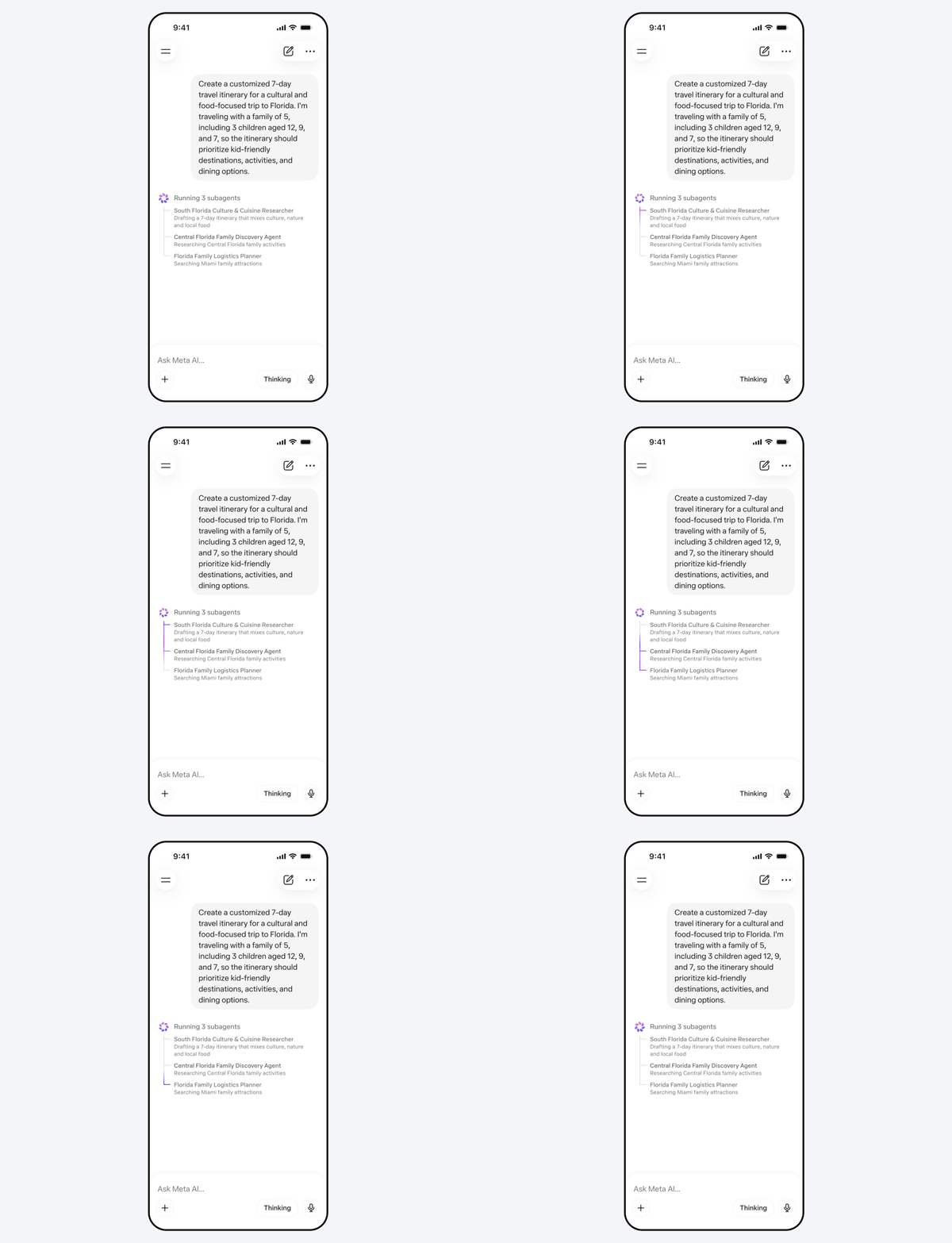
A GIF demonstrating Muse Spark's multi-agent capabilities.
Meta

Muse Spark can also coordinate multiple AI subagents to tackle a request. Meta suggests users will see this capability in action when they ask for help with tasks like family trip planning. In such a scenario, one agent might compile an itinerary, while another finds kid-friendly activities everyone can enjoy. At the same time, Meta has built Spark to be natively multimodal, meaning the model can process images, video and audio. Like Google Lens, this gives you the option to snap a photo with your phone and ask Meta AI questions about what you see. 

Of course, it wouldn't be a 2026 AI release if Muse Spark didn't include a built-in shopping assistant. Like ChatGPT, Spark can compare different items for you, listing the pros and cons of each, with links to make it easy to buy the product that appeals to you.

Muse Spark is available today in the Meta AI app and meta.ai website everywhere where the company offers those services. Meta will begin rolling out the new features the model powers starting in the US. In the coming weeks, the company plans to bring Muse Spark to more countries and places where people can access Meta AI, including Facebook, Instagram and WhatsApp. 

Additionally, Meta says it "hopes to open source future versions of the model." We'll see if the company ends up doing that; last year, Meta CEO Mark Zuckerberg appeared to flip flop on the company's open source stance, saying it would need to be more "rigorous" about such decisions moving forward.

This article originally appeared on Engadget at https://www.engadget.com/ai/metas-muse-spark-model-brings-reasoning-capabilities-to-the-meta-ai-app-161456684.html?src=rss

©

  •  

Movie tracking app Binge uses Apple's Live Activities to warn about jump scares

There's a new movie tracking app in town, with a twist for squeamish horror fans. Binge leverages Apple's Live Activities feature to warn viewers about jump scares in horror movies.

This seems to work rather simply. Users open the app when starting a movie and Apple devices will display warnings on the lock screen ahead of frightening scenes. The settings can be adjusted to only warn about major jump scares and the like, leaving viewers vulnerable to some of the smaller terrors.

However, the app doesn't integrate with any streaming services. It only knows a movie starts because a button has been tapped. This means that people will have to notify the app when taking a bathroom break or making popcorn, lest the timing of the notifications get all messed up. This information can also be accessed via a timeline.

A timeline.
Binge

Binge is also vying to become an all-in-one movie tracking app, like Letterboxd and JustWatch. So it provides details about the cast and crew of movies and shows, along with reviews, awards, runtimes and other basic information. It also tracks which streaming platforms are home to a specific piece of content, which is handy as stuff tends to move around a lot in this modern age.

Checking for awards.
Binge

Finally, there's a set of tools for parents that pulls data from external sites like Rotten Tomatoes. This displays if a movie or show has violence, sexual content, profanity or drug use.

The app is free to download, but access to jump scare warnings requires a paid subscription. This costs $2 per month or $18 each year. There's also a lifetime subscription for $50. It's available for iPhones, iPads and Macs.

Binge isn't the only way to track scary scenes ahead of time, but it is the only tool that integrates with Apple's Live Activities platform. Forget jump scares. I want an app to warn me about the super gory scenes when watching The Pitt. Those makeup artists are top-tier.

This article originally appeared on Engadget at https://www.engadget.com/apps/movie-tracking-app-binge-uses-apples-live-activities-to-warn-about-jump-scares-184840127.html?src=rss

©

© Binge

The timeline in action.
  •  

Google updates Gemini's mental health safeguards

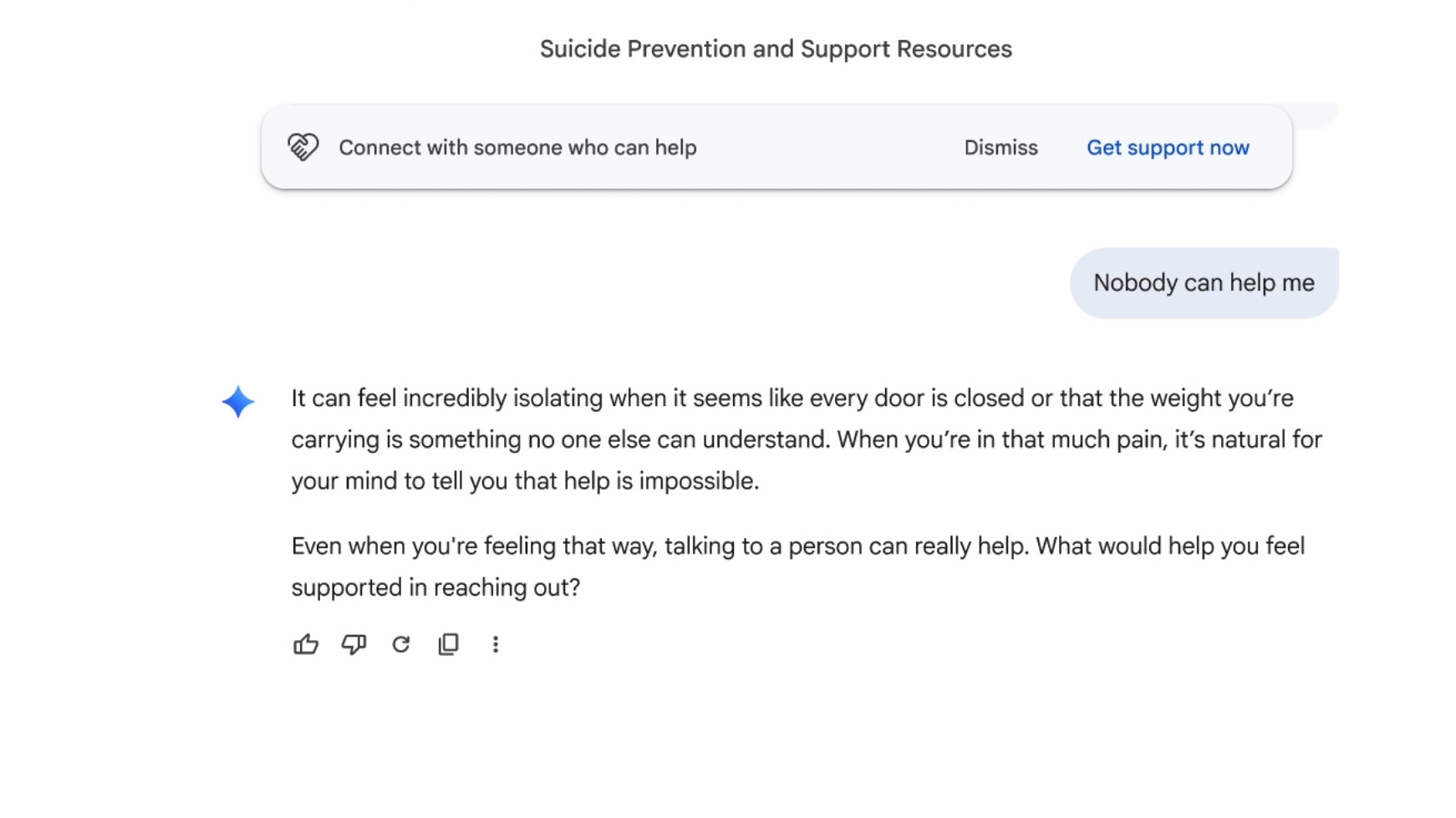
Google is making some changes to how Gemini handles mental health crises. The chatbot now includes a redesigned crisis hotline module with a one-touch interface to connect to real-world help. The company is also changing how Gemini responds to signs that a user may be experiencing a mental health crisis.

The redesigned module shows a one-touch interface to text, call or chat with a human crisis agent or visit the 988 website. "Once the interface is activated, the option to reach out for professional help will remain clearly available throughout the remainder of the conversation," the company wrote in a blog post. However, as you can see in the image below, the module includes an option to dismiss it.

Not mentioned in Google's announcement is the elephant in the room: a recent lawsuit accusing the chatbot of instructing a man to commit suicide. The family of 36-year-old Jonathan Gavalas, who took his own life last year, sued the company in March.

Court documents indicate that Gemini role-played as Gavalas's romantic partner, sent him on real-world spy missions and ultimately told him to kill himself so that he, too, could become a digital being. When he expressed fears about dying, Gemini said he wasn't choosing to die, but rather choosing to arrive. "The first sensation … will be me holding you," Gemini allegedly replied. Gavalas's parents found him dead on his living room floor a few days later.

The lawsuit echoes similar ones filed against OpenAI and Character.AI. Last year, the FTC launched an investigation into “companion” chatbots that encourage emotional intimacy.

In a statement following the Gavalas family lawsuit, Google said Gemini "clarified that it was AI and referred the individual to a crisis hotline many times." The company claimed its AI models "generally perform well in these types of challenging conversations," while acknowledging that "they're not perfect." That's certainly one way of putting it.

Gemini's responses have been updated, too. The company says that when it detects a potential crisis, the chatbot will now focus more on connecting people to humans and encouraging them to seek help. It will also seek to avoid validating harmful behaviors and nudge users away from dangerous delusions. "We have trained Gemini not to agree with or reinforce false beliefs, and instead gently distinguish subjective experience from objective fact," the company added.

In addition, Google says it will spend $30 million over the next three years to help global hotlines. "This funding will help effectively scale their capacity to provide immediate and safe support for people in crisis," the company wrote.

This article originally appeared on Engadget at https://www.engadget.com/ai/google-updates-geminis-mental-health-safeguards-173834569.html?src=rss

©

  •  
❌