Blue Origin plans to put a focus on the development of its human lunar capabilities, so it won’t be sending tourists to space for at least the next two years. That means we won’t be seeing any New Shepard launches for quite some time. Blue Origin is one of the companies NASA chose to develop human landing systems for its Artemis program, along with SpaceX. Specifically, it will work on landers for the Artemis III and Artemis V missions.
The company was originally contracted to build the human landing system that would transfer astronauts from NASA’s Gateway station to the moon’s South Pole region for the Artemis V mission. But last year, NASA asked Blue Origin to design an alternative lander for Artemis III after SpaceX experienced delays due to Starship’s failed tests. Artemis III is expected to be the first crewed moon landing mission of the program, and the Trump administration wants it to happen before the end of the president’s term.
New Shepard takes tourists to suborbital space, where they experience a few minutes of weightlessness before the spacecraft makes its way back to Earth. Jeff Bezos was one of the passengers on New Shepard’s first tourist flight back in 2021. Since then, it has flown and landed 37 more times and carried 98 passengers to the Karman line, including Katy Perry and William Shatner.
This article originally appeared on Engadget at https://www.engadget.com/science/space/blue-origin-is-pausing-its-space-tourist-flights-to-work-on-lunar-landers-for-nasa-143000058.html?src=rss
Since 2021, NASA's Perseverance rover has achieved a number of historic milestones, including sending back the first audio recordings from Mars. Now, nearly five years after landing on the Red Planet, it just achieved another feat. This past December, Perseverance successfully completed a route through a section of the Jezero crater plotted by Anthropic's Claude chatbot, marking the first time NASA has used a large language model to pilot the car-sized robot.
Between December 8 and 10, Perseverance drove approximately 400 meters (about 437 yards) through a field of rocks on the Martian surface mapped out by Claude. As you might imagine, using an AI model to plot a course for Perseverance wasn't as simple as inputting a single prompt.
As NASA explains, routing Perseverance is no easy task, even for a human. "Every rover drive needs to be carefully planned, lest the machine slide, tip, spin its wheels, or get beached," NASA said. "So ever since the rover landed, its human operators have painstakingly laid out waypoints — they call it a 'breadcrumb trail' — for it to follow, using a combination of images taken from space and the rover’s onboard cameras."
To get Claude to complete the task, NASA had to first provide Claude Code, Anthropic's programming agent, with the "years" of contextual data from the rover before the model could begin writing a route for Perseverance. Claude then went about the mapping process methodically, stringing together waypoints from ten-meter segments it would later critique and iterate on.
This being NASA we're talking about, engineers from the agency's Jet Propulsion Laboratory (JPL) made sure to double check the model's work before sending it to Perseverance. The JPL team ran Claude's waypoints through a simulation they use every day to confirm the accuracy of commands sent to the rover. In the end, NASA says it only had to make "minor changes" to Claude's route, with one tweak coming as a result of the fact the team had access to ground-level images Claude hadn't seen in its planning process.
"The engineers estimate that using Claude in this way will cut the route-planning time in half, and make the journeys more consistent," NASA said. "Less time spent doing tedious manual planning — and less time spent training — allows the rover’s operators to fit in even more drives, collect even more scientific data, and do even more analysis. It means, in short, that we’ll learn much more about Mars."
While the productivity gains offered by AI are often overstated, in the case of NASA, any tool that could allow its scientists to be more efficient is sure to be welcome. Over the summer, the agency lost about 4,000 employees – accounting for about 20 percent of its workforce – due to Trump administration cuts. Going into 2026, the president had proposed gutting the agency's science budget by nearly half before Congress ultimately rejected that plan in early January. Still, even with its funding preserved just below 2025 levels, the agency has a tough road ahead. It's being asked to return to the Moon with less than half the workforce it had during the height of the Apollo program.
For Anthropic, meanwhile, this is a major feat. You may recall last spring Claude couldn't even beat Pokémon Red. In less than a year, the company's models have gone from struggling to navigate a simple 8-bit Game Boy game to successfully plotting a course for a rover on a distant planet. NASA is excited about the possibility of future collaborations, saying "autonomous AI systems could help probes explore ever more distant parts of the solar system."
This article originally appeared on Engadget at https://www.engadget.com/ai/nasa-used-claude-to-plot-a-route-for-its-perseverance-rover-on-mars-203150701.html?src=rss
The Sundance documentary Ghost in the Machine boldly declares that the pursuit of artificial intelligence, and Silicon Valley itself, is rooted in eugenics.
Director Valerie Veatch makes the case that the rise of techno-fascism from the likes of Elon Musk and Peter Thiel is a feature, not a bug. That may sound hyperbolic, but Ghost in the Machine, which is built around interviews with philosophers, AI researchers, historians and computer scientists, leaves little room for doubt.
But even I was surprised to learn that we can trace the impact of eugenics in tech all the way back to Karl Pearson, the mathematician who pioneered the field of statistics, and who also spent his life trying to quantify the differences between races. (Guess who he believed was superior.) His legacy was continued by William Shockley, a co-creator of the transistor, an avowed white supremacist who spent his later years espousing (now debunked) theories around IQ and racial differences.
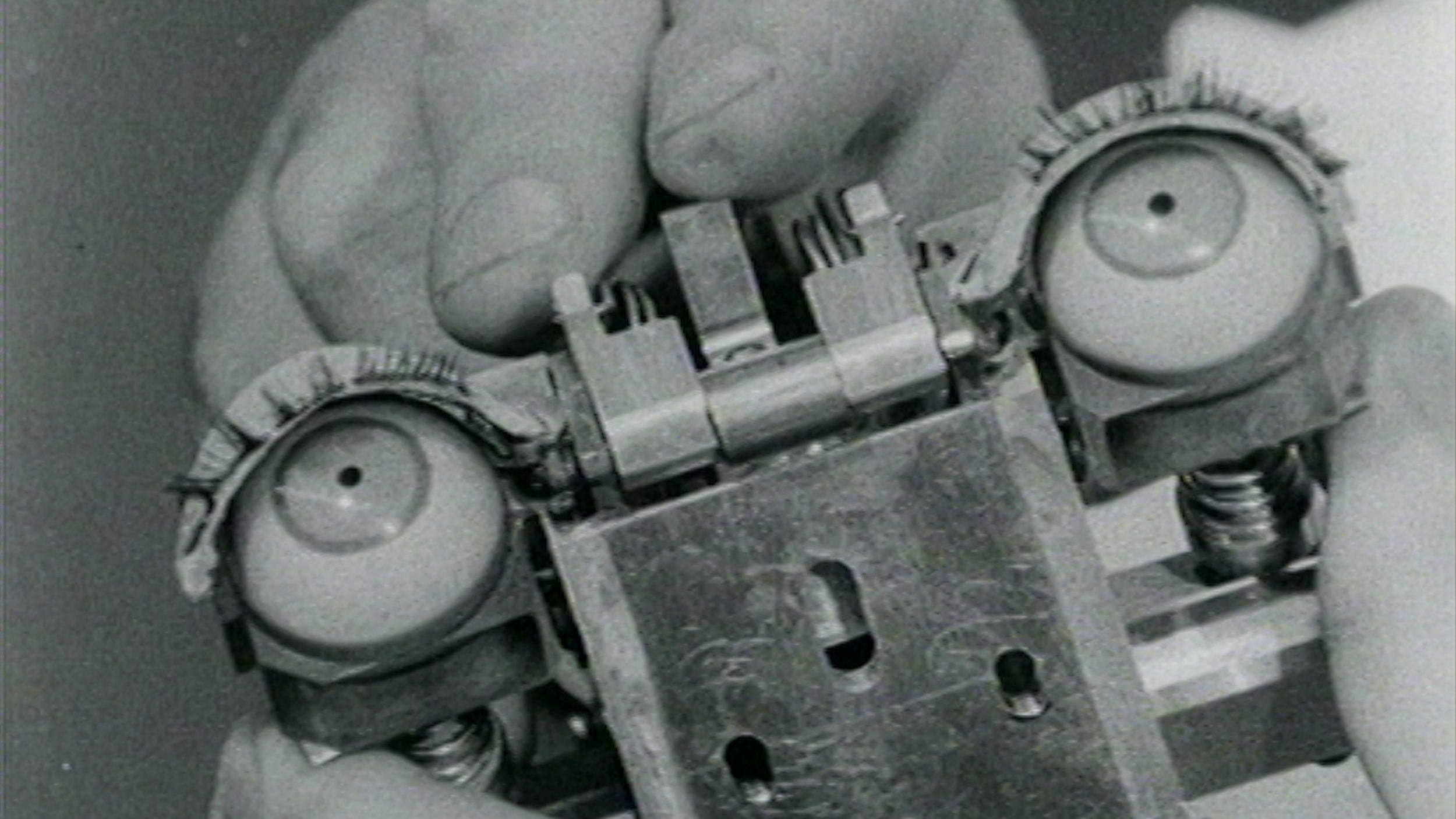
An early robot toy.
Valerie Veatch for "Ghost in the Machine"
As a Stanford engineering professor, Shockley fostered a culture of prioritizing white men over women and minorities, which ultimately shaped the way Silicon Valley looks today. His line of thinking could have had an influence on John McCarthy, the Stanford researcher who coined the term “artificial intelligence” in 1955,
Through its many interviews, which include the likes of AI researcher Dr. Emily Bender, historian Becca Lewis and media theorist Douglass Rushkoff, Ghost in the Machine paints the rise of AI as a fascistic project that aims to demean humans and establish the techno-elite as our de facto rulers. Given how much our lives are already dominated by gadgets and social networks from companies that have pioneered addictive engagement over user safety, it's easy to imagine history repeating itself with AI.
Ghost in the Machine doesn't leave any room for considering potential benefits around AI, which could lead proponents of the technology to dismiss it as a hit-job. But we're currently at the apex of the AI hype cycle, after Big Tech has invested hundreds of billions of dollars on this technology, and after it has spent years shoving it down our throats without proving why it’s actually useful to many people. AI should be able to withstand a bit of criticism.
This article originally appeared on Engadget at https://www.engadget.com/entertainment/tv-movies/sundance-doc-ghost-in-the-machine-draws-a-damning-line-between-ai-and-eugenics-180613367.html?src=rss
Researchers using the James Webb Space Telescope have found a galaxy that is offering new data about the early stages of the universe's existence. The latest discovery shared by astronomers is about a bright galaxy dubbed MoM-z14. According to the team, this galaxy existed 280 million years after the Big Bang.
The sounds like a long time, but in the context of the universe's estimated 13.8 billion years of existence, that's actually one of the closest examples astronomers have found to the Big Bang's occurrence. As a result, MoM-z14 can offer some insights and some surprises about what the early stages of the universe entailed.
"With Webb, we are able to see farther than humans ever have before, and it looks nothing like what we predicted, which is both challenging and exciting," lead author Rohan Naidu of Massachusetts Institute of Technology said. The findings about this galaxy were published in the Open Journal of Astrophysics.
The scientists were able to date MoM-z14 with Webb's Near-Infrared Spectrograph instrument, analyzing how light from the galaxy changed wavelengths as it traveled to reach the telescope. One of the initial questions sparked by this bright galaxy centers on the presence of nitrogen. Some early galaxies, including MoM-z14, have revealed higher nitrogen concentrations than scientists had projected was possible. Another topic of interest is about reionization, or the process of stars producing enough light or energy to permeate the dense hydrogen fog that existed in the early universe.
“It’s an incredibly exciting time, with Webb revealing the early Universe like never before and showing us how much there still is to discover” said Pennsylvania State University graduate student and team member Yijia Li.
This article originally appeared on Engadget at https://www.engadget.com/science/space/astronomers-share-new-insights-about-the-early-universe-via-the-webb-space-telescope-213311848.html?src=rss
Here's a use of AI that appears to do more good than harm. A pair of astronomers at the European Space Agency (ESA) developed a neural network that searches through space images for anomalies. The results were far beyond what human experts could have done. In two and a half days, it sifted through nearly 100 million image cutouts, discovering 1,400 anomalous objects.
The creators of the AI model, David O'Ryan and Pablo Gómez, call it AnomalyMatch. The pair trained it on (and applied it to) the Hubble Legacy Archive, which houses tens of thousands of datasets from Hubble's 35-year history. "While trained scientists excel at spotting cosmic anomalies, there's simply too much Hubble data for experts to sort through at the necessary level of fine detail by hand," the ESA wrote in its press release.
After less than three days of scanning, AnomalyMatch returned a list of likely anomalies. It still requires human eyes at the end: Gómez and O'Ryan reviewed the candidates to confirm which were truly abnormal. Among the 1,400 anomalous objects the pair confirmed, more than 800 were previously undocumented.
Most of the results showed galaxies merging or interacting, which can lead to odd shapes or long tails of stars and gas. Others were gravitational lenses. (That's where the gravity of a foreground galaxy bends spacetime so that the light from a background galaxy is warped into a circle or arc.) Other discoveries included planet-forming disks viewed edge-on, galaxies with huge clumps of stars and jellyfish galaxies. Adding a bit of mystery, there were even "several dozen objects that defied classification altogether."
"This is a fantastic use of AI to maximize the scientific output of the Hubble archive," Gómez is quoted as saying in the ESA's announcement. "Finding so many anomalous objects in Hubble data, where you might expect many to have already been found, is a great result. It also shows how useful this tool will be for other large datasets."
This article originally appeared on Engadget at https://www.engadget.com/ai/astronomers-discover-over-800-cosmic-anomalies-using-a-new-ai-tool-205135155.html?src=rss
Elon Musk is reportedly looking to finally take SpaceX public after years of resistance, according to sources who spoke to TheWall Street Journal. The company has long said it wouldn't choose an IPO until it had established a presence on Mars. That isn't happening anytime soon.
So why now? Company insiders have suggested it's because Musk wants to build AI data centers in space. Google recently announced it was looking into putting a data center in space, with test launches scheduled for 2027. Musk reportedly wants to beat his rival to the punch, but SpaceX would need the billions of dollars in capital that an IPO would deliver. Putting a giant center in space isn't cheap.
Our TPUs are headed to space!
Inspired by our history of moonshots, from quantum computing to autonomous driving, Project Suncatcher is exploring how we could one day build scalable ML compute systems in space, harnessing more of the sun’s power (which emits more power than 100… pic.twitter.com/aQhukBAMDp
Sources say that Musk wants to complete the IPO by July. SpaceX is reportedly expected to select banks to lead the stock offering in the near future.
This is also being seen as an attempt to boost xAI, which trails behind rivals like OpenAI and Google in the AI race. If SpaceX were to be successful in putting data centers in space, it's likely that xAI would get a sweetheart deal given that Musk runs both companies. Then they could pass money to one another in perpetuity, which seems to be the AI way.
Other companies have also begun considering jettisoning data centers into the great beyond. Blue Origin CEO Jeff Bezos recently suggested that shifting data centers to orbit makes sense. OpenAI CEO Sam Altman has been looking into partnering or purchasing a rocket maker called Stoke Space for a similar reason.
Of course, putting data centers in space is an extraordinary undertaking. There are serious issues that must be overcome, from latency to heat dissipation and radiation. Components must be launched and the structure must be built in space. WSJ reports that SpaceX made a breakthrough of some sort last year, but the company hasn't announced specifics.
If we need giant data centers to generate Garfield memes or whatever, I'd rather them in space. Microsoft's latest AI data center in Wisconsin takes up 325 acres. Meta recently announced a data center that would be nearly the size of Manhattan. These structures hoover up energy and water, strain local resources, create pollution and offer just a few long-term local jobs.
This article originally appeared on Engadget at https://www.engadget.com/science/space/elon-musk-is-reportedly-trying-to-take-spacex-public-170337053.html?src=rss
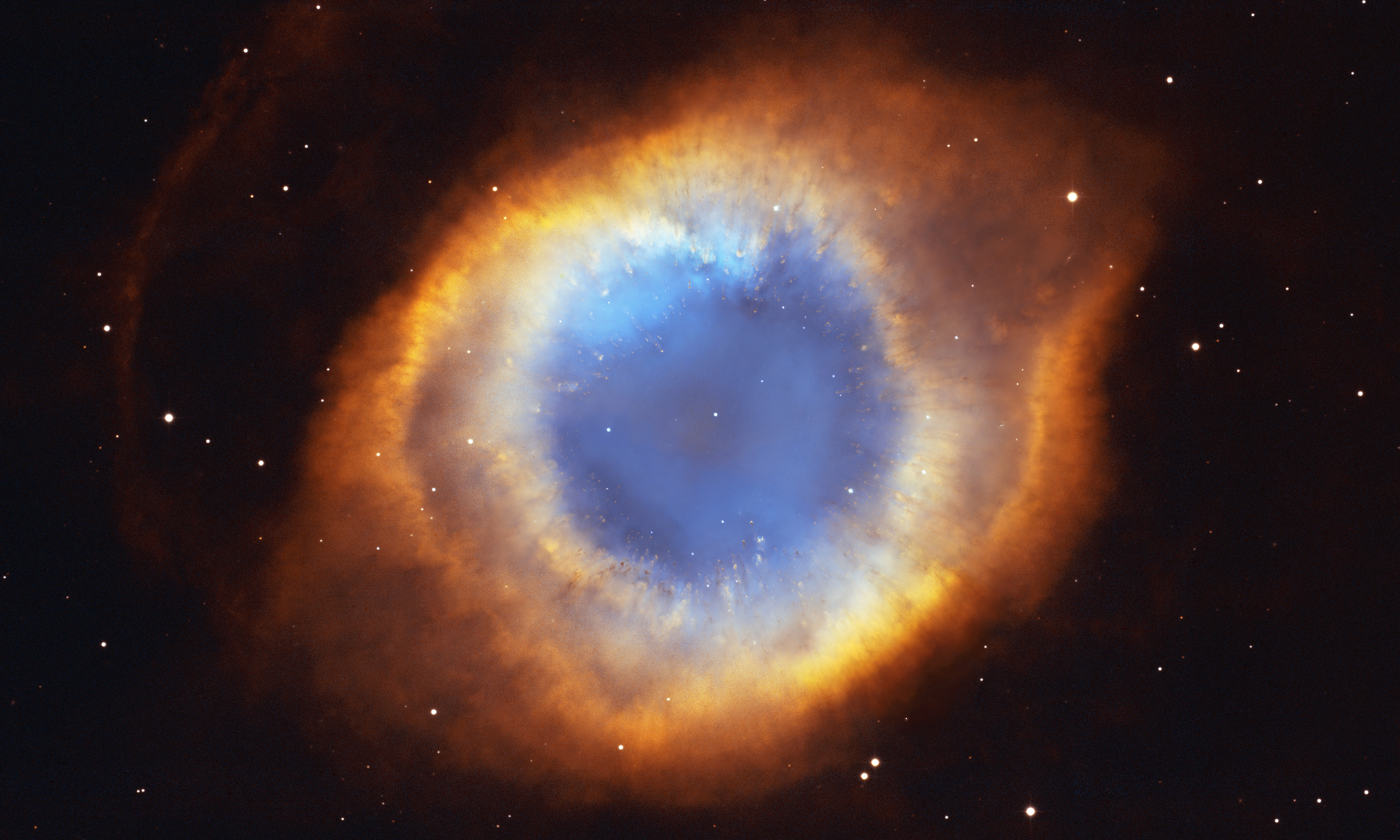
Sometimes, you just need to give your mind a little vacation. And these days, outer space sounds like as good a destination as any. Thankfully, the James Webb Space Telescope (JWST) is here to give us a dazzling new image of the Helix Nebula.
Discovered in the early 19th century, the Helix Nebula resides in the constellation Aquarius. (Cue The 5th Dimension.) At about 655 light-years away, it's one of Earth's closest planetary nebulae. When zoomed farther out, it's easy to see why it's been nicknamed the Eye of God or Eye of Sauron. This 2004 image from the Hubble telescope illustrates that.
A wider view of the same nebula from 2004
NASA / ESA / C.R. O'Dell (Vanderbilt University) / M. Meixner / P. McCullough / G. Bacon ( STSI)
What we're seeing in the nebula is, in a sense, a moment of death that lays the groundwork for a new birth. The dying star (out of frame in the closer new image) sheds its outer layers. As expelled gas and dust cool, they provide raw material that could someday form new stars and perhaps planetary systems.
The new image from Webb's NIRCam (Near-Infrared Camera) provides a much closer, higher-resolution view.
Pillar-like reddish knots in the Helix Nebula
Those pillars you see are called cometary knots, and this image is our best view of those to date. "Here, blistering winds of hot gas from the dying star are crashing into colder shells of dust and gas that were shed earlier in its life, sculpting the nebula's remarkable structure," the ESA wrote in its press release.
The knots' colors represent temperature and chemistry. Hints of blue indicate the hottest gas (energized by ultraviolet light). The yellow regions, where hydrogen atoms form molecules, are farther from the nebula's nucleus (and therefore cooler). On the edges, reddish-orange regions depict the coolest material, where gas thins and dust begins to form.
This article originally appeared on Engadget at https://www.engadget.com/science/space/earth-is-having-some-issues-so-lets-enjoy-the-webb-telescopes-new-nebula-image-181049901.html?src=rss
After a tumultuous 2025 that saw it lose around 4,000 employees, NASA finally has an operating budget for 2026, and one that largely preserves its scientific capabilities. On Thursday, the Senate passed an appropriations bill funding NASA, alongside the National Science Foundation and a handful of other federal agencies.
Going into the appropriations process, the president called for a 24 percent year over year reduction to NASA's total operating budget. As part of that plan, the White House wanted to reduce the Science Mission Directorate's funding by nearly half, a move that would have forced NASA to cancel 55 ongoing and planned missions, including efforts like OSIRIS-APEX. The bill effectively rejects President Trump's plan, reducing NASA's total operating budget by just 1.6 percent year over year to $24.4 billion.
Per the new appropriations, NASA's science budget will stand at $7.25 billion, 1.1 percent less relative to fiscal 2024, while shuffling the remaining funds to focus on different priorities. For instance, the House and Senate allocated $874 million (+8.7 percent) for the agency's heliophysics work; planetary sciences, which oversees missions like New Horizons, was cut to $2.5 billion (-6.5 percent) compared to 2024. At the same time, NASA's STEM engagement office, which the president proposed eliminating, escaped unscathed with its funding maintained at parity.
"It's almost everything we had been asking for, and it's very encouraging to see a House and Senate run by the president's own party agreeing that we need to keep investing in things like NASA science," says Casey Dreier, chief of policy at the Planetary Society, a nonprofit founded by Carl Sagan that advocates for the exploration and study of space. "It contains very clear and direct language that not only is this funding made available to these projects, but that it will be spent on the initiatives that Congress states."
Lawmakers also rejected Trump's effort to scuttle the Space Launch System after its third flight. NASA's heavy-lift rocket is billions of dollars over budget, but remains — as of now — the only spacecraft ready to ferry astronauts to the Moon. Compared to the rest of NASA, the fate of the SLS was never really in doubt. Senator Ted Cruz (R-TX) secured funding for the rocket as part of Trump's Big Beautiful Bill. "I've been saying for a long time you should never underestimate the political coalition behind the SLS, and I think that was very much validated this year," says Dreier.
More importantly, it appears the Goddard Space Flight Center will be safe from further damage. Over the summer, the future of the facility, known for its work on projects like the James Webb Space Telescope, was put in jeopardy. By some estimates, the campus has lost a third of its staff due to workforce cuts, and dozens of buildings, including some 100 laboratories, have been shut down by management. One of the casualties was NASA's largest library, which houses irreplaceable documents chronicling the history of the space race. As part of a "consolidation" effort, many of those documents will be thrown out.
Under the appropriations bill, the Senate has directed NASA to “preserve all the technical and scientific world-class capabilities at Goddard.” It has also instructed the agency to ensure employees of the Goddard Institute for Space Studies are able to continue their work with "minimal disruption." The New York-based office, one of America's leading climate labs, was sent into limbo last spring after the Trump administration moved to shut it down.
The bill also provides a lifeline for NASA's to bring back samples of Martian dirt collected by the Perseverance rover. Congress has effectively cancelled the official program tied to that ambition, the Mars Sample Return (MSR), but has set aside $110 million for the agency to continue developing technologies for future science missions to the Red Planet. MSR advocates have argued the mission could lead to significant scientific discoveries, but Dreier notes the program was "ripe for cancellation" after it became mired in mismanagement.
"I worry MSR now has this stink of bloat, excess cost and threat of overruns that are really going to make it challenging to restart this without having a dramatically different approach," says Dreier, adding that deciding what to do with mission will likely be top of mind for the agency's new administrator, Jared Isaacman.
The 2026 budget leaves NASA with fewer resources. Even in areas where Congress allocated the same amount of funds as it did in 2024, the agency will need to do more with less due to inflation. Compared to the absolute blood bath that would have been Trump's proposed budget, a marginal funding cut is the best case scenario given the circumstances, but the circumstances remain less than ideal.
"There will be another presidential budget request coming out in the next couple of months," Dreier said. "They could do this all over again if they wanted to."
In the immediate future, NASA and its employees are at least protected from the potential fallout of another impending government shutdown. Congress has until January 30 to fully fund the federal government, and as of earlier this week, it has yet to find a way forward on appropriations for agencies like the Department of Labor.
Correction 9:05PM ET: A previous version of this article incorrectly stated Casey Dreier’s surename as Drier. We regret the error.
This article originally appeared on Engadget at https://www.engadget.com/science/space/senate-passes-minibus-bill-funding-nasa-rejecting-trumps-proposed-cuts-231605536.html?src=rss
At every CES I’ve ever been to, there’s been one or two gadgets promising to boost your mental health. In recent years, the number of companies making forays into this space has grown, and will likely continue to do so in the future. Could it be, much like the number of people wearing heart-monitoring wearables today, everyone will be strapping an EEG to their skulls a decade or so down the line? It’s more likely than you think, so it’s worth asking what these devices are good for, what benefit they could bring, and where does the science end and the hype begin.
An Electroencephalogram (EEG) is a clinical tool to monitor the electrical activity of our brains. Put very simply, our minds are constantly moving ions around, and when they reach the scalp, it’s possible to measure those ions. By placing electrodes on the scalp, you can record the changes in voltages pushed out by our brains more or less in real time. These voltages are commonly grouped into categories, which are often described as brain waves. Each one represents a different state of mind: Gamma (hard thinking), Beta (anxious or active), Alpha (relaxed), Theta (creative, or dreaming) and Delta (asleep).
Professor Karl Friston at University College London is one of the world’s most influential neuroscientists and an expert in brain imaging. He explained that these technologies can be used to diagnose issues both in the structure and function of the brain. And while there are many technologies which can look at how our brains work, “we’re a long way away from understanding the brain like we understand the heart.” Broadly speaking, EEGs are a fairly simple tool for looking at how our minds work, but they have one benefit over more complex methods such as fMRI (functional Magnetic Resonance Imaging), since they work in real time.
Consumer-use EEGs are nothing new — in 2011 I tested the Zeo Mobile, a small device which you stuck to your forehead and wore overnight. It monitored how well you slept and sounded an alarm when you were at the top of a sleep cycle, so you woke up pretty easily. It worked well but with one downside: It’s hard to sleep with a hard plastic puck stuck to your forehead.
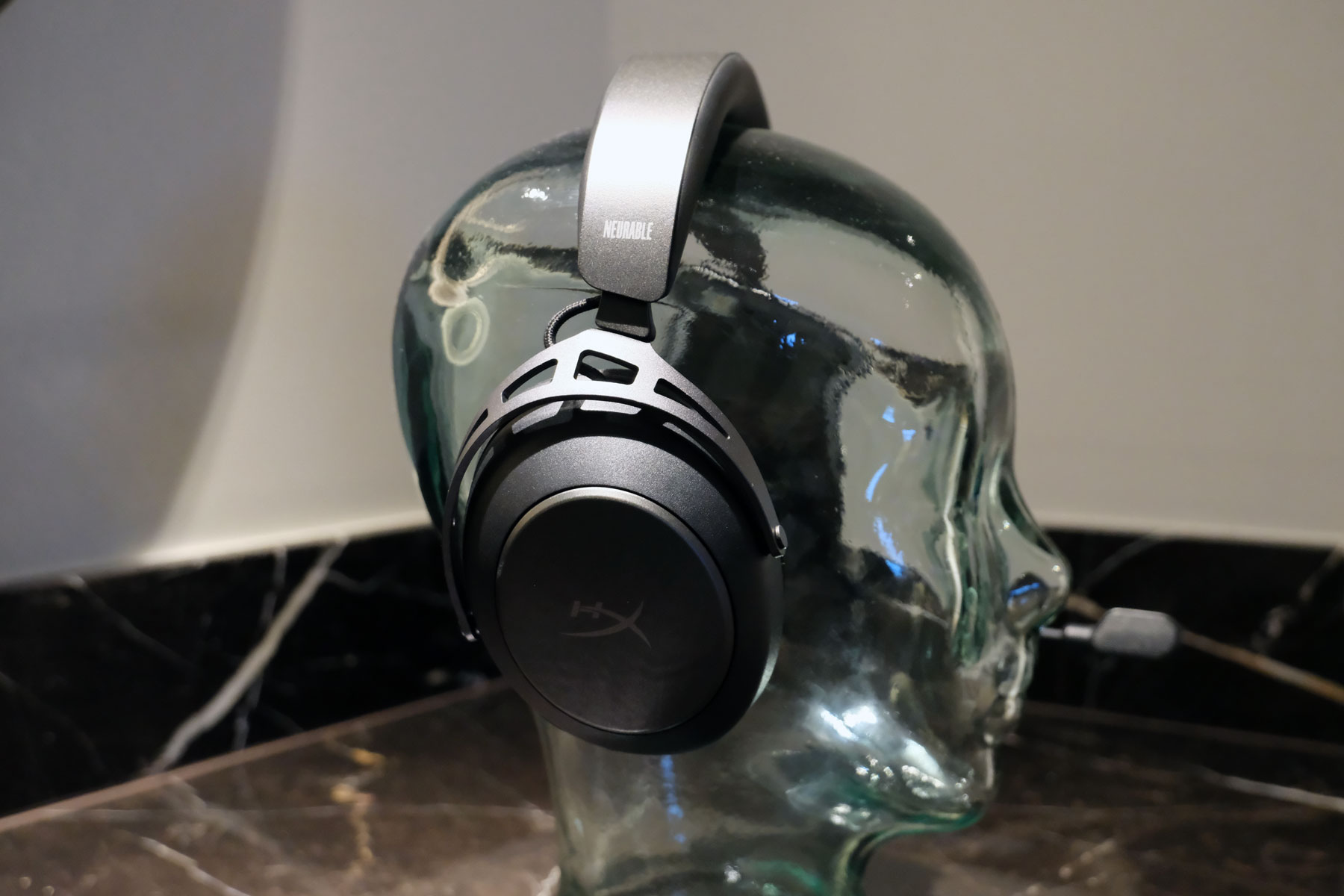
EEGs are more recently used as part of brain computer interfaces, or for neurofeedback tools to help you calibrate the quality of your meditation. InteraXon, for instance, makes the Muse headbands which will monitor your brain waves, telling you when you shift states. Last year, EEG startup Neurable partnered with Master & Dynamic to launch the MW75S Neuro, a pair of high-end headphones designed to track your focus levels. When your attention starts to wane, the system will alert you, advising you to take a rest with the hope of alleviating burnout.
Neurable
Daniel Cooper for Engadget
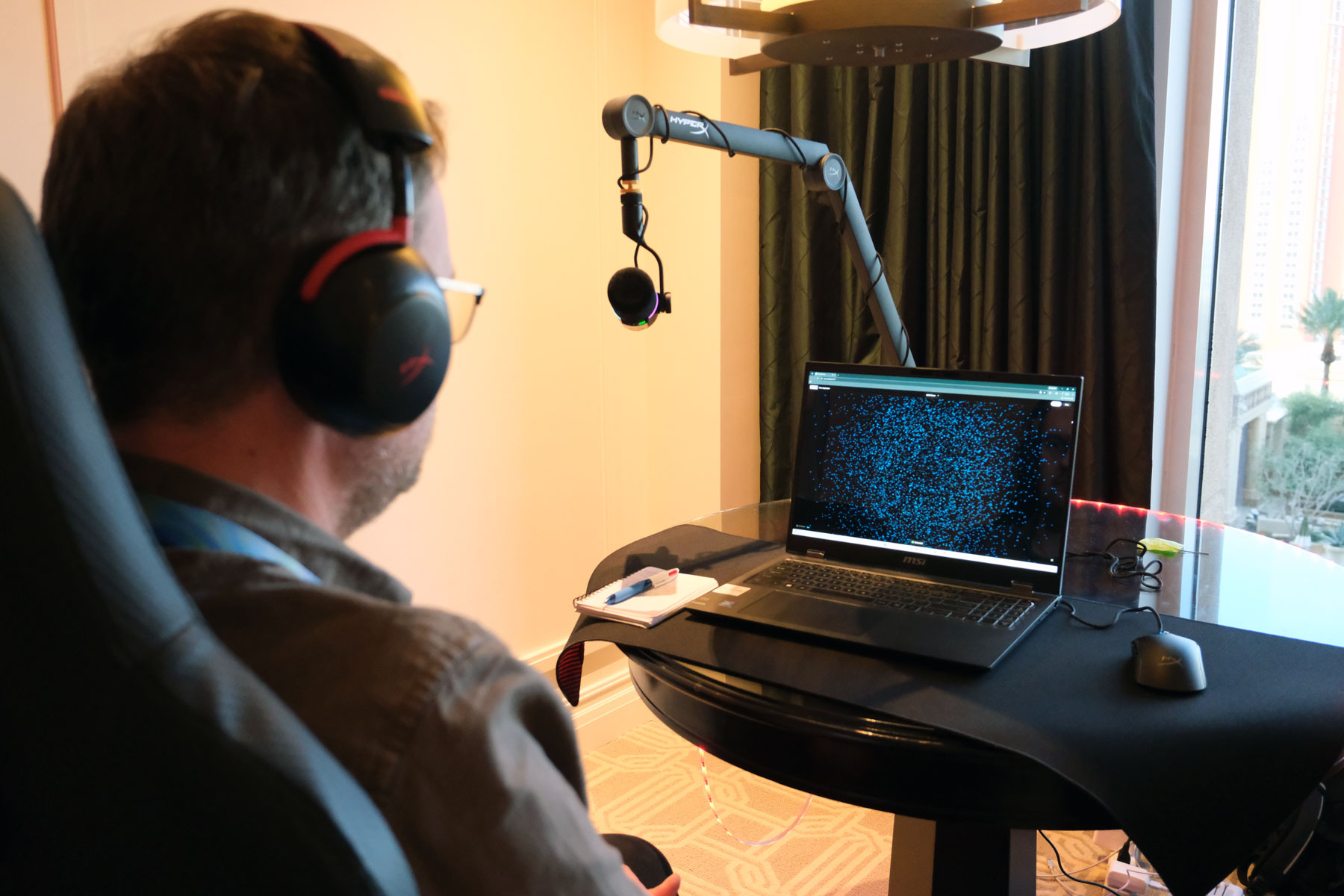
At CES this year, Neurable announced a partnership with HP’s gaming arm HyperX to produce EEG headsets with specific benefits for gamers. As gamers are looking for any way to improve their performance, the company has developed algorithms and training programs to help. You might already know that being in a place of high stress isn’t great for your concentration and focus. Consequently, Neurable research scientist Dr. Alicia Howell-Munson walked me through a system that encourages you to reach a state of calm focus with demonstrable improvements in reaction time and accuracy. It’s a system that was initially designed in partnership with Singapore’s Air Force to help ensure pilots remain in a state of calm focus.
I sat through this demo myself, initially testing my skills in Aimlabs (a tool people use to test their reflexes) where my accuracy and reaction times were measured. Then, while wearing Neurable’s headset, I had to practice focusing my attention on a galaxy of dots, the greater my focus, the slower and closer together the dots got. That wasn’t an easy process, and it took me nearly five minutes to reach the point where I could push all of the dots to coalesce into a single point on the screen. But, when I had, I retook the shooting gallery, and saw dramatic spikes in my performance. My accuracy increased from 91.3 to 99.1 percent, while my reaction time fell from 623ms to 532ms.
Neurable HyperX headset
Daniel Cooper for Engadget
Neurable believes that its systems, which are designed to integrate with any manufacturer’s gear, has the potential to dramatically increase a person’s brain health and productivity. For instance, by taking a break when a person’s focus started to wane, they were able to bounce back and function for far longer than if they’d simply pushed harder. Similarly, the company can advise on your cognitive speed and brain age and guide you toward making healthy choices. The company says that this isn’t just about wellness, either, as being able to identify loss of focus is vital, for instance, to help reduce auto accidents when truck drivers feel fatigued.
Co-founder Adam Molnar explained that the benefits of this technology compound over time, so the more practice a user has in finding that mental state of calm focus, the easier it will be to maintain it for longer. CEO Ramses Alcaide added the company’s aim is to enable people to visualize the often invisible symptoms of cognitive stress to ensure they’re looking after themselves. He added that one thing that separates Neurable from other companies is that it’s looking at far finer-grain detail from its EEG data.
MyWaves
Daniel Cooper for Engadget
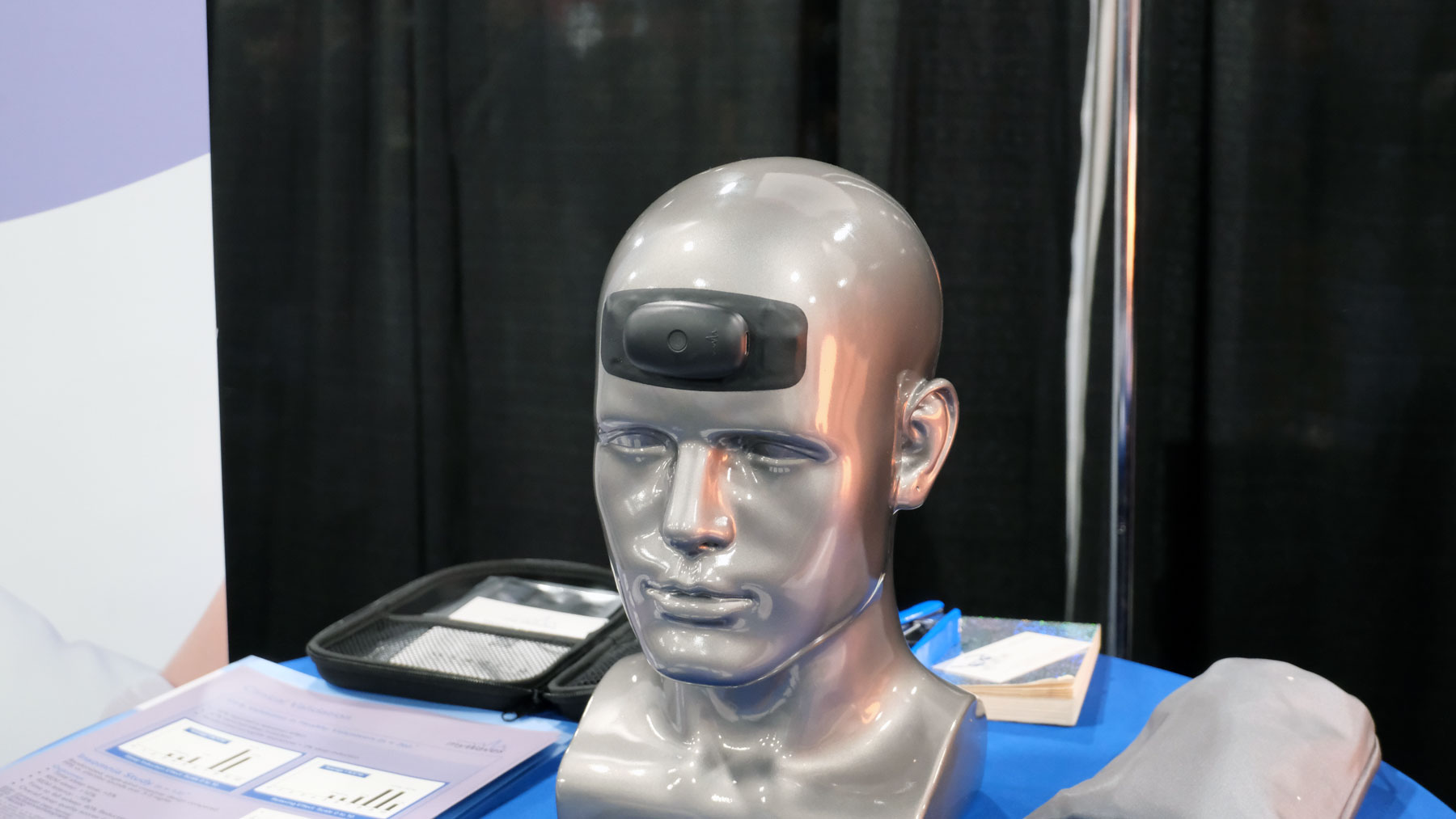
There are plenty of companies at CES that are using EEGs for more specific goals, such as MyWaves. It uses an EEG as part of its broader offering to use sound patterns to make it easier to go to sleep. It sells you a pricey forehead-worn EEG which you wear for a few nights over the course of a year. From there, the system produces a half hour audio file that will mirror the pattern of your delta brainwaves. It claims that, if you listen to the track before you go to bed, the experience of hearing your delta waves will help you fall asleep faster and experience more REM sleep.
And there are plenty of companies which are building EEGs for you to wear to keep an eye on your mental health. Brain-Life, for instance, showed off an early prototype of Focus+, a headband EEG with a companion app that can offer feedback on your cognitive load. It can also tell you how long you can sustain your attention and how well your mind relaxes and recovers. The company didn’t have details on when the hardware would be available or how much it cost, as it’s still early days.
BrainEULink.
Daniel Cooper for Engadget
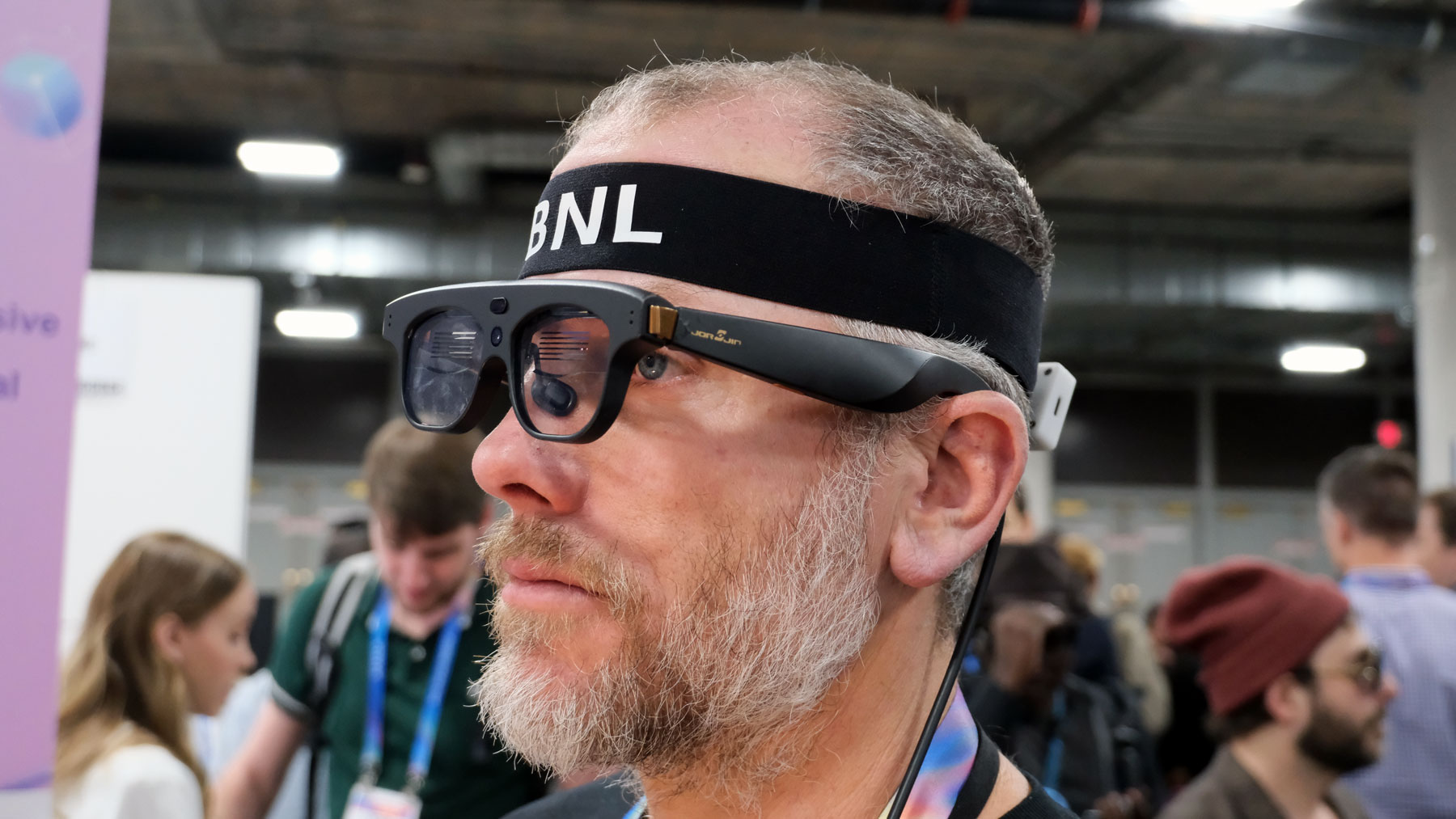
There is broad potential to use an EEG as a brain computer interface, such as the one worked on by Braineulink. That company has combined an EEG with an AR headset to enable people to interact with the world just with their brains. For instance, in a demonstration in the show floor at CES, I was able to turn a light on and off by “focusing” on it, although it’s hard to know how useful that would be in, for instance, creating an assistive device for folks with limited mobility. Like Brain-Life, it’s early days, and so there’s no product that we can point to, but it’s clear we’re going to see more startups looking to enter this world.
Brain-Life
Daniel Cooper for Engadget
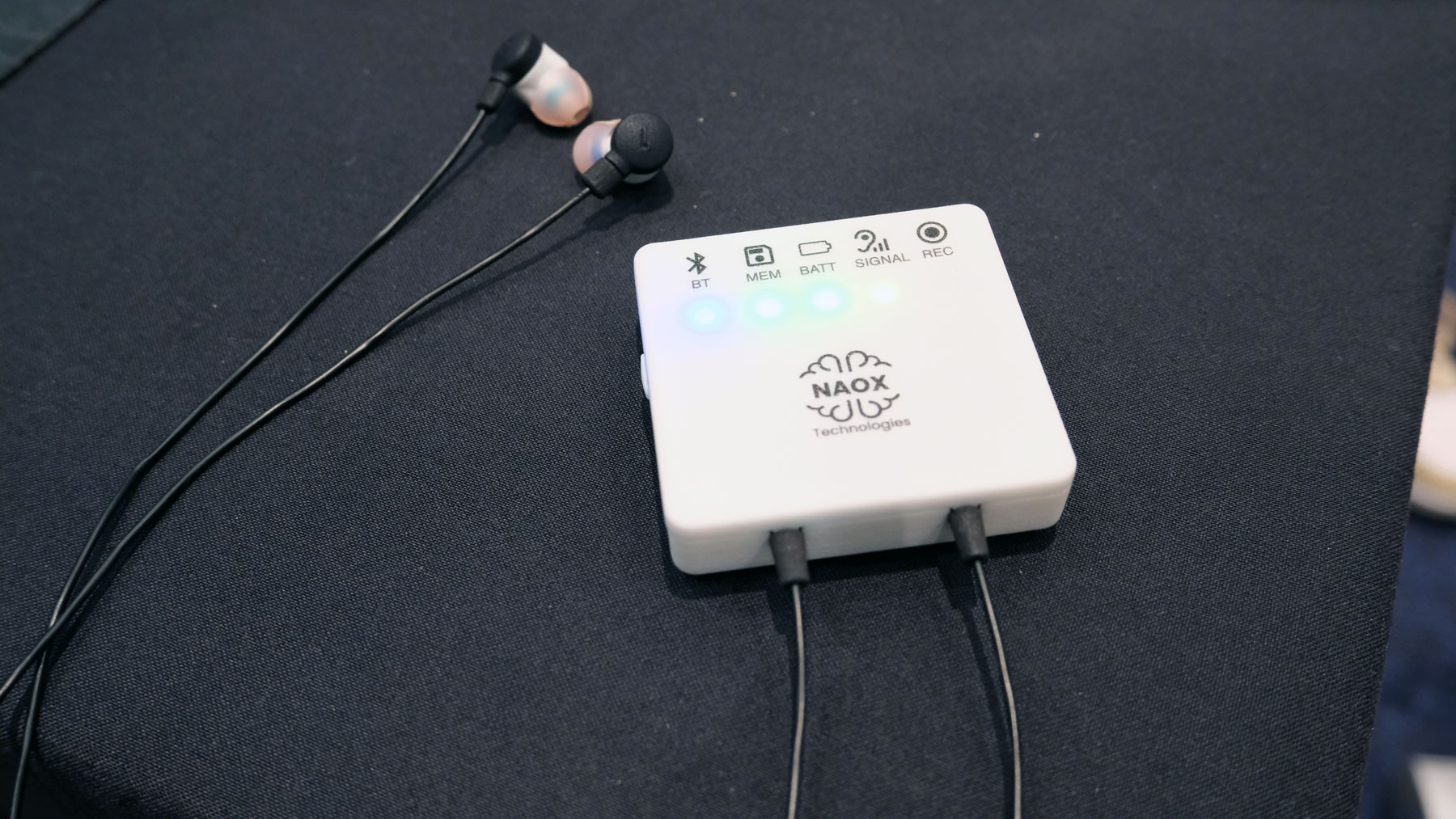
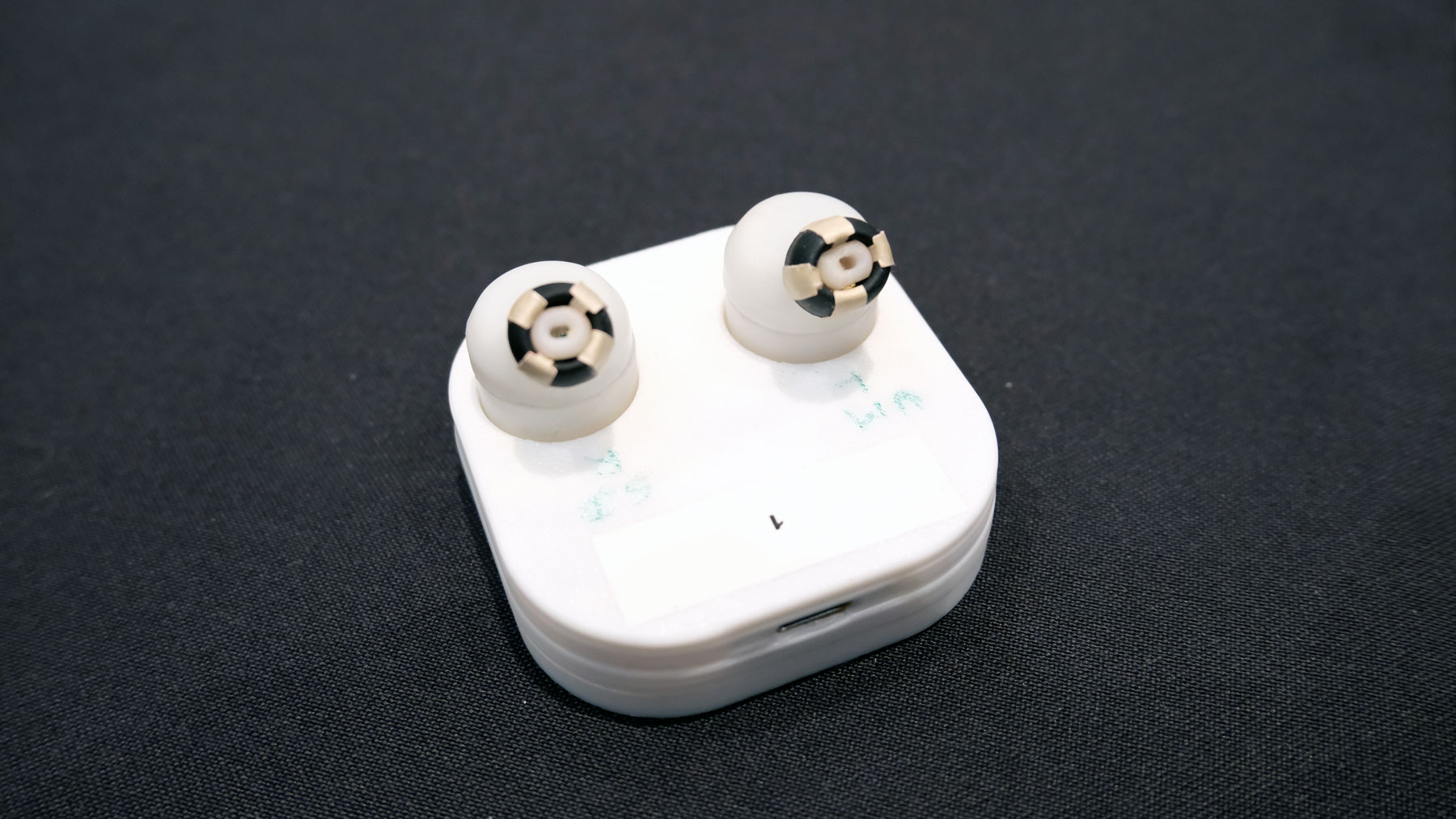
As EEGs become more commonplace, it’s likely they’ll be packaged in smaller devices which fit more seamlessly into our lives. One such example is NAOX, a French startup which has built a wearable, clinical-grade EEG into a pair of earbuds for the sort of longitudinal testing required to diagnose conditions like epilepsy. But the company is also planning on incorporating the technology into a pair of true wireless earbuds.These headphones won’t be arriving until the end of 2026, but Naox says the tech is small enough that it can be integrated with other companies earbuds. Consequently, it’s certainly plausible we could see plenty of earbuds that will keep an eye on our brain health as a side hustle.
Naox
Daniel Cooper for Engadget
NAOX was co-founded by Dr. Michel Le Van Quyen who, at a talk in London in December 2025, talked about the rationale for creating an in-ear ECG. Essentially, he was looking to build a brain equivalent to the Apple Watch’s continuous heart rate monitoring (and ECG). I was curious about the science behind an ear-mounted EEG given they commonly use the scalp. Professor Friston said that an ear-mounted EEG is potentially more useful as “you can get slightly closer to the sources of activity.” And that it makes a lot of sense for a consumer-grade EEG to be added to wireless earbuds given their utility in practices like meditation.
Naox's prototype TWS earbuds sensors.
Daniel Cooper for Engadget
One downside of the proliferation of wearable EEGs is that it could lead users to jump to the wrong conclusions about their mental health. For instance, if someone is to be diagnosed with a condition such as epilepsy, they need to undergo a 24-hour perambulatory EEG. As Professor Friston explained, the recording of that 24 hour EEG would be “carefully scrutinized by experts who are able to run a differential diagnosis ... to specify what further investigations are required.” He, like a lot of clinicians, is concerned about ill-informed consumers using these devices to make medical interventions without consulting a professional.
Friston added that people shouldn’t expect wearable EEGs to be magic bullets for their brain health or cognition. He said the best way for a consumer to approach them is by treating them with the same level of reverence as a household thermometer. “Are thermometers useful in managing the wellness of my children?, Yes,” he explained, “can your thermometer tell you what particular virus you have? Absolutely not.” “In the context of well-being and to augment or validate practices such as mindfulness and meditation, they can be fun and useful quantitative devices.” But, fundamentally, that is all he feels they can be, especially right now.
This article originally appeared on Engadget at https://www.engadget.com/wearables/the-ces-companies-hoping-your-brain-is-the-next-big-thing-in-computing-175048601.html?src=rss
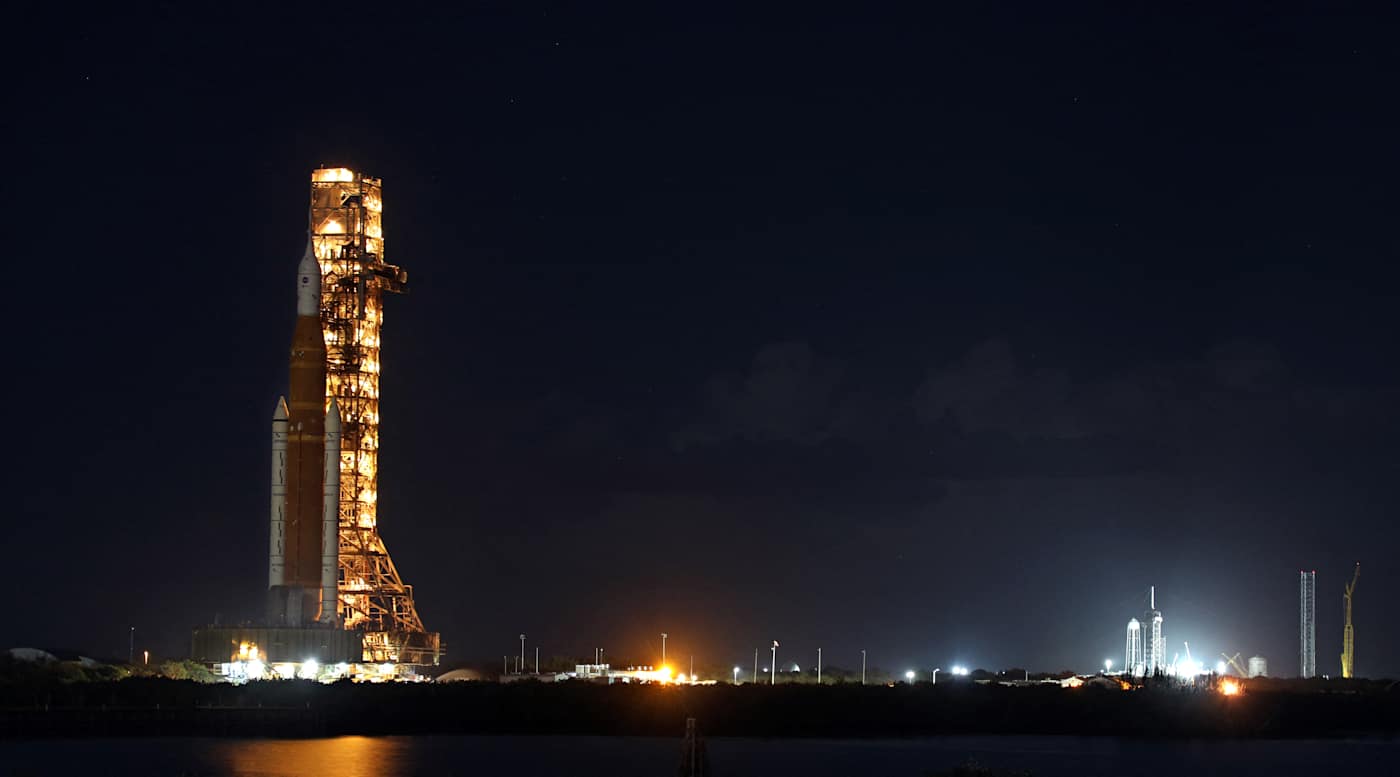
Back in 2024, NASA announced that the Artemis 2 mission was going to be pushed back to April 2026. Now, the agency says it could launch as early as February, with the first flight opportunity being on February 6. NASA is currently making the final preparations for the mission and will soon roll out the Space Launch System (SLS) rocket and the Orion spacecraft to their launch pad at the Kennedy Space Center in Florida. The spacecraft system’s four-mile journey from the assembly building to Launch Pad 39B will take up to 12 hours. NASA is targeting a date no earlier than January 17, with the exact day depending on the weather and on the possible need for additional time to address technical issues.
Artemis 2 is the first crewed mission to the moon since the Apollo program’s final flight in 1972. The 10-day mission will have four astronauts on board who’ll be testing if Orion’s critical life support systems can sustain human passengers on future longer duration missions. They will first orbit the Earth twice before making their way 4,700 miles beyond the far side of the moon. If the SLS and Orion system is rolled out as planned, NASA intends to conduct a wet dress rehearsal at the end of January. The agency will load cryogenic propellants into the rocket and will do a full launch countdown during the rehearsal to prepare for the real event.
This article originally appeared on Engadget at https://www.engadget.com/science/space/nasa-makes-final-preparations-for-its-first-crewed-moon-mission-in-over-50-years-150000825.html?src=rss
NASA has decided to bring the Crew-11 astronauts home a month earlier than originally planned due to a “medical concern” with one of them. This is the first time in its history that the space agency is cutting a mission short due to a medical issue, but it didn’t identify the crew member or divulge the exact situation and its severity. The agency is targeting a return date no earlier than January 14, with the exact schedule depending on the weather. If NASA’s original plan pushes through, the crew will splash down off the coast of California at approximately 3:40 AM on January 15.
The agency previously postponed an International Space Station (ISS) spacewalk scheduled for January 8, citing a medical concern with a crew member that appeared the day before. NASA’s chief health and medical officer, James “JD” Polk, said the affected astronaut is “absolutely stable” and that this isn’t a case of an emergency evacuation. The ISS has a “robust suite of medical hardware” onboard, he said, but not enough for a complete workup to determine a diagnosis. Without a proper diagnosis, NASA doesn’t know if the astronaut’s health could be negatively affected by the environment aboard the ISS. That is why the agency is erring on the side of caution.
Crew-11 left for the space station on August 1 and was supposed to come back to Earth on or around February 20. After they leave the station, only three people will remain: Two cosmonauts and one astronauts who’ll be in charge of all the experiments currently being conducted on the orbiting lab. The team’s replacement, Crew-12, was supposed to head to the ISS mid-February, but NASA is considering sending the astronauts to the station earlier than that.
Update, January 10, 2025, 5:15AM ET: This story has been updated to include Crew-11’s tentative return date.
This article originally appeared on Engadget at https://www.engadget.com/science/space/nasa-is-ending-crew-11-astronauts-mission-a-month-early-140000750.html?src=rss
While wave upon wave of smartglasses and face-based wearables crash on the shores of CES, traditional glasses really haven’t changed much over the hundreds of years we’ve been using them. The last innovation, arguably, was progressive multifocals that blended near and farsighted lenses — and that was back in the 1950s. It makes sense that autofocusing glasses maker IXI thinks it’s time to modernize glasses.
After recently announcing a 22-gram (0.7-ounce) prototype frame, the startup is here in Las Vegas to show off working prototypes of its lenses, a key component of its autofocus glasses, which could be a game-changer.
IXI’s glasses are designed for age-related farsightedness, a condition that affects many, if not most people over 45. They combine cameraless eye tracking with liquid crystal lenses that automatically activate when the glasses detect the user’s focus shifting. This means that, instead of having two separate prescriptions, as in multifocal or bifocal lenses, IXI’s lenses automatically switch between each prescription. Crucially — like most modern smartglasses — the frames themselves are lightweight and look like just another pair of normal glasses.
Mat Smith for Engadget
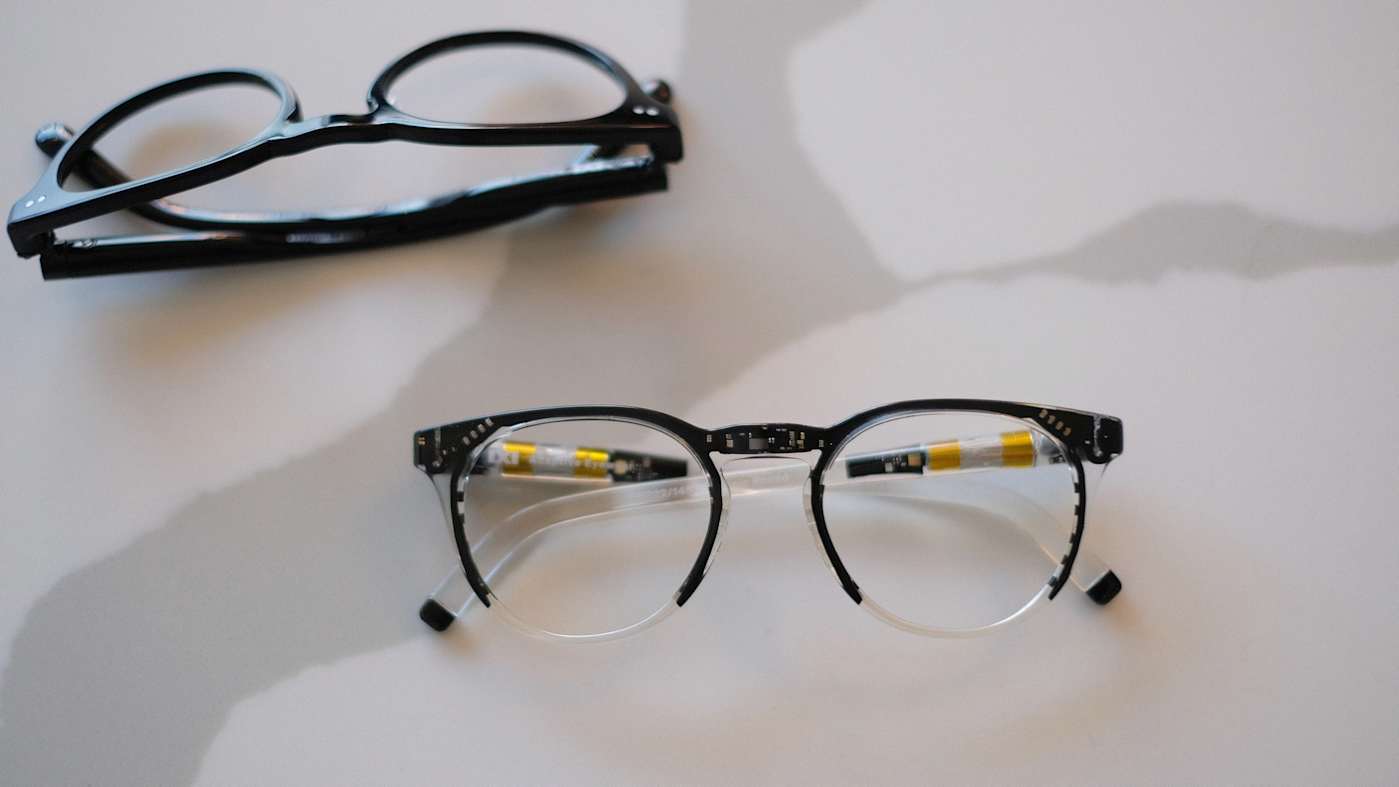
With a row of prototype frames and lenses laid out in front of him, CEO and co-founder Niko Eiden explained the technology, which can be separated into two parts. First, the IXI glasses track the movement of your eyes using a system of LEDs and photodiodes, dotted around the edges of where the lenses sit. The LEDs bounce invisible infrared light off the eyes and then measure the reflection, detecting the subtle movements of your eye and how both eyes converge when focusing on something close.
Using infrared with just a "handful of analog channels" takes far less power than the millions of pixels and 60-times-per-second processing required by camera-based systems. IXI’s system not only tracks eye movements, but also blinking and gaze direction, while consuming only 4 milliwatts of power.
Mat Smith for Engadget
Most of the technology, including memory, sensors, driving electronics and eye tracker, is in the front frame of the glasses and part of the arms closest to the hinge. The IXI prototype apparently uses batteries similar in size to those found in AirPods, which gives some sense of the size and weight of the tech being used. The charging port is integrated into the glasses’ left arm hinge. Naturally, this does mean they can’t be worn while charging. IXI says that a single charge should cover a whole day’s usage.
The prototype frames I saw this week appeared to be roughly the same weight as my traditional chunky specs. And while these are early iterations, IXI’s first frames wouldn’t look out of place in a lineup of spectacle options.
The team has also refined the nose pieces and glasses arms to accommodate different face shapes. Apparently, when testing expanded from Finland to the UK, British faces were “...different.” A little harsh when talking to me, a Brit.
Eiden pulled out some prototype lenses, made up of layers of liquid crystal and a transparent ITO (indium tin oxide) conductive layer. This combination is still incredibly thin, and it was amazing to watch the layers switch almost instantly into a prescription lens. It seemed almost magical. As they’re so thin, they can be easily integrated into lenses with existing prescriptions. It can also provide cylindrical correction for astigmatism too.
Autofocus lenses could eliminate the need for multiple pairs of glasses, such as bifocals and progressives. Even if the glasses were to run out of power, they’d still function as a pair of traditional specs with your standard prescription, just lacking the near-sighted boost. IXI’s sensor sensitivity can also offer insight into other health conditions, detect dry eyes, estimate attentiveness and, by tracking where you’re looking, even posture and neck movement. According to Eiden, blink rate changes with focus, daydreaming and anxiety, and all that generates data that can be shown in the companion app.
Mat Smith for Engadget
Hypothetically, the product could even potentially adapt prescriptions dynamically, going beyond the simple vision correction of Gen 1. For example, it could offer stronger corrections as your eyes get fatigued through the day.
IXI appears to be putting the pieces in place to make these glasses a reality. It still needs to obtain the necessary medical certifications in order to sell its glasses and get all the production pieces in place. It’s already partnered with Swiss lens-maker Optiswiss for manufacturing. Eiden says the final product will be positioned as a high-end luxury glasses option, selling through existing opticians. The company hopes to finally launch its first pair sometime next year.
This article originally appeared on Engadget at https://www.engadget.com/wearables/ixis-autofocusing-lenses-multifocal-glasses-ces-2026-212608427.html?src=rss
NASA has postponed an International Space Station (ISS) spacewalk that was scheduled for Thursday. "The agency is monitoring a medical concern with a crew member that arose Wednesday afternoon aboard the orbital complex," the agency wrote. On Thursday, NASA added that ending Crew-11's mission early was on the table.
The unnamed crew member is stable, according to NASA. Space News notes that Kimiya Yui of the Japan Aerospace Exploration Agency (JAXA) was heard on an open comms channel on Wednesday requesting a private medical conference with a flight surgeon. However, those requests are routine on the ISS, so we can’t assume the events were related.
"The matter involved a single crew member who is stable," NASA wrote. "Safely conducting our missions is our highest priority, and we are actively evaluating all options, including the possibility of an earlier end to Crew-11's mission."
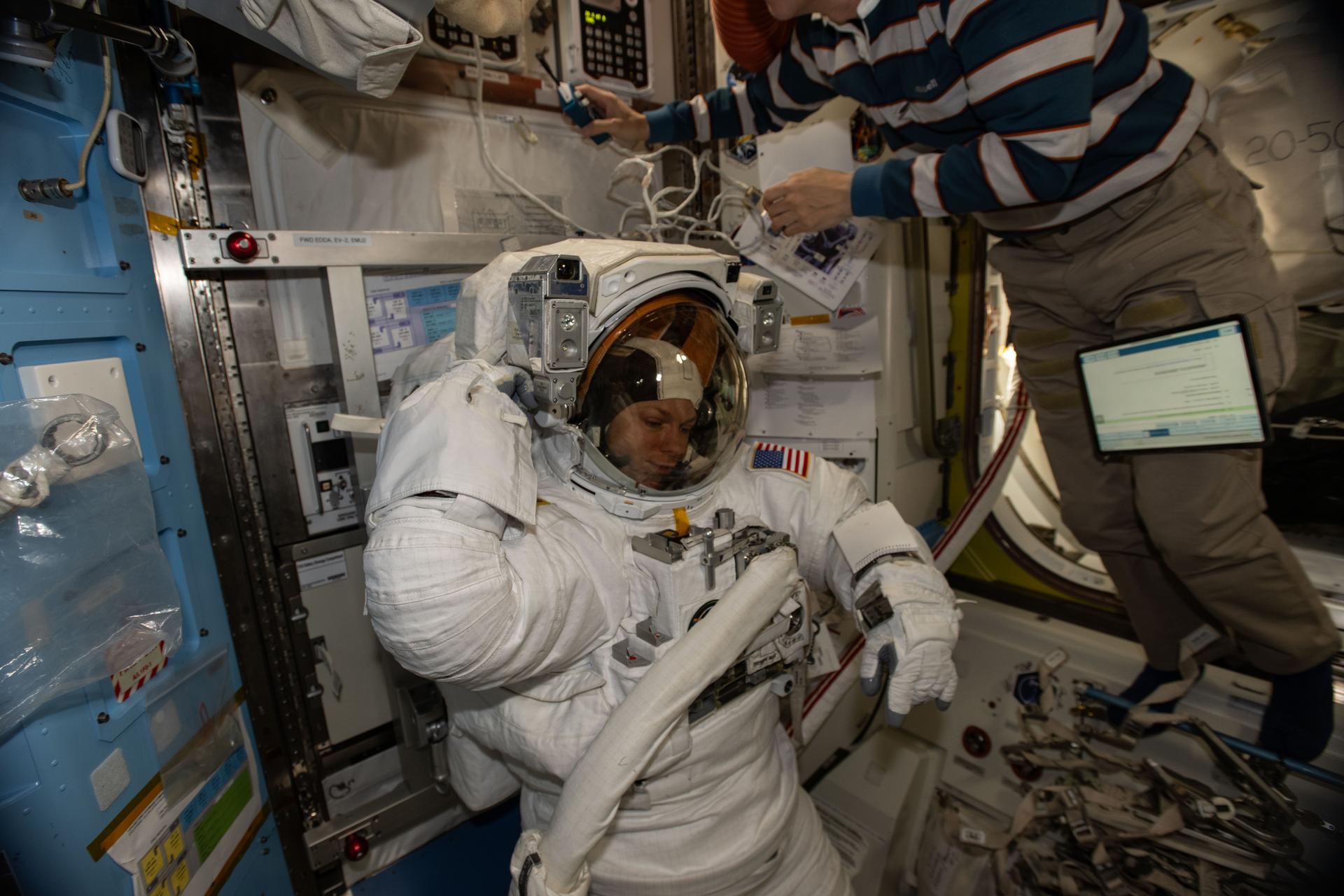
NASA astronaut Zena Cardman in her pressurized spacesuit, checking its comms and power systems ahead of the (now postponed) spacewalk
NASA
Crew-11 was scheduled to remain on board the ISS until at least the second half of February. Its replacement, Crew-12, isn't slated to blast off until February 15 at the earliest.
NASA astronauts Mike Fincke and Zena Cardman had planned to exit the airlock on Thursday for the six-and-a-half-hour spacewalk. The short trip’s mission was to install a kit and cables in preparation for a new roll-out solar array that will arrive on a future mission.
The agency said it will provide further updates within 24 hours.
This article originally appeared on Engadget at https://www.engadget.com/science/space/nasa-delays-spacewalk-due-to-a-medical-concern-with-a-crew-member-171900024.html?src=rss

 Anmelden