Matthew McConaughey filed trademark applications to prevent his likeness from being used by AI companies without permission, and the US Patent and Trademark Office has approved eight so far. According to the Wall Street Journal, the trademarks were for video and audio clips featuring the actor staring, smiling and talking. One was for a video of him standing on a porch, while another was for an audio recording of him saying “alright, alright, alright,” his signature catchphrase from the movie Dazed and Confused.
Under the law, it’s already prohibited for companies to steal someone’s likeness to sell products. However, McConaughey is taking a proactive approach due to the nebulous rules around the use of someone’s likeness for artificial intelligence and what’s considered commercial use involving the technology. His lawyer, Kevin Yorn, admits that they don’t know how the court would decide if an offender challenges the trademarks. But they’re hoping that the threat of a lawsuit would deter companies from using McConaughey’s likeness for AI in the first place. Actors have been trying to protect themselves from AI since the technology blew up, and it was one of the sticking points in the negotiations between SAG-AFTRA and Hollywood studios when the labor union went on a strike in 2023.
McConaughey isn’t anti-AI by any means: He is an investor in ElevenLabs and has partnered with the AI startup to create a Spanish version of his newsletter. He said in a statement sent to The Journal that he just wants to make sure that if his voice or likeness is ever used, it’s because he approved and signed off on it. “We want to create a clear perimeter around ownership with consent and attribution the norm in an AI world,” he added.
This article originally appeared on Engadget at https://www.engadget.com/ai/matthew-mcconaughey-fights-unauthorized-ai-likenesses-by-trademarking-himself-130000567.html?src=rss
Apple and Google have confirmed that Gemini’s models power the new version of Siri and other generative AI features. CNBC broke the news, but Apple and Google soon followed up with a lengthy joint statement. Here’s part of it: “Apple determined that Google’s Al technology provides the most capable foundation for Apple Foundation Models… Apple Intelligence will continue to run on Apple devices and Private Cloud Compute, while maintaining Apple’s industry-leading privacy standards.”
In June, it was reported that Apple was considering partnerships with OpenAI and Anthropic for Siri (the voice assistant can currently tap ChatGPT for certain queries as part of Apple Intelligence). Two months later, Google emerged as a contender. Another report suggested Apple might build the new Siri using a custom version of Gemini — and that it would pay Google around $1 billion a year for the privilege. However, no official deal numbers were shared.
It’s also notable that current iPhones have direct access to OpenAI’s ChatGPT. But how long for?
Netflix’s hit show Adolescence received four awards, including best limited or anthology series. It also won best actor (Stephen Graham), supporting actor (Owen Cooper) and supporting actress (Erin Doherty) in a miniseries or television film.
KPop Demon Hunters — which my nieces refuse to stop talking about — won best animated feature and best original song. “I just want to say this award goes to people who have had doors closed on them, and I can confidently say rejection is redirection. So never give up.”
It’s not all good news. Netflix also won best performance in stand-up comedy on television for Ricky Gervais: Mortality. Apple and HBO Max each won three, and Hulu got one award on the night.
The agency is targeting a February launch date for Artemis 2.
A few years ago, NASA announced it was pushing the Artemis 2 mission back to April 2026. The agency now says it could launch as early as February. NASA is finalizing preparations for the mission and will soon roll out the Space Launch System (SLS) rocket and the Orion spacecraft to the launch pad at the Kennedy Space Center in Florida.
Artemis 2 is the first crewed mission to the moon since the Apollo program’s final flight in 1972. The 10-day mission will have four astronauts, who’ll test whether Orion’s critical life-support systems can sustain human passengers on future longer-duration missions. They will first orbit the Earth twice before making their way 4,700 miles beyond the far side of the moon.
Pre-orders for the first three Lego-Pokémon kits are open now. One of the debut pocket monsters is, of course, Pikachu. You can build the 2,050-piece kit to show Pikachu either at rest or leaping out of an open Poké Ball into battle. It costs $200.
There’s also a 587-piece model of Eevee, for $60. On the bigger side is a set featuring a trio of Pokémon: Venusaur, Charizard and Blastoise. This kit has 6,838 pieces and can show the group together in battle formation or separately in their own mini environments. It retails for $650 and is a bit much.
The 2026 Golden Globes took place on Sunday and it was another big night for streamers. Netflix took home seven awards, Apple and HBO Max each won three and Hulu got one.
Netflix's hit show Adolescence received four awards alone, including best limited or anthology series. It also won for best actor (Stephen Graham), supporting actor (Owen Cooper) and supporting actress (Erin Doherty) in a miniseries or television film.
KPop Demon Hunters — the sensation which became Netflix's most-watched title — won for best animated feature and best original song. "I just want to say this award goes to people who have had doors closed on them, and I can confidently say rejection is redirection. So never give up. It is never too late to shine like you were born to be," singer-songwriter EJAE said in her acceptance speech for the song, Golden.
Netflix also won for best performance in stand-up comedy on television for Ricky Gervais: Mortality.
Apple TV took home two awards for The Studio: best television series musical or comedy and best performance by a male actor in a television series for Seth Rogen. The streamer also won for best performance by a lead actress in a television series drama thanks to Rhea Seehorn in Pluribus.
The Pitt gave HBO Max two of its three awards, with trophies for best television series drama and best performance by a lead actor in a television series drama to Noah Wyle. Jean Smart rounded out the streamer's awards with best performance by a lead actress in a television series musical or comedy for Hacks.
Hulu's award came through best performance by a lead actress in a limited or anthology series for Michelle Williams in Dying For Sex.
This year also brought a first to the Golden Globes: the best podcast category. Amy Poehler won for Good Hang with Amy Poehler, a podcast that has featured interviews with everyone from Tina Fey to Quinta Brunson since debuting in March last year. Fellow nominees included Alex Cooper's Call Her Daddy and Armchair Expert with Dax Shepard.
This article originally appeared on Engadget at https://www.engadget.com/entertainment/streaming/netflix-won-seven-awards-at-the-golden-globes-with-adolescence-and-kpop-demon-hunters-140006510.html?src=rss
Philip Barantini, Owen Cooper, Caitlin Reilly, Hannah Walters, Stephen Graham, Mark Herbert, Ashley Walters, Jeremy Kleiner and Jack Thorne winners of the Best Television Limited Series, Anthology Series, or Motion Picture Made for Television Award for "Adolescence", win the Golden Globe for Best Television Limited Series at the 83rd Annual Golden Globes held at The Beverly Hilton on January 11, 2026 in Beverly Hills, California. (Photo by Gilbert Flores/2026GG/Penske Media via Getty Images)
Star Trek is in a weird place right now. Less than three years ago we were living in a golden age with five shows on the air, all with different styles and intended audiences. But the universe rapidly contracted, with Picard ending while four other shows were cut short. Strange New Worlds still has another two seasons left, sure, but even that final season got truncated. As it stands, there’s only one project with a firm future right now, and that’s a brand-new show, Starfleet Academy, premiering January 15 on Paramount+.
How this show is received could very well determine the future of Star Trek. That’s a lot to put on it, but there’s something very appropriate given the subject matter. Starfleet Academy takes place in the 32nd century, 900 years after the adventures of James T. Kirk and company, and it takes place at the titular academy, meaning its principal cast is a collection of teens representing the next generation of Starfleet officers. That focus on a younger cadre has led to fans online derisively calling the series “CW Trek” without seeing a single episode.
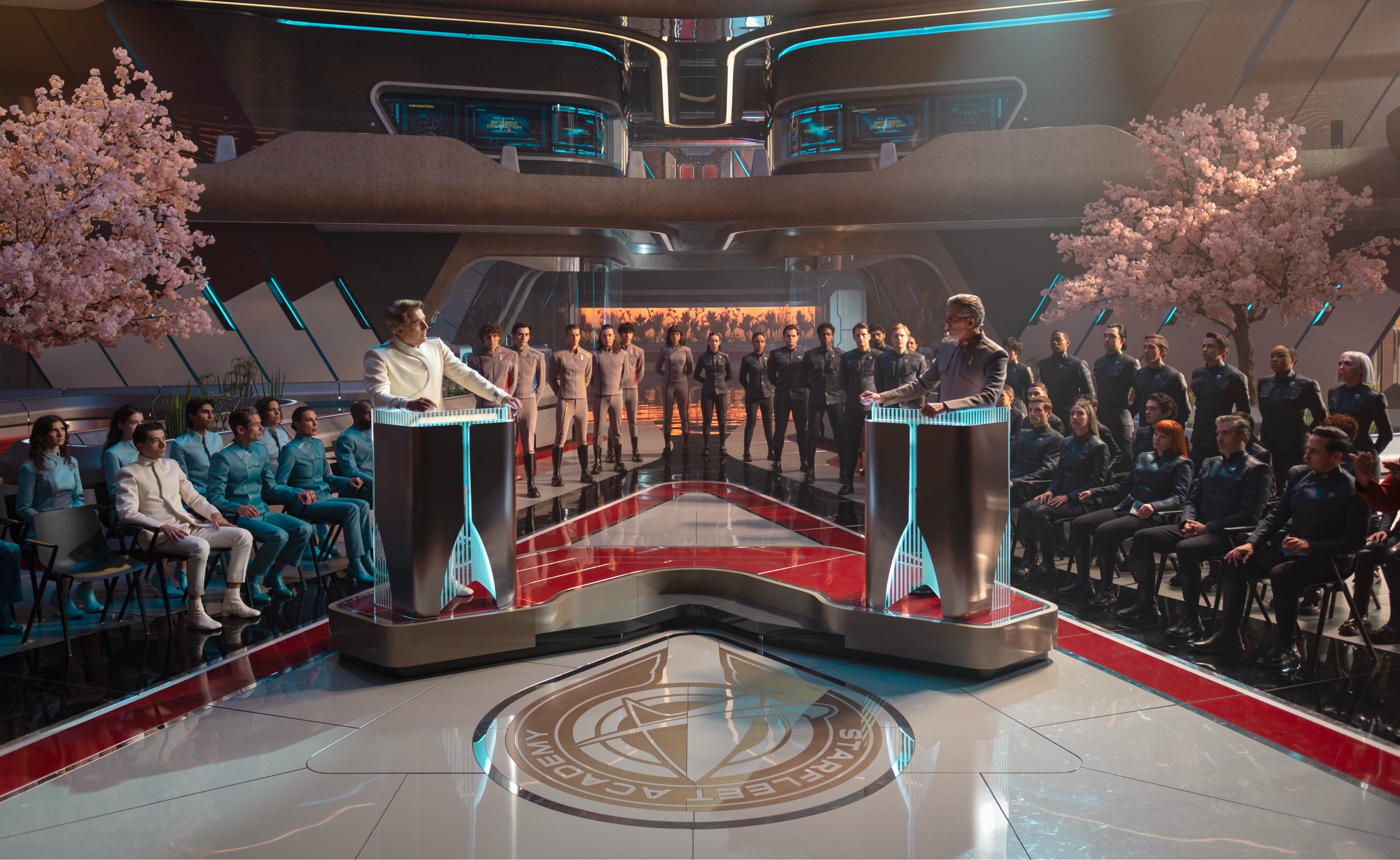
As Starfleet Academy is technically a Discovery spinoff, it picks up some of that series’ traits. The sleek, shiny sets are back, as well as a few plot threads originally set up in Discovery. The most notable is the collapse of the United Federation of Planets and the rebuilding of both the Federation and Starfleet. In fact, the series picks up on that as early as its second episode, with the Academy hosting a delegation from a once stalwart Federation planet that’s now gone isolationist.
Scenes from Star Trek: Starfleet Academy
John Medland/Paramount+
While many complaints about the series have focused on how what fans wanted was an academy show set during the 24th century (the time of The Next Generation, Deep Space Nine, et al.), this particular episode plot works precisely because of the distant future in which it is set. In a fully-functioning galactic democracy like the United Federation of Planets, there’s no logical reason for the average 18-year-old college freshman to be involved in interplanetary diplomacy. But in the 32nd century, the Federation is a lot scrappier and the individuals involved might be asked to wear many hats. It’s a lot like an early-stage tech startup.
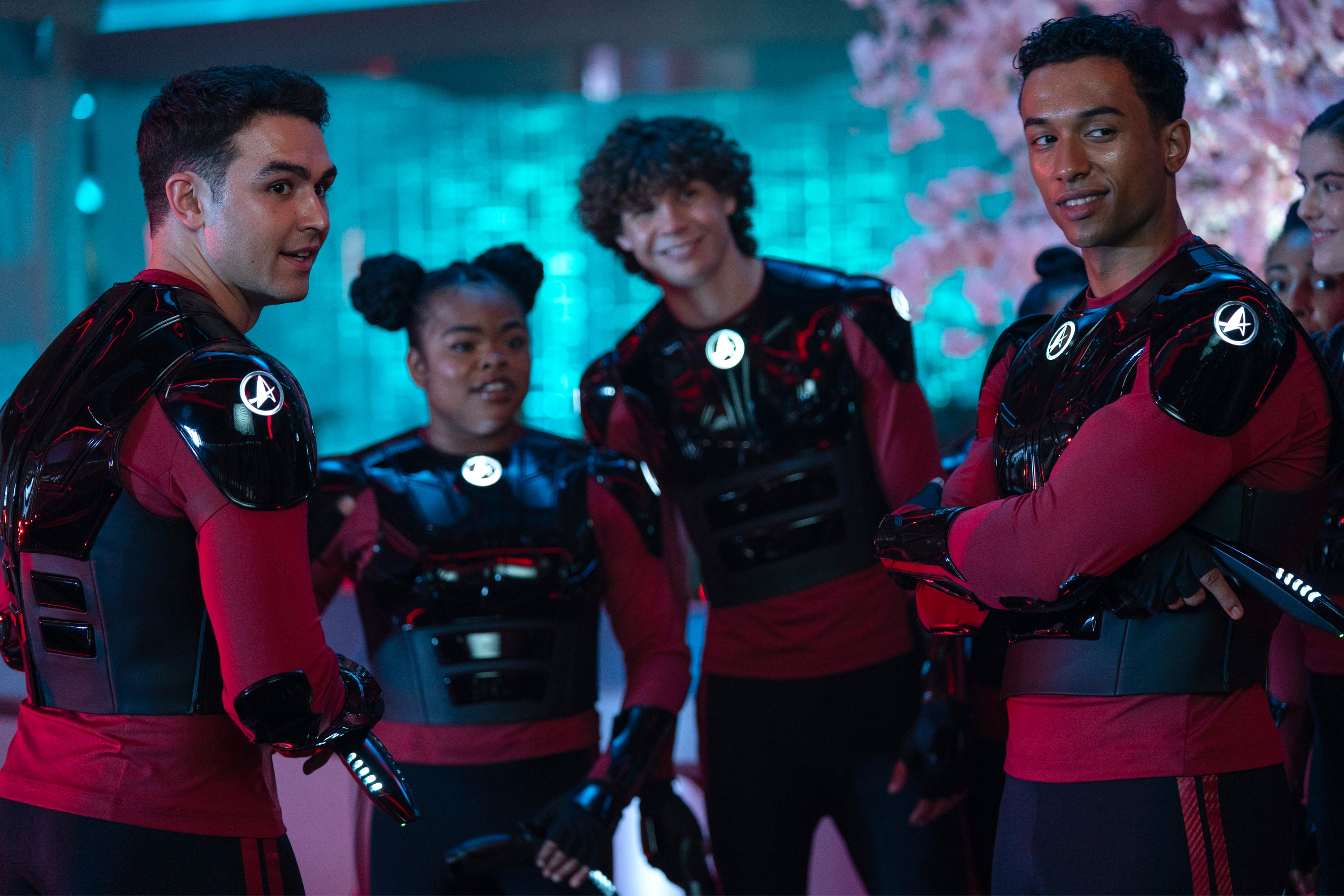
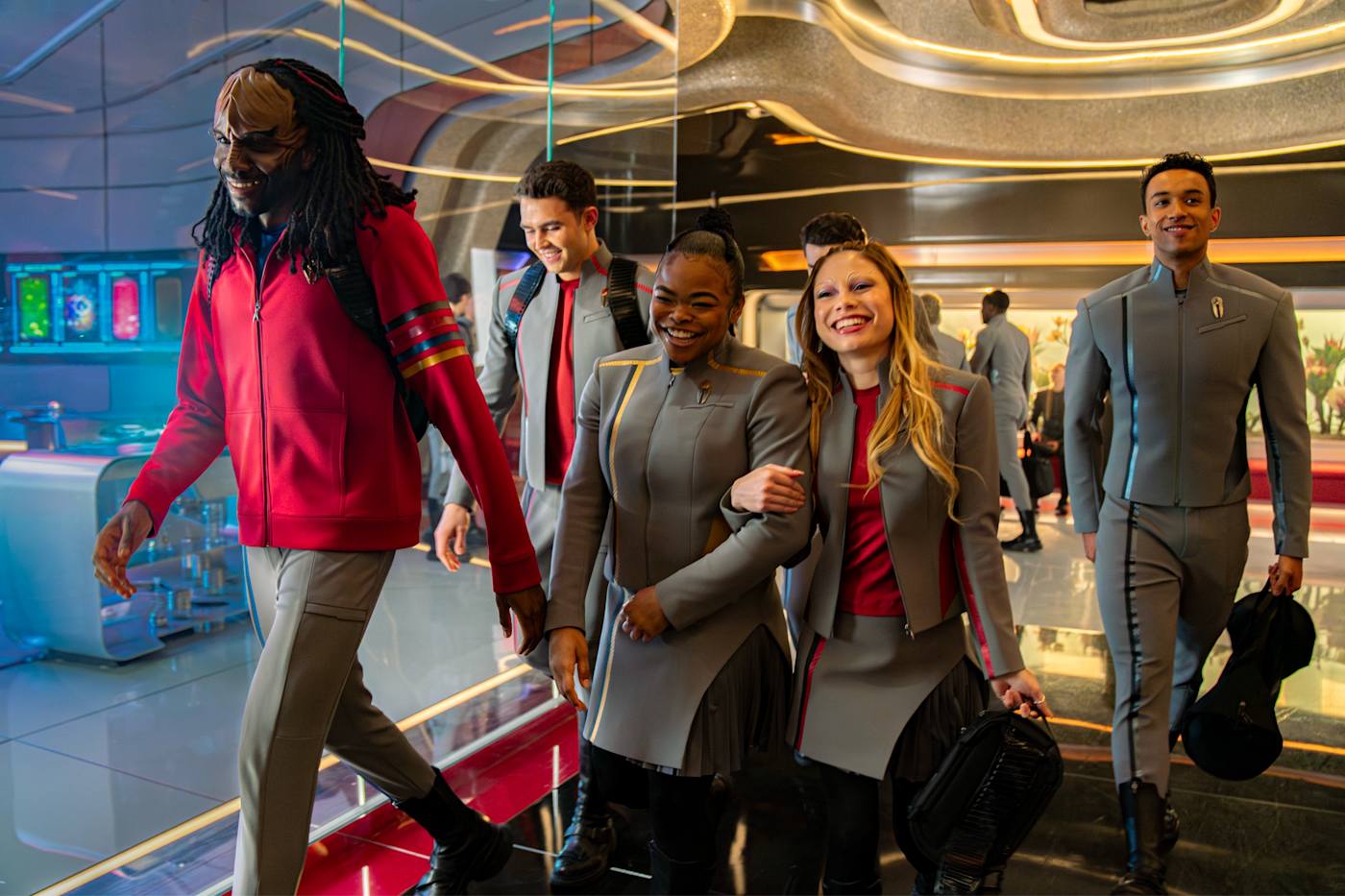
The setting also lets the show be a little more creative with its cast: where TNG featured the first Klingon in Starfleet (Worf), 900 years of progress have created a Starfleet where no one bats an eye when a Klingon cadet like Jay-Den Kraag (played by Karim Diané) shows up to study science. There’s also a holographic cadet, Sam, who is the first of her kind to attend the academy (and she’s super excited to do so). A few new species are present as well: Darem Reymi (George Hawkins) is a Khionian and Genesis Lythe (Bella Shepard) is a Dar-Sha, both aliens making their debut in the Star Trek universe.
The cast of Star Trek: Starfleet Academy
John Medland/Paramount+
However, the show does still lean on some Trek stalwarts, and it’s these characters that have gotten the most chatter from fans. Mary Weisman as Sylvia Tilly was originally slated for the cast, and there was even a backdoor pilot-esque episode of Discovery to tie her in to the new show, but she’s no longer a regular and is nowhere to be seen in the first two episodes. Instead, we have Jett Reno (played by the wonderful Tig Notaro) as supporting cast, and Admiral Vance (Oded Fehr) appearing in a few episodes. And old school fans have been abuzz by the inclusion of The Doctor, who first appeared on Voyager (and later Prodigy). As a hologram, he’s practically immortal so his presence doesn’t need any convoluted explanation, and after 800 years he’s still the same gregarious blowhard (and it’s delightful).
They’re joined by new characters like Lara Thok, a part Klingon, part Jem’Hadar security officer and a Lanthanite chancellor, Nahla Ake, played by Academy Award Winner Holly Hunter. And Hunter isn’t even the only Oscar winner on the cast, with a major villain, Nus Braka, being portrayed by Paul Giamatti.
It’s a stellar cast, and the show’s sets certainly rise up to meet the challenge. Like in the shows of old, a good portion of Starfleet Academy is clearly shot on location, though not in the familiar water reclamation plant that was used back during the TNG and DS9 era. This time it’s all being shot in Ontario, with the outdoor scenes in particular being filmed in Waterloo. Regardless of where it’s shot, it looks enough like sunny California to work.
Scenes from Star Trek: Starfleet Academy
John Medland/Paramount+
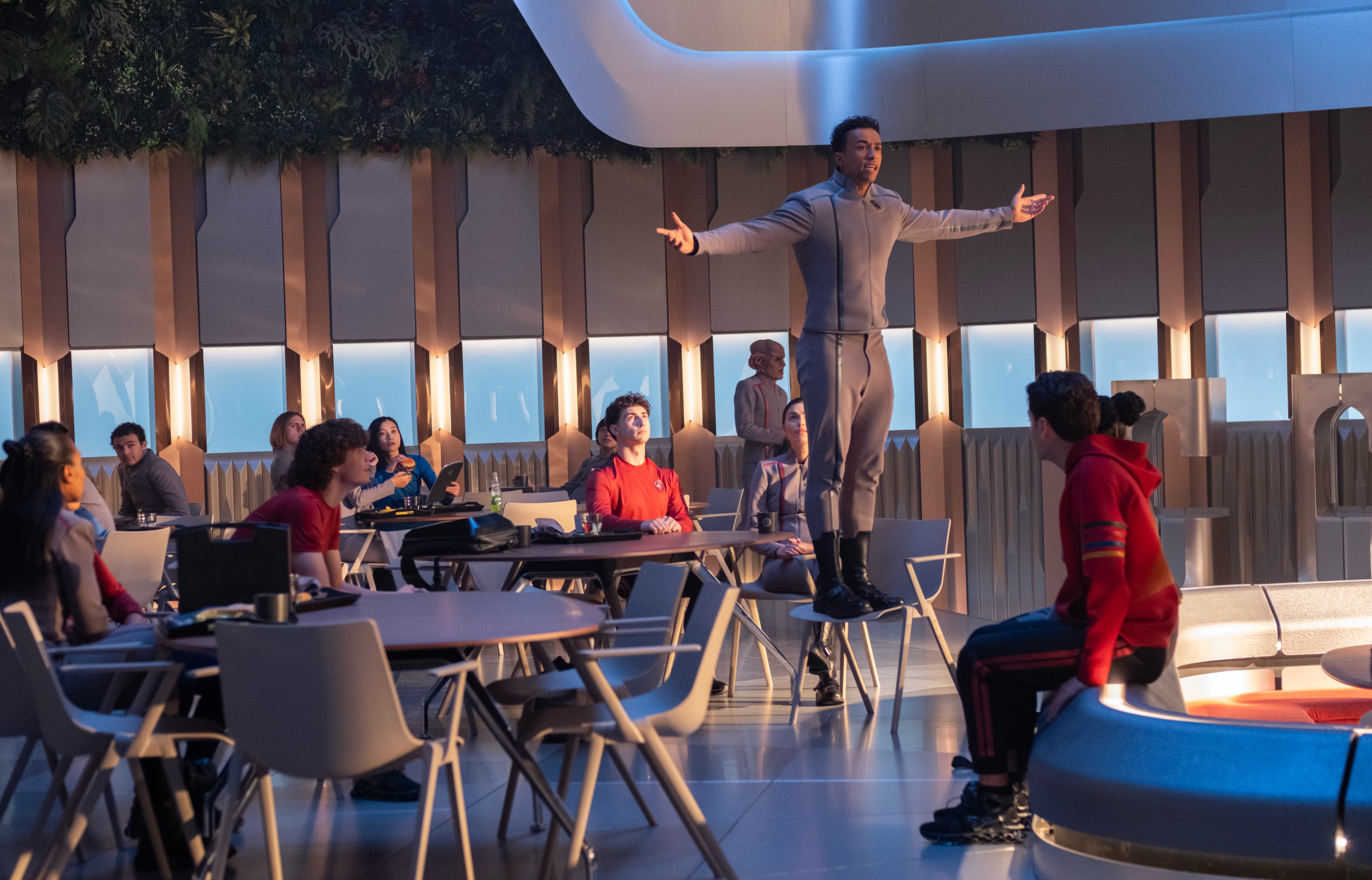
The indoor scenes, shot at Toronto’s Pinewood Studios, have a pleasant convention center quality to them, with lots of wide hallways and large windows in contrast to Discovery’s cramped ship corridors. The hallways are full of students and teachers going to and fro, including some from species that would normally be off-limits to a show with a limited budget. But here robots and strange aliens roam freely in the background. The CGI can’t have been cheap.
And that’s ultimately my biggest question about Starfleet Academy. Exactly how much is this costing Paramount? So much of it is being shot on real sets instead of green screens, established actors like Hunter and Giamatti couldn’t have been cheap, and plentiful CG points to a robust special effects budget. Though Paramount doesn’t release official numbers, estimates have put an average episode of Strange New Worlds at $10 million, so it figures that Starfleet Academy is probably more than that, with some online estimates as high as $20 million per episode.
With 10 episodes scheduled, that’s on par with a major motion picture budget but without the promise of blockbuster box office returns. No wonder Paramount has been doing so much cost-cutting, which includes axing every other Star Trek show.
That said, Starfleet Academy is carrying a lot on its shoulders. Just as the success or failure of its class of Starfleet cadets will determine the future of Starfleet and the Federation, the success of the show may even affect whether this era of Star Trek continues. As a Star Trek fan, this can be nerve-wracking; no one wants the franchise to go dormant again. But Starfleet Academy has so far shown itself to be up to the challenge.
This article originally appeared on Engadget at https://www.engadget.com/entertainment/star-trek-starfleet-academy-deftly-balances-teen-drama-with-intergalactic-intrigue-170253808.html?src=rss
Fujifilm just revealed the Instax mini Evo Cinema camera, which looks suspiciously like a vintage Super 8. More specifically, it was designed to mimic the Single-8 from 1965, which was a rival unit to the Super 8. Fujifilm's latest device captures video, just like its retro inspiration.
Wow, the new FUJIFILM Instax Mini EVO Cinema camera looks nuts.. esp the decade slider thing for the looks. If the cost isn't nuts this could be a must have... Needs to be around $249/299ish to be a hit https://t.co/6w8JPsBxIgpic.twitter.com/plcmNhfyT7
However, this is an Instax and the line has primarily been dedicated to snapping and printing out still images on the fly. The Evo Cinema can still do that, albeit in a slightly different way. Users shoot a video and the camera can convert a shot from the footage into an Instax print. That's pretty cool. The bad news? It requires some kind of QR code tomfoolery.
The camera also comes equipped with something called the Eras Dial, which has nothing to do with Taylor Swift and everything to do with adjusting various effects and filters to create footage "inspired by different eras." There are ten "eras" to choose from, including a 1960s vibe. The filter levels here are adjustable. We'll have to take a look at some footage to see how everything translates.
Fujifilm
Fujifilm is dropping the Instax Evo Cinema on January 30, but only in Japan for now. We don't have a price yet.
This is just the latest nifty camera gizmo the company has thrust upon the world. It recently released an Instax model that has a secondary camera for selfies.
This article originally appeared on Engadget at https://www.engadget.com/cameras/fujifilms-latest-instax-camera-looks-like-a-vintage-super-8-194537863.html?src=rss

 Anmelden