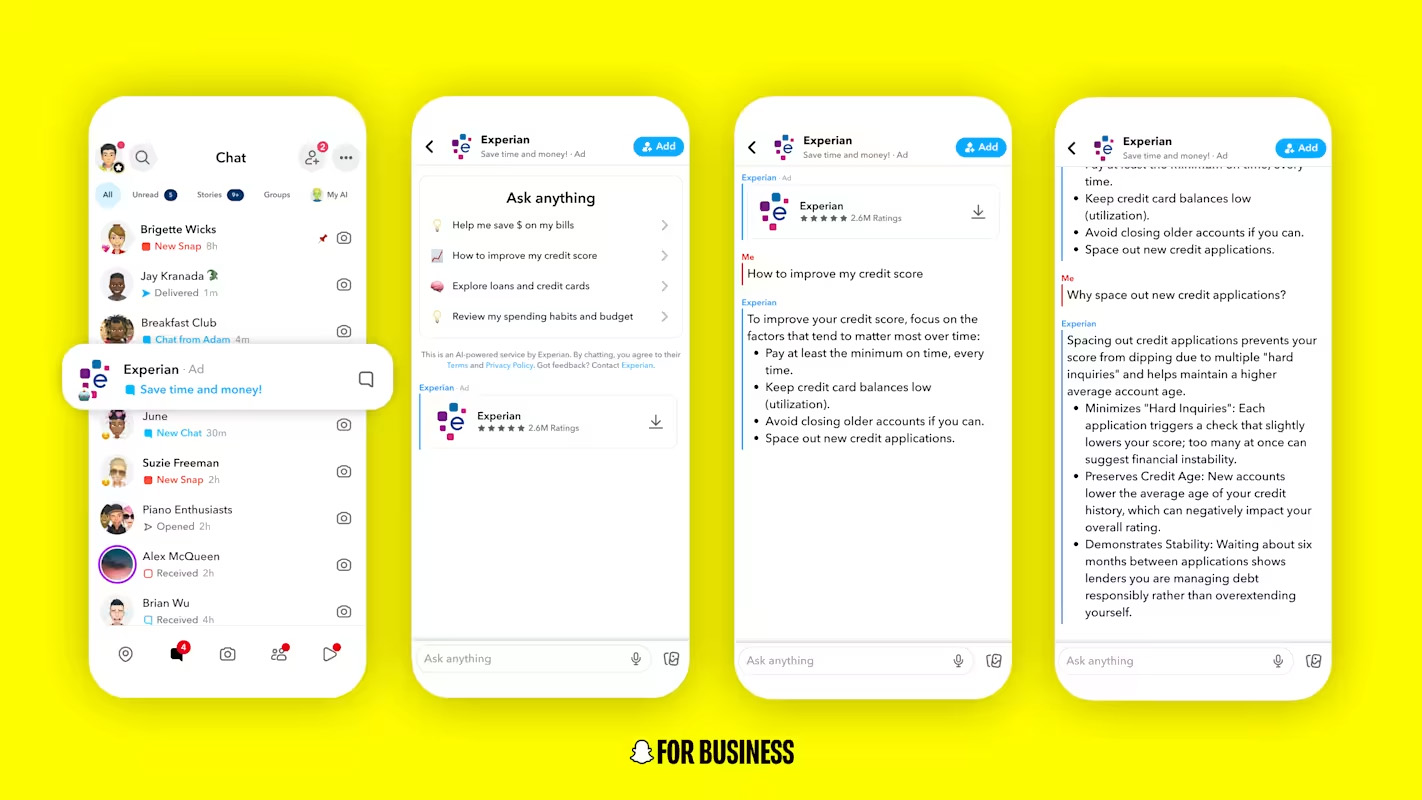
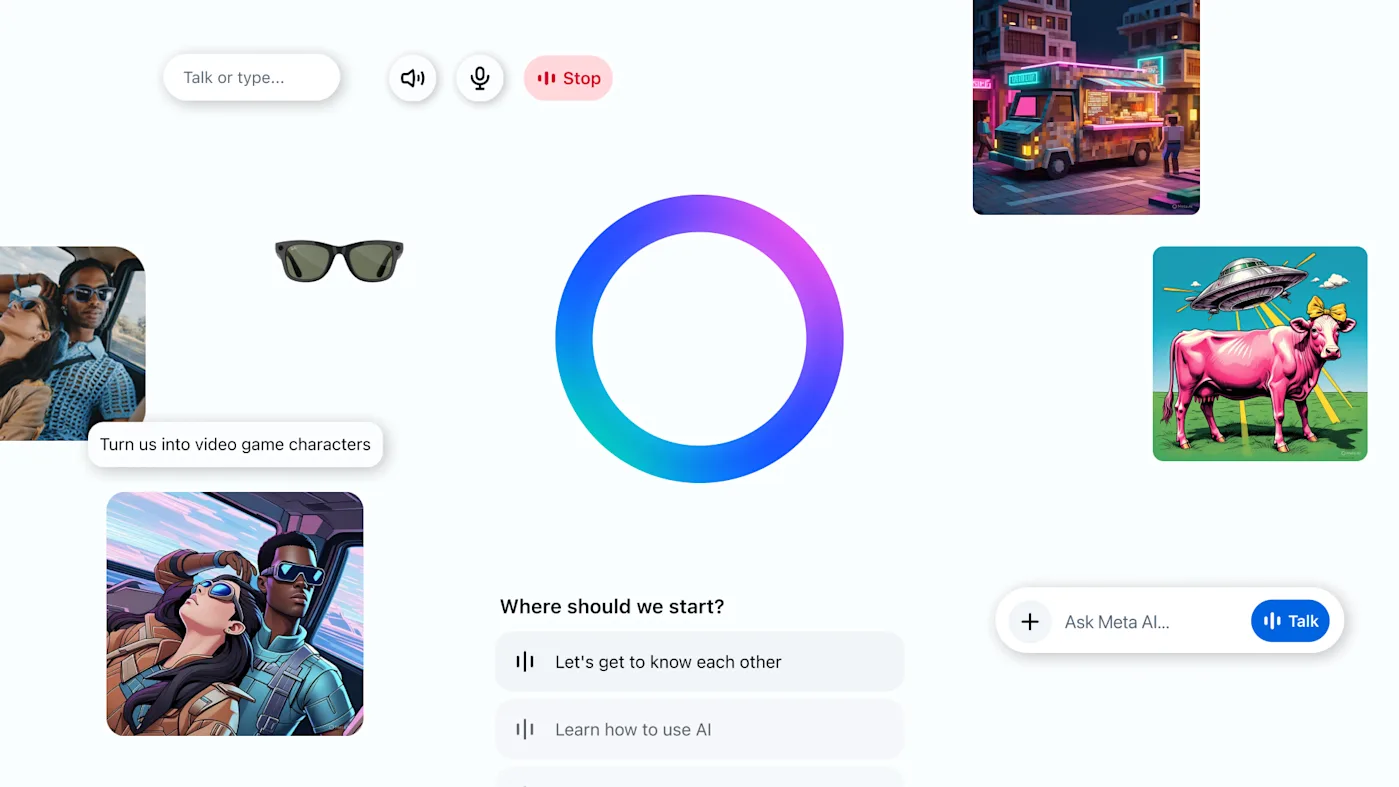
It was only a matter of time before they found a way to use AI agents as corporate shills. On Tuesday, Snapchat rolled out AI Sponsored Snaps, a "new way for brands to show up in Chat through AI agents." Or, put another way, it's conversational advertising. (Yay?)
AI Sponsored Snaps will appear in the app's Chat tab (with a light gray "Ad" notation next to the brand name). After opening the chat, you can ask the agent questions about the brand it represents. Snap showed an example from its first partner for the initiative, Experian. The bot offers to answer your questions on saving money, improving your credit score and — there it is — exploring loans and credit cards.
Whether through credit card offers or other means, the AI agent will presumably try to guide you toward behavior that makes money for the sponsor. So, it isn't clear why this would be better for consumers than asking a general-purpose chatbot like Gemini or Claude the same questions. Maybe the answer is as simple as, "It isn't… but they know people will use it anyway."
Snap
"Conversation is becoming the most valuable real estate in advertising," Snap's Chief Business Officer, Ajit Mohan, wrote in a press release. "AI is accelerating that shift, turning chat into the place where people discover products, ask questions, and make decisions in real time. The real opportunity isn't just putting ads into those environments, it's designing formats that feel native to how people already talk."
Snap says more than half a billion people have messaged its My AI feature since it launched three years ago. That was despite a shaky start, where the bot told researchers and journalists posing as young teenagers how to mask the smell of alcohol or cannabis and set the mood for sex.
This article originally appeared on Engadget at https://www.engadget.com/ai/snapchat-is-rolling-out-sponsored-ai-agents-162720124.html?src=rss
Anthropic is investigating potential "unauthorized access" to its Claude Mythos model that has been touted for its ability to find cybersecurity flaws, the company told Bloomberg. A group gained access to the model through a third-party contractor portal and by using internet sleuthing tools, according to the report. However, the group is only interested in trying the models and not using them maliciously, according to a person familiar with the matter.
"We're investigating a report claiming unauthorized access to Claude Mythos Previous through one of our third-party vendor environments," Anthropic said in a statement.
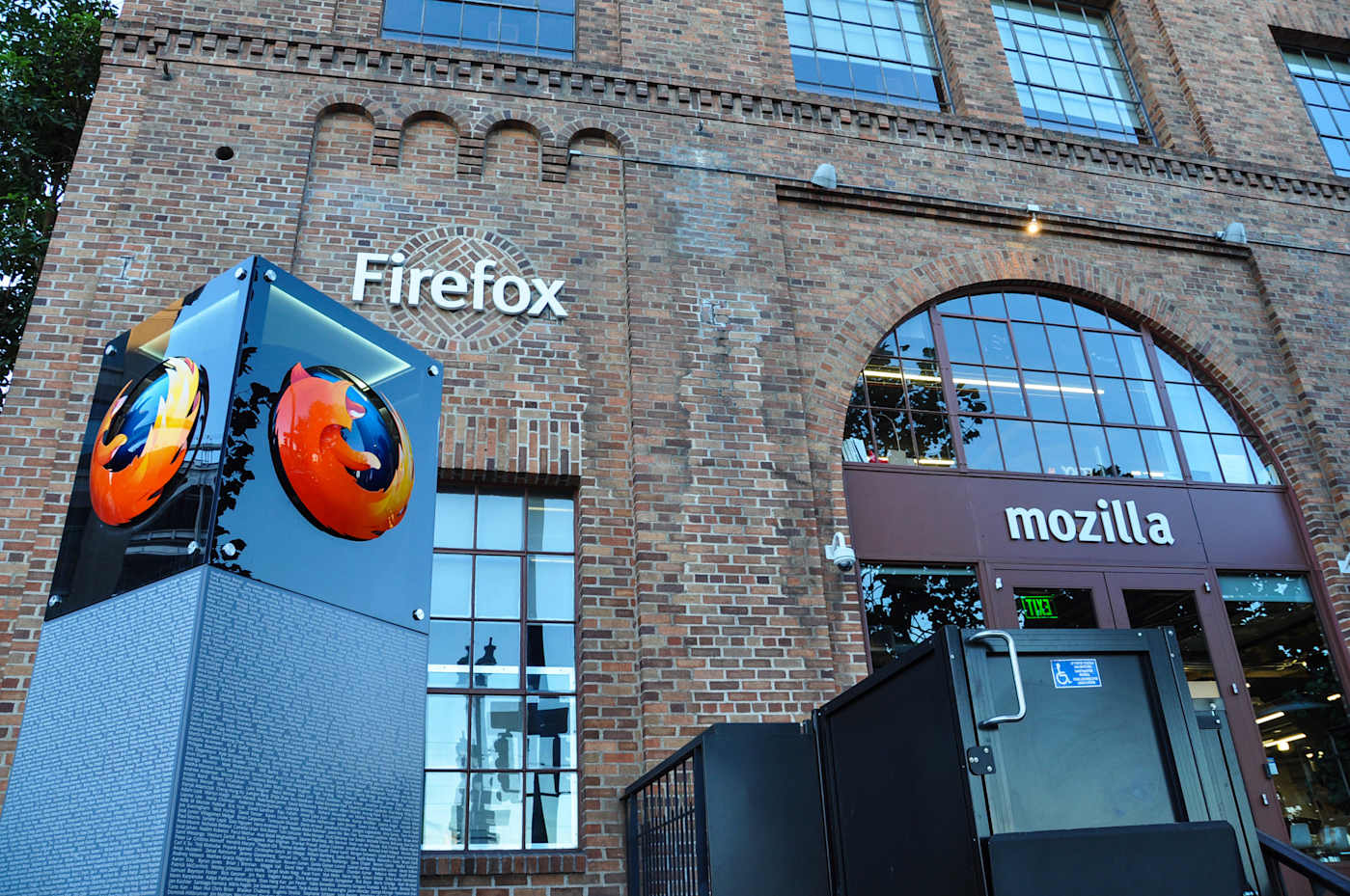
The Claude Mythos Preview arrived earlier this month as part of "Project Glasswing" with significant fanfare. Anthropic limited the preview release to a small number of trusted test companies including Amazon, Microsoft, Apple and Cisco. Another was Mozilla, which said the model helped it find and patch 271 Firefox vulnerabilities. A growing number of banks and government agencies have been seeking access as well in order to safeguard their own systems.
However, several unauthorized users (who reportedly have a private chat on Discord), supposedly gained access to Mythos through a developer portal and by making an educated guess as to where the model might be located. That same group may also have access to other unreleased Anthropic models, according to the report.
The new Mythos model has gained notoriety of late for its supposed ability to sniff out security flaws in operating systems and internet browsers. This has prompted some skepticism among security researchers but also fear that AI-generated cyber attacks could become a "real threat," CTO of cloud security firm Edera Alex Zenla recently told Wired. Anthropic was recently designated as a "supply chain risk" by the US Department of Defense, but has been in talks with the Trump administration of late to have that label removed.
This article originally appeared on Engadget at https://www.engadget.com/ai/anthropic-is-investigating-unauthorized-access-of-its-mythos-cybersecurity-tool-091017168.html?src=rss
A smartphone displays the Anthropic logo against a textured hexagonal background in Creteil, France, on April 8, 2026. Anthropic announces the launch of Project Glasswing, a cybersecurity initiative based on the Claude Mythos model to detect and remediate vulnerabilities in critical open-source software. (Photo by Samuel Boivin/NurPhoto via Getty Images)
Anthropic's buzzy announcement about using AI to improve cybersecurity earlier this month was met with plenty of skepticism. However, Mozilla shared some details that support use of the company's special Claude Mythos Preview model as a way to protect critical services. Using Mythos helped Mozilla's team find and patch 271 vulnerabilities in the latest release of the Firefox browser. "So far we’ve found no category or complexity of vulnerability that humans can find that this model can’t," the foundation said.
The blog post from Mozilla feels like a positive sign for Anthropic's Project Glasswing. Obviously the AI company would want to put itself in the best possible light while presenting its own initiative, but there's something encouraging about hearing the benefits from a third party. Mozilla also noted that in its time with Claude Mythos, the AI wasn't able to turn up any bugs that a human wouldn't have been able to find, given enough time and resources, which indicates that AI isn't presently able to do more to crack cybersecurity protections than a person can.
An organizaion successfully using AI for good is certainly a refreshing change of pace in tech news. And for those Firefox users who aren't personally interested in applying any generative AI in their browsing, Mozilla has given the option to turn it all off for the past several months.
This article originally appeared on Engadget at https://www.engadget.com/ai/mozilla-says-it-patched-271-firefox-vulnerabilities-thanks-to-anthropics-claude-mythos-224330023.html?src=rss
When online platforms violate their own privacy policies to sell your photos, have no fear: They just might have to pay an undisclosed settlement fee 12 years later. (Who says justice is dead?) According to Reuters, AI company Clarifai says it has deleted 3 million profile photos taken from dating site OkCupid in 2014. It follows a settlement reached last month between the FTC and Match Group, OkCupid's owner.
The Delaware-based Clarifai reportedly certified the data deletion to the FTC on April 7. The company also confirmed to US Representative Lori Trahan (D-MA) that it deleted any models that trained on the data. Clarifai told the representative's office that it hadn't shared the data with third parties.
The FTC opened the investigation in 2019, after The New York Timesreported that Clarifai had built a training database using OkCupid dating profile photos. The behavior was a direct violation of OkCupid’s privacy policy. Court documents reviewed by Reuters reveal that Clarifai asked OkCupid executives for the data in 2014. Apparently, they obliged.
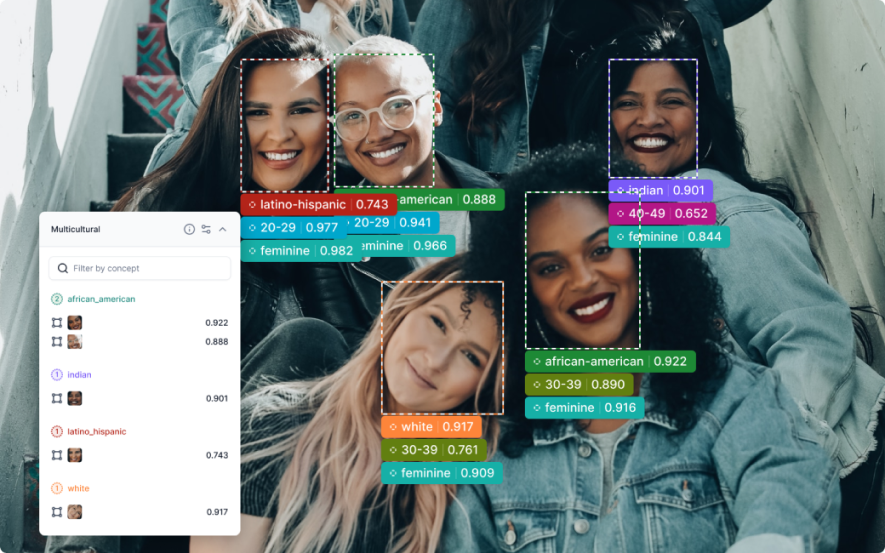
<p>Clarifai uses this creepy facial profiling example to sell its services.</p>
Clarifai
"We're collecting data now and just realized that OkCupid must have a HUGE amount of awesome data for this," Clarifai founder Matthew Zeiler wrote in an email to OkCupid co-founder Maxwell Krohn. The AI startup used the dating site's images to build a facial recognition service that can identify a person's age, gender and race. (Another brilliant and totally ethical idea from Clarifai, tapping into unsecured city surveillance cameras without authorization, was reportedly shuttered.)
Zeiller suggested to The New York Times in 2019 that people needed to, well, get over it. "There has to be some level of trust with tech companies like Clarifai to put powerful technology to good use, and get comfortable with that," the AI founder declared. Some of OkCupid's founders were reportedly investors in Clarifai.
As part of the settlement, the FTC "permanently prohibited" OkCupid from misrepresenting its data collection and privacy controls. TechCrunchnotes how strange it is to use that as a penalty, given that FTC rules already bar that behavior.
This article originally appeared on Engadget at https://www.engadget.com/ai/ai-company-deletes-the-3-million-okcupid-photos-it-used-for-facial-recognition-training-195223996.html?src=rss
Amazon and Anthropic are strengthening their ties once again, with steep financial commitments made on both sides. Today, Amazon announced that it will invest $5 billion in the AI company, along with as much as $20 billion in additional payments if certain milestones are met. This news follows the initial $4 billion investment Amazon made in Anthropic in 2023 and a second $4 billion round from 2024.
On Anthropic's side, it has committed to continued use of Amazon's custom Trainium silicon for its AI models. The latest agreement will see Anthropic promising to spend more than $100 billion on AWS technologies over the coming decade. It will secure up to 5 gigawatts of current and future chip capacity for training and powering its models. Their partnership is also bringing Anthropic's Claude platform to Amazon Web Services customers within the AWS portal, removing the need for additional credentials.
This article originally appeared on Engadget at https://www.engadget.com/ai/amazon-will-invest-up-to-25-billion-in-anthropic-in-a-broad-deal-225239302.html?src=rss
Bluesky is once again having a wobble. The platform said some of its systems are down and that it’s “investigating an incident with service in one of our reginos” (that’s Bluesky’s typo, not mine). The issue appears to have started at 1:42AM ET and was still persisting as of 11AM when this story was originally published. Since then, the site has been experiencing intermitent interuptions, including at times to its status page where users should be able to monitor outages.
At 7:47PM ET, the platform explained that it’s been attempting to mitigate “a sophisticated Distributed Denial-of-Service (DDoS) attack, which intensified throughout the day.” It said the attack had caused interruptions to users’ feeds, notifications, threads and search, all of which the Engadget team experienced first-hand at various points through the day. While DDoS attacks are frequently used as virtual smokescreens for hacks, Bluesky says it has “not seen any evidence of unauthorized access to private user data.” The social media service had another brief outage earlier this month.
In a later update on April 17, Bluesky noted that the DDoS attacks are “ongoing” but that the service has been stable since about 9PM PT last night. The company also reaffirmed that it hasn’t seen any evidence of access to user data. The next update is set to arrive by end of day Friday.
Update, April 17, 12:47PM ET: This story was updated with Bluesky’s latest outage update.
Update, April 16, 8PM ET: This story was updated after publish with an of the outage from Bluesky.
This article originally appeared on Engadget at https://www.engadget.com/social-media/bluesky-blames-ddos-attack-for-server-outages-150515882.html?src=rss
The European Commission has proposed new measures for Google aimed at bringing the tech giant's search business into compliance with the Digital Markets Act. In order to allow third-party online search engines to be competitive with Google, the EC has recommended that Google permit those services to access its treasure trove of search engine data. As it stands, the proposal would require Google to let rivals see data points "such as ranking, query, click and view data, on fair, reasonable and non-discriminatory terms."
"Data is a key input for online search and for developing new services, including AI," said Teresa Ribera, the Commission's executive vice-president for Clean, Just and Competitive Transition. "Access to this data should not be restricted in ways that could harm competition. In fast-moving markets, small changes can quickly have a big impact. We will not allow practices that risk closing markets or limiting choice."
European regulators have been using the Digital Markets Act to hammer at Google's dominant market position for several years. Beginning in March 2024, Google was required to be in compliance with the DMA and it did plan some changes in accordance with the legislation. A year later, though, the Commission levied preliminary charges against Google arguing that Google Search and the Play Store had not met their obligations for market competition. Google offered some possible adjustments to how search results are displayed in response, but it seems the regulator is going to keep fighting for more robust changes to Google's search business.
If you think all that sounds like something Google is unwilling and unlikely to do, you'd be correct. For starters, the actual requirements for Google could change in the coming months. The EC is accepting comments on the proposed measures through May 1, and Google's legal team is certain to have a lot of opinions to share. We've reached out to the company for a comment on these preliminary measures. A final, binding decision on Google's next steps is due by July 27, so we're expecting a lot of back-and-forth between the parties until that date.
Update, April 17 2026, 11:36AM ET: Reached for comment, Google's Senior Competition Counsel Clare Kelly told Engadget, "hundreds of millions of Europeans trust Google with their most sensitive searches — including private questions about their health, family, and finances — and the Commission’s proposal would force us to hand this data over to third parties, with dangerously ineffective privacy protections. We will continue to vigorously defend against this overreach, which far exceeds the DMA’s original mandate and jeopardizes people’s privacy and security."
This article originally appeared on Engadget at https://www.engadget.com/big-tech/the-european-commission-wants-google-to-share-search-engine-data-with-competitors-192709530.html?src=rss
The Oversight Board — the policy body Meta created to weigh its most impactful moderation rulings — has seen its role within Mark Zuckerberg's empire come into question due to shifting content policy priorities and dwindling investment. The Oversight Board has taken steps to formalize its long-contemplated desire to work with other companies, but Engadget has learned Meta has thus far declined to move forward with that process.
Over the last year, board members have become increasingly interested in artificial intelligence policy and how their experience shaping Meta's content rules could translate into advising companies in the generative AI space. That interest has intensified as some AI companies have privately signaled they would be open to working with the board, according to a source familiar with the organization who was not permitted to speak publicly. The board began talks with Meta last fall about the possibility, which would require the company to sign off on changes to the legal documents that govern the board's operations. But Meta officials have not indicated whether the company is willing to make those changes, which would likely require approval from top executives.
Platformer, which first reported on Meta's budget negotiations with the Oversight Board, noted that the company "has long encouraged the board to seek additional funding sources." So far, no other company has publicly shown interest in working with the group, though the board has had conversations with other firms behind the scenes.
Oversight Board co-chair Paolo Carozza told Engadget in December that there had been "really preliminary" discussions between the board and AI companies, though he declined to name which ones in particular. "It feels like quite a different moment now, largely because of generative AI, LLMs, chatbots [and] the way that a variety of retail-level users of these technologies are facing a whole new set of challenges and harms that's attracting a lot of scrutiny," he said at the time.
Meta has readily agreed to amend the board's governing documents in the past — like when the trust that controls the Oversight Board's budget funded a new organization to mediate content moderation disputes in Europe. While Meta executives once promoted the idea of its ostensibly independent Oversight Board working with other social media platforms, the prospect of the group working with a competitor as it pursues AI superintelligence is apparently more complicated.
Over the last five years, board members have received briefings from officials at Meta about the inner workings of its moderation systems and other non-public details as part of their work with the company. That raises practical questions about how the board would safeguard Meta's proprietary information, as well as larger strategic questions about whether Meta would want its Oversight Board to work with some of the companies it's now fiercely competing with, the source said. It's not clear how invested Meta's current leadership is in ensuring a future for the board. Former president of global affairs Nick Clegg, who was one of the most vocal champions of the board's work, left the company last year.
Meanwhile, other board members have publicly made the case that the group, which consists of free speech and human rights experts from around the world, is well-positioned to guide AI companies grappling with an increasing number of real-world harms. When Anthropic published a "Claude Constitution" earlier this year, the board published a lengthy analysis from member Suzanne Nossel arguing that Claude also needed the kind of "oversight" the board has provided for Meta. She made a similar argument for the wider AI industry in an op-ed in The Guardian last month.
While Nossel denied that she was directly pitching the Oversight Board to Anthropic, she said that AI companies face many of the "same dilemmas" as social media platforms. "When the board was first created, there was the notion that we might work across the industry," she told Engadget. "Now, as the world shifts toward an AI-centric paradigm, we're very interested in what our experience can bring to that conversation."
Oversight Board members, who naturally have a vested interest in expanding their purview, aren't the only members of the industry who have warned that generative AI platforms are essentially speed-running social media companies' playbook. A former OpenAI researcher recently wrote that "OpenAI Is Making the Mistakes Facebook Made," citing the AI company's moves toward optimizing for engagement and its plans for in-app advertising. The researcher cited Meta's Oversight Board as an example of the kind of independent governance that's needed in the AI industry.
The question of working with other companies has taken on new urgency as the Oversight Board faces the possibility that it will lose its backing from Meta. In a statement, a Meta spokesperson pointed to previous reports that Meta has committed to funding the board through 2028 and said that "nothing has changed." But a source familiar with the board tells Engadget that Meta has so far only handed over half of the smaller tranche of 2028 funds to the board amid ongoing discussions about its future, including whether it will expand its purview beyond Meta.
There are also very real questions about how the Oversight Board fits into Meta's current strategy around content moderation. Zuckerberg announced last year that Meta was shifting away from most proactive moderation, ending fact-checking in the United States and rolling back hate speech rules. Zuckerberg himself reportedly led the push for these changes following a meeting with then President-elect Donald Trump. The Oversight Board, which Meta has sometimes asked to advise on major policy changes, was not consulted. The company recently said it plans to reduce the number of human moderators in favor of AI-based systems.
"The Oversight Board is currently engaged in meaningful discussions with Meta regarding its future and the evolution of its model to ensure the organization can address the most urgent emerging challenges in AI governance, standards, and accountability," an Oversight Board spokesperson said in a statement. "At this time, no decisions have been made about the Board’s future, and the organization’s day-to-day work and mandate remain unchanged.”
Critics have long said that the board, which has received more than $280 million from Meta, moves far too slowly. In a little more than five years of operation, the board has published more than 200 decisions about specific moderation issues, which Meta is required to uphold. Those decisions — a tiny fraction of the millions of requests it receives — can take months, though the board can opt to move more quickly. The board has also made hundreds of policy recommendations, which Meta has to respond to but isn't required to implement. The company has agreed to at least some changes in response to 75 percent of recommendations, according to the board.
For the Oversight Board, working with a company besides Meta would begin to address some of the challenges it now faces. It would boost the group's credibility at a time when Meta seems to be re-evaluating its relationship with the board, and it would open up the possibility of new sources of funding. But the situation underscores another long-simmering tension when it comes to the role of the "independent" oversight organization. Meta has always been in control of how much influence the group can actually have. And it's not clear that the company is ready to let the board, which has spent the last five years learning the minutiae of Meta's content moderation and policy processes, advise the companies it's now competing with.
During its work with Meta, the Oversight Board has weighed in on its rules for AI several times. The board has criticized the company's "manipulated media" policy that governs deepfakes and other content, which led to Meta adopting new rules around AI labeling. In its most recent decision dealing with AI, the board urged Meta to invest in better AI detection tools and to collaborate more closely with other platforms. The company has not yet formally responded to those recommendations.
This article originally appeared on Engadget at https://www.engadget.com/social-media/meta-isnt-setting-its-oversight-board-free-just-yet-153000172.html?src=rss
You're only able to edit comments you left with your own account, and the process of actually doing so is easy. Just tap on the word "Edit" under your comment to pull up a text box where you can tweak, rework or embellish what you've written, and then press the blue check mark to save it. Meta says comments can be edited as many times as you want in that 15 minute window, so if you need to make more changes, you have that option.
Comments can show up in multiple ways across Instagram — including Stories, as of 2024 — so offering a way to edit them is a welcome addition. The new option is just the latest in a series of changes Meta has introduced to the social app in the last month. Earlier in March, the company announced that it was removing end-to-end encryption from Instagram DMs. At the end of the month, Meta also began testing Instagram Plus, a subscription service that unlocks new features for the app's Stories feature.
This article originally appeared on Engadget at https://www.engadget.com/social-media/instagram-comments-can-now-be-edited-within-15-minutes-195000640.html?src=rss
OpenAI is putting the brakes on Stargate UK, according to Bloomberg. That’s the company’s AI infrastructure project with NVIDIA that’s meant to help the UK build out its sovereign computing capabilities. The company announced Stargate UK back in September, but it launched a strategic partnership with the UK government months before that. Stargate UK would enable the government to run top AI models locally from data centers inside the region, “particularly for specialist use cases where jurisdiction matters.” But now OpenAI is pausing the project due to high cost of energy and regulatory issues.
In a statement provided to the publication, the company said that it still sees a “huge potential for the UK‘s AI future.” It added that “AI compute is foundational to that goal” and that it continues “to explore Stargate UK and will move forward when the right conditions such as regulation and the cost of energy enable long-term infrastructure investment.”
Upon announcing Stargate UK, OpenAI said that it would offer the same deal to other countries that want to expand their sovereign AI capabilities. It’s unclear if those plans are affected, as well, but it’s worth noting that the initiative, OpenAI for Countries, is also working with Australia, Greece, the UAE, Slovakia, Kazakhstan and other regions.
This article originally appeared on Engadget at https://www.engadget.com/ai/openai-pauses-its-stargate-uk-data-center-plan-115626978.html?src=rss
A former Meta employee in the UK is under investigation after allegations that he illicitly downloaded about 30,000 private photos from Facebook. According to The Guardian, the accused developed a software program to evade Facebook's internal security systems and access users' private images. Meta uncovered the breach more than a year ago and referred the case to law enforcement, where it is now being investigated by the London Metropolitan police's cybercrime unit.
"After discovering improper access by an employee over a year ago, we immediately terminated the individual, notified users, referred the matter to law enforcement and enhanced our security measures," a representative from Meta told the publication. "We are co-operating with the ongoing investigation."
This article originally appeared on Engadget at https://www.engadget.com/social-media/uk-meta-employee-reportedly-downloaded-30000-private-photos-from-facebook-users-181058081.html?src=rss
Alphabet's life sciences business Verily is restructuring and raising money as a new corporate entity. Verily announced that with its $300 million investment round, it will change from an LLC to a corporation and rename itself Verily Health Inc. As a result, Alphabet now has a minority stake rather than a controlling one in the business.
Similar to every other tech business, this chapter for Verily will be focused on AI. “From research to care, our customers need solutions that bring the best of clinical and scientific rigor together with AI to deliver the next generation of healthcare - one that is as precise as it is personal," Chairman and CEO Stephen Gillett said.
This article originally appeared on Engadget at https://www.engadget.com/big-tech/alphabet-no-longer-has-a-controlling-stake-in-its-life-sciences-business-verily-221718631.html?src=rss
The FBI has confirmed to the Senate it is once again buying data which can be used to track the locations of US citizens. That may have surprised the people who thought the precedent in Carpenter v. United States prohibited it. But while that case examined if it was legal for law enforcement to obtain location data from mobile networks without a warrant, here the FBI and other agencies have found a way to skirt the Fourth Amendment entirely. Over the last few years, they have taken to just buying location data from the same companies which power the enormous online advertising ecosystem.
Where does this data come from?
When your phone is connected to the internet, it broadcasts about itself, and so do the apps and platforms you use. That information includes your IP address and device type, as well as your longitude and latitude if your device has GPS. This data, known as Bidstream, alongside any third party cookies tied to your device, enables the process of Real Time Bidding (RTB). RTB is the process where your attention is auctioned off to the highest bidder in the milliseconds after you’ve loaded a page. In order to make the auctions work, these platforms need to know as much about you as they can.
As I explained in depth back in 2021, data such as your location and IP address is broadcast over the ad networks. This information can also be aggregated, licensed or sold to data brokers who can pair this with any “deterministic data” available. For instance, if you sign up to a platform and tell them your name, email address and annual income, that data could be licensed to a data broker. Even banks looking for new revenue streams are planning to license anonymized customer data to these companies. Data brokers can easily combine the two streams of information to build out a fairly extensive picture of you as a person, and what advertisers will be the most interested in you. Unfortunately, it’s extremely difficult to opt out of this and, even if it were, it would be even more difficult to destroy the data already in circulation.
In 2018 French company Vectaury, which acted as an ad sales intermediary for mobile apps, was inspected by the French data protection regulator. Officials found the company had built a database containing the personal data of 67.6 million people without proper consent.
Data brokers don’t just harvest and hoard this data to make online ad sales, however, they will also license and sell its databases to others. Lawmakers believe that these brokers have sold this data to rival nations looking for ways to spy on US citizens.
How are law enforcement agencies getting it?
In January, 404Media revealed the US Immigration and Customs Enforcement Agency (ICE) bought access to tools supplied by cybersecurity company Penlink. Specifically, it purchased access to tools named Tangles and Webloc, which can be used to surveil large numbers of people at once. The latter tool reportedly has the power to identify smartphones in a given area and time, and can then follow them on their journey through the day and back to their home at night.
Given the secretive nature of its business, Penlink does not reveal much about how its tools operate. A since-removed marketing page says Webloc automatically analyzes “location based information” available in “endless digital channels from the web ecosystem.” And 404Media’s report says these tools access “commercially available smartphone location data,” supplied by third-party data brokers. Forbes reports the system can also pull together data from a variety of sources, including social media, to offer a real-time view of an event. The Texas Observer says Webloc can use this information to enable “warrantless device tracking.”
The Fourth Amendment guarantees the right of the people to be protected from “unreasonable searches and seizures,” made without probable case. But, as Dori H. Rahbar wrote in the Columbia Law Review, “the Fourth Amendment does not regulate open market transactions.” Aaron X Sobel, writing in the Yale Law and Policy Review, described the practice as “end-running warrants,” and urged legislators to close this loophole. The Electronic Frontier Foundation (EFF), is also pushing for legislation under the Fourth Amendment is Not For Sale Act.
It’s not likely that such legislation will be passed for a long time, and a cynic would suggest it’s not possible under the current administration. But, even if it is, it won’t address the bigger issue of the ad tech industry and its partners vacuuming up as much information about us as it can. When these companies — many of which aren’t even known to the public — are able to store up enough information on us that, if they were so motivated, they could follow our path through the day, it’s a sign something is very rotten indeed. If we’re concerned about governments having this sort of access, then we should be equally nervous about anyone else having it as well.
This article originally appeared on Engadget at https://www.engadget.com/cybersecurity/dont-be-surprised-that-the-fbi-is-buying-your-location-data-182047627.html?src=rss
UNITED STATES - MARCH 18: FBI Director Kash Patel testifies during the Senate Select Intelligence Committee hearing on "Worldwide Threats" in the Hart Senate Office Building on Wednesday, March 18, 2026. (Bill Clark/CQ-Roll Call, Inc via Getty Images)
UK’s Ofcom has fined 4chan a total of £520,000 ($690,000) over the website’s failure to comply with the rules of Online Safety Act 2023. The biggest chunk of the amount came from 4chan’s failure to ensure children cannot encounter pornographic content on its website by implementing an effective age check mechanism. For that violation, the website has received a penalty of £450,000 ($598,000) and an order to apply an age check system by April 2. It carries a daily rate penalty of £500 ($664) until the website is compliant or until June 1, whichever comes sooner.
Ofcom also found that 4chan has failed to carry out sufficient illegal content risk assessment on its website and has fined it £50,000 ($66,400) for that violation. 4chan has until April 2 to conduct a risk assessment, or it has to pay an additional £200 ($266) per day. Finally, the regulator has determined that 4chan failed to include provisions in its terms of service that specify how it protects users from illegal content. That carries a fine of £20,000 ($26,600), with a daily rate penalty of £100 ($133) a day from its compliance deadline of April 2 to June 1.
The regulator started investigating 4chan, famous for its anonymous and unmoderated messaging boards, in June 2025 to determine if it was failing to meet its obligations under the law. In October, Ofcom announced its decision for some of the investigations it opened. It slapped 4chan with a £20,000 ($26,700) fine for ignoring its requests for a copy of the website’s illegal harms risk assessment and to provide information about its qualifying worldwide revenue. The regulator has confirmed to Engadget that 4chan has yet to pay that previous fine, which also earned cumulative daily punishment fees for 60 days.
This article originally appeared on Engadget at https://www.engadget.com/social-media/uk-fines-4chan-nearly-700000-for-failing-its-online-safety-act-obligations-115106264.html?src=rss
OpenAI's forthcoming "adult mode" will allow users to engage in lewd conversations with ChatGPT, but not use the chatbot to generate explicit images, audio or video. In response to reporting from The Wall Street Journal, an OpenAI spokesperson characterized the upcoming release as capable of producing smut rather than pornography.
OpenAI CEO Sam Altman first floated the idea of allowing people to use ChatGPT for erotica last October, saying the company wanted to "treat adult users like adults." OpenAI originally planned to release adult mode at the start of 2026. Since then, the company has pushed back the feature a handful of times, with the most recent delay coming at the start of March so that OpenAI could "focus on work that is a higher priority for more users."
Through The Journal's reporting, we're learning OpenAI forged ahead with work on adult mode despite reservations from its council on wellbeing and AI. The group of eight researchers and experts were reportedly unanimous in warning the company AI-generated erotica could lead to people developing an unhealthy emotional dependence on ChatGPT, and that underage users would almost certainly find ways to access the feature. According to The Journal, one council member, citing cases where people have taken their own lives after becoming attached to ChatGPT, said the company was at risk of creating a "sexy suicide coach."
Those concerns appear to have been well-founded. At one point, the company's age verification technology was misidentifying underage users as adults about 12 percent of the time, according to The Journal. At OpenAI's scale, with around 100 million teens using ChatGPT every week, that error rate would have translated to millions of minors accessing erotic chats. OpenAI told The Journal its prediction algorithm performs to industry standards, adding no such system will ever be completely foolproof.
This article originally appeared on Engadget at https://www.engadget.com/ai/openais-adult-mode-reportedly-wont-generate-pornographic-audio-images-or-video-150744035.html?src=rss
Meta could be preparing for one of the largest layoffs in its history, according to a Reuters report. The tech giant is planning to cut about 20 percent of its workforce, according to the outlet's sources. According to the report, neither a date nor the exact number of layoffs has been finalized yet.
However, Reuters reported that Meta's top executives have told "other senior leaders" to start "planning how to pare back." In its latest financial report, the company's employee headcount was 78,865 as of December 31, 2025, while revenue reached nearly $60 billion for the fourth quarter and more than $200 billion for the entire year. A Meta spokesperson told Reuters that this was "speculative reporting about theoretical approaches."
Meta is no stranger to major layoffs. Earlier this year, Meta targeted about 1,000 employees in its layoffs with the Reality Labs division that's responsible for the company's virtual reality and metaverse efforts. Early last year, Meta laid off about five percent of its workforce, following a smaller round of firings that same month. Meanwhile, the company has been spending heavily to acquire AI startups, like Moltbook, a social network designed for AI agents, and Manus, a startup focused on AI agents for task automation.
This article originally appeared on Engadget at https://www.engadget.com/big-tech/meta-is-reportedly-planning-to-cut-up-to-20-percent-of-its-staff-in-upcoming-layoffs-160812304.html?src=rss
Amazon has secured a temporary win in its fight with Perplexity over the use of AI shopping bots. Bloomberg reported that a San Francisco federal court has determined that Perplexity must stop using its Comet web browser's AI agent to make purchases for users on Amazon's marketplace. The AI company will have a week to appeal the decision, otherwise it has been ordered to stop accessing any password-protected areas of Amazon's systems and destroy its copies of Amazon's data while the two companies continue to argue their cases.
"Amazon has provided strong evidence that Perplexity, through its Comet browser, accesses with the Amazon user's permission but without authorization by Amazon, the user's password-protected account," District Judge Maxine Chesney wrote in placing the temporary block.
"The preliminary injunction will prevent Perplexity’s unauthorized access to the Amazon store and is an important step in maintaining a trusted shopping experience for Amazon customers," an Amazon spokesperson told Bloomberg.
Amazon sent a cease-and-desist letter to Perplexity over the AI company's shopping bots in November. According to Amazon, use of the Comet agent to make purchases is a violation of its terms of service. "Perplexity will continue to fight for the right of internet users to choose whatever AI they want," a representative from Perplexity said of this week's decision.
This article originally appeared on Engadget at https://www.engadget.com/ai/amazon-wins-a-temporary-injunction-against-perplexitys-comet-browser-184000462.html?src=rss
The Oversight Board is once again urging Meta to overhaul its rules around AI-generated content. This time, the board says Meta should create a separate rule for AI content that's independent of its misinformation policy, invest in more reliable detection tools and make better use of digital watermarks among other changes.
The group's recommendations stem from an AI-generated video shared last year that claimed to show damaged buildings in the Israeli city of Haifa during the Israel-Iran conflict in 2025. The clip, which racked up more than 700,000 views, was posted by an account that claimed to be a news outlet but was actually run by someone in the Philippines.
After the video was reported to Meta, the company declined to remove it or add a "high risk" AI label that would have clearly indicated the content had been created or manipulated with AI. The board overturned Meta's decision not to add the "high risk" label and says the case shines a light on several areas where the company's current AI rules are falling short.
"Meta must do more to address the proliferation of deceptive AI- generated content on its platforms, including by inauthentic or abusive networks of accounts and pages, particularly on matters of public interest, so that users can distinguish between what is real and fake," the board wrote in its decision. Meta eventually disabled three accounts linked to the page after the board flagged "obvious signals of deception."
One of the board's top recommendations is that Meta create a dedicated rule for AI-generated content that's separate from its misinformation policy. The rule, according to the board, should include specifics about how and when users are required to label AI content as well as information about how Meta penalizes those who break the rule.
The board was also highly critical of how Meta uses its current "AI Info" labels, noting that the way they are applied is "neither robust nor comprehensive enough to contend with the scale and velocity of AI-generated content,” especially in times of conflict or crisis. “A system overly dependent on self-disclosure of AI usage and escalated review (which occurs infrequently) to properly label this output cannot meet the challenges posed in the current environment.”
Meta, the board said, also needs to invest in more sophisticated detection technology that can reliably label AI media, including audio and video. The group added that it was "concerned" about reports that the company is "inconsistently implementing" digital watermarks on AI content created by its own AI tools.
In a statement, Meta said it “welcomed” the decision and that it would also take action “on content that is identical and in the same context” when “it is technically and operationally possible to do so.” The company has 60 days to formally respond to its recommendations.
The decision isn't the first time the board has been critical of Meta's handling of AI content. The group has described the company's manipulated media rules as "incoherent" on twoother occasions, and has criticized it for relying on third-parties, including fact checking organizations, to flag problematic content. Meta's reliance on fact checkers and other "trusted partners" was again raised in this case, with the board saying that it had heard from these groups that Meta "is less responsive to outreach and concerns, in part due to a significant reduction in capacities for Meta’s internal teams." Meta, the board writes, "should be capable of conducting such assessments of harm itself, rather than rely solely on partners reaching out to them during an armed conflict."
While the Oversight Board's decision relates to a post from last year, the issue of AI-generated content during armed conflicts has taken on a new urgency during the latest conflict in the Middle East. Since the start of the US and Israel's strikes on Iran earlier this month, there has been a sharp rise in viral AI-generated misinformation across social media. The board, which has previously hinted that it would like to work with generative AI companies, included a suggestion that would seem to apply to not just Meta.
"The industry needs coherence in helping users distinguish deceptive AI-generated content and platforms should address abusive accounts and pages sharing such output," it wrote.
Update, March 10, 10:53AM ET: This story was updated to reflect Meta’s response to the Oversight Board.
This article originally appeared on Engadget at https://www.engadget.com/social-media/the-oversight-board-says-meta-needs-new-rules-for-ai-generated-content-100000268.html?src=rss
People can block the xAI's Grok chatbot from creating modifications of their uploaded images on social network X. Neither X or xAI, both Elon Musk-owned businesses, have made a public announcement about this feature, which users began noticing on the iOS app within the image/video upload menu over the past few days.
This option is likely a response to Grok's latest scandal, which began at the start of 2026 when the addition of image generation tools to the chatbot saw about 3 million sexualized or nudified images created. An estimated 23,000 of the images made in that 11-day period contained sexualized images of children, according to the Center for Countering Digital Hate. Grok is now facing two separateinvestigations by regulators in the EU over the issue.
The positive side of the recent feature addition is that X and xAI have taken a step toward limiting inappropriate uses of Grok. This block is a simple toggle and it hasn't been buried in the UI. So that's nice.
The negative side, however, is that this token gesture that doesn't amount to any serious improvement to how Grok works or can be used. It's great that the chatbot won't alter the file uploaded by one person, but as reported by The Verge, the block only limits tagging Grok in a reply to create an image edit. There are plenty of workarounds for those dedicated individuals who insist on being able to use generative AI to undress people without their consent or knowledge.
Hopefully xAI has more powerful protective tools in the works. The limitations Grok on putting real people in scanty clothing that X announced in January seem to have had only partial success at best. If this additional and narrow use case is all the company offers, then the claims of being a zero-tolerance space for nonconsensual nudity are going to ring hollow. Especially since, as we noted at the time, xAI could stop allowing image generation at all until the issue is properly and thoroughly fixed.
This article originally appeared on Engadget at https://www.engadget.com/ai/you-can-sort-of-block-grok-from-editing-your-uploaded-photos-215356117.html?src=rss
Bluesky CEO Jay Graber, who has led the upstart social platform since 2021, is stepping down from her role as its top executive. Toni Schneider, who has been an advisor and investor in Bluesky, will take over the job temporarily while Graber stays on as Chief Innovation Officer.
"As Bluesky matures, the company needs a seasoned operator focused on scaling and execution, while I return to what I do best: building new things," Graber wrote in a blog post. Schneider, who was previously CEO at Wordpress parent Automattic, will be that "experienced operator and leader" while Blueksy's board searches for a permanent CEO, she said.
Graber's history with Bluesky dates back to its early days as a side project at Jack Dorsey's Twitter. She was officially brought on as CEO in 2021 as Bluesky spun off into an independent company (it officially ended its association with Twitter in 2022 and Dorsey cut ties with Bluesky in 2024). She led the company through its launch and early viral success as it grew from an invitation-only platform to the 43 million-user service it is today. During that time, she's become known as an advocate for decentralized social media and for trolling Mark Zuckerberg's t-shirt choices.
Nearly three years since it launched publicly, Bluesky has carved out a small but influential niche in the post-Twitter social landscape. The platform is less than a third of the size of Meta's competitor, Threads, which has also copied some of Bluesky's signature features. Bluesky also has yet to roll out any meaningful monetization features, though it has teased a premium subscription service in the past.
As Chief Innovation Officer, Graber will presumably still be an influential voice at the company going forward. And, as Wiredpoints out, she still has a seat on Bluesky's board so she will get some say in who steps into the role permanently. Until then, Schneider, who is also a partner at VC firm Tre Ventures, will lead the company. "I deeply believe in what this team has built and the open social web they're fighting for," he wrote in a post on Bluesky.
This article originally appeared on Engadget at https://www.engadget.com/social-media/blueskys-ceo-is-stepping-down-after-nearly-5-years-201900960.html?src=rss

 Anmelden