Ford Racing's Mustang Cobra Jet 2200 just ran a quarter mile in 6.87 seconds at 221 mph at an NHRA event in Charlotte, setting a new world record for an EV. The run smashed Ford's own previous EV record of 7.62 seconds, set by the Cobra Jet 1800 last September, by an impressive 0.75 seconds.
As the name suggests, Ford's Cobra Jet 2200 puts a massive 2,200 horsepower to the wheels thanks to a newly designed electric motor and inverter combo. Ford elected to use two motors and inverters instead of four of each as before to reduce complexity and boost efficiency to 98 percent. Overall power is up by 600 horsepower, but the motors and inverters weigh half as much as before. Everything runs on a 900-volt architecture and 32 kWh battery that charges in 20 minutes, easily enough for the NHRA's 45-minute turnaround rule.
It's official: The Ford Racing Mustang Cobra Jet 2200 has clocked a new record time of 6.87 at 221 mph - now the quickest electric car on the planet.#FordRacingpic.twitter.com/drmvH2XRp6
The car has some unusual features for an EV like a clutch that lets the driver dump all the power to the road instantly for maximum acceleration. It also uses a multi-speed transmission that allows the car to run in its ideal power band through the duration of the run — reducing the quarter-mile time by up to a second, according to Ford. The battery design also allowed the team to tune weight distribution for optimal traction. Another racing touch is a pyrotechnic circuit breaker that can instantly break the high-voltage connection via a small explosive charge to align with NHRA safety rules.
Some of this tech, like the high-efficiency motors and 900 volt system, could conceivably trickle down to consumer vehicles. Unfortunately, Ford and other US automakers have significantly reduced their investment in BEV technology of late. Ford recently announced that it would reboot the F-150 Lightning as an EREV with a gas generator, while last week GM delayed its next-gen full-size EV pickups and SUVs — all in the face of rapidly rising gasoline prices.
This article originally appeared on Engadget at https://www.engadget.com/transportation/evs/fords-mustang-cobra-jet-sets-a-new-ev-quarter-mile-record-at-687-seconds-112259793.html?src=rss
Tesla completely ended its free lifetime Supercharging offer way back in 2018, but it has given customers the perk for certain promotions since then. It brought back free Supercharging for Model S and X a couple of times in 2019, for instance. The automaker’s latest offer is for new purchases for a Model 3 Premium or Performance vehicle in North America. On its website, Tesla has announced that it’s including one year of free supercharging with a Model 3 Premium or Performance, though the offer is “subject to change or end at any time.”
As Electrek notes, this is a nice freebie to have but most likely not a deciding factor for people who charge at home. For those who don’t have access to a home charger, however, this could represent significant savings.
The free Supercharging offer starts at delivery and cannot be postponed or redeemed for cash. Owners will also still have to pay certain fees, such as congestions fees that the automaker adds if a vehicle remains plugged into a Supercharger after its battery reaches 80 percent when a site is busy. The offer doesn’t apply to vehicles used for commercial purposes, such as ridesharing, taxi and delivery services, as well. As for those who traded in their gas vehicles to get the 2,000-mile Supercharging incentive, they can enjoy this freebie first and redeem those miles after their first year of ownership.
This article originally appeared on Engadget at https://www.engadget.com/transportation/evs/tesla-is-giving-away-one-year-free-supercharging-with-model-3-premium-and-performance-purchases-144431817.html?src=rss
Lucid Motors has recalled over 4,000 Gravity SUVs after discovering a problem with seat belts. The company told the National Highway Traffic Safety Administration (NHTSA) that some of the anchors for the second-row seat belts weren't welded properly. This means that there's a chance they won't actually hold passengers during a collision.
The company blames the issue on a seat supplier changing its manufacturing process "without notice to or approval by Lucid." It says it has reverted to the original design and that newer models aren't impacted by the recall. Vehicles manufactured after February 14, 2026 are good to go.
Lucid will have to inspect each and every Gravity SUV affected by the recall and potentially install a new bracket or a whole new seat. Owners will receive instructions to bring their vehicles to service centers. The company hasn't reported any injuries related to the defect, which is good news.
4,000 may not sound like a particularly high number, but this isn't Toyota or Ford. The number accounts for nearly every Gravity SUV manufactured since it launched last year, according to The Tech Buzz. It's been reported that the company sold around 15,800 vehicles in 2025, but that accounts for every model in the lineup.
NEWS: Lucid's CEO says he replaced the company's entire software leadership team following the extremely buggy launch of their Gravity SUV.
"We're working through this. We will be over the hump by end of January, latest, latest, end of March." https://t.co/D9ARNVwA5Q
This isn't the first issue that has popped up regarding Lucid's Gravity SUV. The company had to recall many vehicles due to an issue with the airbags at the tail-end of last year. The model has also been plagued by software issues, though numerous patches seem to have cleared that up. The three-row electric SUV starts at $80,000.
The company has been burning through cash without too much to show for it, according to Autoblog. This would doom other manufacturers, but Lucid has an extremely wealthy benefactor. The majority stakeholder is The Saudi Public Investment Fund, which has invested billions in the company. Lucid's VP of Communications, Nick Twork, says the country "stands behind us as a long-term partner."
This article originally appeared on Engadget at https://www.engadget.com/transportation/evs/lucid-motors-recalls-over-4000-gravity-suvs-over-seat-belt-defect-155321460.html?src=rss
Toyota is teaming up with Daimler and Volvo to work on fuel cell technology. The Japanese company is signing on to the joint venture cellcentric that Volvo and Daimler launched back in 2020. Once it officially joins, Toyota and cellcentric will collaborate on managing the development and production of fuel cell unit cells.
"We are deeply grateful for the opportunity to soon be joining Daimler Truck and Volvo Group as partners in building a hydrogen society," Toyota President and CEO Koji Sato said. "cellcentric which possess deep expertise in commercial fields together with Toyota ‘s over 30 years of fuel-cell development in the passenger car sector, can combine their strengths to deliver one of the world-leading fuel cell systems for heavy commercial vehicles."
It's a move that runs counter to where the auto industry has been trending. Last year, Stellantis announced that it would end its hydrogen fuel cell development program. That's the company that owns brands including Chrysler, Citroen, Fiat, Jeep and Peugeot. GM also gave up on hydrogen in 2025. Even Toyota had rethought some of its commitment to hydrogen last year, pivoting to emphasize industrial applications rather than commercial ones.
This article originally appeared on Engadget at https://www.engadget.com/transportation/toyotas-still-trying-to-make-hydrogen-fuel-cells-happen-202237728.html?src=rss
After letting us drive a prototype around in the snow earlier this month, BMW has fully unveiled its all-new i3 electric vehicle. It's a far cry from the original funky hatch launched way back in 2013, offering more of everything including power, range and space. It also looks like you'd hope a 3-series EV would: a sporty sedan, minus the polarizing grille on the gas-powered M3.
The i3 uses BMW's Neue Klasse platform and indeed borrows inspiration from the company's Vision Neue Klasse concept unveiled in 2023. With motors on the front and rear in the 50 xDrive configuration, along with the 800-volt electrical system, it delivers a combined 463 HP and 476 lb-ft of torque, just a touch less than BMW's G80 M3.
BMW
That will make the BMW quick (the automaker didn't say how quick yet), but it will also be efficient. BMW estimates that the i3 will go 440 miles on a charge according to EPA guidelines and offer quick energy replenishment as well via DC charging speeds up to 400kW — up to 30 percent faster than its previous Gen5 tech. The battery pack will also be directly integrated into the chassis to reduce weight and increase torsional rigidity, while allowing bidirectional charging so you'll be able to use it as a battery on wheels to power your home in a blackout.
Styling-wise, the i3 is much simpler up front with the grille and headlights incorporated as a single unit. A recess down the center of the hood draws your eye to the badge, while giving the EV muscle car allure. The side intakes add to that impression, as do the bulgy fenders, "Le Catellet Blue" metallic paint and optional lighting animations (Relaxed, Excited and Balanced).
Fabian Kirchbauer Photography
On the tech side, the i3 supports BMW's Digital Key Plus so you can open the doors or trunk with a smartphone or smartwatch. The interior, meanwhile, looks as futuristic as I've seen in any recent EV thanks to the 17.9-inch Panoramic Vision display that's angled toward the driver, along with an optional 3D heads-up display. The system features a self-learning voice assistant with Amazon Alexa+ AI and supports customizable themes, colors and background images. It also includes a wireless charging pad for your smartphone or other devices.
Inside, you can choose between multifunction and M Sport seats trimmed in different themes, including imitation leather in Agave Green, Digital White, Castanea or Black, or an M Design World theme in Black Veganza with M Performtex material. Alternatively, you can go for the BMW Individual scheme with real black Merino leather. For controls, BMW is using a hybrid system with physical buttons for the hazard lights and parking brake and "Shy Tech" buttons on the steering wheel that activate only when required.
BMW will start i3 production in August 2026 and deliveries later in the fall, with pricing set to be revealed around that time. From what we've seen so far it's going to offer outstanding performance and range, but don't expect it to be cheap.
Fabian Kirchbauer Photography
This article originally appeared on Engadget at https://www.engadget.com/transportation/evs/bmws-i3-is-reborn-as-a-sporty-440-mile-range-ev-sedan-124614369.html?src=rss
There's more waffling going on about the future of electric vehicles in America right now than you might expect at a Belgian breakfast buffet. Some brands like Hyundai are staying committed, some brands like Honda are dialing back, and everyone else is simply doing their damndest to provide as many propulsion options as possible
Count Audi in that last category. On the EV side, it recently launched the new Q6 E-Tron and refreshed the ballistic E-Tron GT. On the internal combustion side, it has a new A6, and there's a full-size, three-row SUV coming in the form of the Q9. The company's latest car, though, can be found in the middle: Meet the new RS5, Audi's latest and greatest plug-in hybrid.
RS stands for "RennSport," or "Racing Sport" in German, the moniker applied to Audi's highest performing cars. RS designates an elite group of machines intended to be a bit more edgy and exclusive than your BMW M cars or Mercedes-Benz AMGs. The 2027 RS5 marks the first time an RS has come with both a big battery and a big engine, but the RS5 is much more than a novelty with a plug.
Tricky diff
2027 Audi RS5
Tim Stevens for Engadget
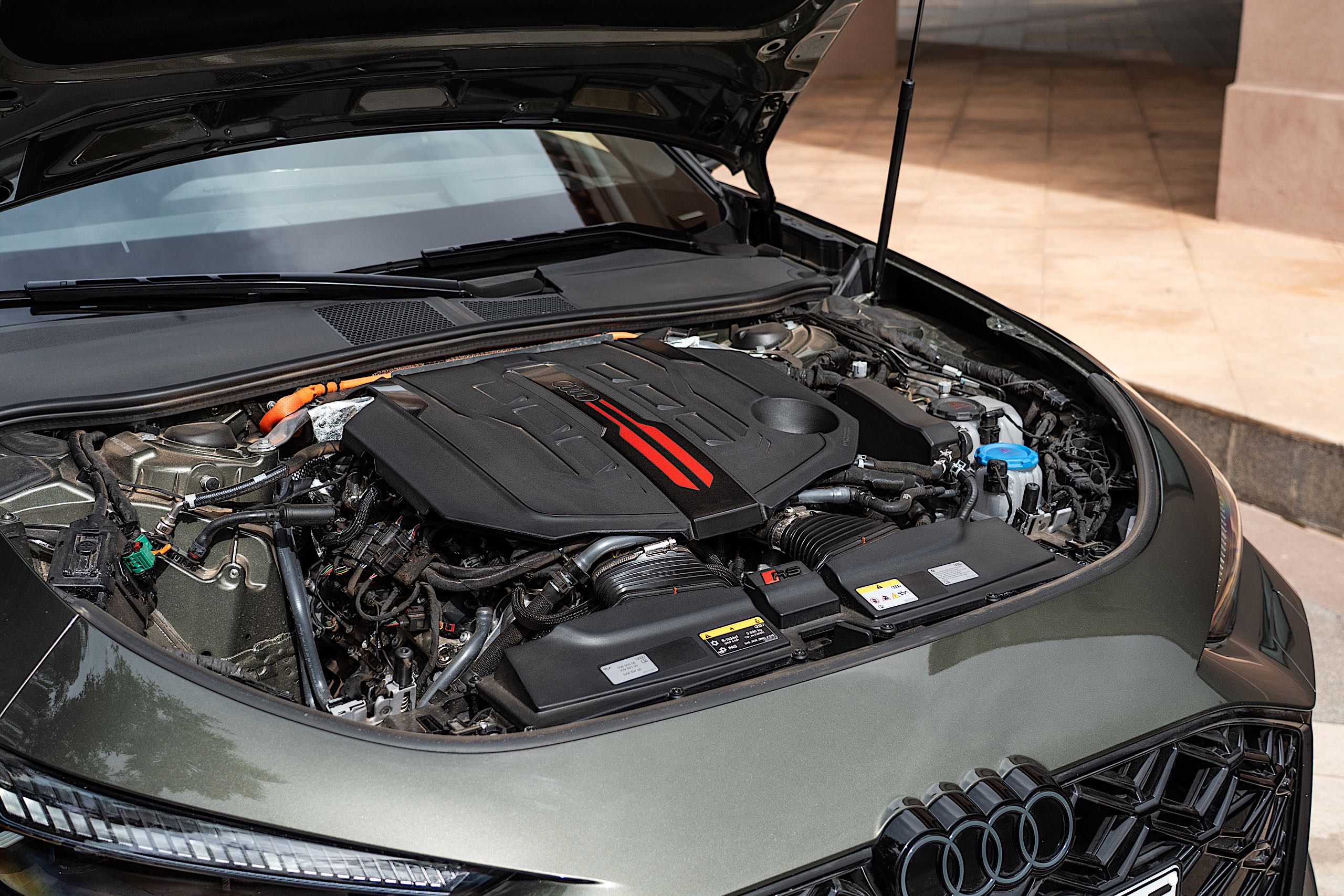
The main grunt of the new RS5 comes from a 2.9-liter, twin-turbocharged V-6 mounted up front under the hood. On its own, that engine produces 503 horsepower, a figure that you might think is plenty. Here, though, it has some help here in the form of not one but two electric motors.
The first is a typical hybrid arrangement, a 174-hp motor wedged in between the engine and transmission. This is the primary means of electric propulsion for the car, giving it a total, maximum system output of 630 hp and 609 lb-ft.
Because that motor is positioned where it is, the RS5 can still make full use of its eight-speed automatic transmission when driven only by the electric motor. That means a top speed of 87 mph before the engine kicks in. Once it does, it'll take you all the way up to 177 mph.
There's a second motor at the back, though, which is far more interesting. No, it isn't there to drive the rear axle like on the RAV4 Hybrid. The RS5 has a traditional Quattro setup with a mechanical differential in the middle to distribute power between the front and rear wheels.
The small, 11-hp motor at the back exclusively controls a new type of system that Audi calls Dynamic Torque Control. This motor uses planetary gearsets to selectively and effectively magnify the power to either the left or the right axle at the back. It may be small, but this motor makes the RS5 do some wonderful things.
Drift time
2027 Audi RS5
Tim Stevens for Engadget
For maximum fun in the new RS5, dial it over to what Audi calls Torque Rear mode. This configures the new rear differential to send maximum twist to the outside rear wheel. Combine that with the center differential, which can send up to 85 percent of the engine's power to the rear, and the result is a remarkably willing drift partner.
After less than 30 seconds behind the wheel on a closed track in Marrakesh, I was confidently sliding my way through a set of cones in a slalom, then pirouetting around a cone at the end in a tight circle, clouds of tire smoke hanging in the air. Normally, drifting a 5,200-pound, 630-hp machine rolling on sticky tires is a real nightmare. It's delightfully easy in the RS5.
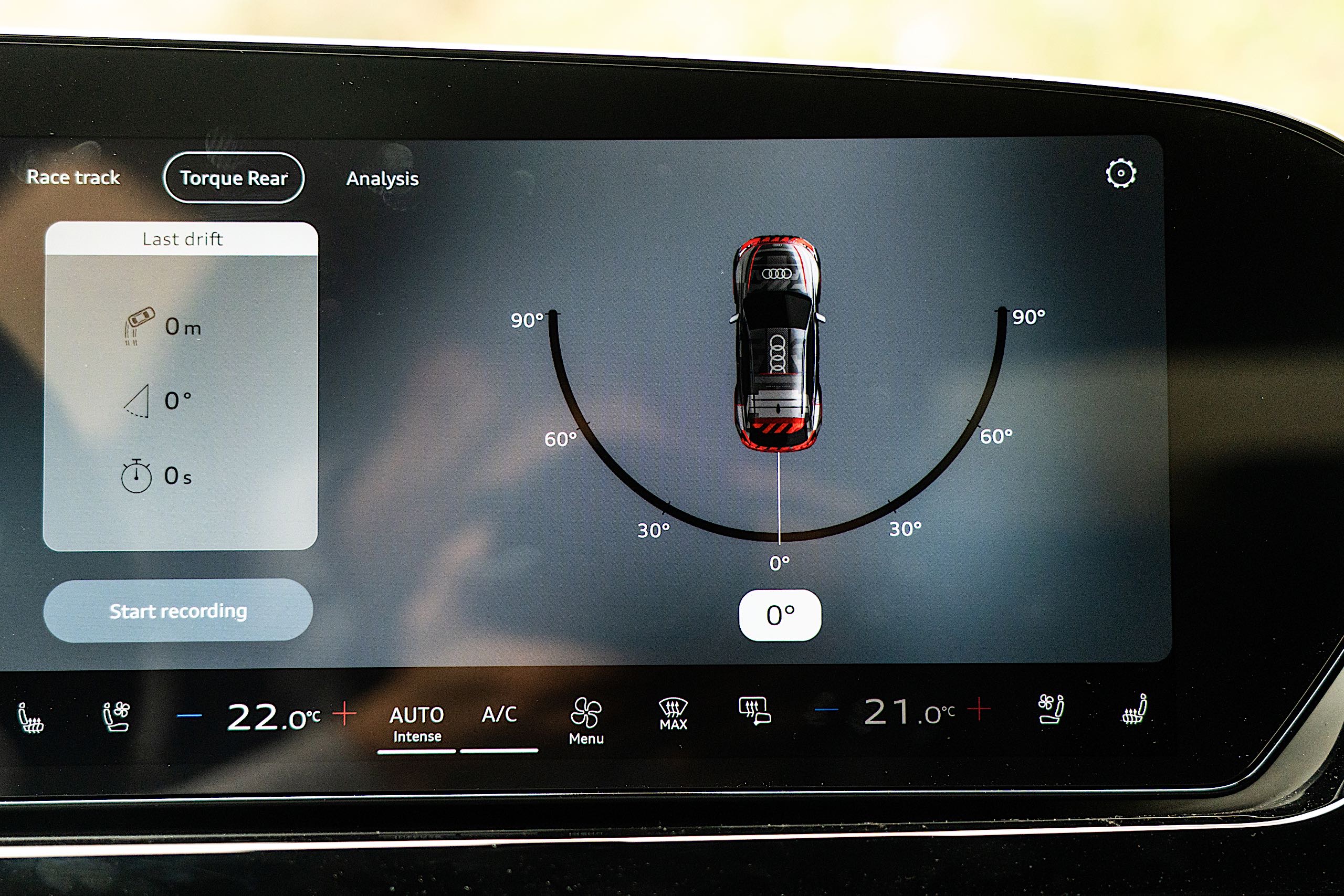
The car's differential setup not only makes this easy but also tracks just how successful you are at it. It records the time, length and even angle of your most dramatic drifts. You can even replay them on the touchscreen if you're so inclined, scrubbing back and forth to see what kinds of G forces you were generating.
This is part of a new extension to its infotainment system called the Audi Driving Experience. It'll also track lap times around race tracks, giving you a bit more information in the timeless pursuit of tenths of a second.
2027 Audi RS5
Tim Stevens for Engadget
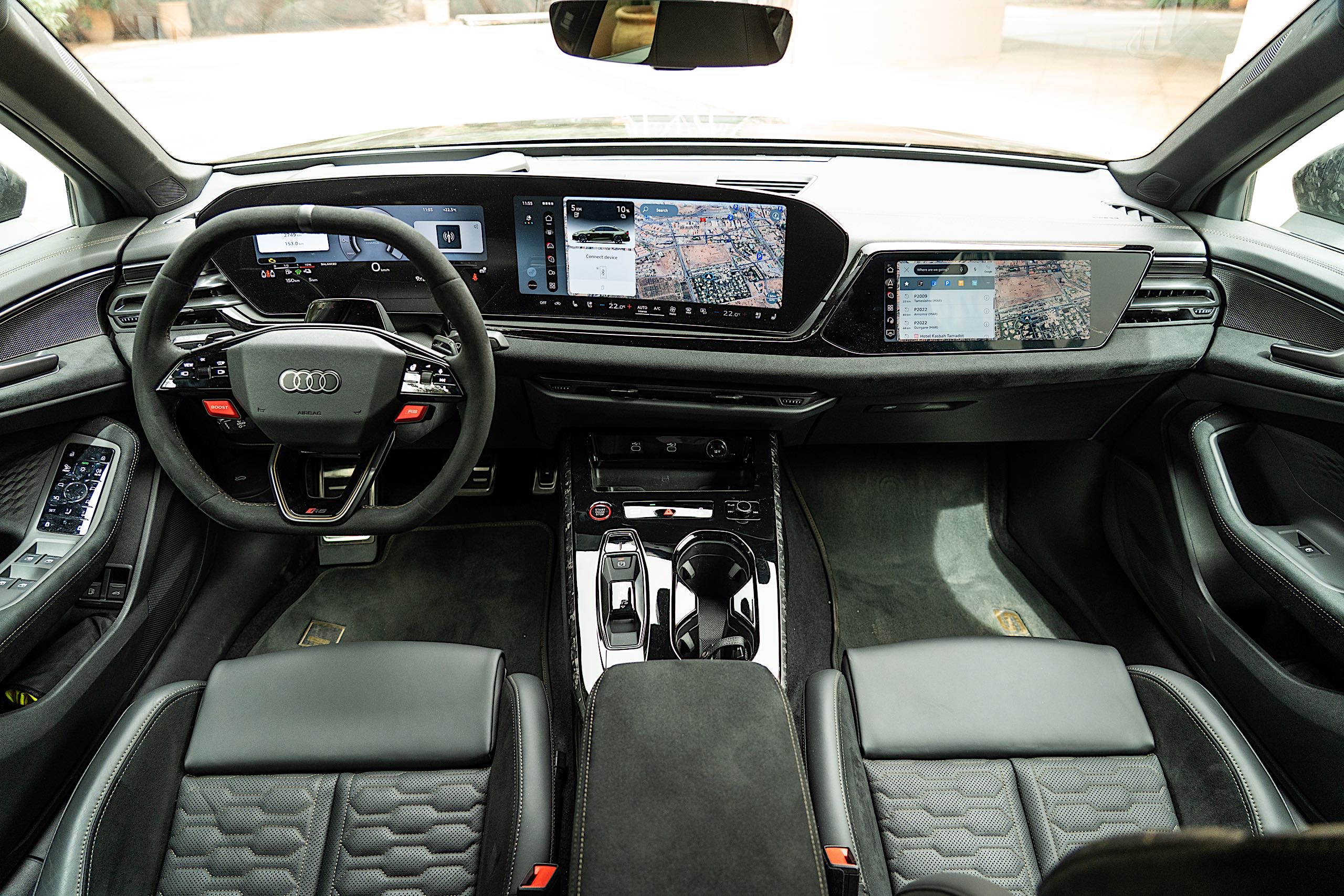
Audi also added a few custom screens showing the power distribution of the car and letting you monitor things like critical system temperatures and tire pressures at every corner. Otherwise, though, it's much the same interface as seen on most new Audis, with a 14.5-inch central touchscreen, an 11.9-inch gauge cluster and an optional 10.9-inch display way over on the right for the passenger.
That's a lot of displays, with the left two encased within an oversized, sweeping panel that stands tall and proud out of the dashboard. Too tall, actually. If big bezels ruin your day, look away, because there's a lot of wasted space here.
Likewise, if you don't like steering wheels with capacitive touch controls, you're not going to love the RS5. Audi has brought back the little scroll wheels under your thumbs, at least, but everything else on there is just a flat surface.
Putting the power down
2027 Audi RS5
Tim Stevens for Engadget
I spent the better part of a day driving the RS5 through the wild streets of Marrakesh and up into the Atlas Mountains to the south. In the city, I left the car in EV mode, letting that primary electric motor and the car's 25.9-kilowatt-hour battery (22 kWh net) do the heavy lifting. Audi says the car can cover up to 54 miles in this mode, and while I didn't have time to go that far on battery power, it seemed like an achievable estimate.
The car is perfectly pleasant in this mode, silent and even reasonably quick. In Comfort mode, the suspension is at its softest, and despite those giant wheels, the RS5 did perfectly fine over the decidedly imperfect Moroccan roads. But it wasn't until I got far away from the city that I could start to open things up a bit, working my way through the various drive modes and eventually all the way up to RS Sport, the most performance-oriented.
Here, the suspension is at its stiffest and the throttle at its sharpest, transmission swinging through its ratios eagerly to keep the engine singing. Jump on the gas, and the car really does leap forward, the electric motor doing its part to cover the power delay caused by the turbochargers in the mix.
You can feel that rear differential here, too, adding an extra bit of pivot to the rear when you're powering out of corners. But, on the way in, you really can feel the substantial weight of this car, the front end scrubbing and pushing forward when you ask too much of it.
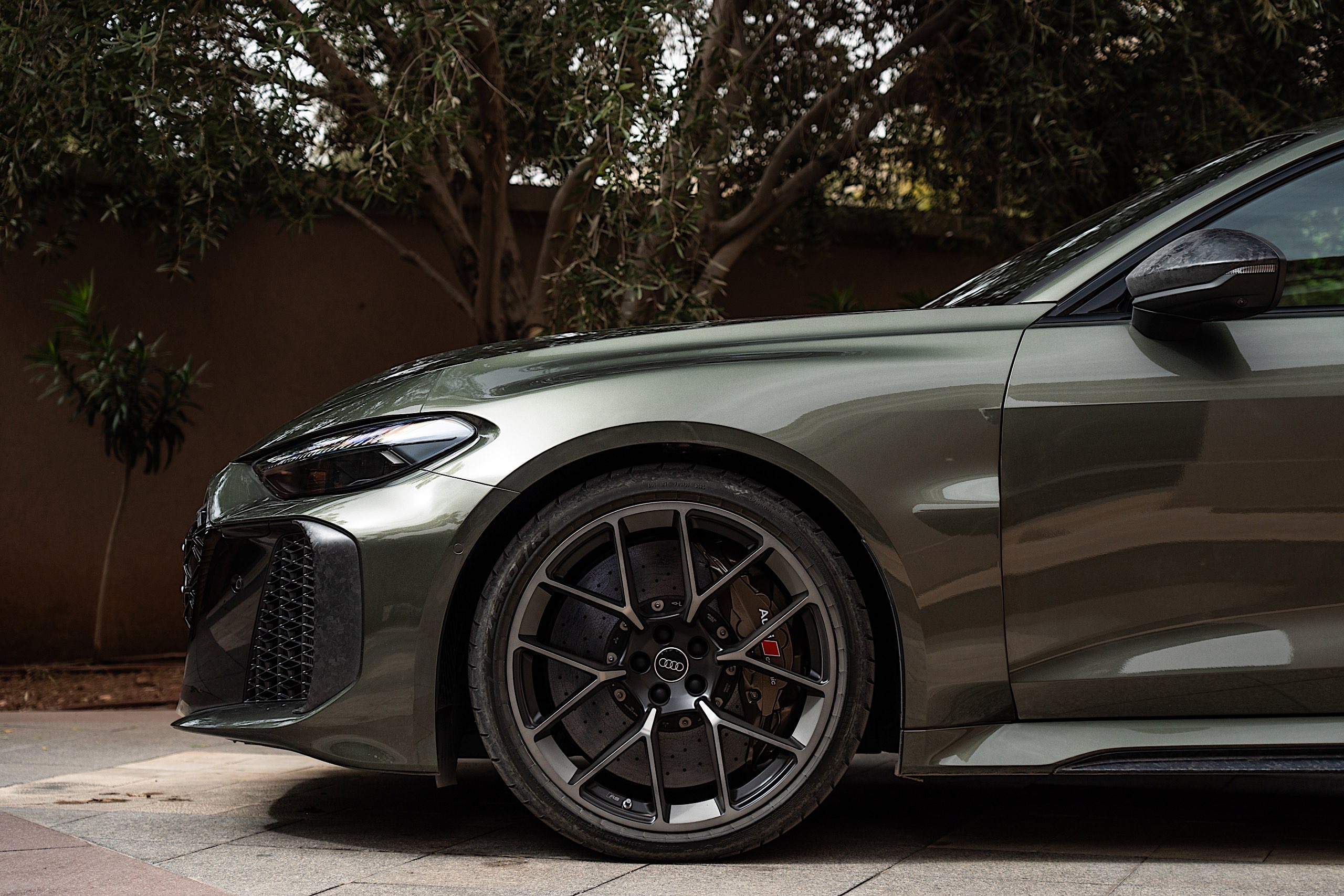
Again, this model gained more than 1,000 pounds over the old RS5, and though the improved suspension, drivetrain, tires and even giant, ceramic brakes all help to reduce its feel, there's no hiding that much mass.
Wrap-up
Yes, the RS5 has gained a lot of weight, and that hurts its nimbleness on track, but remember that this is a large, luxury sedan. It was never meant to be a lithe track toy. Despite that, the new RS5 actually feels far more fun and aggressive than its predecessor, a characteristic at least partially due to that trick new rear differential and the instant response of the new hybrid system. 54 miles of emissions-free range doesn't hurt, either.
The big question is cost, and sadly, Audi's not ready to answer that one yet. You do, at least, have a little time to save. The new RS5 doesn’t hit American shores until sometime in 2027.
This article originally appeared on Engadget at https://www.engadget.com/transportation/2027-audi-rs5-first-drive-big-thrills-with-a-big-battery-152057907.html?src=rss
Polestar is gearing up to launch three new models in the next two years, including a station wagon (estate or shooting brake) version of the Polestar 4 that harkens back to the company's Volvo roots. The Geely-owned Swedish company sold a record 61,000 EVs in 2025, but hopes that the new models will help it take an even bigger bite out of the market. "We want to get more volume out of a bigger cake," CEO Michael Lohscheller said.
Polestar currently offers two models in the US, the Polestar 3 and Polestar 4, both SUVs. However, the new Polestar 4 will come in two variants, one a traditional SUV as before and the other a four-door wagon-type version that combines "the space of an estate and the versatility of an SUV," Loscheller said. "It's all the good things from the current car, but it's a bit more practical." This new model is due later this year and will be built in Busan, South Korea in order to avoid US tariffs on cars built in China.
The automaker is also planning to release a new version of the Polestar 2 targeted at young buyers, though that one is unlikely to come to the US. It will be slightly longer for more passenger space and be produced in China like the current model 2.
Polestar
Finally, the Polestar 7 will be a compact SUV in the same family as Volvo's EX60, set to arrive in Europe to address the fast-growing compact SUV segment. "We are convinced that we can offer customers a progressive performance-driven car for a very attractive price point, built in Europe," Lohscheller said.
The new models are designed to help Polestar hit its goal of 60 percent of EV sales worldwide by "targeting the big profit pools of the BEV segment," Lohscheller stated. Following Polestar's withdrawal from the hyper-competitive Chinese market, Europe accounts for 78 percent of its sales and the US most of the rest — but the company hopes to boost its fortunes in the latter. "People forget that the U.S. is a big EV market, especially on the east and west coasts," the CEO added. "And it will stay a big market."
This article originally appeared on Engadget at https://www.engadget.com/transportation/evs/polestar-unveils-a-station-wagon-version-of-the-4-144025505.html?src=rss
Toyota has unveiled the 2027 Highlander, the first fully electric version of the vehicle and the automaker’s fourth EV in the US. It’s also the company’s first EV assembled in the country and the first electric model with three rows of seats. The automaker already sells the electric C-HR crossover and the electric bZ SUV in the US. While the 2027 Highlander resembles its predecessors, its lines look sharper and it has broader fenders. In addition, it features flush door handles similar to Tesla’s, which were designed for aerodynamics but which China recently banned out of safety concerns.
The new Highlander will be available in several varieties, specifically in Limited and XLE (Executive Luxury Edition) grades with either front-wheel or all-wheel drive configuration. If you get the Limited edition all-wheel drive with a 95.8 kWh battery, you can get a range of 320 miles on a single charge, based on Toyota’s estimates. Take note that range estimates by manufacturers and the EPA could be different from each other. It would be more accurate to compare EPA ranges between vehicles across brands, because they were determined using the agency’s testing methodologies.
The 2027 Highlander in XLE front wheel drive configuration with a 77 kWh battery has a manufacturer-estimated range of 287 miles. Meanwhile, the all-wheel drive XLE variant comes with either a 77 kWh battery that can power it for 270 miles or a 95.8 kWh battery that has an estimated range of 320 miles, similar to the Limited edition vehicle. The all-wheel drive variants have a total maximum power output of 338 horsepower, whereas the front-wheel models have a power output of 221 hp.
All the EV’s versions can seat seven, with the third row being able to fold flat if you need it for cargo. They come with heated front seats, but you can also get ventilated and heated second row seats for an additional fee. Toyota will start selling the 2027 Highlander in late 2026, with some regions getting it early next year. The automaker says it will announce pricing for the EV model closer to its release date.
This article originally appeared on Engadget at https://www.engadget.com/transportation/evs/the-2027-toyota-highlander-is-fully-electric-and-has-a-320-mile-range-115828463.html?src=rss
Ford may be discontinuing its F-150 Lightning pickup but it hasn’t given up on electric cars. CEO Jim Farley just teased the automaker’s electric pickup based on its new Universal Electric Vehicle platform that he called “one of the most audacious and important projects in Ford's history.”
The Universal EV platform will be used on a family of affordable EVs sold around the world, but will start with a mid-sized pickup for the US built in Louisville, Kentucky. It’s set to go on sale next year with a target price of $30,000.
An early peek at our brilliant team working on the Universal Electric Vehicle project - one of the most audacious and important projects in @Ford's history. American innovation is how we compete and win against China and the rest of the world.
Farley discussed some of the tech going into the pickup, particularly the aerodynamics, a key aspect if Ford is to compete with rivals. “The team is spending countless hours getting every last drop of aero efficiency on the mid-size electric pickup,” he noted. Farley also discussed the “simplified aluminum unicastings [that] condense over 146 parts into two” as a way to boost production efficiency.
Ford will invest $5 billion, including $2 billion at the Louisville factory on top of $3 billion already announced for its BlueOval battery plant. It will expand the Louisville facility by 52,000 square feet and "create or secure" nearly 4,000 direct jobs, the company said late last year.
Ford hasn't yet revealed the pickup’s name or shown a photo, but it’s supposed to have more interior room than a Toyota RAV4. Buyers will be able to lock bikes or surfboards into the pickup bed, mooting the need for roof or trailer hitch racks. It will have a low center of gravity from the battery, instant torque and a 0 to 60 mph time "as fast as a Mustang EcoBoost [around 4.5 seconds], with more downforce," Ford said.
Jim Farley famously imported a famously fast and high-tech Xiaomi SU7 EV from China and drove it daily, telling a podcaster he didn’t want to “give it up.” Hopefully, his experience will result in more tech-forward Ford EVs based on the Universal platform.
This article originally appeared on Engadget at https://www.engadget.com/transportation/evs/ford-shows-off-the-tech-going-into-its-30000-electric-pickup-truck-140000509.html?src=rss
Tesla will “basically stop the production” of its Model S and X electric vehicles next quarter, CEO Elon Musk has announced at the automaker’s earnings call for the 2025 fiscal year. “It’s time to bring the Model S and X program to a end with an honorable discharge, because we’re really moving into a future that’s based on autonomy,” Musk said. You can still buy the vehicles as long as there are units to be sold, and Tesla promises to support them for as long as people have them. Once they’re gone, though, they’re gone for good, because Tesla is converting their production space in the company’s Fremont factory into a space for the manufacturing of Optimus humanoid robots.
Model S is Tesla’s second vehicle and has been in production since 2012, while the Model X SUV has been in production since 2015. Their shine has faded over the years, however, and the newer Model 3 and Y now make up the bulk of the company’s sales. For the entirety of 2025, for instance, Tesla delivered 1,585,279 Model 3 and Y vehicles but only sold 418,227 Model S and X units. The company also had to stop selling Model S and X in China in mid-2025, because they were being imported from the US and were subject to China’s tariffs that were put in place in response to US President Donald Trump’s tariffs on imported goods.
In the call, Musk said that Tesla’s long-term goal is to be able to manufacture 1 million Optimus robots in the current Model S and X production space. At the World Economic Forum in Davos, Switzerland a few days ago, the CEO announced that Tesla will start selling Optimus to the public by the end of next year. Musk has big plans for Optimus and once said that it’s bound to become the “biggest product of all time,” bigger than cellphones, “bigger than anything.” But the humanoid robot has been failing to live up to the hype during demonstrations, and Musk is known for his overly optimistic timelines.
The company’s earnings report has also revealed that Tesla invested $2 billion in Musk’s other company, xAI. Tesla’s shareholders notably sued Musk in 2024 for starting xAI, which they argued is a direct competition to the automaker. The CEO has been claiming for years, after all, that Tesla is an AI company and not just an EV-maker. Still, Tesla’s shareholders approved Musk’s $1 trillion pay package in late 2025 on the condition that the company reaches a market value of $8.5 trillion.
This article originally appeared on Engadget at https://www.engadget.com/transportation/evs/tesla-is-killing-off-its-model-s-and-x-cars-to-make-robots-010621101.html?src=rss
Volvo hasn't exactly had a great run of EVs lately. The rollout of its flagship EX90 was stymied out of the gate by a bevy of software glitches. The EX30, meanwhile, was too expensive when it launched — the promised $35,000 model was incompatible with the currently chaotic global tariff situation.
Now, it's time for a new generation of EV from Volvo, one that's radically different at its core with a gigacast frame, a much higher-density battery and enough digital and literal horsepower to impress the most jaded of automotive enthusiasts. Mix in high-performance chipsets from both NVIDIA and Qualcomm, plus Google's Gemini AI onboard, and on paper, it has a lot to offer. After getting an early look at the thing at its unveiling in Sweden, I feel like this EV is ready and able to face off against BMW's new iX3 and Mercedes-Benz's upcoming GLC.
Let's start with the basics: The EX60 slots in the Volvo product lineup right alongside the existing XC60, Volvo's most popular model in the U.S. It's a two-row, mid-size SUV that seats five, the sort of thing perfect for those with small families or big dogs. It'll be available in three different basic configurations, starting with the single-motor, rear-drive, 369-horsepower, 310-mile EX60 P6. Next up is the AWD dual-motor, 503-hp, 320-mile P10, and finally the top-shelf, 670-hp, 400-mile P12.
670 horsepower in an SUV of this size seems frankly excessive to me, but then it does have a lot of weight to move around — 5,137 pounds to be exact. That’s thanks in large part to the P12's 112-kilowatt-hour net battery pack which is about 50 percent bigger than the one inside a Tesla Model Y. The P6 is a relatively svelte 4,663 pounds thanks to its smaller 80-kWh net battery pack, while the P10 has 91 kWh.
Volvo EX60
Volvo
Beyond the powertrain divisions, the Volvo EX60 will also be available in a variety of different trims with varying amounts of equipment, including the Volvo Cross Country edition with air suspension and a 20mm boost of ride height. Prices are said to start "around $60k" for an EX60 P10 Plus with a 21-speaker Bose system, but a 28-speaker Bowers & Wilkins system with Dolby Atmos will be available for those who really need all the channels.
Of course, Atmos support is no good without a good source, and to that end, the EX60 will be the first Volvo with Apple Music built in. That'll be part of the company's Android Automotive-based infotainment system, running on a curved 15-inch OLED screen and powered by a Qualcomm 8255 chipset. It’s paired with a low, wide gauge cluster set far back on the dashboard behind the steering wheel.
This will also be Volvo's first car with integrated Gemini, and indeed one of the first cars on the road with Google's smart agent. You can, of course, do typical Gemini things like ask about the weather or the nuances of René Descartes's concepts on dualism. Beyond that, Volvo CTO Anders Bell said that it will eventually gain access to the car's outward-looking cameras, meaning you'll be able to ask for more details on whatever it is you can see looming on the horizon.
Volvo EX60
Volvo
Volvo calls the car's software-defined architecture and the hardware that powers it HuginCore, named for Huginn, the raven of Norse mythology and represents Odin's mind and senses. Qualcomm powers the infotainment side of the avian experience, but when it comes to active safety, the EX60 relies on an NVIDIA Drive AGX Orin chipset. Unlike the EX90, the EX60 will not use a LiDAR sensor.
Volvo CTO Bell downplayed the absence of the sensor. "We realized we can now achieve many more meaningful and safe automated functions without LiDAR than we could have years ago," he said. Per Bell, LiDAR was never really in the plan for the EX60 anyway, a decision looking all the brighter given the recent bankruptcy of Volvo's former LiDAR partner Luminar.
The car's cameras and radar sensors all tuck nicely into the new exterior of the EX60, which certainly doesn't look miles off from the EX90 or indeed the current, gas-powered XC60. But the pronounced flares on the front fenders are a nice touch of personality on an otherwise understated SUV.
At the core of the EX60 is a new platform Volvo calls SPA3, with a chassis made using gigacasting. This refers to the force required to inject molten aluminum into massive castings, allowing more of the car to be made from fewer components. Volvo says the carbon footprint of the EX60 is lower even than that of the much smaller EX30.
The battery packs use the on-trend cell-to-pack construction method, which means all the cells are lumped together into a single unit. Typically, this boosts density at the cost of repairability, a tradeoff most manufacturers seem willing to make in pursuit of higher range and lower costs. However, Bell said that the company has actually made pack maintenance easier by optimizing the layout of the ancillary equipment.
Volvo EX60
Volvo
"The absolute vast majority, 90 percent of anything that ever needs to be repaired on a battery pack is electronics," he said. In the EX60, Volvo positioned the battery electronics beneath the rear seat to make them even easier to access. "We save a lot of weight, save a lot of cost."
The EX60 will be Volvo's first car to use the Tesla-style NACS charging standard, and the largest two packs will support charging speeds up to 370 kW. That drops to 320 kW on the 80-kWh net P6.
In practical terms, though, they're all roughly the same. Each model charges from 10 to 80 percent in less than 20 minutes, adding between 160 and 173 miles of range in 10 minutes. That's not quite the 200 miles BMW's iX3 can manage in the same time, but it is close.
The iX3 will probably be the EX60's fiercest competition when Volvo opens up orders later this spring. The EX60's $60,000 price for a midrange P10 Plus puts it right in line with the $60,000 that BMW says to expect for its iX3. Mercedes hasn't set American pricing for its GLC yet, but that, too, will be on a lot of shoppers' lists to compare.
I've already been impressed by how both the iX3 and the GLC drive. Sadly, Volvo wouldn't let me behind the wheel of its EX60 just yet, but hopefully I can report back with impressions soon to start to see how all these stack up on the road.
This article originally appeared on Engadget at https://www.engadget.com/transportation/evs/volvo-ex60-suv-preview-400-mile-range-670-hp-and-google-gemini-onboard-173000033.html?src=rss
Tesla's 2026 Model Y is now available on the company's site and it comes with a new (and old) option: a seven-seat version via a third row. The extra seating costs $2,500 and is only available if you order the Premium All-Wheel-Drive Long Range model. Tesla first teased the option last year via an email to prospective buyers with the promise of "seating for up to seven and enough room for everyone's gear," Electrek reported at the time.
The new seats appear to be designed mainly for children as they don't offer much legroom, according to images on Tesla's configurator. Tesla notes that the seven-seat interior "features fold-flat second-row and third-row seats," though it's not clear if those seats fold down electrically like the second row.
Tesla
Tesla is facing increased competition, especially in the crossover/SUV category, and saw another sales decline last quarter. The company previously sold a seven-seat version of the Model Y in the US for a short time before it was refreshed early last year. Since then, though, it has only been available with five seats. Tesla launched a six-seat "Model YL" version in China in August 2025 with a six-inch wheelbase extension that the US model lacks. Elon Musk said that model would come to the US market in late 2026 or maybe "never."
Otherwise, changes to the Model Y lineup are minor and confined to the Premium version. Those include a 20-inch dark-grey "Helix" "wheel option, a new black headliner, a bigger, higher-resolution 16-inch display and darker rear badging.
This article originally appeared on Engadget at https://www.engadget.com/transportation/evs/tesla-launches-a-seven-seat-version-of-the-2026-model-y-130039385.html?src=rss
Kia has unveiled its new entry level electric vehicle, the EV2. The boxy model strongly resembles the company's Soul (Kia did make an electric Soul at one point) and has very similar dimensions, though it's slightly shorter in height and length. It's not exactly a range monster and will charge a bit slower than the competition. The EV2 launched at the Brussels Motor Show and the company said it has no plans for US availability at this point.
The EV2 uses Kia/Hyundai's E-GMP platform and slots into the bottom of its EV lineup as an "entry point to electric mobility," according to the automaker. Though nearly the same size, it certainly looks nicer than the dowdy Soul and has more room inside. Competition-wise, it's going up against Volvo's EX30 and may cost about the same, though Kia has yet to divulge pricing.
Kia
The EV2 will be offered with two battery options: a 42kWh battery with 197 miles of WLTP range (likely around 170 miles by EPA standards) and 61kWh with 278 miles of WLPT range (around 240 EPA miles). That's not a lot, especially compared to the 261 mile EPA max range of the EX30 — so Kia's pricing for the EV2 will be key. As for charging speeds, Kia says the EV2 will charge from 10 to 80 percent in about 30 minutes — a bit slower than the 69 kWh EX30. Like other Kia vehicles, the EV2 supports vehicle-to-grid and vehicle-to-load (V2L/V2G) charging.
Kia calls the vehicle's interior a "Picnic Box" as a way to describe the small but useful space. Kia says its "comparable to larger vehicles" in terms of space, with generous rear legroom and rear cargo capacity up to 403 liters. It will come in four- and five-seat versions.
Kia
As for tech inside, it offers a generous screen setup, with a 12.3-inch instrument cluster, 12.3-inch infotainment screen and a 5-inch climate display. Ambient lighting in the cabin syncs up with specific vehicle functions. At the same time, it offers a fully array of manual controls climate, volume control and more. It comes with multiple USB-C ports (three up front) that support up to 100W charging.
The company has yet to reveal performance figures other than range. Production is set to start in Q1, so deliveries should commence in Europe and other regions later in the year. It doesn't look like the EV2 will arrive stateside any time soon, though, as the company said it "has not announced plans for the US market."
This article originally appeared on Engadget at https://www.engadget.com/transportation/evs/kias-budget-ev2-arrives-with-up-to-240-miles-of-range-130038144.html?src=rss
As an unabashed fan of electric vehicles, even I have to admit that most of them are pretty boring. Their smooth, quiet and calm demeanors don't offer much in the way of intrinsic personality, which has led to many brands slapping on outré designs and fake engine sounds to try and dial up the excitement.
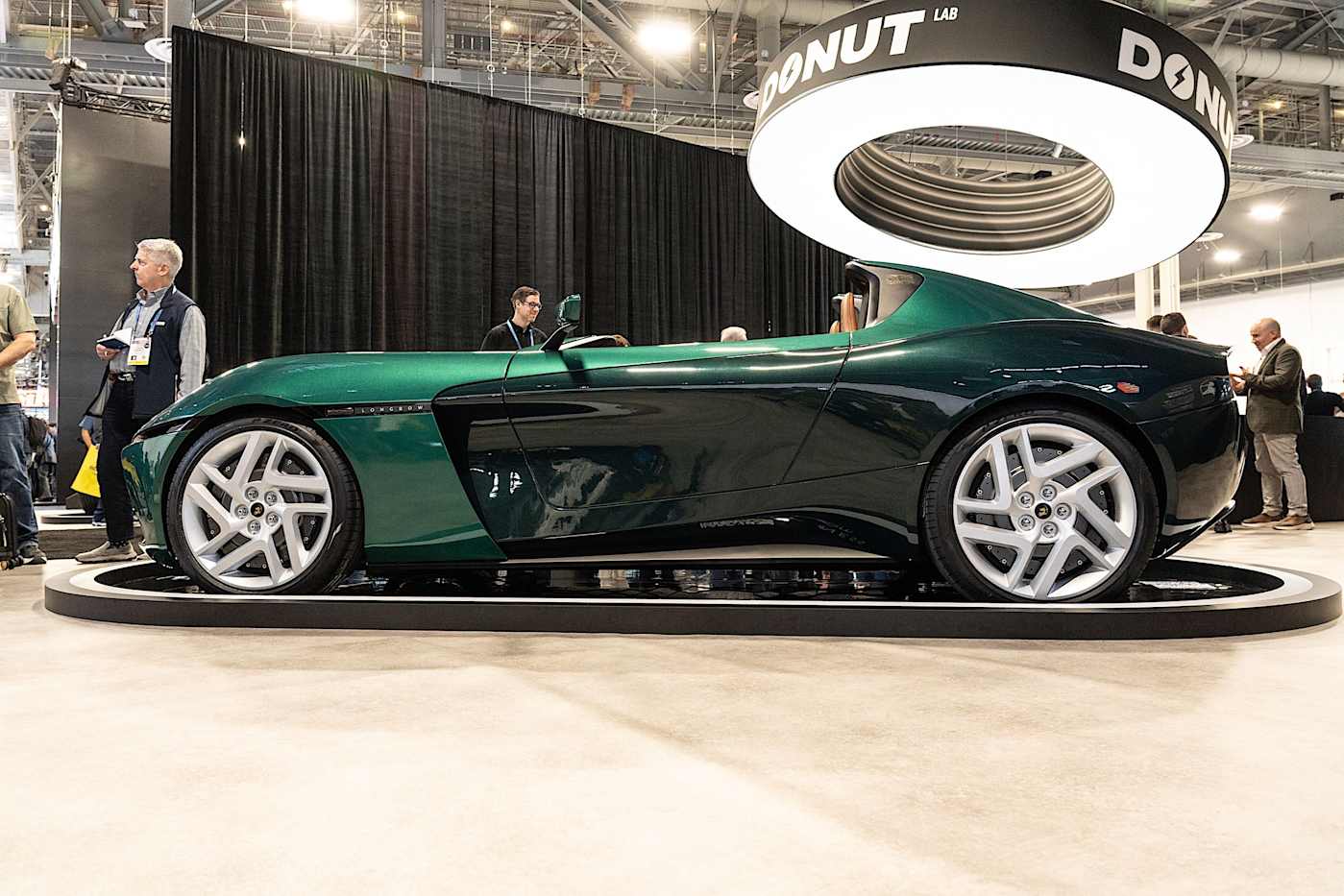
To that end, a pair of offerings coming soon from UK-based EV startup Longbow Motors looks to deliver exactly that. The Speedster and Roadster are high-performance electric machines built using advanced in-wheel motors from Donut Labs. Those motors and a bespoke design enable an astonishing curb weight of just 2,200 pounds.
For comparison's sake, that's over 100 pounds less than a Mazda Miata, the current king of lightweight roadsters. Longbow brought just the Speedster to CES 2026, displaying it on the show floor at the Donut Lab booth. Donut is a spinoff of Verge Motorcycles, which was the debut platform for the company's hub-less electric motor, creating a unique, Tron-style aesthetic.
But the technology is about a lot more than creating physics-defying motorcycles. Donut Lab is expanding its motors to all sorts of platforms, from scooters to heavy-duty trucks, creating a platform for easy adoption by electrified startups.
Donut Labs' motors in the Longbow Motors Speedster
Tim Stevens for Engadget
Of all those platforms, though, Longbow's implementation is the most compelling I've seen. The appeal starts with the style. Co-founders Daniel Davey and Mark Tapscott (who, with Jenny Keisu, founded Longbow after stints at Tesla and Lucid) told me they wanted to offer a classic but also modern and compelling look. The roofless Speedster has an edge over its glass-topped Roadster in terms of visual simplicity, but a complete lack of any protection from the elements — even a token windscreen — will make it viable only for the most committed of open-air enthusiasts.
Exposed or protected, you'll find yourself situated in an extremely spartan interior. Things like the gauge cluster and primary controls were covered, set to be revealed later, so I can't say for sure exactly what the Longbow looks like on the inside. But it was designed to be basic and minimal to an extreme, an abject rejection of the rest of the touchscreen-laden machines on the road today.
There is one seemingly unnecessary piece of equipment in the interior, though, and that's a shift knob. EVs, of course, rarely have transmissions, so there's no outright need to shift. The purpose of that lever is also a mystery for now, as neither Davey nor Tapscott would confirm its function, but it seems safe to expect some sort of simulated gearshift action, a la the Hyundai Ioniq 5 N.
The Longbow machines don't just lack a transmission, they lack a traditional drivetrain layout at all. The direct-drive Donut Lab motors are situated right inside the wheel, freeing up space inside the vehicle's chassis and helping it to maintain its pert dimensions.
Longbow Motors Speedster
Billy Steele for Engadget
They also provide a distinctive look, filling up the wheels as they do. There is a downside to this arrangement, that being the heft of these motors hanging on the outer edges of the vehicle. The suspension, then, has to work a bit harder. But co-founder Mark Tapscott told me that the positives outweigh the negatives, and that the handling benefits of having multiple motors alone are worth it.
To keep the rest of the Longbow's weight centralized, the car uses a battery pack that runs largely along the center of the machine, stacked vertically rather than spread throughout the floor. This keeps the mass centralized in the vehicle while also enabling the kind of ultra-low seating you want in a machine like this.
It looks like it'll be quite a fun package to drive, and while exact power output from those Donut Lab motors hasn't been confirmed yet, the Speedster is said to sprint to 60 mph in just 3.5 seconds. That's supercar-like performance, but unfortunately, that performance won't come cheap.
The Speedster starts at ₤84,995, or just under $100,000 by current conversion rates. The Roadster is a fair bit more attainable at ₤64,995, or about $75,000. However, given the wonderfully chaotic state of international tariffs right now, expect the actual pricing here to be somewhat higher when they go into production later this year. Reservations are open now on the company's site.
That's a little too rich for my blood, sadly, but if you've got the budget, a left-hand drive version will be available. And yes, it'll be fully road-legal in the U.S.
This article originally appeared on Engadget at https://www.engadget.com/transportation/evs/ces-2026-longbow-motors-shows-off-its-speedster-ev-with-donut-labs-in-wheel-motors-192329111.html?src=rss
Ahead of a launch later this month, Volvo has teased some impressive details about its upcoming electric crossover. The EX60, which slots between the EX40 and EX90, will offer an EPA range of 400 miles, beating all other Volvos and most EVs in general. It will also be the first Volvo car to use a megacasting process designed to reduce weight and boost manufacturing efficiency.
"With our new electric vehicle architecture, we directly address the main worries that customers have when considering a switch to a fully electric car," said Volvo CTO Anders Bell. "The result is class-leading range and fast charging speeds, marking the end of range anxiety."
Volvo
Volvo considered that main worry to be range anxiety, so it focused on maximizing endurance to the largest extent possible. Key to that is Volvo's advanced SPA3 EV architecture, which integrates the battery directly into the structure of the car with cell-to-body technology. Volvo also developed its e-motors in-house to improve efficiency and reduce weight.
The company also made the EX60 fast to charge with an 800-volt electrical system and support for up to 400kW fast charging, letting you add up to 168 miles of range in just 10 minutes. New lighter materials and lower heat generation aid in that, "meaning the EX60 can add over 100 miles or range in just a few minutes," Volvo wrote on its blog.
Volvo
The megacasting, meanwhile, helped Volvo replace hundreds of smaller parts with a single, high-precision casting to reduce weight. The Volvo EX60 will be revealed on January 21, 2026 at a livestream on Volvo's website.
This article originally appeared on Engadget at https://www.engadget.com/transportation/evs/volvos-ex60-electric-crossover-promises-400-miles-of-epa-range-130008964.html?src=rss

 Anmelden