
❌

Normale Ansicht

Meta has misled users about scam ads on Facebook and Instagram, lawsuit says

Meta is facing a new lawsuit over its advertising practices. The nonprofit group Consumer Federation of America (CFA) has filed a proposed class-action suit against Meta for "failing to protect users" from scam ads on Facebook and Instagram. 

The lawsuit, which was first reported by Wired, alleges that Meta has run afoul of consumer protection laws in Washington D.C. for misleading Facebook and Instagram users about scams on its apps and that the company has "chased profits rather than protecting its users." The filing includes numerous examples of alleged scam ads that CFA says it found in Meta's ad library. These include ads promoting a "free government iPhone," as well as those claiming to offer $1,400 checks to people born in certain years. Many of the ads use AI videos, according to CFA.  
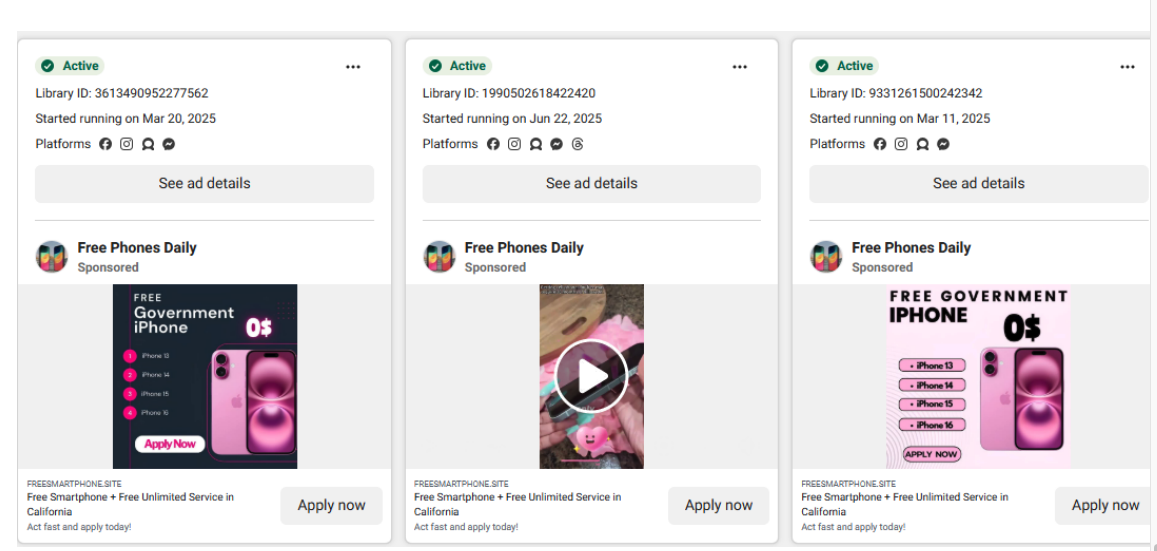
Some of examples of alleged scam ads CFA includes in its lawsuit.
CFA

Meta's advertising practices have been in the spotlight since last year when Reuters reported on internal documents that indicated the company was making billions of dollars from ads promoting scams and banned goods. The report also highlighted how Meta's own processes have at times made it harder for its own employees to fight malicious advertisers.

"Meta claims it is doing all it can to crack down on scam advertising on its platforms," CFA's lawsuit states. "But in reality, Meta has knowingly taken steps and adopted policies that pad its bottom line at the expense of its users’ safety and well-being. In fact, rather than prohibiting advertisers who the company itself has determined pose a higher risk to its users (as other tech companies like Google have), Meta just charges these advertisers more. The perverse result is that the riskier the advertiser, the more money Meta makes."

CFA's allegations "misrepresent the reality of our work and we will fight them," a Meta spokesperson said in a statement. "We aggressively combat scams across our platforms to protect people and businesses — last year alone, we removed over 159 million scam ads, 92% of which we took down before anyone reported them, and took down 10.9 million accounts on Facebook and Instagram associated with criminal scam centers. We fight scams because they are bad for business — people don't want them, advertisers don't want them, and we don't want them either.”

This article originally appeared on Engadget at https://www.engadget.com/social-media/meta-has-misled-users-about-scam-ads-on-facebook-and-instagram-lawsuit-says-193220235.html?src=rss

©

  •  

Amazon allegedly pressured companies to raise product prices with other retailers

Rob Bonta, the Attorney General of California, has released an unredacted copy of a legal document that the state filed in relation to its lawsuit against Amazon, containing details of the company’s alleged price fixing scheme. In it, the state of California accuses the e-commerce company of reaching out to brands and asking them to “fix” the retail prices of their products on competitors’ websites. Due to Amazon’s “overwhelming bargaining leverage” and out of fear of punishment, the brands agree to raise their products’ prices on other retailers like Walmart and Target or to remove them altogether, the filing reads.

California filed an antitrust lawsuit accusing Amazon of price fixing back in 2022. It said the company prevented sellers from offering lower prices on other sites and that vendors risked losing buy buttons and prominent listings if they defied Amazon. In February this year, Bonta filed for a preliminary injunction, asking the court to put a stop to Amazon’s “illegal conduct” while the state’s lawsuit is ongoing and waiting to go to trial next year.

In the unredacted filing, California said that Amazon instructs vendors and brands to increase their prices on other retailers and threatens them with “significant penalties for failure to comply.” State officials gave several examples in the filing, including one incident wherein Amazon allegedly emailed security systems provider Arlo.

The company talked to Arlo about “external price matching,” along with a screenshot of one of its cameras on Walmart, noting that its price of $549.93 “did not go back up.” Arlo reportedly responded that it would get it addressed, and Amazon told the company to “get [it] corrected by EOD.” Afterward, Arlo sent Amazon a screenshot, showing the same Walmart page now listing the camera’s price at $649.99. Amazon ended the conversation by thanking Arlo for its “quick action.” Other samples include Amazon asking Levi’s to “resolve” the lower prices of its khaki pants on Walmart and Hanes to increase the prices of its clothing items on Walmart and Target.

Amazon shrugged off the filing’s release and called California’s case against the company weak. “The Attorney General’s motion is a transparent attempt to distract from the weakness of its case, coming more than three years after filing its complaint and based on supposedly ‘new’ evidence it has had for years,” an Amazon spokesperson told Engadget. “Amazon is consistently identified as America’s lowest-priced online retailer, and we’re proud of the low prices customers find when shopping in our store. Amazon looks forward to responding in court at the appropriate time.”

This article originally appeared on Engadget at https://www.engadget.com/big-tech/amazon-allegedly-pressured-companies-to-raise-product-prices-with-other-retailers-115302642.html?src=rss

©

  •  

Apple could be fined up to $38 billion by Indian antitrust regulator

Apple's refusal to provide financial data to an Indian regulatory agency as part of an antitrust case will culminate in a final hearing on May 21, as first reported by Reuters. According to the Competition Commission of India (CCI), Apple still hasn't submitted information about its financials and its views on an antitrust investigation that started in October 2024.

The case revolves around the CCI accusing Apple of exploiting its dominant position with the App Store, arguing that developers are forced to use Apple's proprietary system for in-app purchases. Apple countered that Android was the more dominant smartphone operating system in India and that iPhones held a smaller market share in India. However, Apple has slowly been gaining momentum with its share of the Indian smartphone market, hitting nine percent in 2025, according to data from Counterpoint Research.

Reuters reported that the latest CCI order said that Apple had plenty of opportunities to file objections or suggestions, but added that the company still hadn't submitted the "requisite financial information," which is used to determine the amount of a potential penalty. Apple argued that the penalties could be up to $38 billion and responded to the order by citing a separate case where the tech giant challenged the country's antitrust penalty law.

It's not the first time Apple has butted heads with the Indian government, as it previously refused to pre-install a state-owned app called Sanchar Saathi onto its smartphones. The Indian government later decided to withdraw its mandate requiring smartphone makers to install the app, but it's much less willing to budge on this antitrust case. According to Reuters, the CCI offered Apple two more weeks to file any responses before the final hearing date next month.

This article originally appeared on Engadget at https://www.engadget.com/big-tech/apple-could-be-fined-up-to-38-billion-by-indian-antitrust-regulator-150821172.html?src=rss

©

© REUTERS / Reuters

The newly launched iPhone 17 series are displayed at an Apple store in New Delhi, India, September 19, 2025. REUTERS/Bhawika Chhabra
  •  
❌