To that end, the earbuds integrate with Razer's proprietary HyperSpeed 2.4GHz streaming platform, which allows for "gaming-grade lag-free" audio. This works with plenty of devices, including smartphones, tablets, PCs, the Steam Deck, the PS5 and more. The earbuds can also connect via Bluetooth for devices that don't support Wi-Fi-based streaming audio.
The charging case includes a dongle that plugs into devices via USB-C, which doubles as a wireless transmitter. Razer promises that users can quickly switch between Wi-Fi and Bluetooth audio, which would be useful when going from a PC to, say, a smartphone to listen to music.
These earbuds include improved ANC, when compared to the previous generation. The battery here lasts for 40 hours, with the earbuds getting 10 hours per charge and the case offering four charges.
Razer
The case can charge via USB-C, which means it charges as the transmitter is being used to stream audio. However, the dongle can also work on its own without the charging case. The earbuds also support THX spatial audio on PCs.
Razer's Hammerhead V3 HyperSpeed gaming earbuds are available right now and cost $130. The almost identically-named Hammerhead V3 X HyperSpeed earbuds run $100 and connect via Bluetooth 5.3 instead of Bluetooth 6.0, with a slightly reduced battery life.
This article originally appeared on Engadget at https://www.engadget.com/audio/headphones/razer-just-released-some-new-gaming-earbuds-with-low-latency-and-fast-switching-between-devices-172907717.html?src=rss
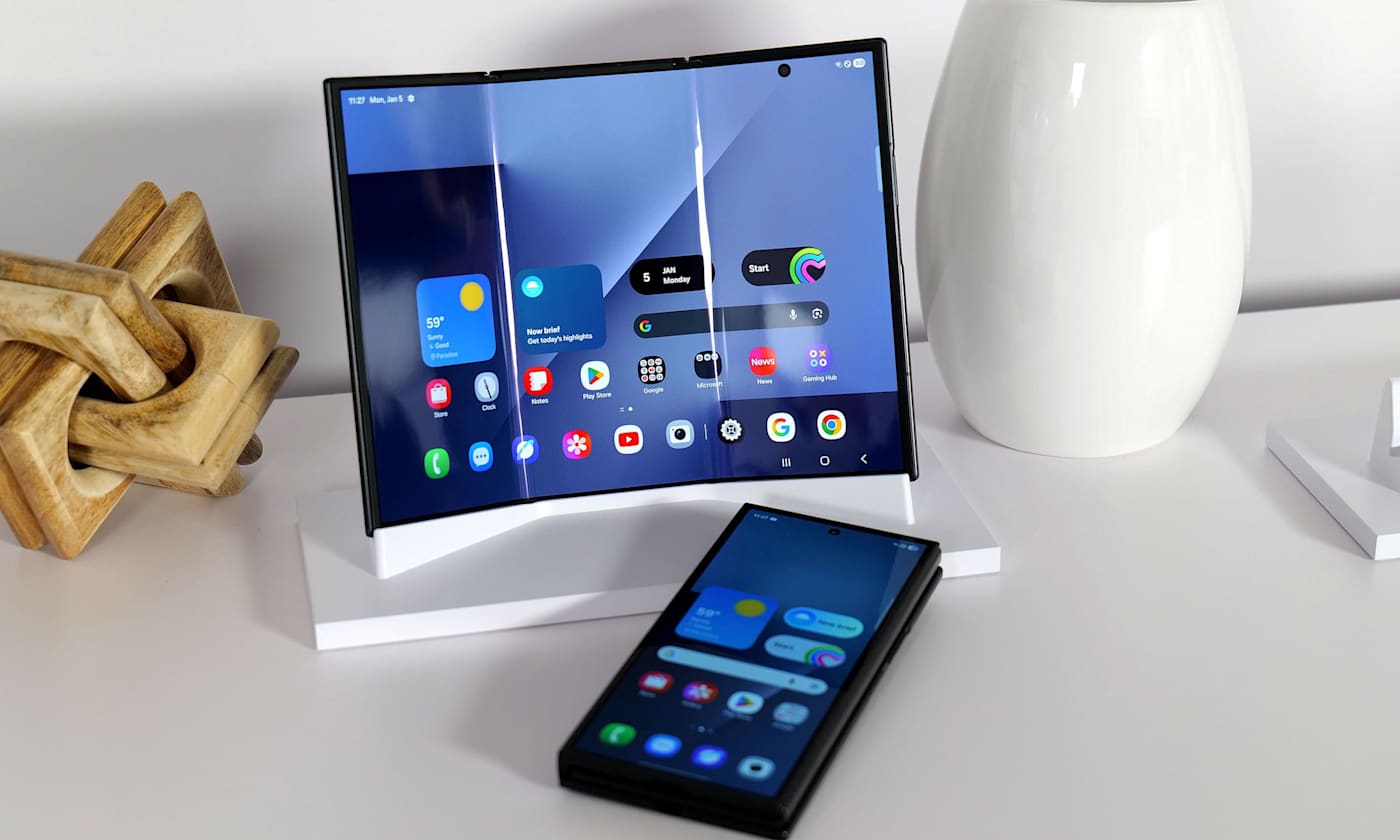
If you missed your chance to pay Samsung $2,900 for a phone earlier this year, we have great news for you. Android Police reported that what may be the final shipment of the Samsung Galaxy Z TriFold will be arriving in the US on April 10. The unique foldable was discontinued a mere three months after it first went on sale, and it seems like Samsung is clearing out whatever inventory it has left. So if you have a spare $3,000 that you're just desperate to get rid of, bookmark the TriFold's page where Samsung has a countdown ticking away.
All jokes aside, our hands-on time with the TriFold at CES 2026 revealed a pretty snazzy device that managed to strike a decent balance between size and heft. But perhaps unsurprisingly for a phone with such an intricate design and high price tag, the company didn't appear to have any intention to make the TriFold widely available. Samsung may have sold out each batch of the smartphone that went to retail, but the device didn't offer much in the way of profit, according to reports in South Korean newspaper Dong-A Ilbo.
This article originally appeared on Engadget at https://www.engadget.com/mobile/smartphones/youll-have-one-more-chance-to-buy-samsungs-pricey-galaxy-z-trifold-this-friday-225222969.html?src=rss
If you’re using an older Kindle, you may want to check what year it was released. Amazon has sent out emails to some of its users, with a warning that it’s discontinuing support for Kindle ereaders and Fire tables released in 2012 or earlier. You can still read books you’ve already downloaded on those devices, but you’ll no longer be able to purchase, borrow or download new ones, starting on May 20, 2026. In addition, if the device has an issue that can only be solved by a factory reset, doing so will brick it. Deregestering it will also render it unusable. On Kindle Fire devices, users won’t be able to purchase or download content anymore, but other services would remain functional.
The affected models include the very first Kindle, Kindle 2, Kindle DX, Kindle Keyboard, Kindle 4, Kindle Touch, Kindle 5 and the first version of Kindle Paperwhite. We’ve asked Amazon why it decided to cut off support for those models, and the company told us: “These models have been supported for at least 14 years — some as long as 18 years — but technology has come a long way in that time…”
Amazon also told Engadget that this only affects approximately 3 percent of its current users, whom it’s now urging to upgrade. In its email, it gives them a promo code for 20 percent off select Kindle devices, as well as ebook credits if they purchase a new model by June 20. “Our newer Kindle devices bring meaningful improvements in screen quality, performance and accessibility — and you'll have access to your complete Kindle library and the Kindle Store,” the company wrote.
Update 04/08/26 8:23AM ET: Added information we received from Amazon.
This article originally appeared on Engadget at https://www.engadget.com/mobile/amazon-is-cutting-off-support-for-older-kindles-115653205.html?src=rss
Insta360, the company best known for its action cameras, just released the Snap selfie screen. It's a small display that connects via USB-C and sits on the back of your phone, helping you to use your rear camera for higher resolution vlogging or selfies.
The 3.5-inch touchscreen allows you to adjust camera settings like zoom and focus and frame your selfies before you take them. The company has also released a model it co-developed with the beauty tech brand AMIRO that offers a built-in light with multiple color temperatures and brightness levels. The standard Snap costs $79.99, while the version with the light runs $89.99.
If you search "selfie screen" on Amazon, you'll see that this isn't a brand-new product space, but you'll also find that the most popular results are wireless screens. Insta360 claims that its USB-C-connected solution offers a more stable and lower latency feed.
The Snap is 6.8mm thick, a hair thinner than an iPhone 17, and attaches magnetically to the back of MagSafe-compatible iPhones. Insta360 says there is an included magnetic ring for other devices and that Snap supports Android phones that offer DisplayPort Alt Mode, a screen-mirroring function. Insta360 says Snap is compatible with all the major third-party camera and social media apps to make capturing and posting easier.
Phones like the iPhone 17 and Galaxy S25 feature rear cameras that offer roughly three to five times the resolution of their front cameras, or in the case of the Galaxy S25 Ultra, about 16 times as much. So, unless smartphone manufacturers start investing more heavily in front-facing cameras, Snap could find a market among creators and social media aficionados.
This article originally appeared on Engadget at https://www.engadget.com/mobile/insta360-releases-usb-c-selfie-screen-its-calling-snap-120001741.html?src=rss
Apple has run into "more issues than expected" with its foldable iPhone that may set back its release, according to Nikkei. The engineering problems reportedly cropped up during the device's early test production phase and may delay first shipments by months, according to multiple sources briefed on the matter. However, a separate report in Bloomberg refutes the gist of Nikkei's claims.
"The current situation could put the mass production timeline at risk," one of Nikkei's sources said. "April will mark a crucial stage of the engineering verification test, and this month till early may is extremely critical." Component suppliers have supposedly been notified that the foldable iPhone's production schedule will be delayed, and Apple is working to address the problems.
In a separate article inBloomberg, however, the usually reliable Apple reporter Mark Gurman wrote that the device is still on track for a September 2026 release. "The company is scheduled to introduce the foldable model in September alongside the iPhone 18 Pro and Pro Max, said the people, who asked not to be identified because the plans haven’t been announced," according to the report.
The complexity of the foldable iPhone's display and other components may "limit initial supply for several weeks," but Apple plans to put it on sale at the same time or shortly after the other non-foldable devices, Gurman wrote. That said, the timing isn't final and issues could still crop up ahead of production. Engadget has reached out to Apple, but so far the company has declined to comment on either the Bloomberg or Nikkei reports.
A foldable iPhone has been rumored since 2017, and Apple's biggest rival, Samsung, released its first one back in 2019. According to multiple sources, Apple was aiming to launch its debut foldable iPhone in fall 2026 alongside the iPhone 18. However, as we detailed in an explainer last month, "the project could slip into 2027 if Apple runs into manufacturing or durability issues, particularly around the hinge or display."
Apple was reportedly prioritizing the foldable iPhone and other premium models for its September event this year due to constrained supplies of components like memory chips. "Apple and the supply chain are working under a pressured timeline and the current solutions are not enough to completely solve the engineering challenge... more time is needed," Nikkei's source stated.
The problems reportedly arose during Apple's production verification tests. That's the fourth of six steps the company's new products must go through before shipping, prior to the key pilot production and mass production phases. Since the foldable would be an all-new design, it would likely need to pass each stage with flying colors before proceeding to the next.
Though likely to account for less than 10 percent of iPhone production, the foldable will be a key product for Apple designed to boost interest in iPhones across its range. Apple reportedly plans to produce seven to eight million of the devices initially, Nikkei reported. Apple has yet to announce the device.
Update April 7, 2026 at 3:02 PM ET: The article has been updated with information from Bloomberg's Mark Gurman stating that the foldable iPhone is still on schedule for a September 2026 launch.
This article originally appeared on Engadget at https://www.engadget.com/mobile/smartphones/apples-foldable-iphone-may-be-delayed-due-to-engineering-snags-073813890.html?src=rss
SHENZHEN, CHINA - MARCH 24: A delivery worker carrying takeout walks while looking at a smartphone past an Apple Store featuring an iPhone 17 advertisement inside a shopping mall on March 24, 2026 in Shenzhen, Guangdong province, China. Apple continues to promote its latest smartphone lineup in China as competition in the consumer electronics market remains intense alongside the growth of app-based delivery services. (Photo by Cheng Xin/Getty Images)

 Anmelden