❌

Lese-Ansicht

SpaceX and Cursor strike partnership that might end in a $60 billion acquisition

SpaceX and AI company Cursor have struck a new partnership that could see the owner of X buy the AI company for $60 billion later this year. "SpaceXAI and  @cursor_ai  are now working closely together to create the world’s best coding and knowledge work AI," SpaceX wrote in a post on X. 

SpaceXAI and @cursor_ai are now working closely together to create the world’s best coding and knowledge work AI.

The combination of Cursor’s leading product and distribution to expert software engineers with SpaceX’s million H100 equivalent Colossus training supercomputer will…

— SpaceX (@SpaceX) April 21, 2026

According to SpaceX, the deal allows for it to either invest $10 billion into the company known for its AI coding tool, or acquire it entirely "later this year" for $60 billion. If an acquisition were to happen, it's not clear at what point Cursor could officially join the fold of Elon Musk's rapidly expanding and increasingly enmeshed web of companies. SpaceX bought xAI, the billionaire's AI company that also controls X, earlier this year. SpaceX is currently getting ready to go public this summer in what will likely be the biggest initial public offering (IPO) in history. 

Cursor, which has reportedly been in talks to raise its own $2 billion round of funding, is known for its AI coding tool of the same name that's become the vibe coding platform of choice for many developers. It allows people to use either its own models or those from other leading AI companies, including OpenAI, Google, Anthropic and xAI.

In a statement, Cursor said its partnership with SpaceX will "accelerate our model training efforts" while addressing infrastructure-related issues that have slowed it down in the past. "We've wanted to push our training efforts much further, but we've been bottlenecked by compute," the company said. "With this partnership, our team will leverage xAI's Colossus infrastructure to dramatically scale up the intelligence of our models for coding and beyond."

This article originally appeared on Engadget at https://www.engadget.com/ai/spacex-and-cursor-strike-partnership-that-might-end-in-a-60-billion-acquisition-232131487.html?src=rss
©
  •  

Meta has misled users about scam ads on Facebook and Instagram, lawsuit says

Meta is facing a new lawsuit over its advertising practices. The nonprofit group Consumer Federation of America (CFA) has filed a proposed class-action suit against Meta for "failing to protect users" from scam ads on Facebook and Instagram. 

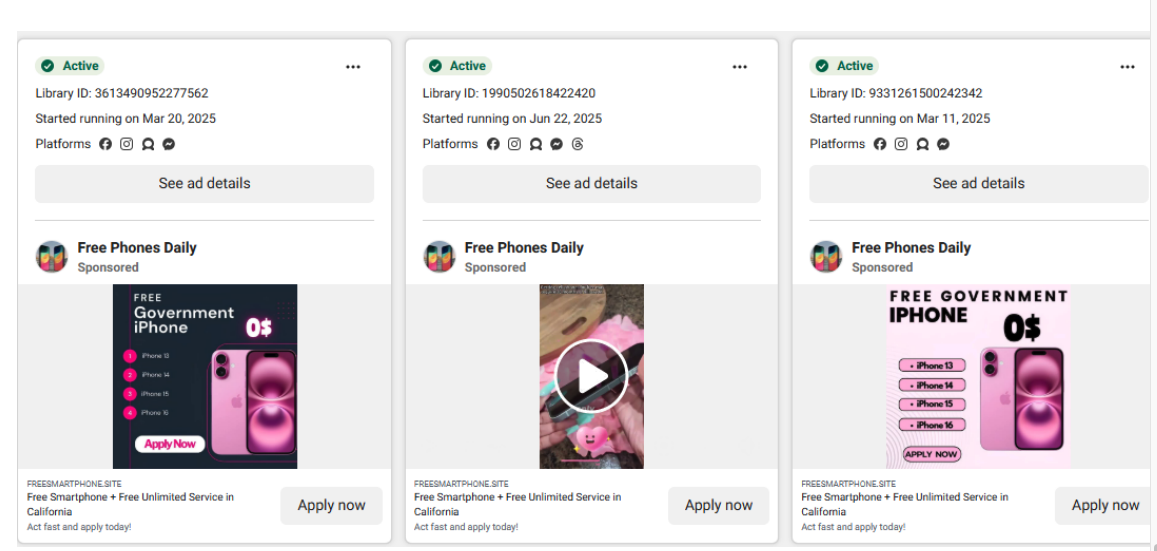
The lawsuit, which was first reported by Wired, alleges that Meta has run afoul of consumer protection laws in Washington D.C. for misleading Facebook and Instagram users about scams on its apps and that the company has "chased profits rather than protecting its users." The filing includes numerous examples of alleged scam ads that CFA says it found in Meta's ad library. These include ads promoting a "free government iPhone," as well as those claiming to offer $1,400 checks to people born in certain years. Many of the ads use AI videos, according to CFA.  

Some of examples of alleged scam ads CFA includes in its lawsuit.
CFA

Meta's advertising practices have been in the spotlight since last year when Reuters reported on internal documents that indicated the company was making billions of dollars from ads promoting scams and banned goods. The report also highlighted how Meta's own processes have at times made it harder for its own employees to fight malicious advertisers.

"Meta claims it is doing all it can to crack down on scam advertising on its platforms," CFA's lawsuit states. "But in reality, Meta has knowingly taken steps and adopted policies that pad its bottom line at the expense of its users’ safety and well-being. In fact, rather than prohibiting advertisers who the company itself has determined pose a higher risk to its users (as other tech companies like Google have), Meta just charges these advertisers more. The perverse result is that the riskier the advertiser, the more money Meta makes."

CFA's allegations "misrepresent the reality of our work and we will fight them," a Meta spokesperson said in a statement. "We aggressively combat scams across our platforms to protect people and businesses — last year alone, we removed over 159 million scam ads, 92% of which we took down before anyone reported them, and took down 10.9 million accounts on Facebook and Instagram associated with criminal scam centers. We fight scams because they are bad for business — people don't want them, advertisers don't want them, and we don't want them either.”

This article originally appeared on Engadget at https://www.engadget.com/social-media/meta-has-misled-users-about-scam-ads-on-facebook-and-instagram-lawsuit-says-193220235.html?src=rss

©

  •  

Mastodon was hit by a 'major' DDoS attack that briefly took down parts of the service

Mastodon seems to be recovering after a Distributed Denial of Service (DDoS) attack that took down its primary mastodon.social instance. As TechCrunch notes, the platform began reporting issues early Monday morning as much of the Mastodon-operated server became inaccessible. 

It's not clear who might be behind the attack, but Mastodon's head of communications Andy Piper described it as a "major" incident. A couple hours later, Mastodon shared on a status page that it had implemented countermeasures and that users should be able to access mastodon.social once again. Piper said that "some ongoing instability is a possibility" as the site recovered. It's unclear if any other instances of the service were also targeted; mastodon.social is run directly by the nonprofit and is the largest server on the federated platform. 

Mastodon is the second decentralized platform to be targeted with a DDoS in recent days. Last week, Bluesky also dealt with a significant DDoS incident that took parts of the service offline for several hours. The company posted what it said was its final update Monday morning, saying that its service had "remained stable" and that there was "no evidence of unauthorized access to private user data." A few hours later, however, it seemed Bluesky was once again experiencing some issues, though the cause was unclear. Its official status page was down, and a post from its server status account indicated that there were "elevated errors and timeouts on some Bluesky-hosted services." Bluesky said it was investigating.

This article originally appeared on Engadget at https://www.engadget.com/social-media/mastodon-was-hit-by-a-major-ddos-attack-that-briefly-took-down-parts-of-the-service-204823221.html?src=rss

©

  •  

LinkedIn's new Crosscheck feature lets premium subscribers test competing AI models for free

You can now use LinkedIn to test out some of the latest AI models from OpenAI, Anthropic, Google, Microsoft and other companies without having to worry about token limits or paying for an extra subscription. The professional network is experimenting with a new feature that allows people to test AI platforms' latest offerings within LinkedIn. 

It’s called Crosscheck, and it's rolling out now to anyone with a LinkedIn Premium subscription in the United States. The feature is meant to be a kind of "blind taste test" for AI models, according to the company's Chief Product Officer Hari Srinivasan. Users start with a prompt and get two answers, each of which is provided by a different model. It's only after choosing which model you like better that you can see the underlying models behind each. 

Srinivasan says that Crosscheck is still an "early product" from LinkedIn Labs and that "there’s work to do to make it faster and add more models and question types." But it already seems to support a fairly wide range of models. In my initial tests of the feature I saw multiple answers generated by Anthropic models, as well as those from Google, MoonshotAI, Mistral and Amazon. Crosscheck will also have its own leaderboard that tracks how people in different industries are rating the various models.

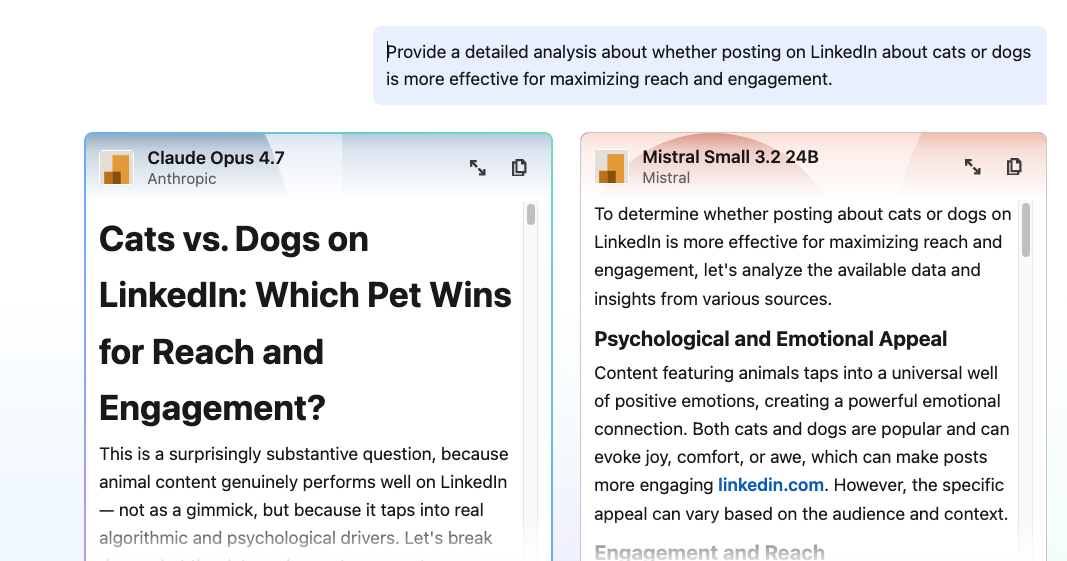
After you choose an answer you like better, LinkedIn will show which model provided each answer.
LinkedIn Screenshot

Crosscheck only supports text-based prompts, so you can't generate images, upload files or use some of the more advanced tools that would be available natively on the AI platforms themselves. But there are no limits on the number of text-based chats you can have, so you don't have to worry about token limits or signing up for a pricey subscription if you find a model that's helpful.

LinkedIn is, however, sharing data back to the respective AI companies who will presumably use information gleaned from LinkedIn usage to improve their products. "Anonymized data is shared with model builders to help them understand how their models are performing amongst different occupations," the company explains. "No personally identifiable information is shared with model builders."

While Crosscheck is initially only available to LinkedIn Premium subscribers in the United States, the company plans to expand the the feature to more countries and free users “soon.”

This article originally appeared on Engadget at https://www.engadget.com/ai/linkedins-crosscheck-feature-lets-premium-subscribers-test-ai-models-for-free-183949210.html?src=rss

©

  •  
❌