Somehow, ZSNES has returned after laying dormant for 20 years. The developers of the iconic Super Nintendo emulator, which originally debuted in 1997 for DOS (something I distinctly remember trying to install on my ancient Intel 486 Packard Bell), are back with a sequel release dubbed Super ZSNES. And really, what else would they call it?
Developers zsKnight and Demosay that Super ZSNES has been rewritten from scratch with a focus on a GPU-powered “Super Enhancement Engine,” which allows for high resolution playback, overclocking (which could help with games notorious for slowdown), widescreen support, uncompressed audio and 3D height maps for Mode 7 graphics. Purists, of course, can turn all of these extra features off if they want.
Super ZSNES is built on “far more accurate CPU and Audio cores” than the original emulator, according to the developers, as well as the usual fast forward/rewind save states and a higher-resolution version of the original ZSNES UI. And as a cherry on top, they promise there’s “No Vibe Coding.”
There’s no shortage of SNES emulators out there today, but it warms my gaming heart to see ZSNES completely revived. And while I still need to play with its enhancement features to truly judge them, the early footage from Modern Vintage Gamer looks very sharp without losing the SNES charm. There’s no replacement for playing the original console on a CRT, but the GPU upgrades in Super ZSNES seem to do a great job of modernizing classic games like Super Mario World for modern displays.
Super ZSNES is currently available as an early build for Windows, Mac and Android. An iOS release is coming soon, according to the emulator’s website.
This article originally appeared on Engadget at https://www.engadget.com/gaming/nintendo/the-sequel-to-the-iconic-emulator-zsnes-is-called-super-zsnes-of-course-135203417.html?src=rss
John Ternus was unavoidable when Apple debuted the Macbook Neo. He kicked off an intimate media event for the Neo, introducing it as a transformative machine for Apple thanks to its low $599 cost ($499 for education customers) and premium build quality. He was interviewed on Good Morning America, the sort of prominent media feature CEO Tim Cook typically handles. And when I asked Apple workers about the Neo at its launch event, they almost always brought up Ternus’ vision of the laptop.
For all intents and purposes, Ternus was Apple’s frontman for the MacBook Neo.
Ternus is slated for his coronation as Apple's CEO on September 1, and the Neo is not only a feather in his cap, but a likely indication of the company's approach to products going forward. It’s a sign that Apple is getting more comfortable taking risks.
Apple lives and dies on its own premium image. It completely gave up on making cheap iPhones like the SE and 5C, and the $599 iPhone 16e and 17e are more expensive than typical mid-range Android phones (though the $249 Apple Watch SE is admittedly one of the cheaper smartwatches around.). It was risky to shove a mobile processor into a full-fledged computer, which could have made it too weak. And it was a gamble to stick with a meager 8GB of RAM, practically sacrilegious within the Apple pantheon. It's not breaking new ground for product categories, but the Neo, in being a budget laptop at all, is surprisingly un-Apple.
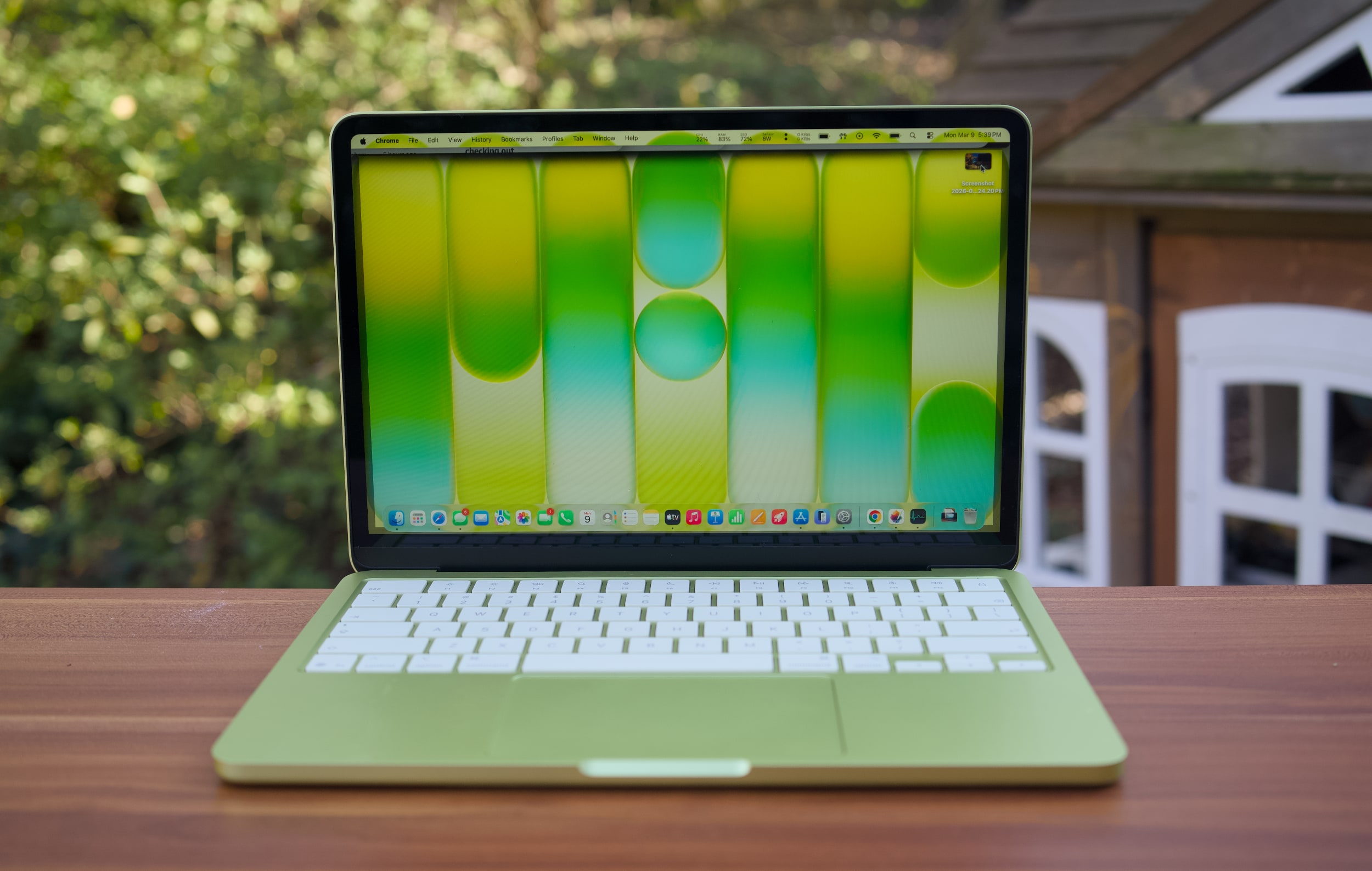
A citrus MacBook Neo on a table outside.
Devindra Hardawar for Engadget
And yet, thanks to Ternus's hardware leadership and Apple's command of its software, the MacBook Neo has been a resounding success. It has the best build quality, screen, keyboard, speakers and trackpad that I've ever seen in a $600 laptop. As I wrote in my review, "every Windows PC maker, including Microsoft, should be ashamed."
While we don’t know the full build cost for the Neo, Apple’s margins for selling it will undoubtedly be far slimmer than the MacBook Air or Pro. But the Neo is more than a profit maker. It’s a device that can serve as a gateway to the Apple ecosystem for kids and students. Even better, it could easily tempt over Windows users.
We can't give Ternus all the credit for the Neo, of course, there's an entire team of product managers and engineers below him doing the actual design work. But it's hard to deny the flex of building a $600 laptop that doesn't feel like total garbage. The MacBook Neo surprised me, a jaded technology reporter, on practically every level. And its existence makes me wonder how a Ternus-led Apple could continue to iterate without compromising quality or Apple's signature attention to detail.
Ternus is the rare Apple engineer who has played a role in almost all of its existing products — in his 25 year tenure, he’s taken charge of building the Mac, iPad, iPhone and Apple Watch. That gives him a unique perspective of where the company could go next, as well as how Apple could stretch its own capabilities. And based on what I’ve seen of the MacBook Neo, it’ll be interesting to see how Apple reshapes itself for the future.
This article originally appeared on Engadget at https://www.engadget.com/computing/laptops/the-macbook-neo-is-a-glimpse-into-john-ternuss-apple-170000842.html?src=rss
The Apple rumors were true, once again. This week, the company announced that Tim Cook will be stepping down from his CEO role on September 1. Replacing him will be John Ternus, who currently serves as Apple's SVP of hardware engineering. In this episode, Devindra and Engadget's Nathan Ingraham discuss Cook's legacy as Apple's CEO, and pontificate about how Ternus may change things. We're going from Apple being led by a logistics guru, to Apple being driven by a product and engineering wizard. Surely, that will have some impact on future products.
Tim Cook to step down as Apple CEO after 15 years, John Ternus will take his place on September 1 – 1:22
Palantir woke up last Saturday morning and posted a comic book villain manifesto on X – 26:01
DHS wants to make facial recognition smart glasses for ICE – 31:53
A lot of people panic bought PCs to avoid RAMageddon – 36:25
Meta faces a new lawsuit over running ads for outright scams –
Employees at Meta will have they keystrokes and mouse moves recorded for AI training – 40:10
Xbox Game Pass Ultimate price goes down, but it won’t include Call of Duty – 44:55
Around Engadget: a great (expensive) Dyson vac with a silly name – 49:15
Working on – 51:58
Pop culture picks – 52:55
Credits
Hosts : Devindra Hardawar and Nathan Ingraham Producer: Ben Ellman Music: Dale North and Terrence O’Brien
This article originally appeared on Engadget at https://www.engadget.com/computing/engadget-podcast-tim-cooks-apple-era-and-what-lies-ahead-for-john-ternus-121853488.html?src=rss
The single most impressive piece of technology I saw at CES this year was LG’s revamped Wallpaper TV, AKA the OLED evo w6. It’s about as thin as a typical pencil, it’s completely wireless and it packs in all of LG’s latest OLED technology, giving it incredibly rich colors and anti-reflective capabilities. We ended up giving the Wallpaper set our best TV of CES 2026 award, simply because it looked so damn good. Now, we finally know how much it costs: LG announced the 77-inch evo w6 will go for $5,500, while the 83-inch model will sell for $7,500.
Both sets are a $1,000 premium over the OLED evo G6 models, which are LG’s highest-end TVs without the company’s super-thin Wallpaper tech. While the thicker sets are obviously a better deal, there’s still something inherently impressive about the Wallpaper models. For many people, the simple “wow factor” of the evo W6’s design will be worth the extra $1,000.
If that all sounds too rich for your blood, LG’s mainstream OLED sets are far cheaper, starting at $1,399 for the 43-inch C6 set. And if you don’t need the latest OLED panels around, it’s worth keeping an eye out for deals around older models. I’ve seen 65-inch C5 sets for near $1,000, and 77-inch TVs for around $1,500. Those older sets will be a bit less bright, and probably show more reflections, but in a dim room they’ll still have all the benefits of OLED: Incredibly high contrast, and ridiculously dark black levels.
This article originally appeared on Engadget at https://www.engadget.com/general/lgs-super-thin-wallpaper-oled-tv-starts-at-5500-163415130.html?src=rss
Apple CEO Tim Cook is officially stepping down from his role on September 1, the company announced today, while current SVP of hardware engineering John Ternus will take over as the new CEO. Cook will transition to a new role as executive chairman of Apple’s Board of Directors. The company says the move was “approved unanimously” by Apple’s Board, and that Cook will work on transitioning his duties over the summer.
“It has been the greatest privilege of my life to be the CEO of Apple and to have been trusted to lead such an extraordinary company,” Cook said in a statement. “I love Apple with all of my being, and I am so grateful to have had the opportunity to work with a team of such ingenious, innovative, creative, and deeply caring people who have been unwavering in their dedication to enriching the lives of our customers and creating the best products and services in the world.”
Cook became CEO of Apple in 2011 following the death of co-founder Steve Jobs, and he led the charge for Apple’s post-iPhone and iPad era by launching the AirPods, Apple Watch and Vision Pro. He also pushed the company into being more of a service provider with the launch of Apple TV and Apple Music. While he’s had a strong reputation as a logistics-oriented executive, Cook has been criticized for lacking the product vision that Jobs was known for.
Ternus, on the other hand, has been focused on product design since joining Apple in 2001. He became VP of hardware engineering in 2013, and later transitioned to a senior executive role in 2021. Ternus was also prominently featured at the MacBook Neo launch a few months ago, where Apple announced a low-cost yet high-quality notebook that encapsulates its unique place in the PC industry.
“I am profoundly grateful for this opportunity to carry Apple’s mission forward,” Ternus said in a statement. “Having spent almost my entire career at Apple, I have been lucky to have worked under Steve Jobs and to have had Tim Cook as my mentor. It has been a privilege to help shape the products and experiences that have changed so much of how we interact with the world and with one another.”
Cook published a community letter timed for the announcement, which we’ve included below:
To the Apple community:
For the past 15 years I’ve started just about every morning the same way. I open my email and I read notes I received the day before from Apple’s users all over the world.
You share little pieces of your lives with me and tell me things you want me to know about how Apple has touched you. About the moment your mom was saved by her Apple Watch. About the perfect selfie you captured at the summit of a mountain that seemed impossible to climb. You thank me for the ways Mac has changed what you can do at work and sometimes give me a hard time because something you care about isn’t working like it should.
In every one of those emails I feel the beating heart of our shared humanity. I feel a sense of deepening obligation to work harder and push further. But most of all, I feel a gratitude that I cannot put into words, that I somehow got to be the person on the other end of those emails, the leader of a company that ignites imaginations and enriches lives in such profound ways it defies description. What an honor and a privilege it has been.
Today we announced that I’m taking the next step in my journey at Apple. Over the coming months I will be transitioning into a new role, leaving the CEO job behind in September and becoming Apple’s executive chairman. A new person will be stepping into what I know in my heart is the best job in the world. That leader is John Ternus, a brilliant engineer and thinker who has spent the past 25 years building the Apple products our users love so much, obsessed with every detail, focused on every possible way we can make something better, bolder, more beautiful, and more meaningful. He is the perfect person for the job.
John cares so much about who we are at Apple, what we do at Apple, who we reach at Apple, and he has the heart and character to lead with extraordinary integrity. I am so proud to call him Apple’s next CEO. This company will reach such incredible heights under his leadership, and you will feel his impact in every bit of delight and discovery that grows out of the products and services to come. I can’t wait for you to get to know him like I do.
This is not goodbye. But at this moment of transition, I wanted to take the opportunity to say thank you. Not on behalf of the company, this time, though there is a wellspring of gratitude for you that overflows inside our walls. But simply on behalf of me. Tim. A person who grew up in a rural place in a different time and, for these magical moments, got to be the CEO of the greatest company in the world. Thank you for the confidence and kindness you’ve shown me. Thank you for saying hi to me on the street and in our stores. Thank you for cheering alongside me when we unveiled a new product or service. Thank you, most of all, for believing in me to lead the company that has always put you at the center of our work. Every day we get up and think about what we can do to make your life a little bit better. And every day, you’ve made mine the best I could have asked for.
Thank you.
Meanwhile, the newly named chief hardware officer, Johny Srouji, reportedly told employees that his division’s staff members will be divided to work on five key areas. According to Bloomberg, staffers working on hardware will be organized into hardware engineering, silicon, advanced technologies, platform architecture and project management teams. Apple reportedly plans to add thousands of employees to work on its iPhones, iPads, Macs, Watches and other products, as well.
Update, April 21, 2026, 8:05AM ET: This story has been updated to add information about the hardware team’s new structure.
This article originally appeared on Engadget at https://www.engadget.com/computing/tim-cook-will-step-down-as-204959434.html?src=rss
Director Jon Favreau (Iron Man, The Jungle Book) hasn't been shy about embracing new technology for filmmaking. While producing The Mandalorian for Disney+, he was one of the first filmmakers to use ILM's massive LED screens, AKA "The Volume," to produce more realistic lighting and backgrounds on studio sets. For the feature film The Mandalorian and Grogu, which hits theaters May 22, Favreau recently revealed that he had Disney build an Apple Vision Pro app to preview its full IMAX scope during filming.
"So I'm making an IMAX movie, and I'm looking at a TV screen, and no matter how big your TV screen is it's not an IMAX screen," Favreau said in a recent episode of The Town podcast. "We built software so that I can pop on my Apple Vision Pro and be sitting in an IMAX movie theater and see the full aspect ratio when we're lining a shot up. And I can watch that take and see what people will see."
Favreau isn't the first director to use the Apple Vision Pro — Wicked filmmaker Jon Chu also used it to handle post-production work — but he's the first to specifically mention using the headset for IMAX production. That's still a relatively limited use case for the Apple Vision Pro, but it's one that could be useful to future filmmakers. With its large field of view and sharp micro-OLED screens, the Apple Vision Pro is one of the only ways to replicate the experience of watching a large IMAX screen at home. (The Meta Quest 3 comes in as a close second.)
In general, Favreau says he's more excited about using existing consumer technology in the filmmaking process than AI. He mentions using the Unreal Engine to previsualize special effects on The Mandalorian and his previous films, and he believes the quality from game engines could be good enough to make it into final productions down the line.
"This is what the animation industry has understood from the beginning," he said. "Get it right before you ever paint a cel."
This article originally appeared on Engadget at https://www.engadget.com/entertainment/tv-movies/the-mandalorian-and-grogu-director-used-apple-vision-pro-to-preview-the-film-in-imax-140331311.html?src=rss
The rules of Exit 8, both the cult indie game and the recent film adaptation, are simple: You're stuck in a subway station that loops around endlessly. If you notice any anomalies on your current loop, you turn around. If everything is the same, you keep going forward. Each successful guess takes you to a new entrance where the loop recurs, until you reach the end of the labyrinth, Exit 8 itself.
It's a setup that perfectly suits a first-person video game, where you can fully control where your character looks and moves. And it's also something director Genki Kawamura deftly replicates in the film through long tracking shots and sweeping camera movements. Even without a controller, or a keyboard and mouse, the viewer remains immersed, looking and listening for any minor changes. Within just a few minutes, the film makes it clear it's not just another thoughtless video game adaptation like The Mario Galaxy Movie — it's an attempt to translate the experience of the game to an entirely new medium.
That's a daunting challenge for most artists, but Kawamura is no stranger to jumping between formats. He's known for producing popular anime films from the likes of Makoto Shinkai and Mamoru Hosoda, including Your Name and Belle. He's also made a name for himself as a best-selling author, with books including the novelization of Exit 8.
Kawamura's perspective for the film came from a conversation with Nintendo's legendary game designer Shigeru Miyamoto, who had mentioned that the greatest games are both fun for the players and people watching them. "So what I tried to do in the film is to really place the audience in the shoes of the player in certain shots... almost like they were watching a live stream of a video game in other scenes," he said in an interview with Engadget (via a translator). "That's kind of structurally the through-line of the film."
The Exit 8 adaptation balances that sense of immersion with a more traditional narrative structure, something the game lacked entirely. As the film begins, we're introduced to a young man standing in a crowded train. A drunken businessman shouts at a mother to quiet crying baby down. Instead of telling the belligerent salaryman to fuck off, the young man plugs in his earbuds and tries to ignore the situation, just like everyone else. He eventually steps off, while the tearful mother suffers through the verbal assault.
It's a scene that anyone who's lived in a crowded city can relate to — the moments where you know you should try to help a stranger, but fear, cowardice or embarrassment hold you back.
Exit 8
NEON
Shortly after receiving a call from his ex-girlfriend, who reveals that she's pregnant, the young man stumbles into the Exit 8 loop. At first, it's just a normal subway station, with large poster ads, a photo booth and random maintenance doors. But he quickly notices that the room repeats itself. Thanks to a helpful set of instructions on the wall, he learns that his only way out is to start tracking anomalies, like slight changes in text, or the way a robotic businessman walks past him. And yes, things get freaky quickly.
Kawamura points to his experience working in animation as a major influence for Exit 8. In particular, the works of Satoshi Kon and Katsuhiro Otomo influenced how he externalized what characters were thinking and feeling, as well as how he depicted the interaction of dream and real worlds.
" When we were filming, I told my DP [director of photography] that the main character of this film is the corridor," he said. "And all of our human characters, they have no names, so therefore they're NPCs in this corridor, which is the main character. So I wanted the corridor to almost evoke this feeling in the audience that it has a will of its own. And this yellow Exit 8 sign is almost like this divine God-like being."
Kawamura says he personally views it as the corridor challenging humans who have a guilty conscience, but you can easily read in other meanings. More importantly, Exit 8 isn't merely a faithful recreation of the source material — it adds enough to make a case for existing a separate medium, a challenge many video game adaptations fumble.
This article originally appeared on Engadget at https://www.engadget.com/entertainment/tv-movies/exit-8-is-cinema-for-the-livestreaming-era-151112907.html?src=rss
So a shoe company turned into an AI company…. That’s it, that’s the joke. In this episode, Devindra chats with Engadget’s Daniel Cooper about Allbirds’ sudden transformation and what it says about the AI economy. Also, they chat about the Artemis II moon mission, Meta being warned about the dangers of facial recognition (again) and how teens think social media is really shaping them.
If you're feeling anxious about AI and what it means for the future of humanity, you should watch The AI Doc: Or, How I Became an Apocaloptimist. As I noted in my review, the film aims to deliver some clarity amid all the hype. Now that it's in theaters, we sat down with director Daniel Roher, who won an Oscar for his film Navalny, to dive deeper into his complicated feelings around AI.
The entire topic made him nervous, Roher said, so he decided to team up with similarly anxious colleagues to demystify AI using film. He describes the goal of the project to be a sort of "first date" with AI, a way to hear about its potential benefits from AI boosters, while also taking in the many negatives brought up by critics. It’s probably too late to stop AI entirely, but he thinks we can at least try to find ways to limit the worst impulses of the tech industry.
"I wanted to make this movie because I was scared shitless, that's the crux of it," he said in an interview on the Engadget Podcast. "I didn't understand what AI was. I didn't understand why everyone was talking about it and why it seemed to be this thing that came outta the woodwork and all of a sudden, people were talking about it like it was the apocalypse or like it was gonna be the most optimistic, greatest thing ever."
Ultimately, Roher arrived at the term “apocaloptimist,” which balances the contradictory ideas that AI can both seriously harm society, and that we can still shape the future by criticizing or outright rejecting it. "It's a worldview. It's choosing not to buy into a binary that's asking us to see this as either apocalypse and the end of the world, or through the rose-colored glasses of unvarnished optimism, which is also sort of a fallacy," he said.
On the one hand, he's well aware the major players pushing AI are, at best, flawed. When I mentioned Marc Andreessen’s recent comments about proudly having no inner thoughts, Roher added,” They're just fucking weird. They're just nerds who became billionaires because they were born at the right time and they had the right interests. They're brilliant in their own way and they have abilities, but they don't understand what it is to exist. They don’t know what real human beings navigate and go through.They have a very narrow worldview that's callous and cold and calculated.”
For many, the overnight ubiquity of this largely untested technology and the collective wealth and power of those supporting it means rampant negative externalities are all but guaranteed. But Roher's apocaloptimism (we'll see if the term quite catches on) chafes against cynicism and doomsaying. He points to OpenAI’s Sora video generation app, which was heavily criticized as a tool that could lead to more realistic deepfakes, but was unceremoniously killed last week.
"I think people were [made] uncomfortable by it, and good,” Roher said. “And, shame on OpenAI for releasing this thing without any thoughtfulness. I guess the low bar of like, at least they had the decency to pull back and retract it, but only after public condemnation." He added, "to the cynical people saying we're all fucked, I'm like, no fuck you, we're not. Collective action matters.”
And notably, the entire goal is to think more deeply about the uses of technology than the people actually creating it. "These guys, when you actually sit down with them, they don't have clarity, they can't make you feel better. They don't know themselves. They're just motivated by the unbridled optimism of the greatest profit-making technology in the history of humanity. "
This article originally appeared on Engadget at https://www.engadget.com/entertainment/tv-movies/the-ai-docs-director-was-scared-shitless-by-ai-so-he-made-a-movie-about-it-145747961.html?src=rss
Against all odds, A24’s adaptation of The Backrooms actually looks like a proper elevated horror movie. Hell, it’s even got Oscar winner Chiwetel Ejiofor (12 Years a Slave, Serenity) and Cannes favorite Renate Reinsve (Sentimental Value) onboard. Judging from the film’s fist trailer, which combines The Backrooms creepypasta-born dread around liminal spaces, and A24’s slick horror aesthetic, you couldn’t tell that its director can’t even legally drink in the US yet. Yes folks, Kane Parsons is just 20.
Parsons, AKA Kane Pixels, made a splash four years ago with his original Backrooms shorts, the first of which has amassed over 73 million views on YouTube. Those were relatively simple episodes created in Blender, but they did an admirable job of feeling genuinely creepy. More recently, Parsons has also dabbled in horror shorts with his series The Oldest View.
While Parsons certainly has a ton of internet clout behind him, he also has a strong eye for slow-burn horror. This trailer alone is making me feel uneasy about heading into my dimly lit basement office. He also won’t be the first internet creator to reach cinemas this year. Markiplier’s adaptation of the indie game Iron Lung was particularly notable, since he funded both the production and theatrical distribution on his own.
The Backrooms joins Genki Kawamura’s adaptation of the game Exit 8 as another new horror film about spooky liminal spaces. It’ll be interesting to see how the two compare. The former started as 4chan stories and images around eerily empty buildings, while the latter was a game where you slowly walked through a repetitive Tokyo subway. There’s more room for Parsons to turn The Backrooms into a narrative of his own, whereas Exit 8 is somewhat restricted by the original game.
This article originally appeared on Engadget at https://www.engadget.com/entertainment/tv-movies/the-backrooms-trailer-combines-creepypasta-dread-and-a24-prestige-horror-213602238.html?src=rss
It's hard not to find the premise of Andy Weir's Project Hail Mary instantly compelling: Something is slowly killing the sun and threatening life on Earth. That same mysterious force, dubbed the Astrophage, also destroyed every nearby star — except one. Our only hope is to visit that solar system and figure out what helped it survive. And there's just one middle school science teacher who can do it.
At its core is Weir's love of technical problem solving, along with a tremendous performance by Ryan Gosling in full nerd hero mode as the aforementioned science teacher (and former molecular biologist). It's the sort of sweeping sci-fi epic that will make a whole generation of kids ready to science the shit out of humanity's future problems. And maybe it'll remind clueless adults that we gain much more by working together to solve global issues, instead of being purely self-interested.
The film starts with Gosling's character, Ryland Grace, waking up from an induced coma with no memory. He's shocked to find that he's light years away from Earth, and that the other two members of his crew are already dead. As he gets his bearings, he recalls that he was sent on a last-ditch mission, Project Hail Mary, to save the sun and everyone on Earth. No pressure! These early moments make it clear that screenwriter Drew Goddard (who also adapted The Martian), as well as directors Phil Lord and Chris Miller, can deftly juggle comedy alongside the inherent drama in the story.
There's something genuinely moving about the mission. With about 30 years before the planet is faced with a global cooling event likely ending in mass starvation, Earth's major political powers put aside their differences and deliver their finest scientific minds to come up with a solution. You can really take your pick with real-world parallels, like the impending climate crisis, or the increasing threat of nuclear war. Simply seeing the world work together feels meaningful in these bleak times. And unlike other space disaster films like Armageddon and Interstellar, cooperation, rather than NASA alone, is the only way forward.
Ryan Gosling in Project Hail Mary.
Jonathan Olley for Amazon
Sure, humanity's hope for survival ultimately falls on the shoulders of one of the most attractive white men on (or in this case, off) the planet, but you know, movies. It's also not a spoiler to say that Grace isn't entirely alone on his journey. As already revealed by the film's trailers and a ton of social media clips, he's also joined by a crab-like being made of rock, which he simply calls Rocky. They eventually learn to communicate, and it's revealed that Rocky is also on a mission to save their own home planet.
While we get brief glimpses of life on Earth, and the planning of Project Hail Mary, for the vast majority of the film we're just left with Grace figuring things together with a rock alien. And yet, the film never drags. It's a testament to Gosling's inherent charm, but he also demonstrates an incredible ability to shift from joy and goofiness, to sheer terror, to leading-man heroics on a dime. It's also hard to take your eyes off of Rocky, who is rendered with a loving mixture of practical puppetry and CG. We've never seen a creature like them before – one that, despite having no eyes or mouth, manages to connect with viewers mostly through their very expressive arms.
Ryan Gosling in Project Hail Mary.
Jonathan Olley for Amazon
Project Hail Mary is ultimately a work of pulp sci-fi as told by an author who loves deeply nerdy technical solutions, as well as a writer and directors who know precisely what makes a great blockbuster tick. But the notion that humanity can collectively come together to do the impossible always tugs at my heartstrings a bit. And yes, there’s the power of friendship, too. In this moment, when things seem particularly bleak, these ideas seem especially meaningful.
This article originally appeared on Engadget at https://www.engadget.com/entertainment/tv-movies/project-hail-mary-could-teach-humanity-a-thing-or-two-154327806.html?src=rss
NVIDIA started an online firestorm this week when it announced DLSS 5 at its GTC conference. The company claims it's meant to deliver "photorealistic" lighting and materials in games by using neural processing. But it differs considerably from previous versions of DLSS, which were focused on using machine learning to upscale lower resolutions and generate additional frames, and gamers online aren’t too happy. To help us break this down, Anshel Sag, VP and principal analyst at Moor Insights and Strategy joins us to discuss his experience with NVIDIA's DLSS 5 demos. Also, we dive into what's next for Xbox with Project Helix.
NVIDIA announced DLSS 5, the disgust was immediate (with Anshel Sag from Moor Insights & Strategy) – 0:51
Arizona attorney general sues Kalshi for operating an illegal gambling business – 36:22
Polymarket users threaten the life of a reporter at The Times of Israel over accurate reporting – 36:59
Apple announces AirPods Max 2 with improved noise cancellation – 44:33
Elon Musk’s xAI faces class action suit over facilitating CSAM dsitribution – 47:38
Samsung stops selling Galaxy Z TriFold after 3 months because components got too expensive – 51:22
Around Engadget: Apple Studio XDR review, Dell XPS 16 review – 53:49.346
Listener Mail: Stick with iPhone on Linux? And are there any good Android tablets? – 55:41
Pop culture picks – 58:46
Credits
Hosts: Devindra Hardawar Guest: Anshel Sag Producer: Ben Ellman Music: Dale North and Terrence O’Brien
This article originally appeared on Engadget at https://www.engadget.com/gaming/pc/engadget-podcast-why-does-everyone-hate-nvidias-dlss-5-ai-upscaling-121335918.html?src=rss
You can sum up the gamer response to NVIDIA's DLSS 5 announcement with the ever-relevant Fallout 4 meme: "Everyone disliked that." Across social media and Reddit last night, I couldn't find anyone who's genuinely positive about the potential for DLSS 5, which uses AI to add "photorealistic" lighting and materials to in-game models and environments. Instead, it's mostly complaints about the feature being another avenue for AI slop. And you know what? I agree.
It's not unusual to see gamers being reflexively angry about new technology on the internet, especially when it's being pitched by NVIDIA as the “biggest breakthrough in computer graphics” since its RTX 20-series GPUs arrived in 2018 with real-time ray tracing. There was plenty of suspicion around DLSS's original AI upscaling model, as well as the "fake" frames generated by later iterations. But the few demos we've seen of DLSS 5 basically look like "yassified" AI filters for popular games.
Leon and Grace from Resident Evil: Requiem have more distinct facial and hair detail, but they look a bit too slick. There are more wrinkles on an old woman in Hogwarts Legacy. And the face, hair and clothing from a Starfield character gain an uncanny sheen.
None of the demos have the immediate impact of the Star Wars real-time ray tracing short ILMxLab produced with NVIDIA seven years ago. That demonstration showed us glorious reflections and lighting effects we'd never seen before in real-time. The DLSS 5 demos, on the other hand, don't look much different from the AI filters that make you look more presentable for Zoom calls. There's no genuine excitement for DLSS 5, just NVIDIA telling us that it's groundbreaking.
There's also plenty of concern about DLSS 5 straying from an artist's original intent, as well as a potential homogenization of game visuals if every developer starts using the feature. NVIDIA claims developers will have "detailed controls for intensity, color grading and masking," which will help DLSS 5 stay in line with a game's aesthetic. But we don't have any direct developer experience with the feature yet — some artists may want far more control than NVIDIA wants to give.
The difference between DLSS 5 and earlier versions NVIDIA's upscaling is like the difference between generative AI and more traditional machine learning models. NVIDIA relied on the latter to make low-resolution textures and models appear sharper, and later to insert generated frames to smooth out gameplay and raise your fps count. As Wirecutter and former Polygon editor Arthur Gies points out, you could argue those features were in service of delivering what developers originally intended. But DLSS 5's neural model applies its concept of "photorealism" on top of what games are rendering -- it's like watching a Pixar movie that let OpenAI's Sora do a final visual pass.
Part of the negative response towards DLSS 5 may stem from a widespread anti-gen AI sentiment, but that doesn’t devalue the criticisms either. Similar to AI generated text, images and video, there’s a dehumanizing aspect about DLSS 5. It can erase the work of human artists (despite how much control NVIDIA claims they have), and it also feels like a calculated attempt to appeal to gamers who just want shinier graphics. NVIDIA showed off how generative AI could be used to create dialog and voices for NPCs last year at CES, but that was also widely disliked (and I called it a genuine nightmare).
Of course, I can’t fully judge DLSS 5 until I see it in action beyond a short demo. But I think the visceral disgust is an important indicator that many gamers aren’t onboard with the AI-powered future NVIDIA is trying to sell us. And perhaps the idea of chasing “photorealism” may be a bit of a fool’s errand. It may be appropriate for some games, but as Nintendo and indie PC devs have shown, you can also make some of the best games of all time without striving for realism. Tears of the Kingdom could use a better framerate and higher resolution textures, but it certainly doesn’t need DLSS 5.
This article originally appeared on Engadget at https://www.engadget.com/gaming/pc/gamers-are-right-to-be-disgusted-by-nvidias-dlss-5-151105593.html?src=rss
 Anmelden