
❌

Lese-Ansicht

Acme Weather: „We’re launching in Europe!“
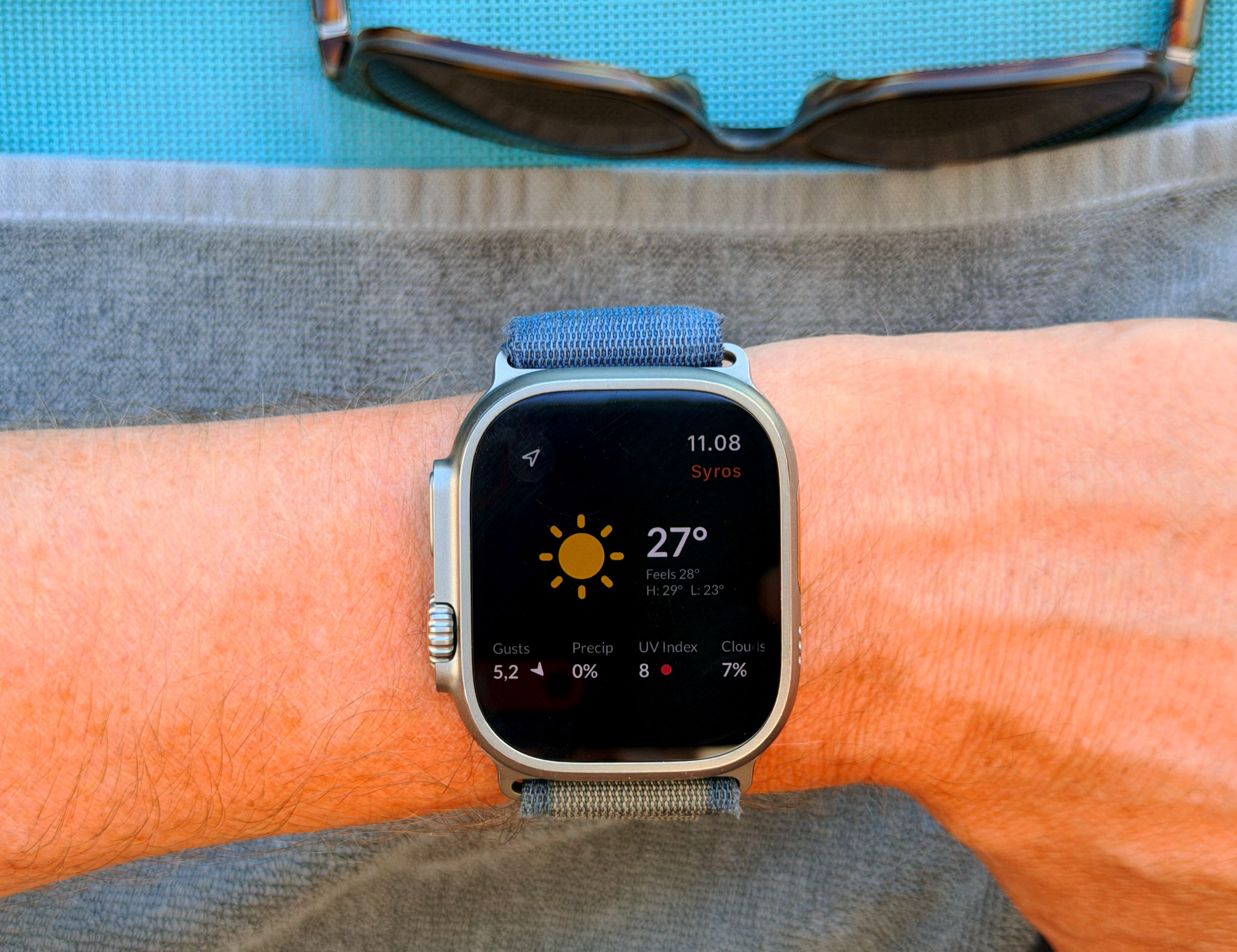
Eine Nahaufnahme einer Apple Watch Ultra am Handgelenk einer Person, die eine Wetter-App mit einer Temperatur von 27 Grad Celsius anzeigt, während das Handgelenk auf einem grauen Handtuch ruht und im Hintergrund eine Sonnenbrille zu sehen ist.

Dark Sky hinterließ bei mir einen bleibenden Eindruck, als ich im Jahr 2014 in New York die tatsächlich minutengenaue Regenvorhersage erlebte.

It’s one of the questions we heard most often at Dark Sky. Back then we had limited access to high quality or affordable data that would allow us to provide hyperlocal precipitation forecasts. This meant Dark Sky was only available in the US, Canada, UK and Ireland. That’s changed, and Acme is now available in the App Store in Europe. Pricing is the same as North America. It’s a two-week free trial then $25 USD/year.

For existing subscribers, you’ll now receive next hour rain notifications and forecasts in Europe just like you do in the United States and Canada.

acmeweather.com/blog

Nach sechs Jahren unter Apples Schirmherrschaft probieren sie die Eigenständigkeit noch einmal – inklusive Europa.

When you open the app, you are presented with the weather “Right Now,” the forecast for the “Next 24 Hours,” and the forecast for the “Next 10 Days”; each is listed under a bold text banner that resembles a print newspaper headline. The twenty-four-hour temperature forecast is shown as a fluctuating black line tagged with icons denoting the weather every three hours. Crucially, though, there are alternate forecasts that appear in the form of paler gray lines; sometimes the gray lines hew closely to the main black one; other times they stray considerably, indicating that the predictions are less reliable during that window. As Grossman put it to me, “Climate change is causing an increase in uncertainty. It sucks that we can’t predict the weather perfectly, but knowing that uncertainty is very useful.

Kyle Chayka | Why You Hate Your Weather App

Direkt abonniert!

  •  

The new Storm Radar app is a treasure trove of data for weather nerds

The horrible winter of 2026 is behind us in New England; now we’ve moved on to the season where there’s a threat of rain basically every day. Given that, the updated Storm Radar app from The Weather Company (owners of the Weather Channel app) caught my eye. There are tons of good weather apps out there, and I’m the kind of nerd that likes to try them all, and Storm Radar feels pretty unique to me.

The main interface is, as you’d expect, your local radar. Tapping on any point of the map calls up a detailed forecast for that exact point, with data coming via The Weather Company’s “gridded forecast on demand” (FOD) system. The default view is precipitation, but there are multiple other layers you can add including temperature, cloud cover, nearby lighting strikes, wind and so forth. There are also overlays for storm cells being tracked; you can tap on those and see things like the direction, speed and range of the storm.

In addition to that standard radar view, Storm Radar has just added something called high-res single site radar. As the name suggests, it pulls data specifically from a single weather station in much greater detail than the typical radar map; The Weather Company says the standard view is based on its FOD system which uses a variety of sources, including the company’s own APIs.

The single-site radar, on the other hand, includes reflectivity data, which measures the amount of energy returned to a radar receiver from precipitation. The National Oceanic and Atmospheric Administration (NOAA) says reflectivity is “he most frequently used product by forecasters to indicate where precipitation and severe weather is occurring.” That's a level of specificity I find delightful.

Naturally, there’s some AI baked into the updated app as well. In my testing, it responds pretty clearly to natural language questions like “what’s the best time to go for a run.”There’s a more conversational element to the AI experience that should be rolling out in the coming weeks, as well.

Like the standard Weather Channel app, you can use Storm Radar for free, but its most advanced featuers require a premium subscription. $4 a month or $20 per year unlocks all of Storm Radar’s features; you can also get a Weather Channel Premium Pro subscription for $5 a month or $30 a year which includes Storm Radar as well as removing ads and providing more detailed data (like hourly forecasts for eight days rather than two). That pricing is about in line with what other weather apps are charging for premium features these days. So if the basic iPhone weather app isn’t cutting it, Storm Radar may be worth a look. It’s only on iOS for now, but it’ll eventually come to Android too.

This article originally appeared on Engadget at https://www.engadget.com/apps/the-new-storm-radar-app-is-a-treasure-trove-of-data-for-weather-nerds-133646812.html?src=rss

©

  •  
❌