
❌

Normale Ansicht

At MWC, Tecno’s super-thin modular concept phone doesn't even have a wired charging port

On its own, at 4.9mm thin, Tecno's modular phone concept barely feels like a smartphone. It has a screen, a basic camera module, four low-profile pogo-pin connectors and that's about it. From there, you can seemingly build your conceptual phone however you want.

At its booth at MWC 2026, Tecno had two families of modular components in two different colorways, which is surprising at this concept stage. The chunky telephoto lens and housing must weigh over three times as much as the base phone, adding up to 20x zoom capabilities, even if it was a little glitchy during my hands-on. The barrel also offers manual focus, which is always a nice touch. The lens itself is huge, though, making even Vivo's latest 400mm telephoto lens peripheral look reasonable by comparison.

Tecno's modular concept phone at MWC 2026
Image by Mat Smith for Engadget

There are more subtle camera modules, including ultrawide options and a more streamlined periscope telephoto. There's even an action cam that can attach through Wi-Fi and be used on its own. Depending on the module, transmission is also done through Bluetooth and even mmWave. One module has an antenna that folds out, turning the phone into a walkie-talkie messenger… thing that can communicate without cell service or Wi-Fi. There were also lanyard connectors, grip clips, and several that I may have forgotten. Sadly, the game controller mod wasn't on the stand, though I'm not sure how you'd use it blindly on the back. 

It's a lot of fun to swap out and even stack the modules, most of which were functionally working. There are plenty of questions left to answer, and I'm concerned about how rigid the magnetic connection would be when pulling this kind of phone out of your pocket repeatedly. Also, who's going to carry around an attaché case filled with all these things? 

Tecno's modular concept phone at MWC 2026
Who doesn't love an aerial?
Image by Mat Smith for Engadget

Naturally, due to its thickness, the phone has a tiny battery cell (I don't know the capacity), but you can add 3,000mAh battery packs to the back. And another. And even another, topping out at around 10,000mAh, beating the capacity of most mainstream smartphones. It was only then that I realized it lacked any traditional USB-C charging port. Instead, a charging module can be attached to either of the two pairs of connectors. (And you can add further modules on top of that.)

Tecno often has thrilling concepts and one-off devices at trade shows, so we can't vouch that this will eventually make its way to consumers. Modular phones are a tricky sell, as they can often lose the efficiencies that come from unified components. Google ended its Project Ara modular concept over 10 years ago, while Motorola's Moto Mods just weren't very good and even I struggle to remember LG's G5 modules.

Adding to that, the company also rarely sells its phones in Western Europe and the US. Judging by the moves being made by other Chinese phone manufacturers in the last year, that could change.

This article originally appeared on Engadget at https://www.engadget.com/mobile/smartphones/at-mwc-tecnos-super-thin-modular-concept-phone-doesnt-even-have-a-wired-charging-port-123129135.html?src=rss

©

© Image by Mat Smith for Engadget

Tecno's modular concept phone at MWC 2026
  •  

TCL is upgrading its easy-on-the-eyes glare-free NXTPAPER display tech with AMOLED

TCL has been making smartphones and tablets at an impressive clip for years. While most companies have focused on foldable display tech — and TCL has dabbled — the focus has been on its NXTPAPER screens. Aimed at being friendlier on the eyes, and pitched as a device somewhere between e-ink slates and traditional tablets, NXTPAPER has gradually been upgraded and refined, reaching an apex at CES 2026 earlier this year with the Kindle Scribe-alike, the Note A1 NXTPAPER and its latest smartphone, the NXTPAPER 70 Pro.

At MWC, just a couple of months later, it's preparing for a major leap forward on future phones and tablets. It's been announced (and backed up with tech demos) that it's developing AMOLED NXTPAPER displays, aiming to combine the eye comfort benefits of TCL's current displays with flagship visual performance. This involved fundamentally redesigning and re-engineering the display architecture. Still, it should address the biggest problems with current LCD-based NXTPAPER, such as mediocre brightness, poor outdoor performance, and dull colors.

This NXTPAPER AMOLED screen, well, it looks like AMOLED:

TCL NXTPAPER AMOLED at MWC 2026
Image by Mat Smith for Engadget

On the showfloor at CES, the company had several demo devices showcasing the new screen technology's brightness. While still photos don't really do it justice, it's impressive, and the anti-glare effect seems premium compared to third-party anti-glare protective films. 

TCL says its incoming AMOLED display — it hasn't announced a device yet — will reach 3,200 nits of brightness. For reference, TCL's 70 Pro topped out at a mere 900 nits. TCL says it will also feature 120Hz refresh rates, 100 percent color gamut coverage, and blue light reduction that can go as low as 2.9 percent, which is 15 percent less than existing NXTPAPER displays.

The company plans to launch an AMOLED NXTPAPER smartphone before the end of the year.

This article originally appeared on Engadget at https://www.engadget.com/mobile/smartphones/tcl-is-upgrading-its-easy-on-the-eyes-glare-free-nxtpaper-display-tech-with-amoled-085736065.html?src=rss

©

© Image by Mat Smith for Engadget
TCL NXTPAPER AMOLED at MWC 2026
  •  

Motorola Razr Fold hands-on at MWC 2026: Bright screens, inside and out

After briefly announcing its new foldable at CES, Motorola is now ready to debut its first book-style foldable in full at MWC 2026. There are several features we already knew, including support for Motorola’s new Pen Ultra stylus and no fewer than five cameras. However, many specs were still unknown. There are some pleasant surprises.

Motorola decided to make both screens brighter than any of its rivals by quite a margin. The main 8.1-inch foldable display of the Razr Fold has a peak brightness of 6200 nits, while the external screen almost matches it with 6000 nits. For comparison, both screens on the Pixel 10 Fold Pro have a peak brightness of 3000 nits and other foldables’ internal screens typically have substantially lower brightness levels. Inside Motorola's demo room, filled with windows and Barcelona sun, I had no trouble reading either screen.

The main display is a 2K (2,484 x 2,232) LTPO display that can reach a peak refresh rate of 120Hz, while the external display has a 2,520 x 1,080 resolution and peaks at 165Hz. Both screens also support Dolby Vision.

Motorola Razr Fold at MWC 2026
Image by Mat Smith for Engadget

With those high-brightness levels, Motorola has opted for a silicon-carbon 6,000mAh battery, another leading specification among foldables at the time of writing. It’ll be interesting to see how battery life fares, powering those big, bright screens. The Razr Fold also supports fast charging at up to 80W with the company’s own (sold separately) TurboPower charger and up to 50W wireless charging.

With a silicon-carbon battery that offers higher energy density, Motorola’s biggest foldable yet remains surprisingly svelte, despite its huge battery. The Razr Fold is 4.6mm (0.181 inches) thin when open and 9.9mm (0.39 inches) when closed. Yes, Samsung’s latest Z Fold is thinner (4.2 mm; 8.9 mm), but it has a substantially smaller 4,400mAh battery.

Motorola Razr Fold at MWC 2026
Image by Mat Smith for Engadget

The Razr Fold’s hardware continues with many of the design touches found on recent Razr phones. I spent most of my time with the Blackened Blue iteration of the Razr Fold, with a woven piqué design that felt both easy to hold and didn’t seem to hold onto fingerprints. There will also be a Lily White color that doesn’t have the piqué design, but a more satin finish.

The Razr Fold has a Snapdragon 8 Gen 5 processor, the de facto flagship Android processor at this point. The foldable also has its own liquid-cooling system to maintain consistent performance during tougher tasks and gaming sessions.

The Razr Fold’s cameras will have to do more than what we’re used to seeing on the flip-style Razr smartphones, which have underwhelmed in the past. Fortunately, it looks like it could be a very capable smartphone camera. The main 50-megapixel sensor has a f/1.6 lens and 3.5 degrees of optical image stabilization. It’ll also work alongside a multi-spectral 3-in-1 light sensor to improve color accuracy. The Razr Fold’s ultrawide camera has a 50MP sensor, a 122-degree field of view, and support for macro photography. The 50MP periscope telephoto camera can reach up to 3x optical zoom and 100x SuperZoom, through image cropping and AI-boosted image processing. And finally, there are two selfie cameras: a 32MP internal camera that can record up to 4K video and a 20MP external selfie cam, both with a f/2.4 lens.

Motorola Razr Fold at MWC 2026
Image by Mat Smith for Engadget

Motorola is already claiming this is the best camera on a foldable smartphone, with the highest DXOMARK score among foldables. If you haven’t heard of DXOMARK before, it’s a benchmarking website and lab in France that offers professional image quality testing for smartphones, camera lenses and cameras. It also offers a consultancy service to help manufacturers improve their devices’ camera performance.

It’s too early to tell whether this is objectively a better cameraphone than Samsung’s Z Fold 7, but I was particularly impressed by the Razr Fold’s telephoto camera results. Similarly, I’m intrigued by Motorola’s decision to support its newest stylus, the Moto Pen Ultra. It warrants further testing when the foldable lands for review.

Motorola hasn’t announced pricing and availability for the Razr Fold. It’ll be coming to North America “in the coming months.”

This article originally appeared on Engadget at https://www.engadget.com/mobile/smartphones/motorola-razr-fold-hands-on-mwc-2026-050027092.html?src=rss

©

© Image by Mat Smith for Engadget

Motorola Razr Fold at MWC 2026
  •  

Lenovo's robot concept can help you digitally sign documents (and maybe annoy coworkers)

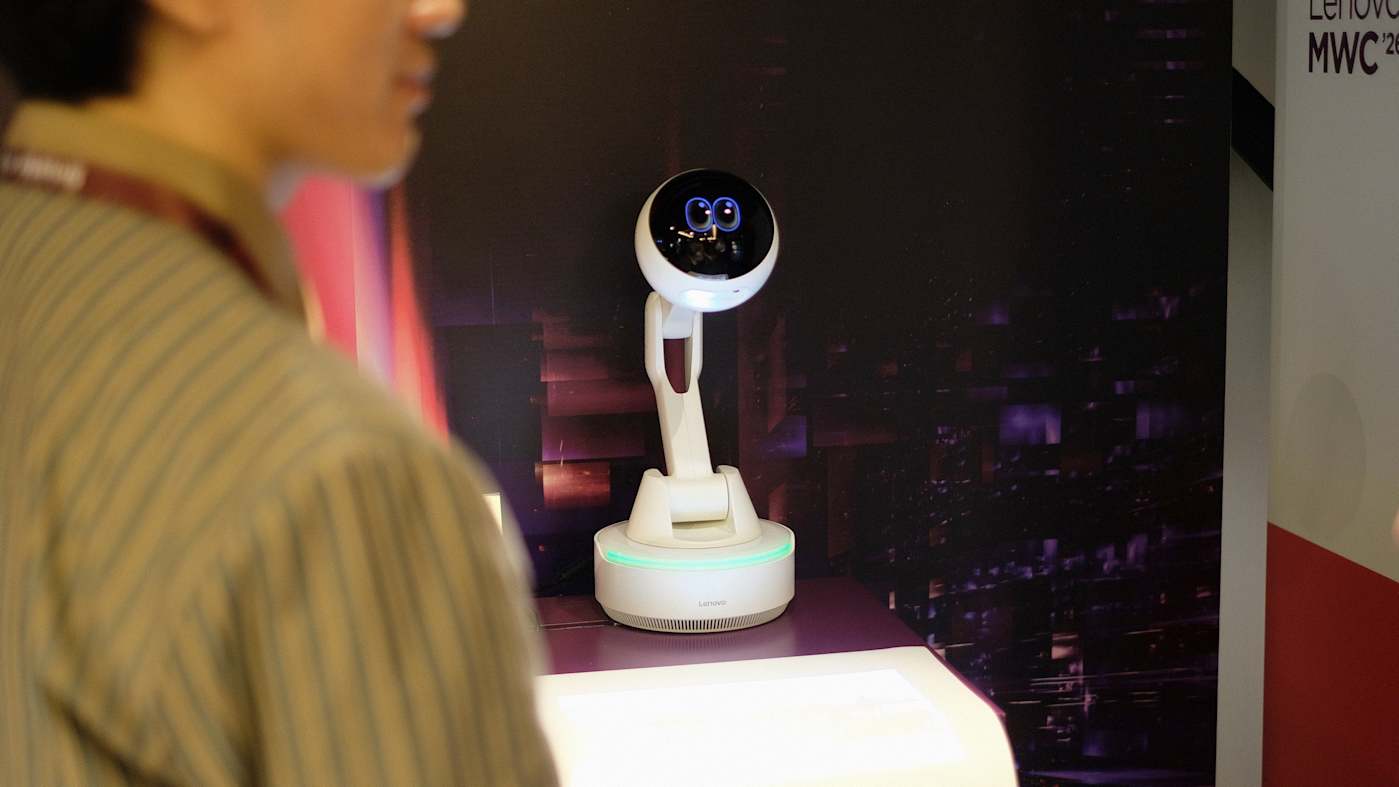
Lenovo can make a robot, too. Alongside proof-of-concept foldable gaming PCs and modular laptops, it introduced the AI Workmate Concept at MWC 2026. With its own Intel Core Ultra processor, 64GB of memory and its own Pico projector, it’s an AI-laced “workmate” meant to streamline office tasks and collaboration. And it has an LCD face.

For now, it’s a proof of concept, musing on how to integrate voice commands and LLMs (large language models) into workplace settings. It's meant to sit on your desk, but preferably also near a wall – more on that later.

Voice commands aside, the concept bot supports writing, voice and gestures with on-device AI processing. While it can answer the usual voice assistant questions, it can also scan and summarize documents (both digitally and physically) and even assist with creating a PowerPoint presentation – though you might want to check its work.

Lenovo AI Workmate Concept at MWC 2026
Mat Smith for Engadget

The 3.4-inch 480 x 480 screen doesn’t seem to offer any data visualization or numbers. During my demo, it only seemed to show the bot's eyes and facial expressions: it’ll sip coffee as it listens (with a moustache), cup a floating hand to the side of its face when it needs you to repeat a command, or twinkle when it’s processing more complicated tasks, like that fictional PowerPoint presentation.

With its articulated head, which houses the projector, cameras and LCD face, you can ask it to project images or documents on either the desk in front of it or a wall nearby. No need to flip around your monitor or laptop to share with colleagues. In one example, a spokesperson asked for a postcard. The Workmate then projected a (Lenovo-branded) image of Barcelona onto the desk. The rep laid paper down, then signed the ‘postcard’ and got the robot to scan it (with two downward-facing 5-megapixel cameras), and then send the file to a nearby printer.

Lenovo AI Workmate Concept at MWC 2026
Image by Mat Smith for Engadget

In theory, this sort of flow could transition to document signing or adding notation to images and files. However, one caveat here is whether those of us who work in offices want the extra workplace noise of a chatty robo and the person barking orders at it.

Lenovo says this concept (and it has a few at MWC) is meant to demonstrate the company’s “exploration of spatial and physical AI experiences” that integrate “seamlessly into professional environments.” Hopefully, further evolutions offer a text-based way to make using it a little less noisy.

Lenovo was also showing a simpler AI work device, the AI Work Companion Concept. It’s a completely different premise, despite the name being a little too close to the AI Workmate Concept.

Lenovo AI Workmate Concept at MWC 2026
Image by Mat Smith for Engadget

The AI Work Companion is not a robot, but a handsome chunky desk clock, with a solid, satisfying dial on the top and programmable buttons. The front is almost entirely display, able to show calendars, task lists and other work-centric dashes. It runs independently, plugging into a USB-C port for power and pulling data down wirelessly, while also acting as a port hub for charging other accessories and devices.

It’s certainly not as high-concept as the robot, but there are some AI smarts inside.

The Work Companion’s “Thought Bubble” uses AI to sync a user’s tasks and daily schedule across devices, synthesizing a daily action plan. It will even suggest times to break up bursts of work and attempt to monitor screen time to better manage burnout.

According to the press release, Lenovo says it also has “playful interactions with the user” and will, kind of bleakly, offer an end-of-week celebration report of tasks completed. It’s lucky it’s a good-looking desk clock.

This article originally appeared on Engadget at https://www.engadget.com/ai/lenovo-concept-robot-ai-workmate-mwc-2026-230159746.html?src=rss

©

© Image by Mat Smith for Engadget

Lenovo AI Workmate Concept at MWC 2026
  •  
❌