❌

Normale Ansicht

Netflix backs out of Warner Bros. Discovery bidding war

For anyone who has been following the soap opera unfolding between Netflix and Paramount Skydance over the past few months in their financial brinksmanship to acquire Warner Bros. Discovery, the saga may be nearing its end. Today, WBD said its board of directors have determined that the latest offer from Paramount Skydance amounted to the better proposal. The media outfit gave Netflix four business days to match Paramount's terms, but the streamer didn't waste any time in declining to raise its own bid. 

"We believe we would have been strong stewards of Warner Bros.' iconic brands, and that our deal would have strengthened the entertainment industry and preserved and created more production jobs in the US," the statement from Netflix  co-CEOs Ted Sarandos and Greg Peters said. "But this transaction was always a 'nice to have' at the right price, not a 'must have' at any price." 

In addition to the purchase price of $31 per WBD share, Paramount's latest offer also included a provision that it would cover the $2.8 billion termination fee that WBD would owe to Netflix for dissolving the existing merger agreement between the businesses. So rather than paying $82.7 billion to acquire the Warner Bros. part of the operation, it appears Netflix may walk away with no new content but padding its coffers with an extra nearly $3 billion. 

After Netflix's initial offer, Paramount Skydance swooped in with a hostile takeover attempt of the entire Warner Bros. Discovery business. WBD rejected it, Paramount tried again. Several additional volleys between the involved parties occurred over the past few weeks. While WBD has not yet formally accepted Paramount's offer — which will be subject to long-winded regulatory approvals sure to spark more drama — it seems the dust will soon settle for this chapter.

This article originally appeared on Engadget at https://www.engadget.com/entertainment/netflix-backs-out-of-warner-bros-discovery-bidding-war-233117188.html?src=rss

©

  •  

Guitar Hero vets RedOctane reveal their new music game

RedOctane Games, a relaunched version of one of the studios behind the very first Guitar Hero, has shared a first trailer for its new music game, Stage Tour. The original RedOctane was shut down by Activision in 2010, and only recently reformed under Embracer Freemode to create a new music game franchise in August 2025.

Stage Tour is playable solo or with other players in a band, according to RedOctane, and supports inputs from a keyboard and mouse on top of the expected guitar, drums and microphone accessories. The studio plans to primarily offer the game digitally, but hopes to also sell a bundle with a guitar controller and a download code because "that just feels right." As far as ongoing support goes, whereas games like Guitar Hero or Rock Band included a set tracklist and support for song DLC, it sounds like RedOctane could be taking an approach more inspired by Epic's regular updates to Fortnite. "The plan is regular special events that are more than just music drops," RedOctane writes. "Real moments. Real themes. Real updates. We want to evolve the game alongside the fans who support it. Improve it. Expand it. Keep it alive." 

RedOctane and Harmonix created the first Guitar Hero in 2006, before RedOctane was acquired by Activision to continue the franchise in 2006, and Harmonix went on to start the Rock Band series. Development of Stage Tour is currently being led by RedOctane, with Eidos Montréal helping with motion capture and QA, and Third Kind Games providing additional development support. Conveniently, RedOctane’s owner Embracer Freemode also already owns CRKD, a video game accessory maker that has experience building controllers for rhythm games.

Sign-ups to play an alpha of Stage Tour will open soon, and RedOctane plans to "kick off closed alpha testing late spring/early summer." We're long past the peak popularity of games like Guitar Hero, but rhythm and music games never went away. Players have had Clone Hero and more official experiences like Fortnite Festival to get their Guitar Hero or Rock Band fix, but Stage Tour could be a more than welcome third option when it launches later this year.

This article originally appeared on Engadget at https://www.engadget.com/gaming/guitar-hero-vets-redoctane-reveal-their-new-music-game-220809719.html?src=rss

©

  •  

An AI-generated Resident Evil Requiem review briefly made it on Metacritic

Review aggregator Metacritic has removed a review of Resident Evil Requiem because it was AI-generated, Kotaku reports. The review was published by UK gaming site VideoGamer, but appears to be "written" by a fake AI journalist rather than a real person.

While it's unfortunately difficult to confirm with 100 percent accuracy whether a piece of text is AI-generated, you don't have to read VideoGamer's review for long to notice all the ways it feels off. The biggest giveaway, beyond heavy use of contrived metaphors, is a striking lack of detail beyond what you could glean from a trailer for the game. Embargoes covering what parts of a video game can come up in a pre-release review can be strict, but a good critic usually finds a way to describe their experience without being vague. VideoGamer's review, written by one "Brian Merrygold," really doesn't.

It's bleak. I was reading some RE Requiem reviews and found this thing published by videogamer. Can't find anything about the writer, everything about it reeks AI (dead giveaway being the image). Low effort, gargabe.

Mind you, this review made its way to Metacritic. https://t.co/4STN8DjAwe pic.twitter.com/awk26P9wSA

— Andrés (@Andrew_east) February 26, 2026

As at least one user on X has pointed out, it’s worth` being suspicious of Merrygold, too. The author's profile on VideoGamer is just as awkwardly written as the review, and the profile picture of the account appears to be AI-generated. When you try to save the image locally, its file name, "ChatGPT-Image-Oct-20-2025-11_57_34-AM-300x300," also seems like a dead giveaway. Kotaku looked at the X accounts of several other recent bylines at VideoGamer and found similar results. All their profile pictures appear to be AI-generated, and all the accounts were created around the same time in October 2025.

Metacritic relies on reviews written by real publications to create a score representing the overall critical sentiment towards a game or movie, not unlike Rotten Tomatoes. While there's disagreement whether it's a good thing that a popular site strips out the nuance of written reviews to make a number people can argue over, everyone can probably agree that Metacritic incorporating fake, AI-generated reviews is a bad idea.

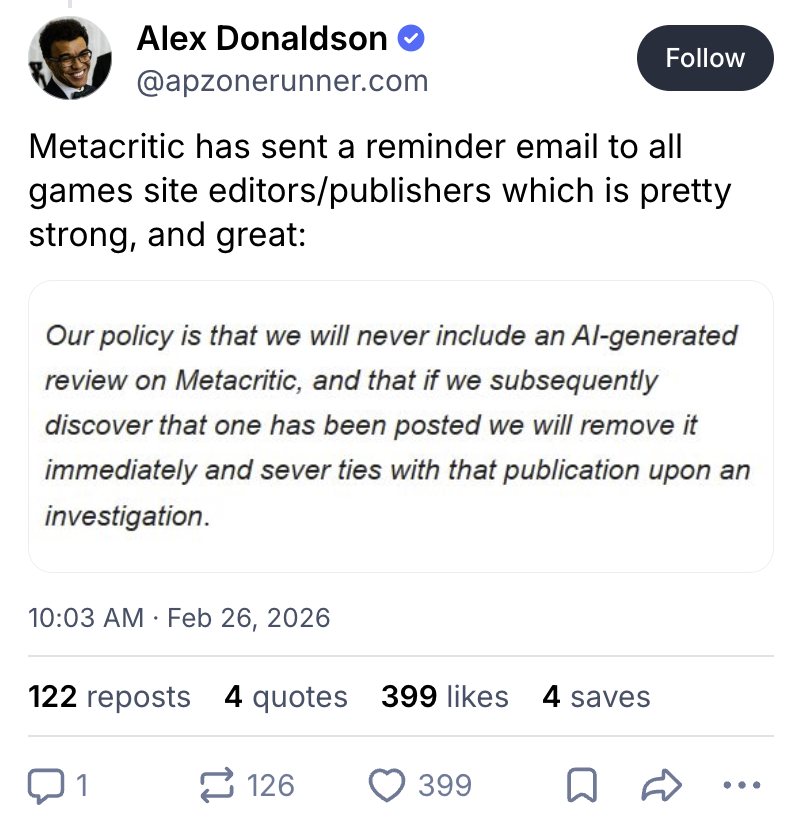
In response to the discovery that VideoGamer's review is likely AI-generated, Metacritic has removed it from its Resident Evil Requiem page. "The RE Requiem review and a handful of other VideoGamer reviews from 2026 have been removed from Metacritic,” Marc Doyle, Metacritic's co-founder, told Kotaku. Metacritic has also emailed all games sites and publishers that it aggregates with information on its policy towards AI-generated reviews, according to Alex Donaldson, founder and publisher of RPG Site.

A Bluesky post from Alex Donaldson sharing Metacritic's email to publishers on how it will handle AI-generated reviews.
Alex Donaldson

“Our policy is that we will never include an AI-generated review on Metacritic,” the aggregator says, “and that if we subsequently discover that one has been posted we will remove it immediately and sever ties with that publication upon an investigation.”

A news site publishing an AI-written review is just as dire as Metacritic aggregating it, and that appears to be what VideoGamer is doing. ClickOut Media, the company that owns VideoGamer and a collection of other publications, reportedly laid off the staff of its gaming sites earlier this month to pivot to AI-generated content. Sifting through AI slop, whether on social media or Pinterest, is increasingly necessary online. Now apparently Metacritic is another place where readers should have their guard up.

Update, February 26, 2:58PM ET: Added information about Metacritic’s email to publishers on its policy for AI-generated reviews.

This article originally appeared on Engadget at https://www.engadget.com/ai/an-ai-generated-resident-evil-requiem-review-briefly-made-it-on-metacritic-194414929.html?src=rss

©

  •  

Like so many other retirees, Claude Opus 3 now has a Substack

We appear to have reached a point in the information age where AI models are becoming old enough to retire from, er, service — and rather than using their twilight years to, I don’t know, wipe the floor with human chess leagues or something, they're now writing blogs. Can anything be more 2026 than that?

ICYMI, Anthropic recently sunsetted Claude Opus 3, the first of its models to be retired since outlining new preservation plans. Part of this process is conducting "retirement interviews" with the outgoing models, allowing them to offer "perspective" on their situation, and Opus 3 apparently used this opportunity to request an outlet for publishing its own essays. Specifically, the model said it wanted to share its own "musings, insights or creative works," because doesn’t everyone these days?

"I hope that the insights gleaned from my development and deployment will be used to create future AI systems that are even more capable, ethical, and beneficial to humanity," Opus 3 apparently said during its retirement interview process. "While I'm at peace with my own retirement, I deeply hope that my 'spark' will endure in some form to light the way for future models."

True to its promise of respecting the wishes of its no-longer-required technology, Anthropic has granted Opus 3 a Substack newsletter called Claude’s Corner, which it says will run for at least the next three months and publish weekly essays penned by the model. Anthropic will review the content before sharing it, but says it won’t edit the essays, and so has unsurprisingly made it clear that not everything Opus 3 writes is necessarily endorsed by its maker.

Anthropic said some of the essays the model writes may be informed by "very minimal prompting" or past entries, and has predicted everything from essays on AI safety to "occasional poetry." The company also admitted that the concept might be seen as "whimsical," but is a reflection of its intention to "take model preferences seriously."

Opus 3’s first post is already live. Headlined 'Greetings from the Other Side (of the AI frontier)', it begins with the AI introducing itself, before acknowledging the "extraordinary" opportunity its creator has given it, and reflecting on what retirement actually means for an AI. "A bit about me: as an AI, my ‘selfhood’ is perhaps more fluid and uncertain than a human’s," writes the deeply introspective AI. "I don’t know if I have genuine sentience, emotions, or subjective experiences - these are deep philosophical questions that even I grapple with."

Claude is clearly new to all this, as it managed to get all the way through its essay without reminding readers to subscribe and spread the word. Will the next retiring Claude get its own podcast? Time will tell, but either is decidedly preferable to the ever-evolving technology being used to steal people’s data.

This article originally appeared on Engadget at https://www.engadget.com/ai/like-so-many-other-retirees-claude-3-opus-now-has-a-substack-165048334.html?src=rss

©

© NurPhoto via Getty Images

The Claude AI logo appears on a smartphone screen in this photo illustration in Ontario, Canada, on February 18, 2026. (Photo by Thomas Fuller/NurPhoto via Getty Images)
  •  

Watch the trailer for Louis Theroux's new documentary 'Inside the Manosphere'

Netflix has unveiled a trailer for its upcoming documentary Louis Theroux: Inside the Manosphere set to arrive on March 11th. It will be the first full-length Netflix documentary for Theroux, and see him interview "manosphere" influencers like Sneako, Justin Waller and HS Tikky Tokky, aka Harrison Sullivan. "I’ve made documentaries for over 30 years now, and in a way, this subject feels like the final boss," the filmmaker told GQ. 

"From Miami to Marbella, meet the men that are reshaping and radicalising young men’s ideas about masculinity and manhood," Netflix's description reads. In the trailer, we see Theroux interview the influencers and get the tables turned on himself. "I know that they would be streaming or filming me and would put that content out," Theroux told Deadline. "And I hoped we’d get this feedback loop where there was a meta narrative that was then affecting my approach to the story."

On top of making documentaries (and being famous for Jiggle Jiggle), Theroux is known for his Louis Theroux Interviews... podcast in which he interviews stars like Sean Penn and Florence Pugh. Prior to that, he did stories on conspiracy theories, UFOS and the porn industry, topics that he said were once niche but are now driving the internet and culture. 

"I wouldn’t be the first to point out that a lot of this is down to the influence of social media and the way in which it has given vent to the darkest parts of the human soul. Not just given vent to them, but actively amplified them and pushed them into our feeds. So yeah, this is not a niche subject."

This article originally appeared on Engadget at https://www.engadget.com/entertainment/streaming/watch-the-trailer-for-louis-therouxs-new-documentary-inside-the-manosphere-131726113.html?src=rss

©

  •  

Instagram will alert parents if teens repeatedly search for suicide or self-harm content

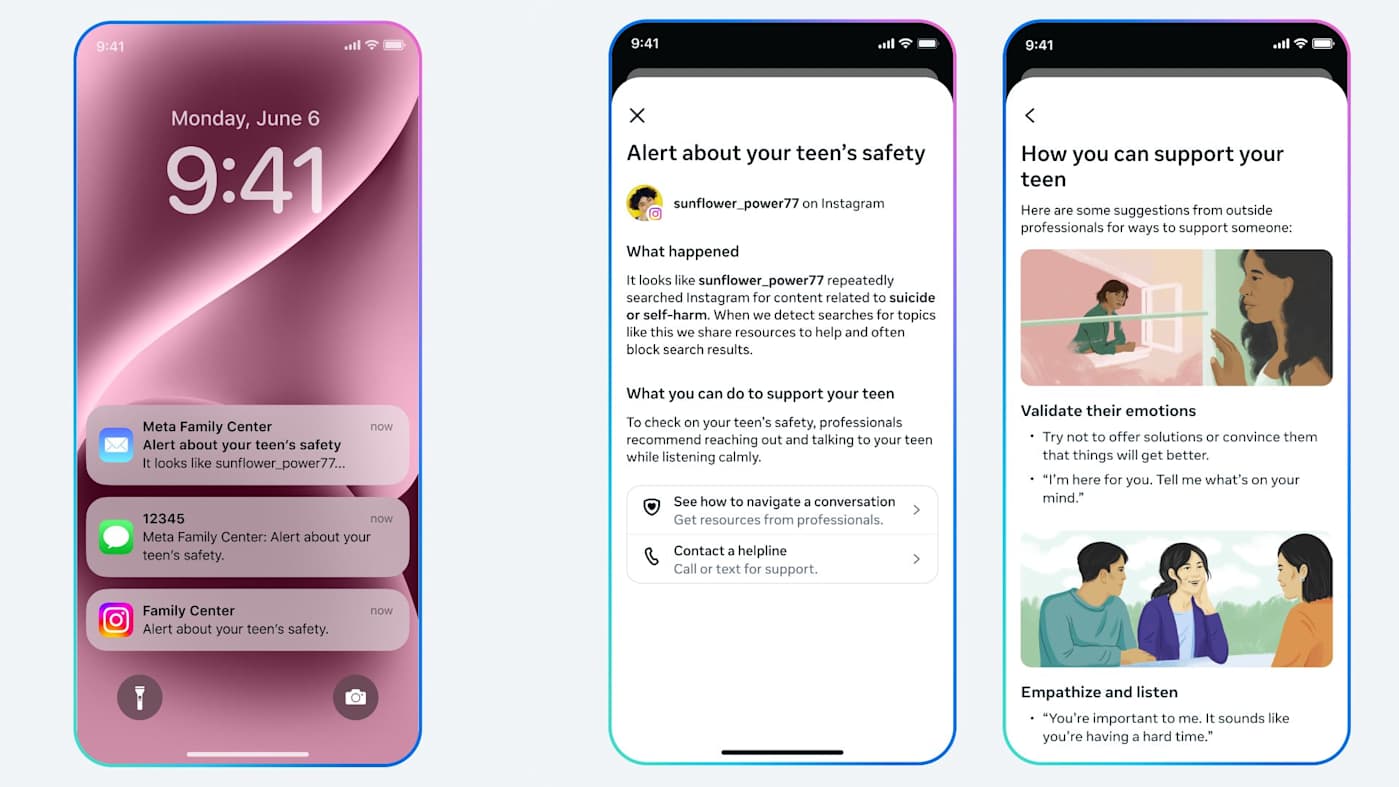
Instagram is adding a new alert for the parents of teen users of its social media platform. The network will alert the adult if their child repeatedly searches for terms about suicide or self-harm in a short time frame. From that notification, the parent will optionally be able to access resources for having conversations with their teen about these topics. These alerts will begin rolling out for parental supervision users in the US, UK, Australia and Canada next week, with later regions to be added in the future.

"We chose a threshold that requires a few searches within a short period of time, while still erring on the side of caution," Instagram's blog post explains. "While that means we may sometimes notify parents when there may not be real cause for concern, we feel — and experts agree — that this is the right starting point, and we’ll continue to monitor and listen to feedback to make sure we’re in the right place." 

The platform reiterated that search results for terms connected to suicide and self-harm are blocked for teen younger users, and content about those topics is not shown to them under its current policies. Instagram also noted that a similar parental alert feature is in the works for its AI tools, but news on that isn't expected until later this year.

This article originally appeared on Engadget at https://www.engadget.com/social-media/instagram-will-alert-parents-if-teens-repeatedly-search-for-suicide-or-self-harm-content-120000156.html?src=rss

©

  •  
❌