❌

Normale Ansicht

Samsung Galaxy S26 Ultra hands-on: Meaningful tweaks plus a slick new Privacy Display

Last year, it felt like Samsung relied a bit too much on AI when trying to convince people to upgrade to its flagship phone. And while there’s no shortage of features that utilize machine learning on the new Galaxy S26 Ultra, it feels like Samsung has done a much better job of filling out the rest of the phone’s kit with fresh hardware, faster charging and a more cohesive design. It’s still rather expensive, but its price has stayed flat year-over-year at $1,300, which when combined with everything else makes it a much more attractive package than its predecessor. 

Design and display

Samsung’s Ultra phones are always going to be somewhat boxy and that’s OK. However, for the Galaxy S26 Ultra, the company’s top-of-the-line handset is getting a slightly curvier appearance thanks to rounder corners. There’s also a very (and I do mean very) small reduction in size that technically makes this version the thinnest and lightest Ultra to date (214 grams and 7.9mm thick). That said, considering the previous model weighed 218 grams and measured 8.2mm, it’s incredibly hard to feel a difference even when you know what you’re looking for. 
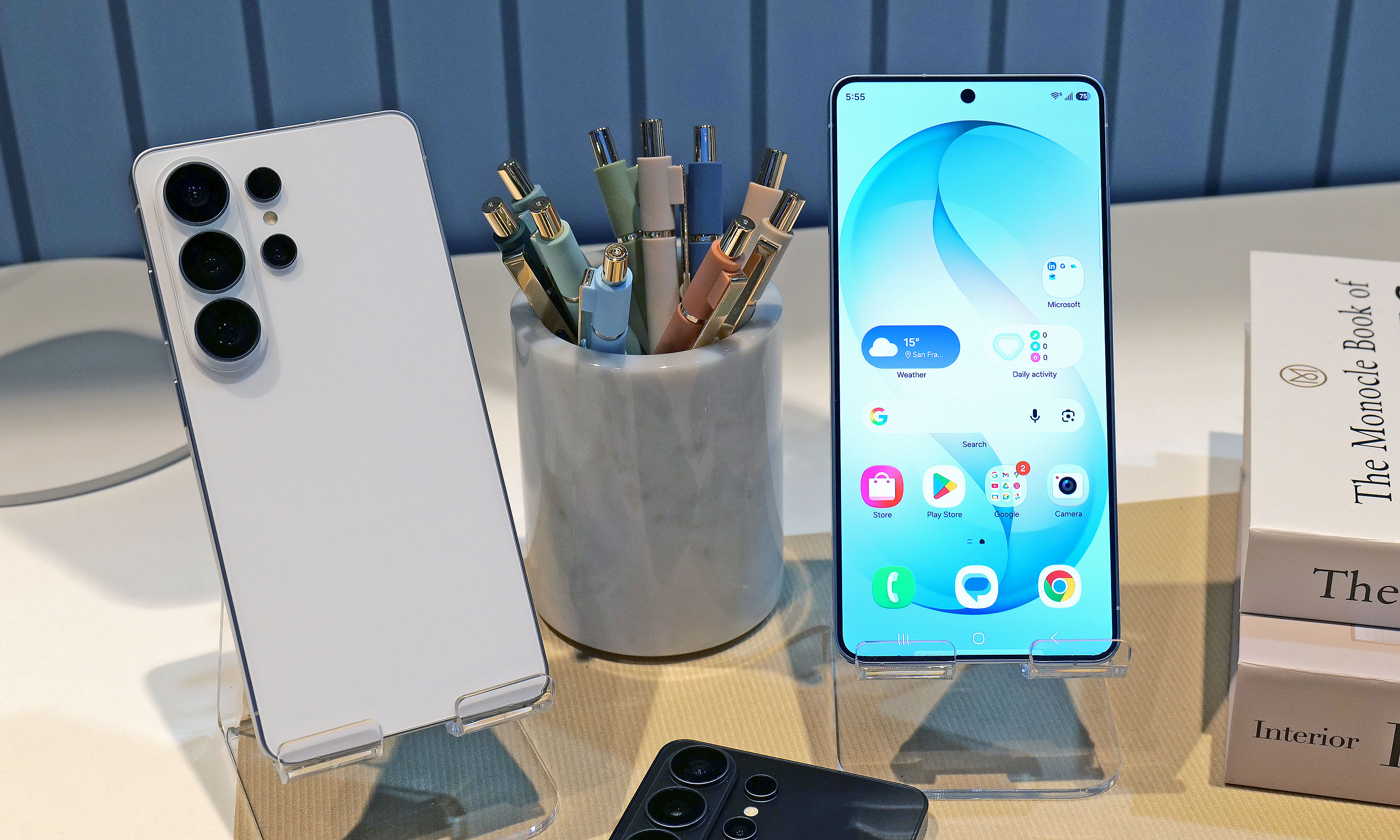
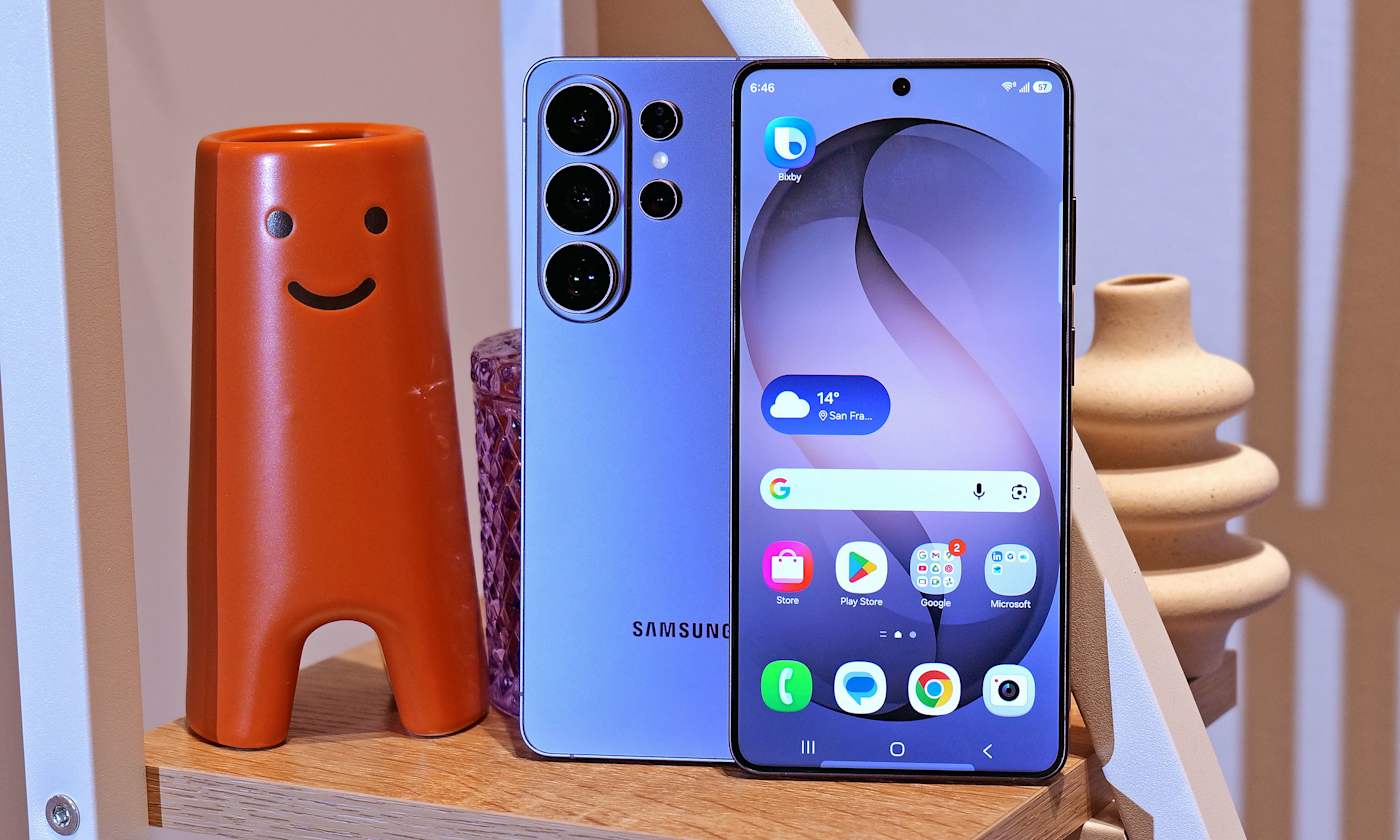
The two biggest changes to the S26 Ultra's exterior design are more rounded corners and an aluminum chassis instead of titanium like we got on the S25U.
Sam Rutherford for Engadget

In reality, the biggest exterior change is that Samsung has ditched the titanium frame from last year’s phone in favor of an Armor Aluminum chassis with Corning Gorilla Armor 2 panels in front and back. Samsung says this new design is meant to make the Ultra fit in better with its less expensive siblings while also making it easier to do things like color match the phone’s body to the rest of the device. Also, for anyone who keeps track of Samsung’s palette, the hero color for the S26 Ultra is a rather fetching shade of purple called cobalt violet, with sky blue, white and black available as well (plus silver shadow and pink gold being Samsung’s online exclusive hues).
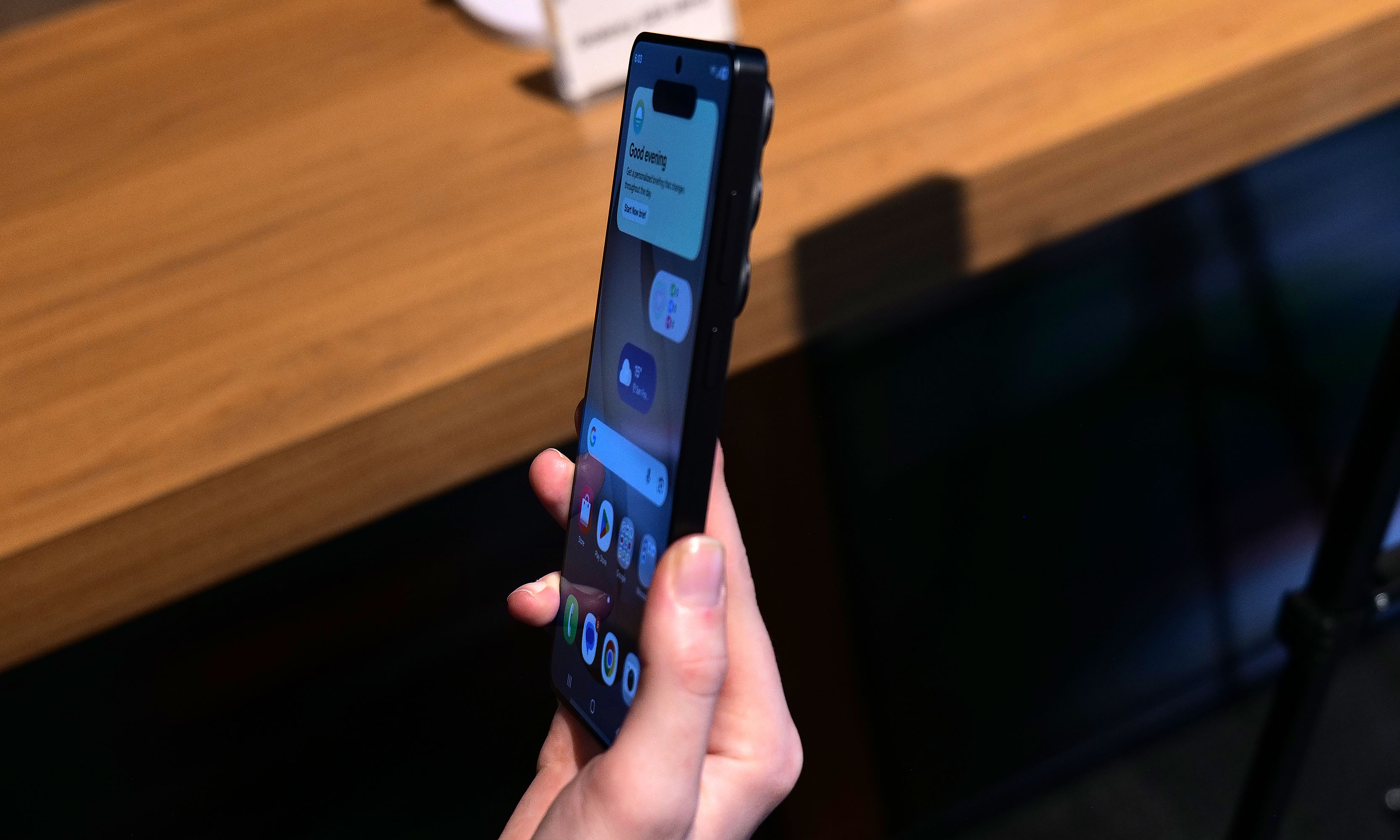
If you look closely at the top of the phone, you can see where a notification has been blacked out via the S26 Ultra's Privacy Display.
If you look closely at the top of the phone, you can see where a notification has been blacked out by the S26 Ultra's Privacy Display.
Sam Rutherford for Engadget

However, my favorite new thing on the S26 Ultra is its Privacy Display. When activated, it functions a lot like HP’s Sure View tech, which prevents people from peeking at your screen from acute angles. It works both when viewed from the side or up and down and has a surprising amount of customization. Not only can you set it to turn on automatically when the phone asks you for a password or PIN, it can also be triggered by specific apps or whenever you receive a notification. But perhaps the most impressive thing is that there’s almost no impact on image quality. When Privacy Display is active, there is a minor reduction in overall brightness, but aside from that, it’s really hard to tell when it’s on (at least from the front). Furthermore, the S26 Ultra’s 6.9-inch AMOLED screen has the same underlying specs as last year, including its 120Hz variable refresh rate and 2,600 nit peak brightness, so there are pretty much no trade-offs for the added functionality. 

Performance and charging
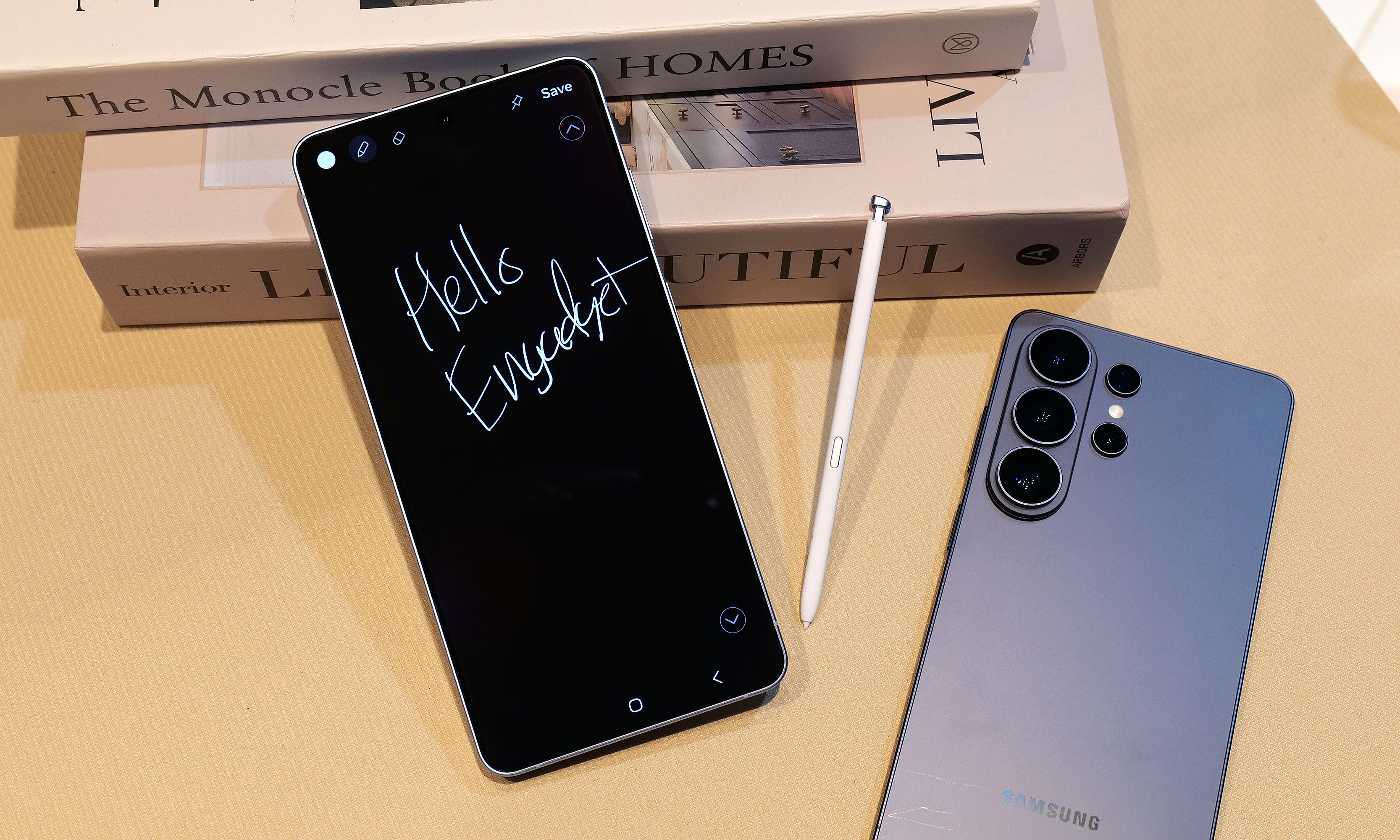
The S26 Ultra still comes with an included S-Pen and a built-in storage slot, but it still doesn't have Bluetooth connectivity like on some of Samsung's older models.
Sam Rutherford for Engadget

Inside, the S26 Ultra features a Qualcomm Snapdragon 8 Elite Gen 5 for Galaxy chip along with either 12GB or 16GB of RAM and up to 1TB of storage. Compared to its predecessor, Samsung claims the NPU’s performance has made the biggest leap with it being 39 percent more powerful year-over-year with respectable increases for its CPU (19 percent faster) and GPU (24 percent faster) as well.

As for charging, both wired and wireless speeds have gotten a big boost with the former now rated at up to 60 watts (up from 45 watts) or 25 watts (up from 15) for the latter when using compatible Qi2 pads. Samsung says buyers will even get a three amp cable in the box, so all you need to do to get those peak wired speeds is to hook it up to the right adapter.
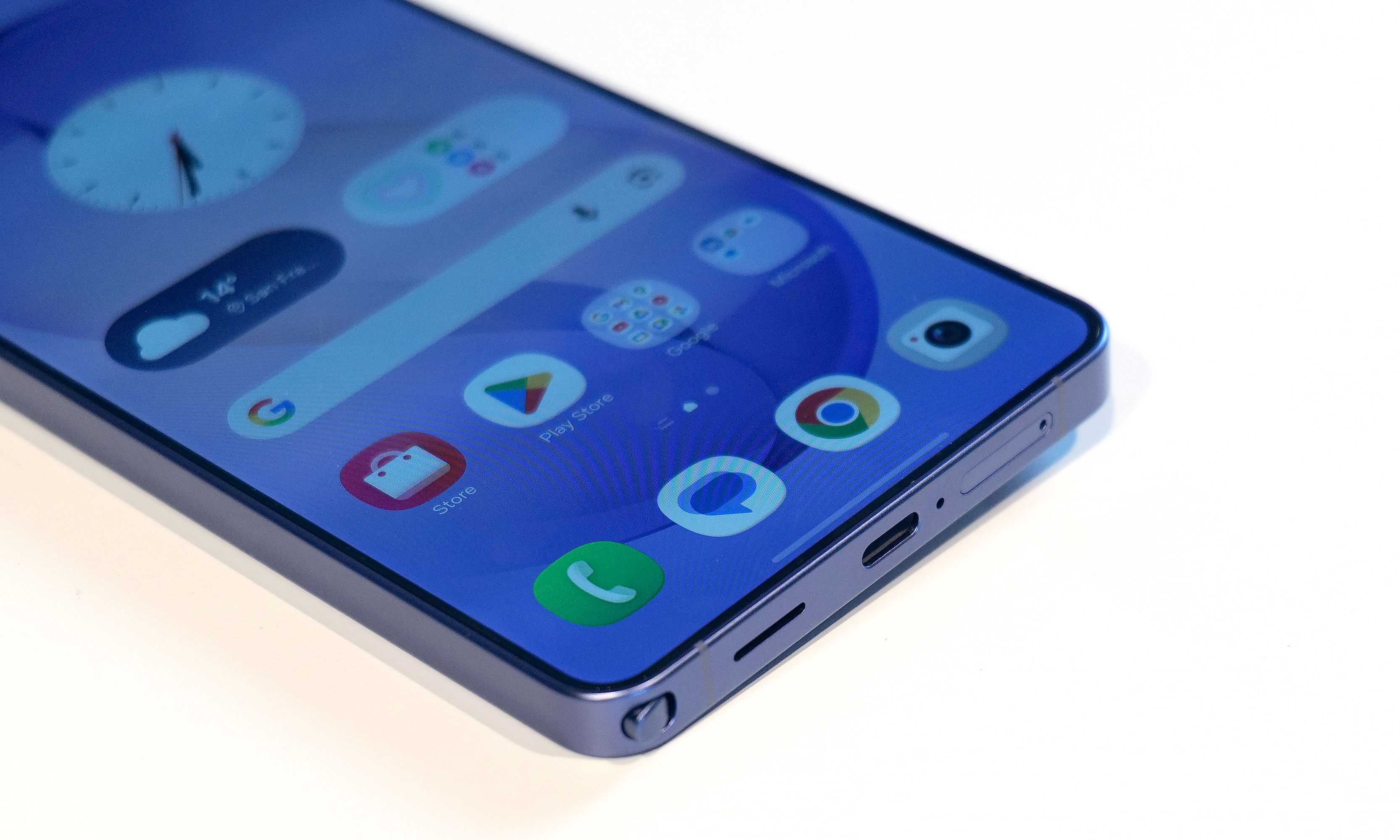
A small quirk with the S26 Ultra's S-Pen is that because the end of the stylus is curved to match the corner of the phone, if you put it in "wrong," it'll stick out a bit.
Sam Rutherford for Engadget

Unfortunately, we’re still not getting a magnetic ring inside the phone, which means if you want to use the S26 Ultra with magnetic accessories, you’ll need to pair the phone with a case that supports that functionality. This is super frustrating because Samsung says this decision was made in part to keep the handset as thin as possible, but when you consider the difference between the S26 Ultra and the S25 Ultra is 0.3mm, that choice feels rather misguided. 

Cameras

One of my biggest complaints about last year’s S25 Ultra is that the only new hardware was an updated 50MP sensor for its ultra-wide lens, which is the camera I (and probably most people) use the least. Thankfully, it seems Samsung took note of that because while the resolution of its 200MP main cam, 10MP 3x telephoto and 50MP 5X telephoto are the same as before, the S26 Ultra’s main and 5x zoom lenses now have significantly wider apertures (from f/1.7 to f/1.4 and f/3.4 to f/2.9, respectively). This results in as much as 47 percent more light reaching the phone’s primary sensor (or 37 percent for the 5x telephoto), which should result in some major gains in photo quality and low light sensitivity. That said, I wasn’t able to properly test this during my hands-on session, so I’m going to reserve final judgement for a proper review. 
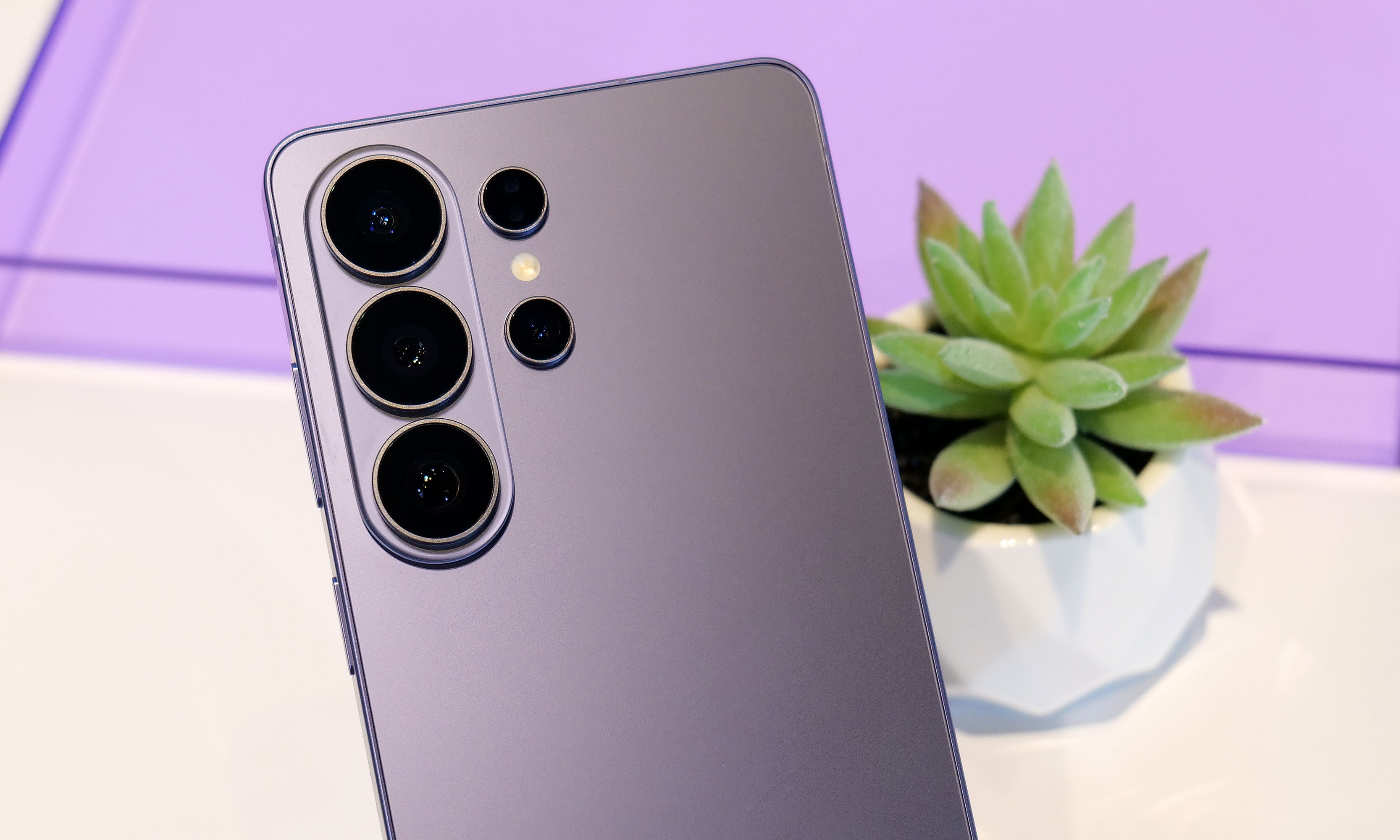
The S26 Ultra's 200MP main and 50MP 5x zoon lenses feature significantly larger apertures, which should deliver much improved image quality in low light conditions.
Sam Rutherford for Engadget

Meanwhile, for video capture, Samsung is adding support for the APV codec at up to 8K/30 fps to the S26 Ultra along with a new horizon lock feature that will keep your footage level no matter how much you rotate the phone. Now I will admit that the latter didn’t impress me much when I first heard about it, but after testing it out and spinning the phone a full 360-degrees while recording a clip, I was shocked when the resulting video showed no hint of being whirled around. Samsung also says the handset’s improved Nightography processing uses AI to recognize noise patterns in low light to improve image quality. But similar to the wider apertures bringing in more light, I’ll believe it when I see it. 

Finally, there’s a new AI-powered Photo Assist tool that lets you edit or adjust images using natural language prompts. From what I experienced, it’s effective and works as you’d expect. However, with the proliferation of services and devices offering similar functionality over the past year, this feature feels more like Samsung’s attempt to keep up with the Joneses. 

AI features

When it comes to AI, the S26 Ultra is getting the same batch of new and improved features as the rest of the S26 family. So if you’re big into machine learning, there’s no need to pay extra for this model. Furthermore, many of the updates for 2026 are tweaks or refinements of existing things like the Gallery app, which now uses AI to automatically sort screenshots into eight different categories so they’re easier to find later. There’s also what Samsung is calling Now Nudge, which functions a lot like Google’s Magic Cue. It’s built into the Samsung keyboard and it can do things like suggest relevant photos based on your conversations. 

One of the S26's most powerful new AI features is Automated  App Actions, which allows the phone to do things like book a car ride via Uber while you continue to use other apps in the foreground.
One of the S26's most powerful new AI features is Automated App Actions, which allows the phone to do things like book a car ride via Uber while you continue to use other apps in the foreground.
Sam Rutherford for Engadget

To me, the most impressive of the bunch is the S26’s Automated App Actions, which allow you to ask the phone to do slightly more complicated tasks like ordering an Uber to a specific location. After your initial prompt, Gemini can even complete the task in the background while you go back to doomscrolling or watching videos. When it’s done, you’ll get a notification so you can manually review and confirm the command. Unfortunately, Uber will be the only supported app at launch, though Samsung says it’s working on expanding the feature to others like Instacart. 

Early thoughts
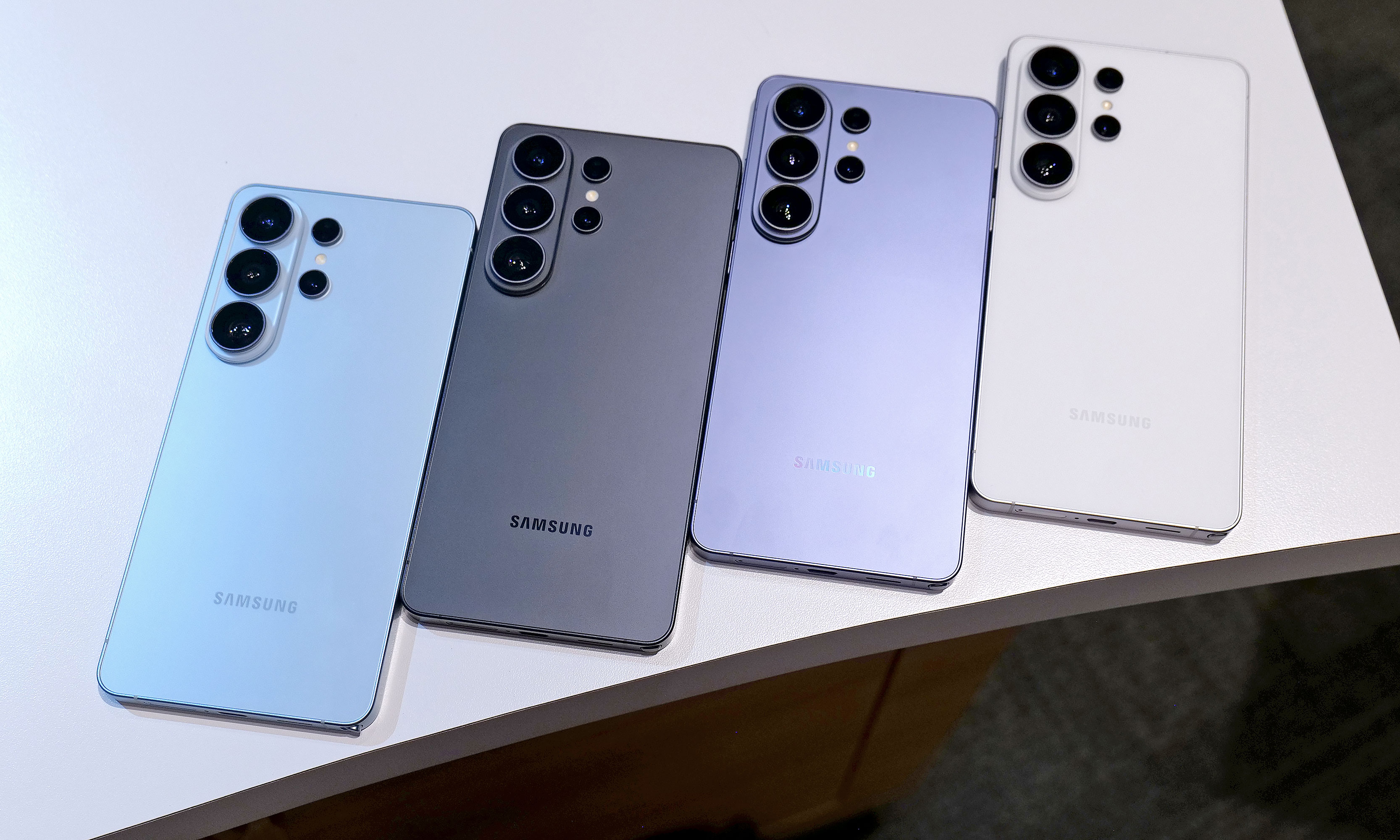
The Galaxy S26 Ultra will be available in four main colors: sky blue, black, cobalt violet and white, along with two more online exclusive hues in silver shadow and pink gold.
Sam Rutherford for Engadget

Look, there’s no getting around it: $1,300 is a lot to spend on a phone. That said, considering the RAM shortage that’s going on right now, keeping the S26 Ultra’s price the same as last year’s phone feels like a small blessing. And when you get that on a handset with a more refined design, a beefier chip, a fancy Privacy Display, faster charging and an updated generation of AI-powered tools, Samsung’s latest flagship feels like a much better deal than its predecessor. Really, the only thing that hasn’t been improved is the Ultra’s S-Pen, which as time goes on, is starting to feel more and more like a consolation prize for people who are still nostalgic about the Note line than a true tentpole feature. 

Now this doesn’t mean that people with an S25 Ultra or even an S24 Ultra should run out and upgrade. But for anyone with something older than that who’s in the market for a true do-everything phone, the S26 Ultra has quite a bit to offer. 

Pre-orders for the Galaxy S26 Ultra are live now, with official sales slated for March 11. 

This article originally appeared on Engadget at https://www.engadget.com/mobile/smartphones/samsung-galaxy-s26-ultra-hands-on-meaningful-tweaks-plus-a-slick-new-privacy-display-180000057.html?src=rss

©

  •  

Seattle Ultrasonics C-200 review: This is the future of kitchen knives

There’s a type of knife tech often seen in science fiction that revolves around vibrating a blade to increase its sharpness. We’ve seen examples of this in franchises like Star Wars (vibroblades), Evangelion (the prog knife), Dune (pulse-swords) and the Marvel universe (vibranium), but what might surprise you is that the underlying science is sound. By vibrating a cutting tool at high frequencies, not only do you reduce friction, you essentially turn the blade into a saw, as tiny oscillations enhance the inherent sharpness of a blade. 

However, up until recently, this tech largely only existed in fiction or for large companies that have the money to utilize the tech on an industrial scale. But that's changing in a big way for home cooks this year thanks to Seattle Ultrasonics, which is releasing the world's first ultrasonic chef's knife: the C-200. After chopping, smashing and cooking with it for about a month, I'm convinced that this is the future of kitchen knives.

Design

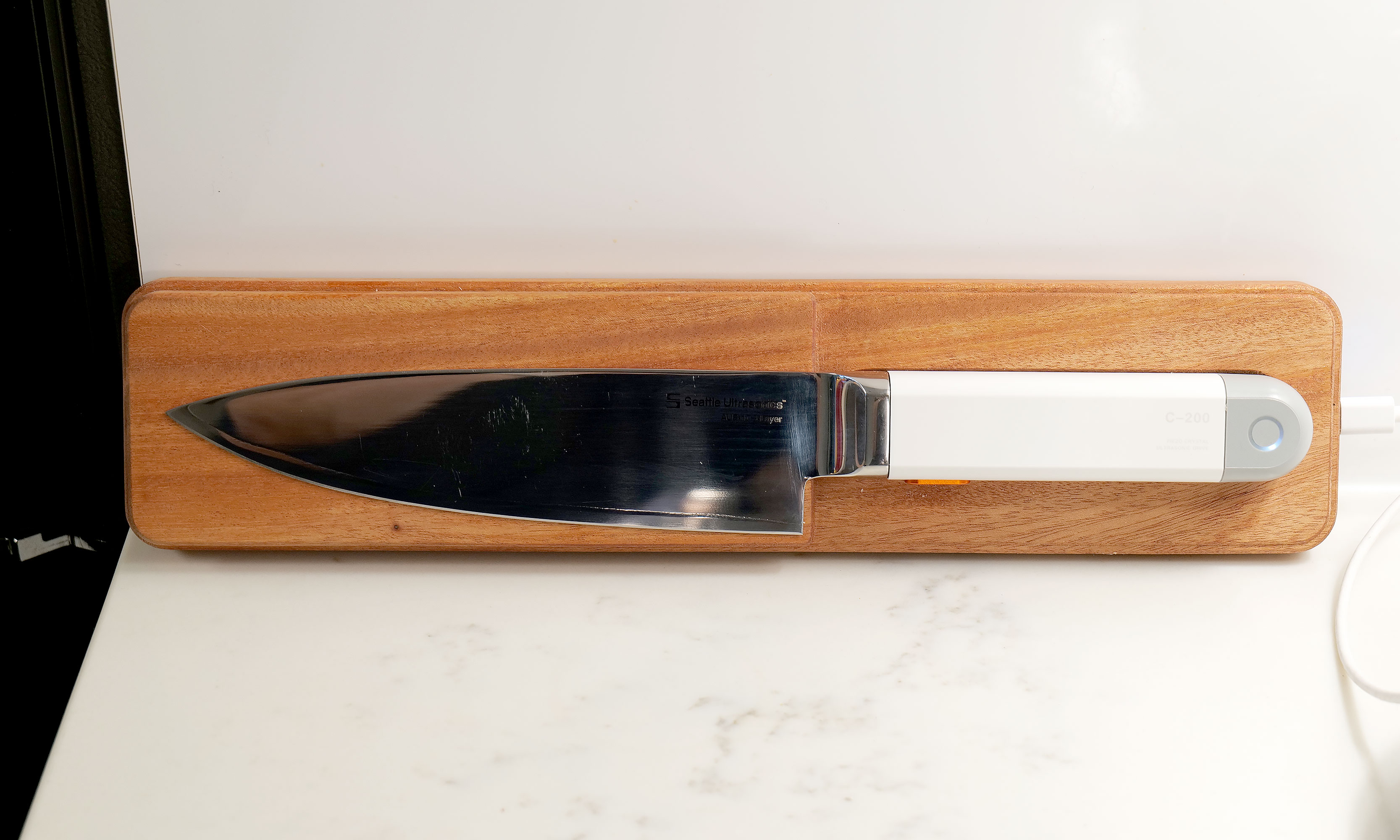
From afar, the C-200 looks a lot like a regular 8-inch chef's knife, but with a slightly more contemporary design. It features a three-layer san mai blade made from Japanese AUS-10 steel with a 13-degree edge angle per side (26 degrees total). However, upon closer inspection, you'll notice there are some features that seem a bit out of place on a premium knife. 

The first is that the C-200 doesn't have a full tang, which is the back end of a blade that ideally extends into the handle to provide added strength and durability. This is usually a major no-no, particularly on a $400 knife. However, when you consider that Seattle Ultrasonics needed somewhere to put its vibration tech, there really isn't any room for it other than inside the knife's grip. 

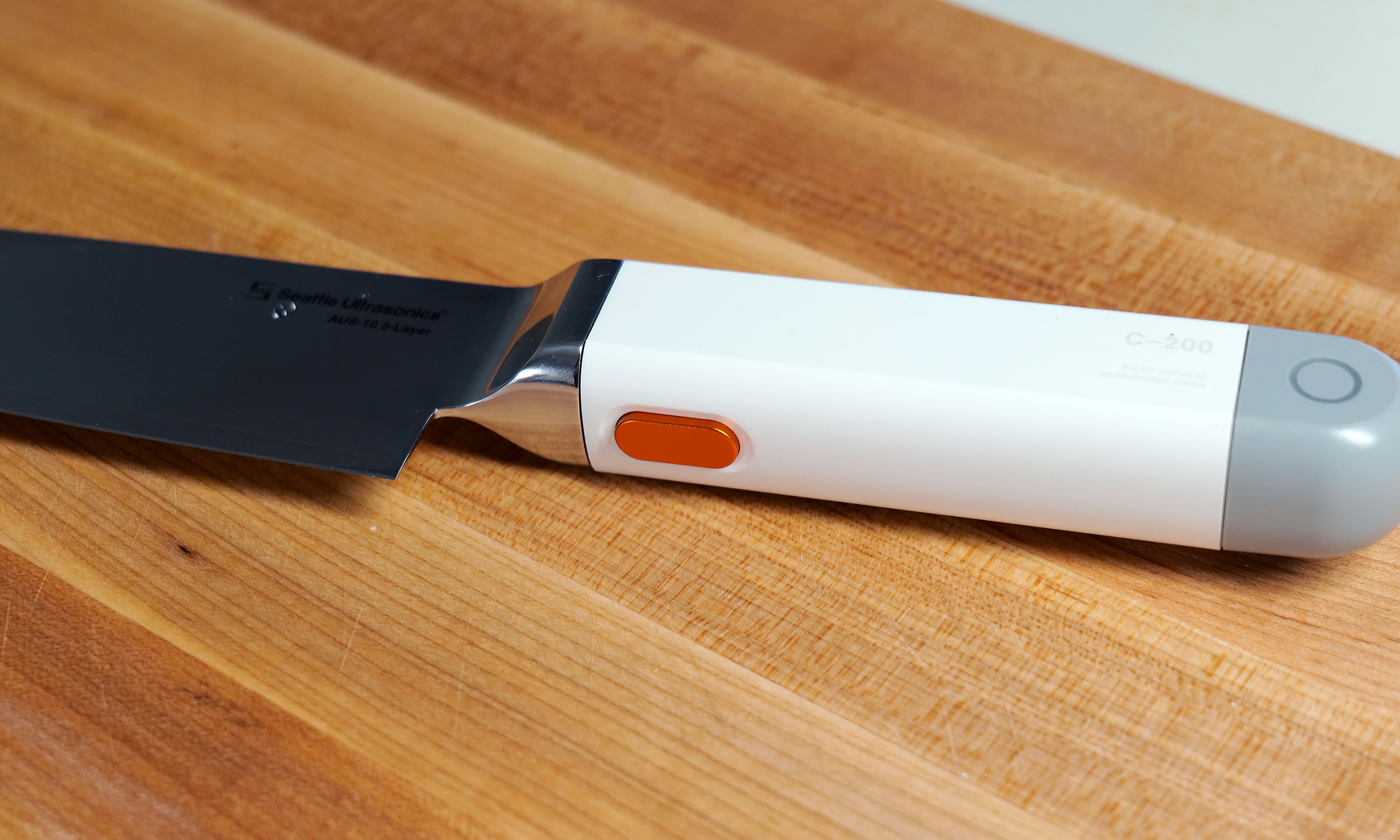
You won't be able to feel, but pressing this button allows the C-200's blade to vibrate 30,000 times per second.
You won't be able to feel it, but pressing this button allows the C-200's blade to vibrate 30,000 times per second.
Sam Rutherford for Engadget

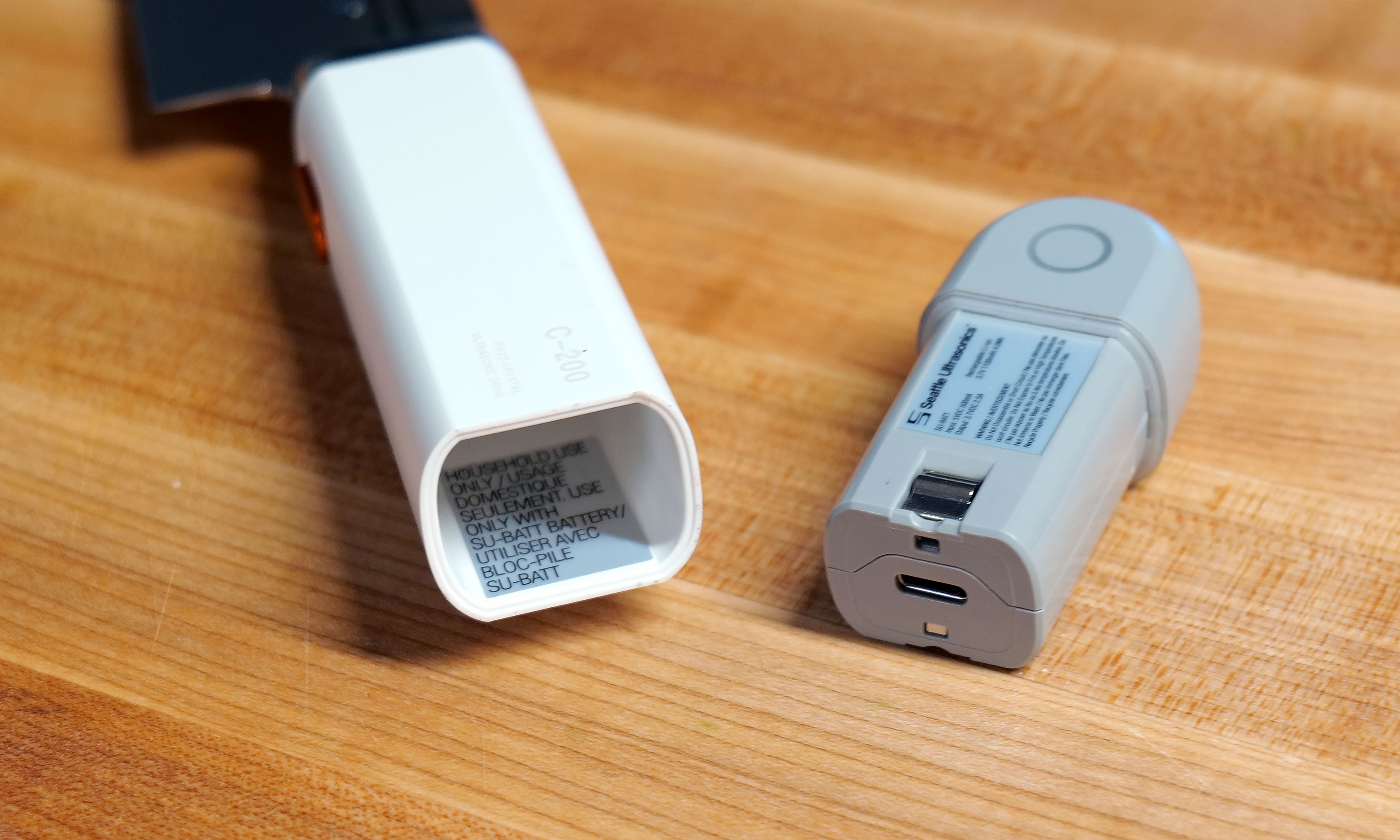
The knife's second quirk is that the back of the plastic handle features small indicator lights on either side, which is obviously a bit weird. Furthermore, the entire gray section can be removed to reveal a small 1,100mAh battery with an onboard USB-C port. Frankly, the presence of a battery in a knife is just kind of funky. But hey, the power to vibrate the knife has to come from somewhere because it definitely isn't being generated by your hands. And while Seattle Ultrasonics doesn't include a charging adapter or cable in the box, I don't mind because the company wisely took cues from the larger gadget industry and went with a power spec that's already widely in use. Honestly, I wish more kitchen tech makers would do the same. 

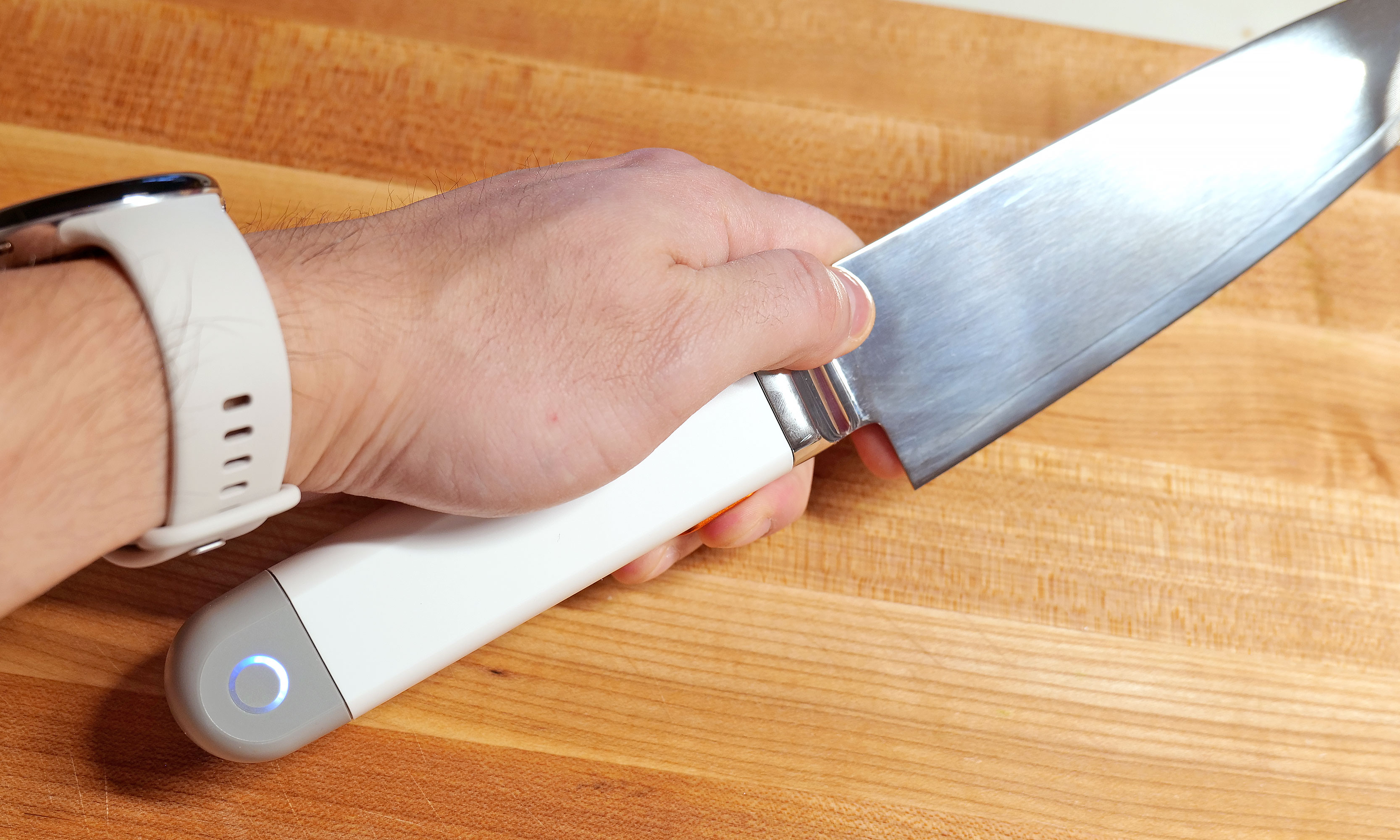
However, the knife's biggest oddity is the big orange button on the bottom of its handle. This is what you use to make the blade vibrate, which it does at 33kHz. It's positioned well so that it's easy to press regardless of whether you do a traditional pinch grip or if you're a bit more casual and prefer to hold the knife only using its handle. In the future, I can see this button becoming a touch-sensitive sensor, but for now, it's simple and effective.

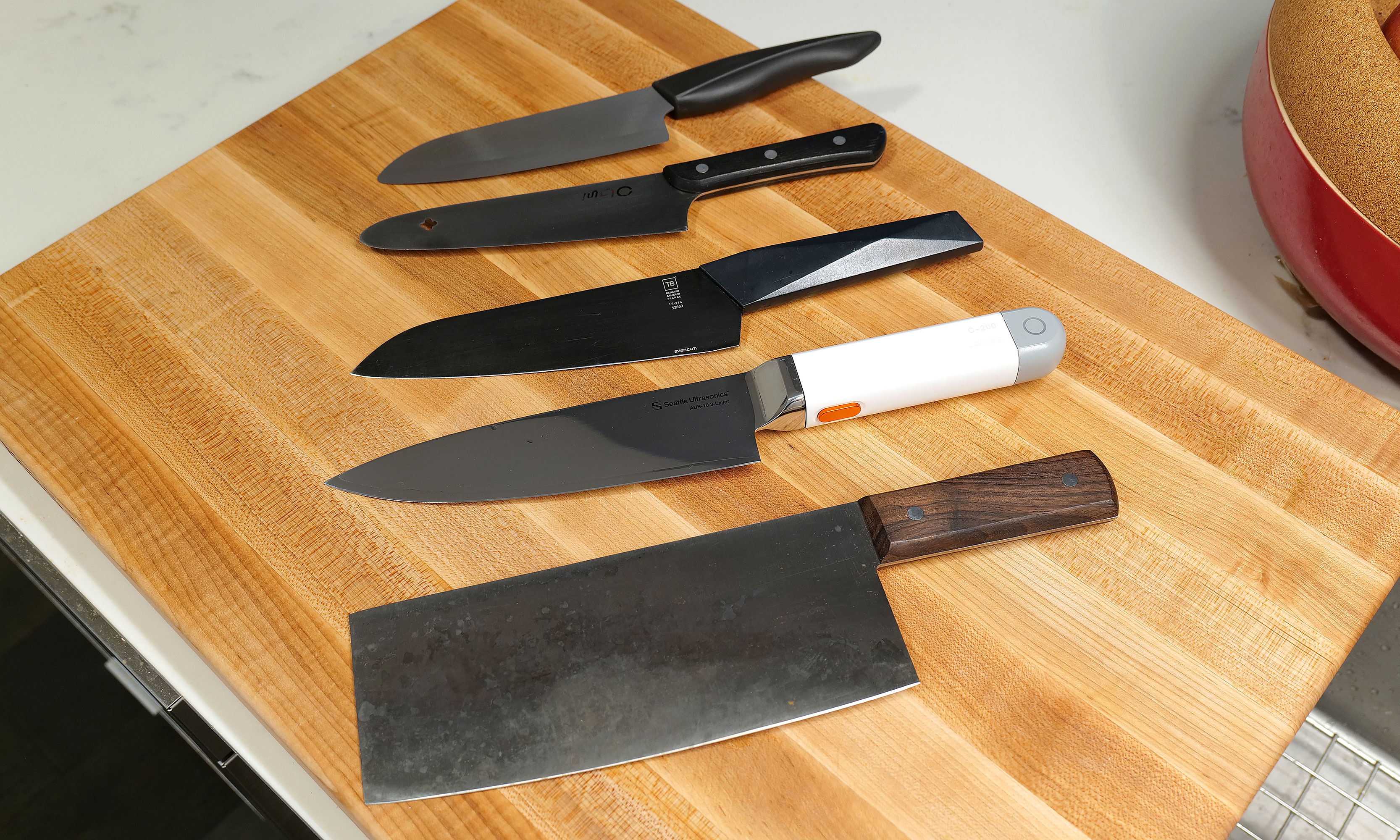
Here's a small selection of knives I own sorted by weight (from top to bottom) compared to the C200: 6-inch Kyocera ceramic knife (97 grams), MAC molybdenum steel chef's knife (110g), Furtif Evercut titanium carbide chef's knife (190g), Seattle Ultrasonics C-200 (328g), Korin carbon steel cleaver (396g).
Sam Rutherford for Engadget

The main downside to the C-200's design is that at 328 grams (around 0.75 pounds) it's heavier and bulkier than a typical knife. When compared to other knives I own, which are made from a wide variety of materials including, ceramic, molybdenum steel, carbon steel and even titanium carbide, it weighs more than everything else aside from my big Chinese cleaver (396 grams). And while it fits nicely in my hand, my wife said it takes a bit more effort for her to wield. It's not too much to the point where you don't want to use it. But for quick tasks, sometimes I found myself subconsciously reaching for lighter options like my 6-inch ceramic knife, which weighs just 97 grams. 

How it works

From a user standpoint, putting the C-200 to work couldn't be simpler. Just press the button and let the knife do its thing. The big difference from how knives like this work in sci-fi is that there's no audible hum or detectable vibration when it's on. It's practically silent (well, most of the time, but more on that later), so you have to trust that it's on or check the indicator light on the handle. That said, if you still don't believe anything is happening, you can run the edge of the blade under water or scrape it over some cut citrus, at which point the blade's vibration will atomize nearby liquid into a fine mist. It's a cool party trick that also doubles as a way to amp up a cocktail by adding a faint essence of lemon, lime or anything else you can think of.

Pushing the C-200's button is super easy, regardless of what kind of knife grip you prefer.
Sam Rutherford for Engadget

Inside, the knife relies on PZT-8 piezoelectric ceramic crystals to generate up to 30,000 vibrations per second, which propagate down the blade and make the knife function as if it's sharper than it actually is. This all sounds rather fantastic, so how does it function in the real world?

In-use

To really put the C-200 through its paces, I cooked over a dozen meals that involved neatly slicing or preparing a wide variety of foods — including Hasselback potatoes, flank steak, pork belly, chives, sushi-grade tuna and all sorts of fruit. 

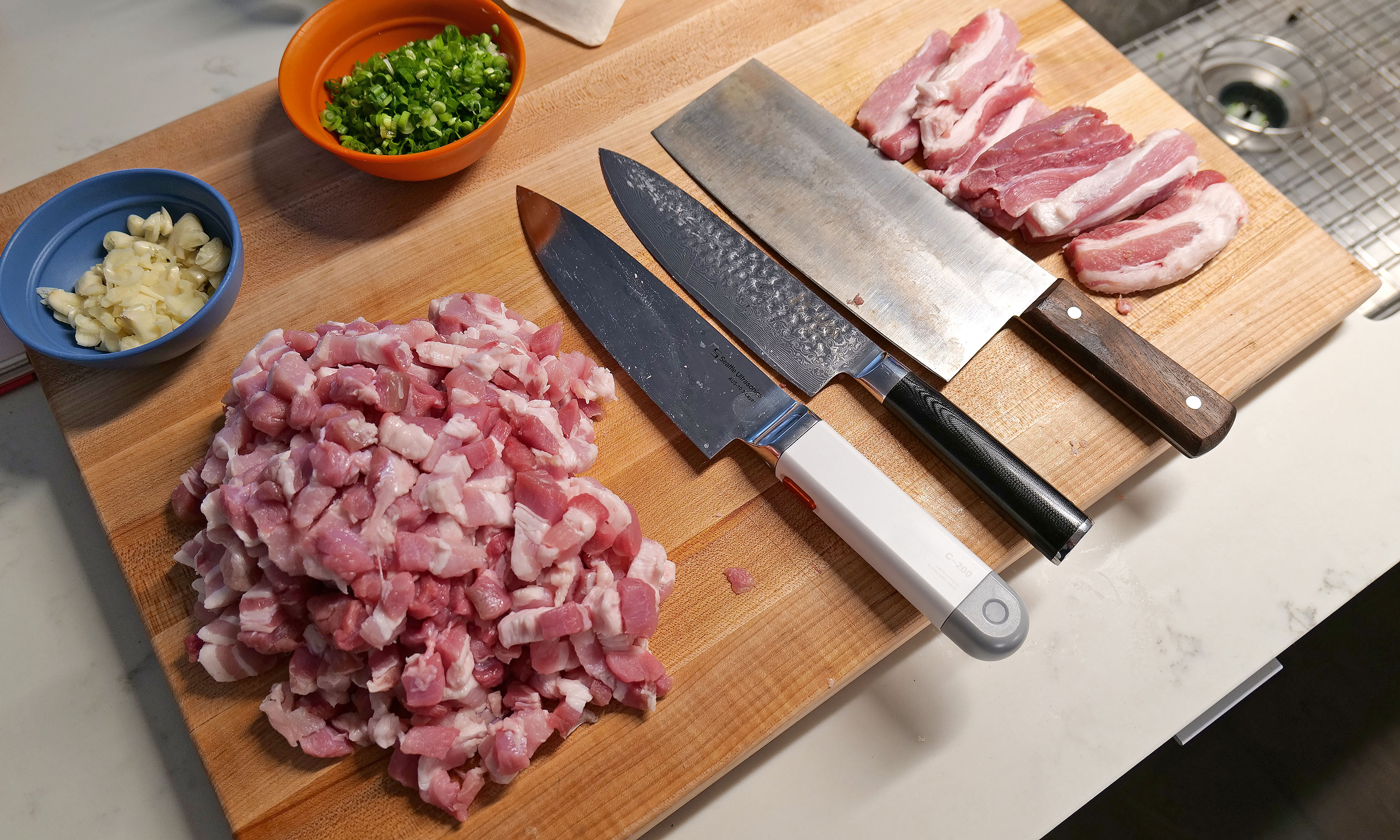
After prepping four pounds of pork belly with various knives, the C-200 really showed off how much of a difference its vibration tech makes.
Sam Rutherford for Engadget

In short, the C-200's effectiveness depends a lot on what you're chopping. For soft things like strawberries or a piece of cake, I didn't notice much of a difference. To make things even more difficult, the knife arrived out of the box with an incredibly fine edge — the kind that makes shearing through a sheet of paper child's play. So even though Seattle Ultrasonics says its knife can reduce cutting effort by up to 50 percent, there's not much gain to be had when slicing foods that could just as easily be cut by a butter knife. 

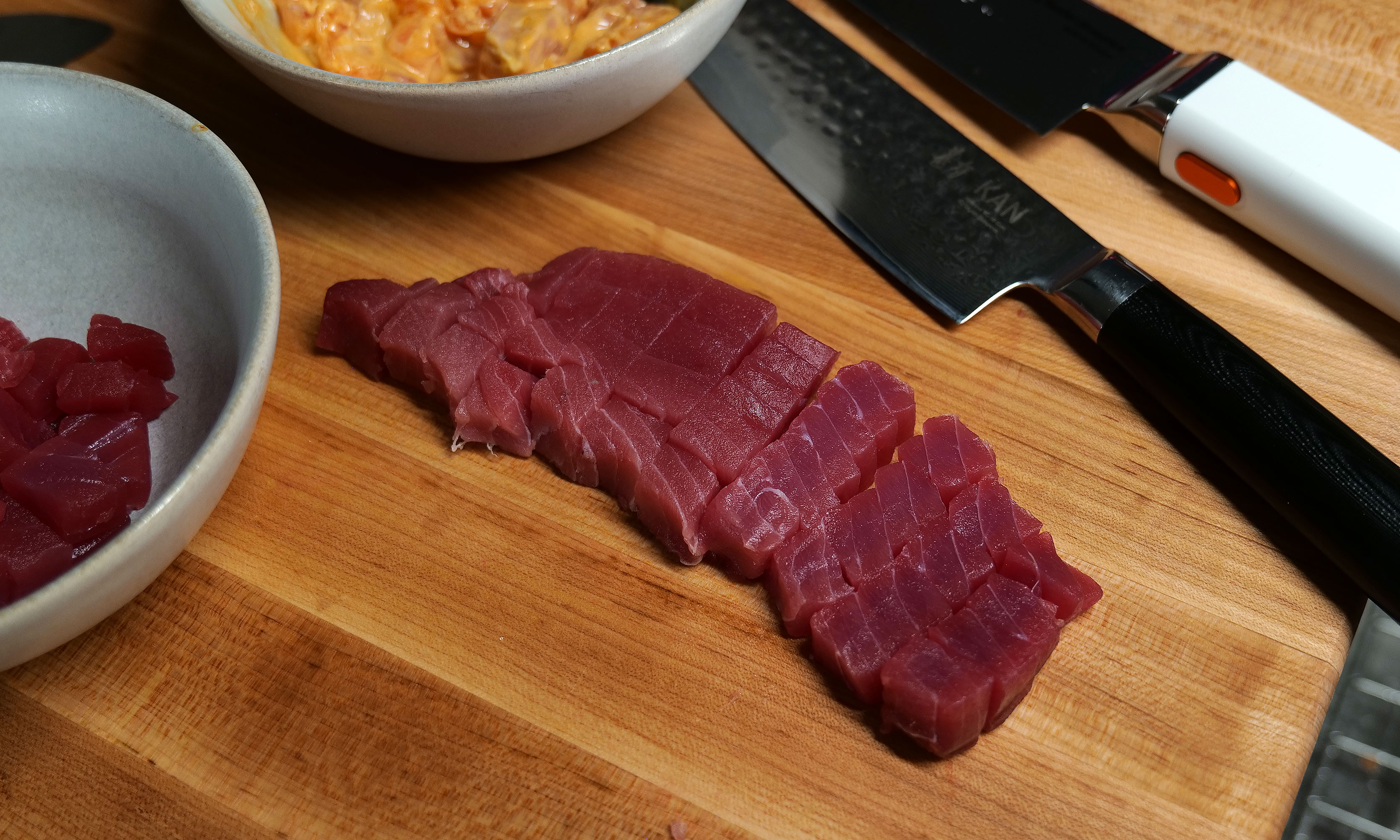
However, as I used it more, I found that the C-200 excels at cutting through delicate items like tomatoes, scallions and fish, where using a dull knife often results in bruising the food as you chop. This was most evident when I made poke at home, where Seattle Ultrasonic's knife delivered cleaner, more precise cuts than anything else I own. 

For me, the C-200's $399 price tag is almost worth it just so I have an an easier time making my one of my all-time favorite dishes (lu rou fan).
Sam Rutherford for Engadget

When I whipped up some pico de gallo, I distinctly noticed how neatly the C-200 sliced through the skin of a tomato, instead of initially putting a crease in it before cleanly passing through its interior — which often happens when using dull knives. An additional benefit is that because of the vibrations, I found some foods like garlic didn't stick to the side of the blade as much. This made it easier to keep track of how much I chopped while simultaneously reducing the mess from things falling willy-nilly during prep. But perhaps the most obvious demonstration of the knife's prowess was when I diced an onion. When using my other knives or the C-200 without powering it on, I could feel when I tried to cut through thicker, more sturdy layers. But then, at the touch of a button, I was able to slice down with practically no resistance. It's almost shocking because it feels like magic. 

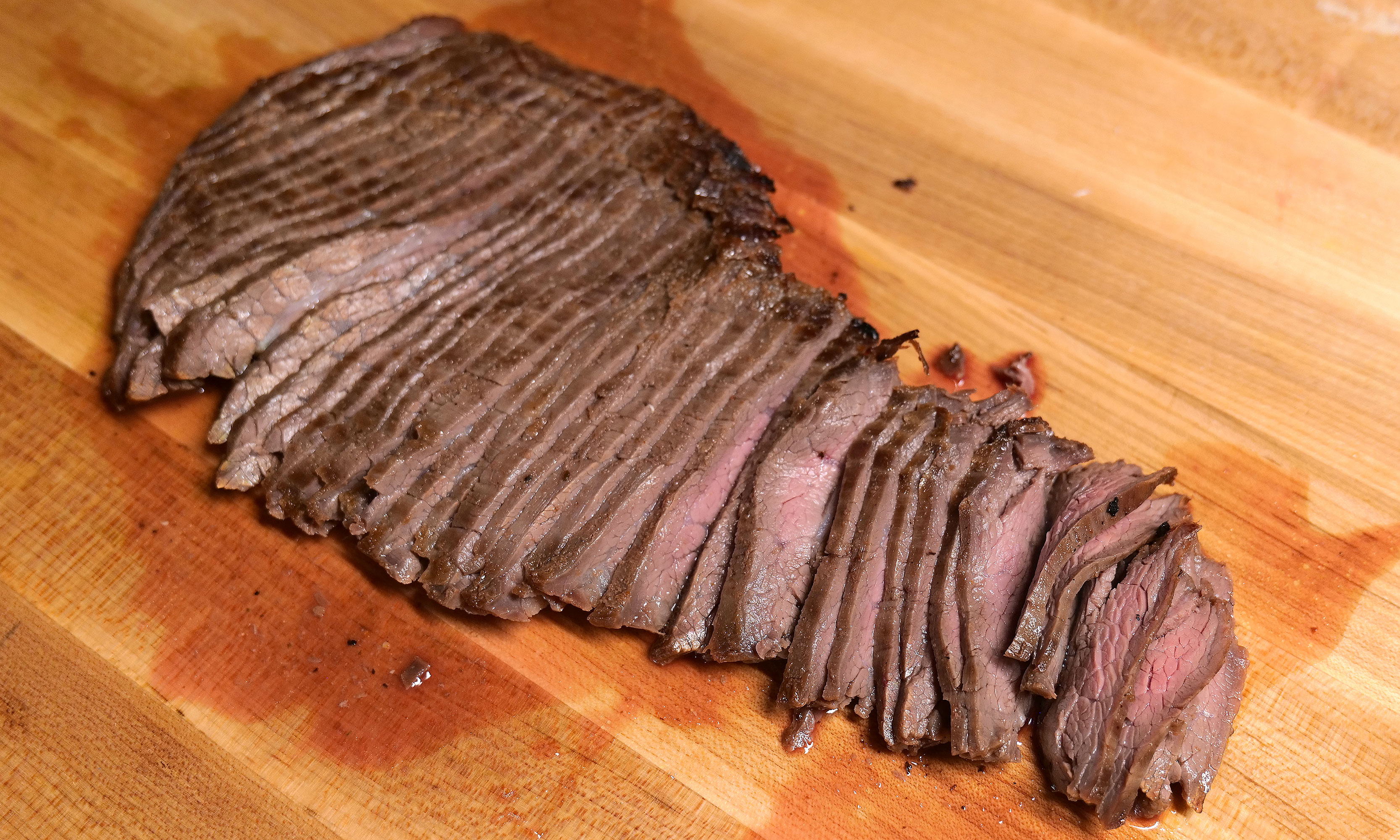
The C-200 truly excels at cutting denser foods like flank steak. Sadly mine ended up closer to medium than medium rare, but that's not the knife's fault.
Sam Rutherford for Engadget

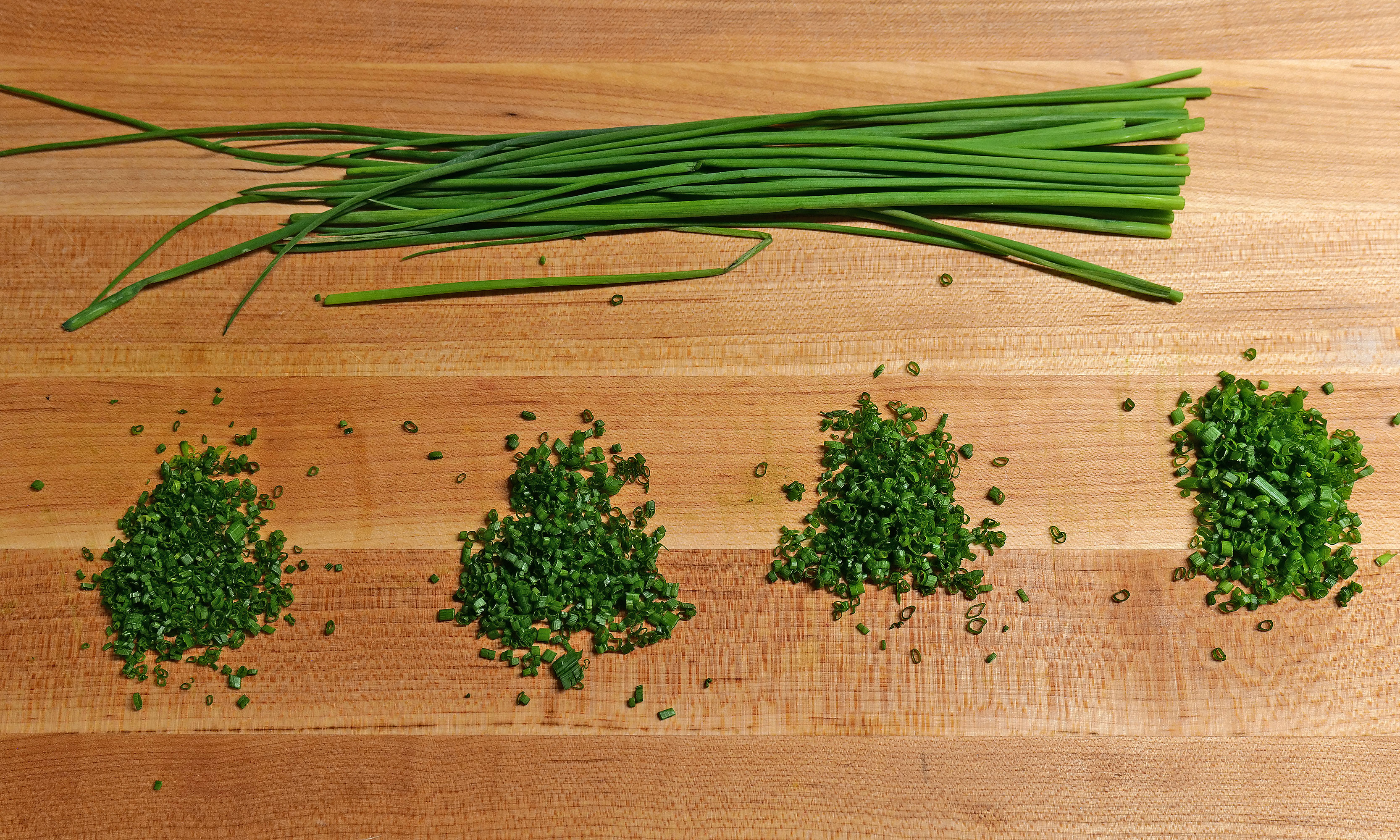
The C-200 even has the ability to reduce the importance of certain knife techniques. Anyone who's seen all the posts on r/kitchenconfidential about cutting chives will already know what I'm talking about. As J Kenji Lopez-Alt neatly demonstrated, the ideal way to get crisp, clean slices is to do a subtle forward or back cut instead of simply chopping straight down. But with Seattle Ultrasonics' knife, I've found that it's so sharp you can get away with almost any motion and still get good results. And if you do it the right way, things are even better. 

Other types of food that makes the C-200 really shine are denser ingredients like meat and potatoes, where you can really feel the added cutting power. Previously, when I had to break down thick cuts of protein, I sometimes wished I owned a serrated electric knife. You know, the kind you break out once a year on Thanksgiving and then it sits and gathers dust for the other 364 days. But the C-200 made that desire a thing of that past, as it quickly and easily worked through flank steak while once again producing neat, uniform slices. 

Sushi-grade tuna is another food that really shows off how the C-200's increased sharpness is better at preserving the delicate texture of the fish.
Sam Rutherford for Engadget

My favorite application of the C-200 was when I was doing prep for Taiwanese braised pork (aka 滷肉飯). Despite this being one of my most beloved dishes that I taught myself how to cook because I couldn't easily find it from local restaurants, I don't make it very often because it's a lot of work to cut multiple pounds of pork belly into small lardon-shaped pieces. Here, the knife's vibrations made it so much easier to cut through all those layers of meat, fat and skin. If there's any situation where the C-200 makes it 50 percent easier to slice through something, it's this. 

It might be hard to tell, but I was able to cut chives a little finer and more neatly with the C-200 (left) than with my other knives.
Sam Rutherford for Engadget

During my testing, two small issues cropped up. While it was quite rare, the knife would sometimes emit a faint high-pitched whine. When I asked Seattle Ultrasonic's founder Scott Heimendinger about this behavior, he was rather frank, saying that this can occur when water or moisture accumulates in just the right spots on the blade. Furthermore, he said this only happens on a small number of V1 models, which the company is working to fix in the future. Thankfully, I don't mind, but if it bothers you, making the noise go away is as easy as wiping down the knife down with a cloth or paper towel. 

The C-200s battery can be easily removed for cleaning and charging.
Sam Rutherford for Engadget

The other complication came while I was working through the multiple pounds of pork belly I mentioned earlier. After 10 to 15 minutes of continuous use, the knife beeped and its indicator light turned red. Turns out the knife had overheated, which was something I had not even considered. This led to higher-than-normal temperatures inside the knife's sealed electronics causing it to shut off. But after just 30 seconds, it returned to form. During later uses, I learned that simply taking my finger off the button between tasks, which happens naturally as you prep anyway, was more than enough to stop that situation from happening ever again.

On the flipside, I was happy to discover that despite lacking a full tang, the C-200 can handle fairly rough tasks, including laying the knife on its side to smash garlic or jamming it into an avocado to remove its pit. That said, I would really recommend against doing the latter, because between its inherent sharpness and its vibration tech, this is the first knife I've used that can slice cleanly through an entire avocado with almost no extra effort.

Cleaning and care

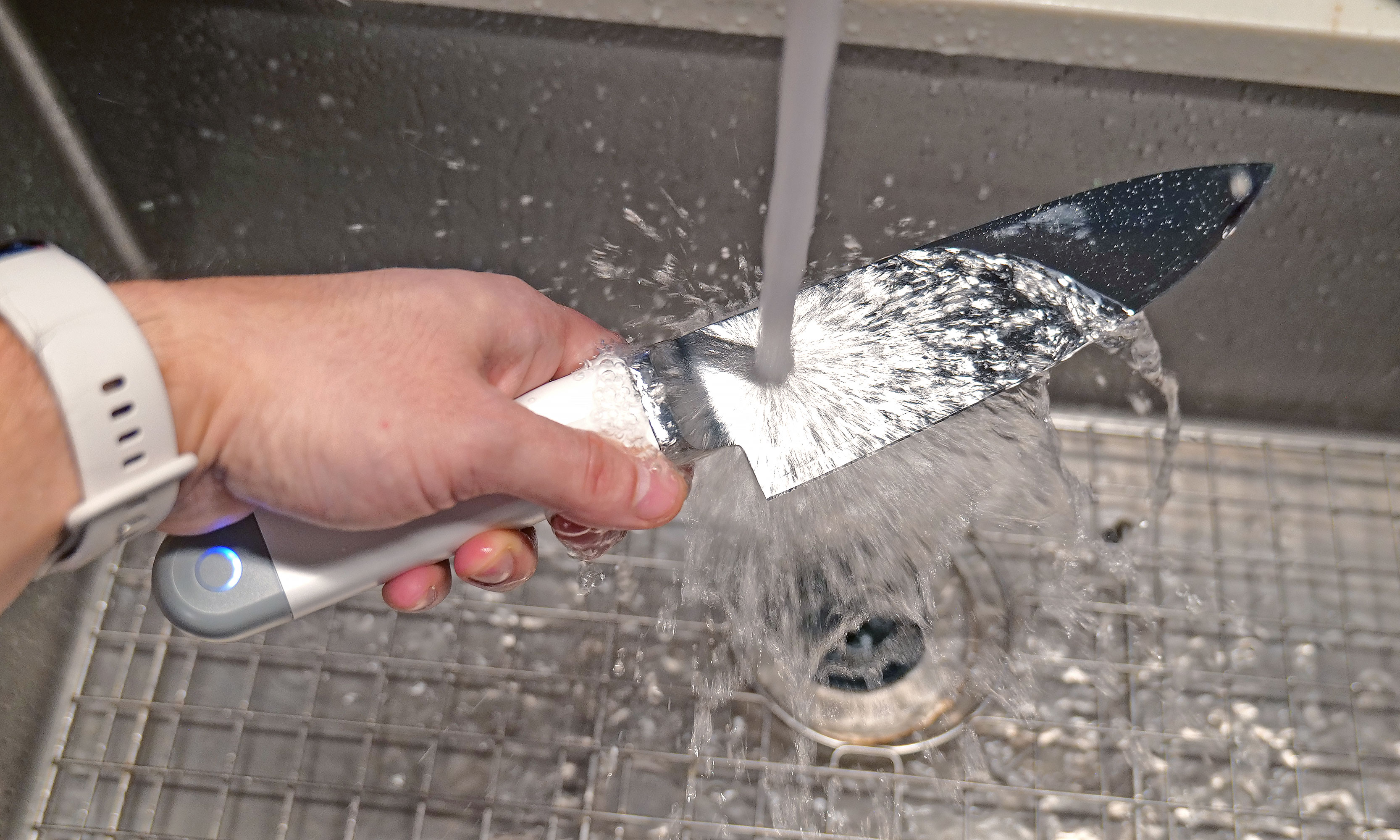
The Seattle Ultrasonics C-200 8-inch chef's knife features an IP65 rating for the whole device, though the front half is actually a bit more resistant thanks to an IP67 rating for its button and bolster.
Sam Rutherford for Engadget

The last big concern about a knife with built-in electronics is how it handles clean-up. Thankfully, the C-200 features an IP65 rating for dust and water resistance. That means it can withstand rinsing and splashes without issue. And it's actually even tougher than that, because the front of the knife, including its bolster and button, are rated IP67. This means it can take full submersions in water if need be. However, just because you can, doesn't mean you should. Good kitchen protocol says you don't throw knives you care about in the sink and forget them, just like how you wouldn't put one in the dishwasher either.  

But perhaps the greatest advantage of this tech is that it allows you to go longer between needing to get your knives sharpened, which if you're like most home cooks, is probably never. To be clear, I haven't tested this and in some respects I wish I had been able to test out a dull version of the C-200. That said, science dictates that slice for slice, an ultrasonic knife will simply cut better than an equivalent blade without the extra tech. So if you believe in the adage that a dull knife is more dangerous than a sharp one because you need to apply more force to get the same results, this is another bonus for both safety and convenience.

The not-so-optional accessory

Seattle Ultrasonics' wireless charging tile makes it incredibly easy to forget that the C-200 needs to be topped up between uses.
Sam Rutherford for Engadget

I fully admit the need to keep a knife charged up is a major annoyance and something I or anyone else probably doesn't want to do. Thankfully, Seattle Ultrasonics thought of that by including support for wireless charging via the C-200's magnetic tile and it's dead simple to use. Just toss it on the charger when you're not using and it will take care of itself, so you never have to worry about how much of its normal 20-minute runtime it may or may not have left. There are also holes around back so you can easily mount the charger on a wall or shelf. In short, the added convenience the charging tile brings is so valuable that I don't really consider it an optional accessory. If you're getting the C-200, you need to buy this too, which sadly means you're looking at an all-in price of $500 for the bundle instead of just $400 for the knife by itself. 

Wrap-up

As much as I love old-school knives, they'll simply never be as sharp an equivalent blade with this newfound tech.
Sam Rutherford for Engadget

After using the C-200, I don't think people need to rush out and throw all their old-school knives in the trash. The beauty of an ultrasonic blade like this is that it can handle everything your old cutlery is meant for, but with the touch of a button, it delivers sharpness unlike anything you've experienced before. And while it has some quirks, they're nothing like the kind you typically encounter on first-gen gadgets. Its biggest drawback is that its magnetic charging tile feels like an essential accessory, but it adds extra cost on top of a product that already has a deservedly premium price tag. 

Even though I'm sure knife makers will continue tweaking blade shapes and alloy mixes from now until the end of time, the addition of ultrasonic vibrations to a chef's knife unlocks a completely new tier of performance. That's because this technology is additive. All it does is enhance what a blade already does best. And when you look at related gadgets in the maker space, I don't think it's a coincidence that there's a similar revolution that resulted in Adam Savage of Mythbusters fame naming a sonic cutter as one of his favorite things of 2025. When viewed that way, it makes me even more confident that the C-200 is the flagbearer for a new breed of kitchen knives. 


This article originally appeared on Engadget at https://www.engadget.com/home/kitchen-tech/seattle-ultrasonics-c-200-review-this-is-the-future-of-kitchen-knives-140000051.html?src=rss

©

  •  
❌