
❌

Normale Ansicht

Good Luck, Have Fun, Don't Die rails against AI in style

You've seen this movie before: A disheveled man (Sam Rockwell) busts into a restaurant, threatening to blow up the joint unless a crew of people joins him. Like Groundhog Day, he's been through this countless times before, and he immediately starts recounting otherwise unknowable details to convince the diner patrons. Like 12 Monkeys, he's from the future — the timely twist in Good Luck, Have Fun, Don't Die is that, rather than a world-ending virus, he needs help preventing a humanity-ending AI from being born. 

Good Luck is more of a primal scream than a thoughtful articulation about where everything went wrong. There's a bit of "old man yells at cloud" energy here (director Gore Verbinski is 61, and screenwriter Matthew Robinson is 47), but it fits the film's satirical tone. Looking around at the world today, who doesn't wish they could warn their past selves about the tech industry and the new ruling class it helped breed. 

Rockwell's character eventually wrangles a ragtag crew of future saviors: Mark and Janet (Michael Pena and Zazie Beetz), a married couple of high school teachers; Susan (Juno Temple), a distraught mother; and Ingrid (Haley Lu Richardson), a sad woman wearing a princess dress. There's also Asim Chaudhry's Scott, who mostly serves as comic relief, but doesn't get any real backstory like the others. 

Good Luck wastes no time fleshing out its present near-dystopia in episodic chapters. It turns out Mark and Janet are also on the run from smartphone-obsessed high schoolers, who spend their days scrolling through endless TikTok-like feeds. Susan is forced to confront a horrific situation around her son (I won't get into specifics here, but it's a distinctly American phenomenon). And Ingrid is literally allergic to Wi-Fi and smart devices, which makes it hard to fit into the modern world. 

Each of these scenarios play out like mini Black Mirror episodes. Everything is heightened to the absurd, and all the problems can be traced back to unchecked technological encroachment and capitalism. Nothing subtle there. The glimpses of an apocalyptic future are even less so — all we see are destroyed cities, people trapped in VR headsets (which place them in an AI-generated reality) and robots hunting down anti-AI humans. 
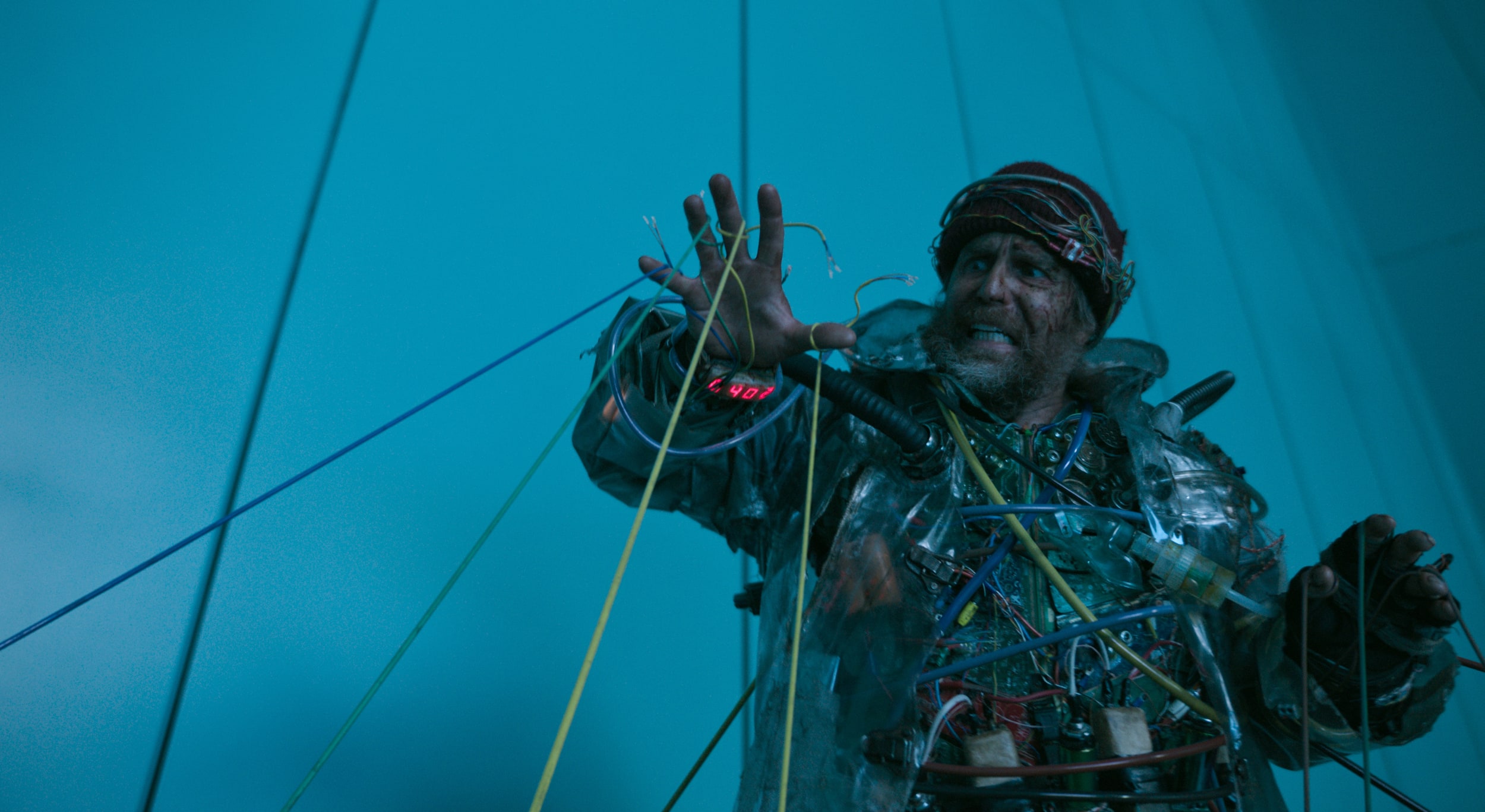
Sam Rockwell in Good Luck, Have Fun, Don't Die.
Briarcliff Entertainment

Good Luck is at its best when it's simply having fun. As Rockwell and crew make their way to their final destination — a child who is about to invent true AI — they encounter pig-faced assassins, Stepford-esque parents and an adorably horrific kaiju. Even when faced with half-baked scripts, Verbinski always manages to impress visually (think back to the creepiness of The Ring, or the wildly entertaining set pieces in Pirates of the Caribbean). That's as true as ever here, where the final scene evokes the hyper-tech chaos of Akira.

As much as Good Luck, Have Fun, Don’t Die, evokes classic sci-fi, it still can’t hold a candle to the sheer terror of seeing AI unleash a nuclear bomb in Terminator 2. And despite its zanines, it doesn’t reach the madcap heights of Gilliam’s Brazil or 12 Monkeys. But if you’re sick of having AI products shoved down your throat, and you think the notion of “true AI” is a farce, it’s a fun way to channel your rage.

This article originally appeared on Engadget at https://www.engadget.com/entertainment/tv-movies/good-luck-have-fun-dont-die-rails-against-ai-in-style-154437854.html?src=rss

©

  •  

Meta really wants you to believe social media addiction is 'not a real thing'

Meta went to court this week in two major trials over alleged harms facilitated by its platform. In New Mexico, the state's attorney general has accused the company of facilitating child exploitation and harming children through addictive features. In a separate case in Los Angeles, a California woman sued the company over mental health harms she says she suffered as the result of addictive design choices from Meta and others.

In both cases, Meta has disputed the idea that social media should be considered an "addiction." On the stand this week, Instagram chief Adam Mosseri said that social media isn't "clinically addictive," comparing it to being "addicted" to a Netflix show.

In opening statements in the New Mexico trial, Meta's lawyer Kevin Huff went further. He told the jury that "social media addiction is not a thing" because it's not in the Diagnostic and Statistical Manual of Mental Disorders (DSM), the handbook used by mental health professionals in the US.

"According to the American Psychiatric Association, they don't recognize the concept of social media addiction in the same way as addiction to drugs and alcohol," Huff said during opening arguments that were broadcast by Courtroom View Network. "What you see on the screen is what's called the DSM, which is basically the official manual for recognized mental disorders. The American Psychiatric Association studied this and decided that social media addiction is not a thing."

But the American Psychiatric Association (APA) has never said that social media addiction doesn't exist. The organization provides information and resources about social media addiction on its website. "Social media addiction is not currently listed as a diagnosis in the DSM-5-TR—but that does not mean it doesn’t exist," the APA said in a statement to Engadget.

Dr. Tania Moretta, a clinical pyschophysiology researcher who has studied social media addiction, agrees. "The absence of a DSM classification does not mean that a behavior cannot be addictive, maladaptive or clinically significant," she told Engadget. That argument, she said, "reflects a misunderstanding" of how psychiatry professionals define and classify conditions. "Diagnostic manuals formalize scientific consensus; they do not define the boundaries of legitimate scientific inquiry. Many maladaptive behaviors and clinically significant symptom patterns are studied and treated well before receiving official classification."

Meta's critics have long claimed that the company has profited from addictive features that hook children and teens. The trials in Los Angeles and New Mexico are just the start of several court battles over the issue. The social media company is also facing a high-profile trial with school districts in June, and lawsuits from 41 state attorneys general. 

Moretta said that social media addiction is a field that requires more study, but that there is already evidence that it can have harmful effects on some people. "At present, from a scientific perspective, there is documented evidence that social media use disorder is associated with both psychophysiological alterations, including changes in reward/motivational and inhibitory/regulatory systems, and clinically significant negative impacts on functioning (e.g., sleep disturbances, psychological distress, impairment in social, academic, or occupational domains)," she said. "The key question is not whether all social media use is addictive, but whether a subset of users exhibits patterns consistent with behavioral addiction models and whether specific platform design features may exacerbate vulnerability in predisposed individuals."

Both trials are ongoing and expected to last the next several weeks. In New Mexico, jurors have already heard from former employee turned whistleblower Arturo Bejar and former exec Brian Boland, both of whom have publicly criticized the company for not prioritizing safety. In Los Angeles, Mosseri's testimony has wrapped up, but Meta CEO Mark Zuckerberg is expected to testify next week. The trials will also feature extensive internal documents from Meta, including details about the company's own research into the mental health impacts of its platform on young people.

This article originally appeared on Engadget at https://www.engadget.com/social-media/meta-really-wants-you-to-believe-social-media-addiction-is-not-a-real-thing-130000257.html?src=rss

©

  •  

There's a new John Wick game on the way

There's a new AAA John Wick game coming with Keanu Reaves portraying the main character both in voice and likeness, Lionsgate and Saber Interactive announced. Currently untitled, it's in development for PS5, Xbox Series X and S, and PC, and will be a single-player third-person experience designed for "mature" audiences. So far, there's no release date. 

"The new single-player third-person action game will combine John Wick’s unparalleled, adrenaline-fueled 'gun-fu' fighting style with Saber’s proven reputation for creating thrilling gaming experiences that leave players craving more," the companies said in an announcement post. They added that franchise director Chad Stahelski and star Keanu Reeves are both involved in the game’s production, with Reeves reprising his character's look, voice and more. 

The story is original and "addresses a significant time in John Wick's life," according to the game's director Jesus Iglesias. It will include both familiar film characters and new ones created for the game. As for gameplay, it will offer "a hard-hitting gun-fu combat system, jaw-dropping camerawork, intense driving experiences, cinematic storytelling, and a bold range of atmospherically immersive environments," the team said.

Saber Interactive is the developer behind Warhammer 40,000: Space Marine 2 and is also developing the upcoming titles Jurassic Park: Survival and John Carpenter's Toxic Commando. It will be the first John Wick game since John Wick Hex, which came out in 2019 but was recently delisted. 

This article originally appeared on Engadget at https://www.engadget.com/gaming/theres-a-new-john-wick-game-on-the-way-103900064.html?src=rss

©

  •  

Marvel Tōkon: Fighting Souls lands on PS5 and PC August 6 with X-Men in tow

Marvel Tōkon: Fighting Souls was first announced last year as a tag fighting game feature superheroes including Captain America, Ms Marvel and Spider-Man, with a launch sometime in 2026. We expected more details to be revealed at Sony's State of Play yesterday and indeed they were. The game will arrive August 6 on PS5 and PC and include the Unbreakable X-Men's Storm, Magik, Wolverine, and Danger. 

The trailer teases each character's fighting style, with Magik and Wolverine using a more in-your-face melee fighting style. Storm and Danger, meanwhile, offer more diverse attack abilities, with Storm manipulating wind and lightning and Magik deploying sorcery skills. We also saw a team-based finisher attack with all four characters joining forces to unleash a flurry of attacks. The trailer also revealed that Marvel Tōkon: Fighting Souls will offer an Episode Mode with a "new form of storytelling adapted for a modern video game format" that marries Manga with American comics. 

MARVEL Tōkon: Fighting Souls launches on August 6, 2026 for PS5 and PC. Pre-orders open February 19, 2026 at the PlayStation Store and PC storefronts. It will be sold in three versions: the $60 Standard Edition, $85 Digital Deluxe Edition (includes the full game, all pre-order incentives, a Year 1 Characters and Stage Pass) and Howard the Duck and Cosmo. Finally, the $100 Ultimate Edition includes all the preceding, plus costumes for Storm, Captain America, Doctor Doom, Iron Man, and Spider-Man, along with an Animated Chromatic color unlock for all 20 launch characters. 

This article originally appeared on Engadget at https://www.engadget.com/gaming/marvel-tokon-fighting-souls-lands-on-ps5-and-pc-august-6-with-x-men-in-tow-095235773.html?src=rss

©

  •  
❌