❌

Normale Ansicht

Google is appealing the ruling from its search antitrust case to avoid sharing data with rivals

Google has filed its appeal to the Department of Justice’s antitrust case that ended with a federal judge ruling that the company was maintaining a monopoly with its search business. While the company goes through the appeals process, it’s also asking that implementation of the remedies from the case, which include a requirement that Google share search data with its competitors, also be paused.

“As we have long said, the Court’s August 2024 ruling ignored the reality that people use Google because they want to, not because they’re forced to,” Google said in a statement. “The decision failed to account for the rapid pace of innovation and intense competition we face from established players and well-funded start-ups. And it discounted compelling testimony from browser makers like Apple and Mozilla who said they choose to feature Google because it provides the highest quality search experience for their consumers.”

The company says that the requirement that it “provide syndication services to rivals” and share search data is a privacy risk and could “discourage competitors from building their own products.” Both remedies where compromises based on what the Justice Department originally proposed, which included forcing Google to sell its Chrome web browser.

After a 10-week trial held in 2023, Google was found to have a search monopoly in 2024 because of the placement it maintained as the default search engine on multiple platforms, and the control it exerted over the ads that appear in search results. Both arguments were key points in the DOJ’s original 2020 lawsuit.

This article originally appeared on Engadget at https://www.engadget.com/big-tech/google-is-appealing-the-ruling-from-its-search-antitrust-case-to-avoid-sharing-data-with-rivals-215107905.html?src=rss

©

  •  

Anthropic opens up its Claude Cowork feature to anyone with a $20 subscription

Claude Cowork, Anthropic's AI assistant for taking care of simple tasks on your computer, is now available for anyone with a $20 per month Pro subscription to try. Anthropic launched Cowork as an exclusive feature for its Max subscribers, who pay a minimum of $100 per month for more uses of Claude's expensive reasoning models and early access to experimental features. Now Claude Cowork is available at a cheaper price, though Anthropic notes "Pro users may hit their usage limits earlier" than Max users do.

Like other AI agents, the novelty of Claude Cowork is its ability to work on its own. If you have the macOS Claude app and a Pro subscription, you can prompt Claude Cowork to work on tasks on your local computer, like creating documents based on files you have saved or organizing your folders. The feature is an evolution of Claude Code, Anthropic's AI coding agent, and can similarly use connectors and the Claude Chrome plugin to work with other apps and the web.

As part of this expanded rollout, Anthropic has included a few fixes inspired by early user feedback. You'll now be able to rename sessions with Claude Cowork ("Tasks" in the parlance of the Claude app) and the company says the AI assistant will offer better file format previews, more reliable use of connectors to other apps and confirmation messages before it deletes files.

Coding agents top the list of applications of AI that have gained real traction in the last year, so Anthropic applying what it learned with Claude Code to a more general collection of computer tasks makes sense. Claude Cowork is still limited to macOS and Anthropic's paid subscribers, but assuming the AI agent continues to be popular, it wouldn't be surprising if the company brought it to other platforms.

This article originally appeared on Engadget at https://www.engadget.com/ai/anthropic-opens-up-its-claude-cowork-feature-to-anyone-with-a-20-subscription-194000021.html?src=rss

©

  •  

Bluesky's 'Live Now' badge is available to everyone

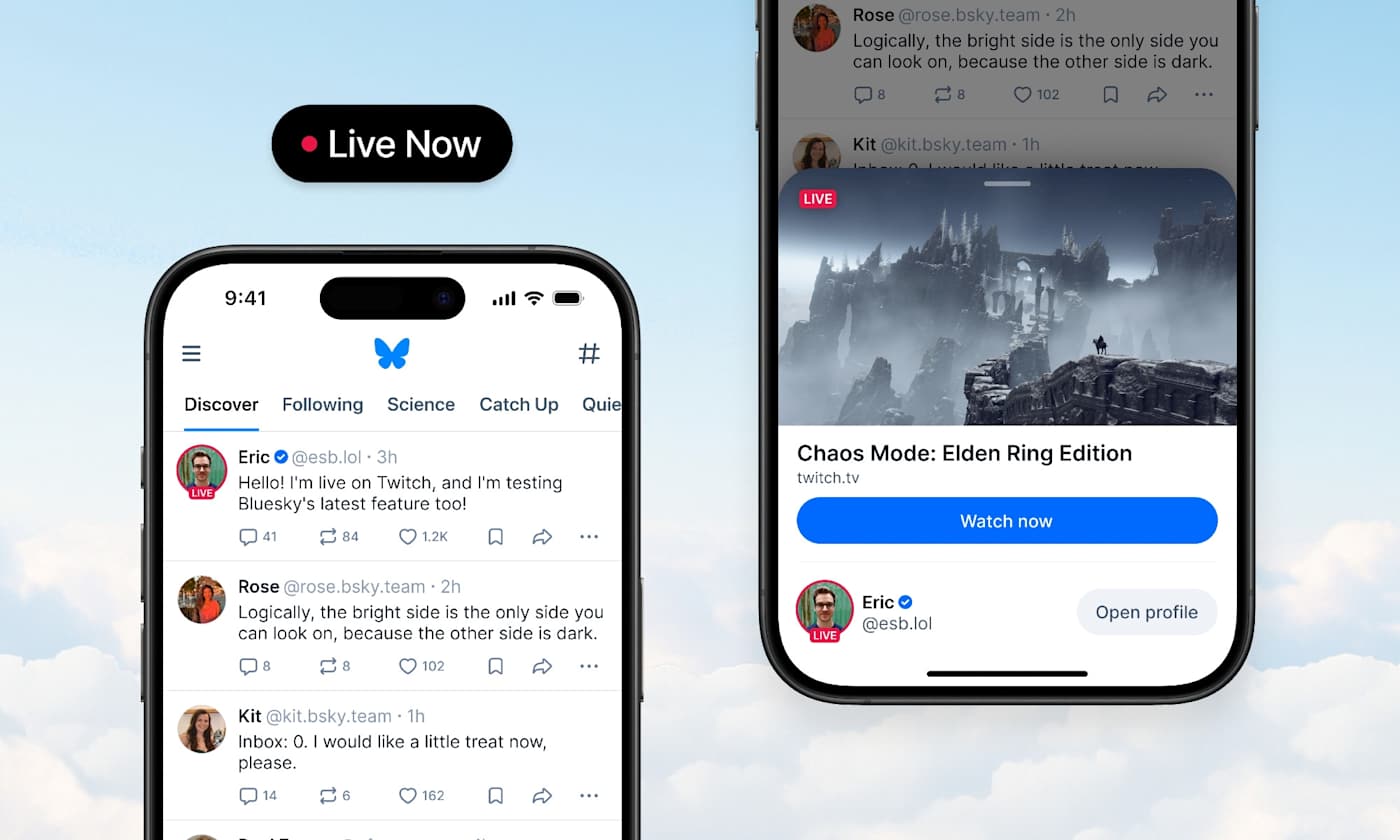
After testing the feature in a limited beta, Bluesky is making its "Live Now" badge for streamers available for everyone on the social network to try. Live Now is included as part of Bluesky's v1.114 update, alongside "cashtags," a separate type of hashtag for collecting conversations about publicly-traded companies.

Bluesky first started testing its Live Now badge in May 2025 with a limited group of accounts, including the official NBA account. The feature lets Twitch streamers with Bluesky profiles append a Live Now badge to their profile picture that links directly to their livestream. Live Now badges are limited to Twitch links for now, but Bluesky says "support for other streaming platforms may follow" as it learns from the beta. Linking to other social platforms shouldn't be a radical concept, but since Bluesky's competitor X has tried to prevent users from posting links in the past, the company has made it a point of trying to do the opposite.

Cashtags are a similar attempt to appeal to a certain type of veteran X user. Originally a feature of pre-Musk Twitter, cashtags work like a hashtag, marking posts in a way that makes them easy to find in a search or by tapping the cashtag itself. On Bluesky, by typing a dollar sign ($) and the stock abbreviation of a company (AAPL for Apple, for example), you can add a cashtag to your post that links it to other posts using the same cashtag. So far, the cultural makeup of Bluesky hasn't seemed as business-oriented as X, but the feature suggests Bluesky wants the option to be available for anyone who jumps ship.

This article originally appeared on Engadget at https://www.engadget.com/social-media/blueskys-live-now-badge-is-available-to-everyone-223335221.html?src=rss

©

  •  

Netflix's expanded Sony deal includes streaming rights to the Legend of Zelda movie

As part of a new agreement, films from Sony Pictures Entertainment will stream on Netflix first, the companies announced via a joint statement. The new deal expands on the exclusive rights Netflix had to Sony films in the US, and means the service will be the first place people will be able to stream upcoming projects like the live-action adaptation of The Legend of Zelda, and a quartet of biopics about The Beatles.

Sony's films will stream worldwide on Netflix in what's called "Pay-1," the first window of availability after a movie's theatrical and VOD releases. As part of the deal, Netflix is also licensing an undisclosed number of films and television shows from the Sony Pictures back catalog to help fill out its library. Netflix says the new arrangement "will roll out gradually" as licensing rights become available throughout the year, with full availability happening sometime in 2029. Neither company shared how long this new setup will last, but did describe the deal as a "multi-year agreement."

Netflix and Sony's partnership has been fruitful so far. Films like Spider-Man: Across the Spider-Verse, Uncharted and Anyone But You have had popular second lives on the streaming service. In the case of KPop Demon Hunters, Netflix was also able to spin a surprise Sony Animation streaming hit into a profitable theatrical run. Netflix will pay Sony north of $7 billion for this new deal, Variety reports — clearly that's worth it to secure the companies’ relationship for another few years.

Netflix has a similar deal with Universal, which has brought other Nintendo adaptations to the streaming service like The Super Mario Bros Movie. Beyond licensing, the company has an even bigger purchase in mind, though: buying Warner Bros. for $82.7 billion. In an effort to prevent the deal from going through, Paramount is now suing Warner Bros. Discovery for ignoring its own competing bid for the company.

This article originally appeared on Engadget at https://www.engadget.com/entertainment/streaming/netflixs-expanded-sony-deal-includes-streaming-rights-to-the-legend-of-zelda-movie-203011384.html?src=rss

©

  •  
❌