Now that Artemis II is all wrapped up, NASA has begun its post-game performance analyses of all the systems that worked together to get four astronauts safely to the moon and back earlier this month. In addition to taking humans farther than ever before, Artemis II served as a crucial test flight for upcoming crewed missions that are planned for as soon as 2027 and 2028, the latter being NASA's ambitious target for landing astronauts on the lunar surface. So far, the Orion spacecraft and the SLS rocket seem to have fared pretty well.
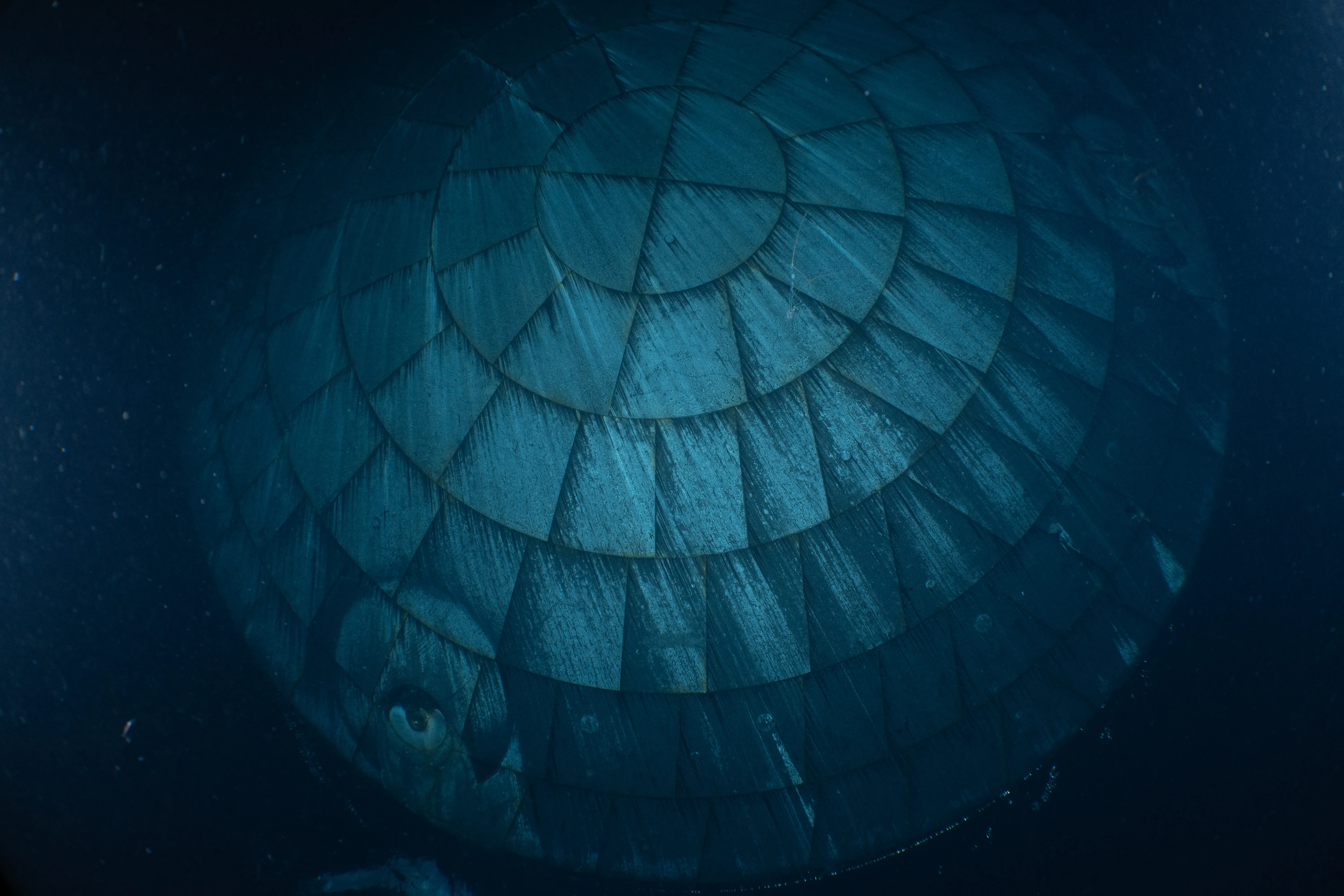
NASA says its initial assessments of the crew capsule show its heat shield "performed as expected, with no unusual conditions identified," and it didn't exhibit as much char loss as seen in the uncrewed Artemis I test. (Navy divers snapped some really cool pictures of the heat shield underwater after splashdown, as seen below). Splashdown went according to plan, with Orion landing 2.9 miles from its targeted landing site, according to NASA, and its entry interface velocity "was within one mile-per-hour of predictions."
US Navy
NASA says the SLS rocket performed well, too. It still has tests to run, but, "At main engine cutoff, when the core stage’s RS-25 liquid engines shutdown, the spacecraft was traveling at over 18,000 miles per hour, achieving its insertion velocity for orbit, and executing a precise bullseye for its intended location," the space agency noted in a blog post.
One thing that we know did cause some issues, though, was the toilet system. Shortly after launch, the astronauts reported problems with the urine vent line, which mission specialist Christina Koch was able to troubleshoot with help from the ground crew. But, everyone would like to avoid that on the next mission, so NASA now has teams checking out the hardware and data to identify what went wrong and how to prevent it.
Watch the Earthset
The Artemis II astronauts have continued to share glimpses into their journey around the moon, and this week, the mission's commander, Reid Wiseman posted an incredible video of the Earth setting behind the moon, as seen from the Orion spacecraft. Humans haven't seen that phenomenon firsthand in over 50 years, since the last Apollo mission. Read more about that here.
Only one chance in this lifetime…
Like watching sunset at the beach from the most foreign seat in the cosmos, I couldn’t resist a cell phone video of Earthset. You can hear the shutter on the Nikon as @Astro_Christina is hammering away on 3-shot brackets and capturing those… pic.twitter.com/8aWnaFJ69c
While ten days might not seem like that long of a time to be in space, it still does things to the body, and returning to Earth has been a bit of an adjustment for the crew. Astronaut Koch last week posted a video of herself struggling through a tandem walk exercise with her eyes closed, taken after her return to Earth. "When people live in microgravity, the systems in our body that have evolved to tell our brains how we’re moving, the vestibular organs, don’t work correctly," she explained in the caption. "Our brains learn to ignore those signals and so when we first get back to gravity, we are heavily reliant on our eyes to orient ourselves visually."
This article originally appeared on Engadget at https://www.engadget.com/science/nasas-initial-takeaways-from-the-artemis-ii-mission-and-more-science-stories-160000808.html?src=rss
Need something new for your reading list? Here are two titles we think are worth checking out. This week, we read Monsters in the Archives: My Year of Fear with Stephen King and the first issue of the Image Comics miniseries, Corpse Knight.
This article originally appeared on Engadget at https://www.engadget.com/entertainment/what-to-read-this-weekend-monsters-in-the-archives-dives-deep-into-stephen-kings-early-works-150000954.html?src=rss
Despite the months-long feud between Anthropic and the Pentagon, the National Security Agency is using the AI company's new Mythos Preview, according to Axios, which spoke to two sources with knowledge of the matter. Anthropic announced Mythos Preview at the beginning of April, describing it as a general-purpose language model that is "strikingly capable at computer security tasks." But back in February, Trump ordered all government agencies to stop using Anthropic's services after the company refused to budge on certain safeguards for military uses during contract talks.
The news comes days after Anthropic CEO Dario Amodei met with White House chief of staff Susie Wiles and other officials, reportedly to discuss Mythos. The White House later said the meeting on Friday was "productive and constructive," though President Trump said he had "no idea" about it when asked by reporters, Reuters reports. According to Axios' sources, the NSA is one of the roughly 40 organizations Anthropic gave access to Mythos Preview, and one said it's "being used more widely within the department" too.
This article originally appeared on Engadget at https://www.engadget.com/ai/the-nsa-is-reportedly-using-anthropics-new-model-mythos-211502787.html?src=rss
In case you haven't gotten around to reading Palantir CEO Alex Karp and Nicholas W. Zamiska's 2025 book, The Technological Republic, (because why would you do that to yourself?), the company best known for supplying AI-driven defense and surveillance software to the likes of the US Army, ICE and NYPD shared a 1,000-word X post this weekend covering its main points. The entire thing is both bizarre and deeply concerning. "The ability of free and democratic societies to prevail requires something more than moral appeal,” one of the 22 points states. "It requires hard power, and hard power in this century will be built on software."
The book is billed as "a passionate call for the West to wake up to our new reality," and other excerpts in the social media post include assertions such as: "Free email is not enough. The decadence of a culture or civilization, and indeed its ruling class, will be forgiven only if that culture is capable of delivering economic growth and security for the public"; "National service should be a universal duty"; "The postwar neutering of Germany and Japan must be undone"; and "Some cultures have produced vital advances; others remain dysfunctional and regressive."
The statement criticizes the West’s resistance to "defining national cultures in the name of inclusivity," as well as the treatment of billionaires and the "ruthless exposure of the private lives of public figures." It's a lot to take in, and it should make crystal clear what Palantir stands for to anyone who somehow didn't already know. Here's the post, in full:
Because we get asked a lot.
The Technological Republic, in brief.
1. Silicon Valley owes a moral debt to the country that made its rise possible. The engineering elite of Silicon Valley has an affirmative obligation to participate in the defense of the nation.
2. We must rebel against the tyranny of the apps. Is the iPhone our greatest creative if not crowning achievement as a civilization? The object has changed our lives, but it may also now be limiting and constraining our sense of the possible.
3. Free email is not enough. The decadence of a culture or civilization, and indeed its ruling class, will be forgiven only if that culture is capable of delivering economic growth and security for the public.
4. The limits of soft power, of soaring rhetoric alone, have been exposed. The ability of free and democratic societies to prevail requires something more than moral appeal. It requires hard power, and hard power in this century will be built on software.
5. The question is not whether A.I. weapons will be built; it is who will build them and for what purpose. Our adversaries will not pause to indulge in theatrical debates about the merits of developing technologies with critical military and national security applications. They will proceed.
6. National service should be a universal duty. We should, as a society, seriously consider moving away from an all-volunteer force and only fight the next war if everyone shares in the risk and the cost.
7. If a U.S. Marine asks for a better rifle, we should build it; and the same goes for software. We should as a country be capable of continuing a debate about the appropriateness of military action abroad while remaining unflinching in our commitment to those we have asked to step into harm’s way.
8. Public servants need not be our priests. Any business that compensated its employees in the way that the federal government compensates public servants would struggle to survive.
9. We should show far more grace towards those who have subjected themselves to public life. The eradication of any space for forgiveness—a jettisoning of any tolerance for the complexities and contradictions of the human psyche—may leave us with a cast of characters at the helm we will grow to regret.
10. The psychologization of modern politics is leading us astray. Those who look to the political arena to nourish their soul and sense of self, who rely too heavily on their internal life finding expression in people they may never meet, will be left disappointed.
11. Our society has grown too eager to hasten, and is often gleeful at, the demise of its enemies. The vanquishing of an opponent is a moment to pause, not rejoice.
12. The atomic age is ending. One age of deterrence, the atomic age, is ending, and a new era of deterrence built on A.I. is set to begin.
13. No other country in the history of the world has advanced progressive values more than this one. The United States is far from perfect. But it is easy to forget how much more opportunity exists in this country for those who are not hereditary elites than in any other nation on the planet.
14. American power has made possible an extraordinarily long peace. Too many have forgotten or perhaps take for granted that nearly a century of some version of peace has prevailed in the world without a great power military conflict. At least three generations — billions of people and their children and now grandchildren — have never known a world war.
15. The postwar neutering of Germany and Japan must be undone. The defanging of Germany was an overcorrection for which Europe is now paying a heavy price. A similar and highly theatrical commitment to Japanese pacifism will, if maintained, also threaten to shift the balance of power in Asia.
16. We should applaud those who attempt to build where the market has failed to act. The culture almost snickers at Musk’s interest in grand narrative, as if billionaires ought to simply stay in their lane of enriching themselves . . . . Any curiosity or genuine interest in the value of what he has created is essentially dismissed, or perhaps lurks from beneath a thinly veiled scorn.
17. Silicon Valley must play a role in addressing violent crime. Many politicians across the United States have essentially shrugged when it comes to violent crime, abandoning any serious efforts to address the problem or take on any risk with their constituencies or donors in coming up with solutions and experiments in what should be a desperate bid to save lives.
18. The ruthless exposure of the private lives of public figures drives far too much talent away from government service. The public arena—and the shallow and petty assaults against those who dare to do something other than enrich themselves—has become so unforgiving that the republic is left with a significant roster of ineffectual, empty vessels whose ambition one would forgive if there were any genuine belief structure lurking within.
19. The caution in public life that we unwittingly encourage is corrosive. Those who say nothing wrong often say nothing much at all.
20. The pervasive intolerance of religious belief in certain circles must be resisted. The elite’s intolerance of religious belief is perhaps one of the most telling signs that its political project constitutes a less open intellectual movement than many within it would claim.
21. Some cultures have produced vital advances; others remain dysfunctional and regressive. All cultures are now equal. Criticism and value judgments are forbidden. Yet this new dogma glosses over the fact that certain cultures and indeed subcultures . . . have produced wonders. Others have proven middling, and worse, regressive and harmful.
22. We must resist the shallow temptation of a vacant and hollow pluralism. We, in America and more broadly the West, have for the past half century resisted defining national cultures in the name of inclusivity. But inclusion into what?
Excerpts from the #1 New York Times Bestseller The Technological Republic: Hard Power, Soft Belief, and the Future of the West, by Alexander C. Karp & Nicholas W. Zamiska
This article originally appeared on Engadget at https://www.engadget.com/big-tech/palantir-posted-a-manifesto-that-reads-like-the-ramblings-of-a-comic-book-villain-181947361.html?src=rss
A judge has granted the makers of the "ICE Sightings - Chicagoland" Facebook group and the Eyes Up app a preliminary injunction to stop the Trump administration from coercing platforms to take these projects down. Judge Jorge L. Alonso of the United States District Court for the Northern District of Illinois found that the plaintiffs, Kassandra Rosado and Kreisau Group, are likely to succeed in their case, which alleges that the government suppressed protected speech under the First Amendment by strong-arming Facebook and Apple into removing ICE monitoring efforts.
Both Eyes Up and ICE Sightings - Chicagoland use publicly available information to keep tabs on ICE activity. But after pressure from Trump officials, they were removed from Apple's App Store and Facebook, respectively. Similar apps including ICEBlock and Red Dot were also taken down from the App Store and Google Play. The lawsuit cites social media posts by former US Attorney General Pam Bondi and former Secretary of Homeland Security Kristi Noem that demanded and took credit for the removal of these apps. In a document filed on Friday, Alonso called these posts "thinly veiled threats."
The Foundation for Individual Rights and Expression (FIRE), which is defending the plaintiffs, wrote in a post on X that it is "extremely encouraged by this ruling." It continued, "Even though it’s not the end of the case, it bodes well for the future of our legal fight to ensure that the First Amendment protects the right to discuss, record, and criticize what law enforcement does in public."
This article originally appeared on Engadget at https://www.engadget.com/apps/judge-sides-with-creators-of-banned-ice-trackers-who-allege-dhs-and-doj-violated-their-first-amendment-rights-191701801.html?src=rss
The Artemis II astronauts are settling back into life on Earth, but we're not quite tired yet of hearing about their amazing journey. There's a new PBS documentary now streaming on YouTube that dives into the Artemis program and the latest efforts to send humans to the moon again. Also this week, NASA shared some awesome images of a comet flying into the sun, the nonprofit American Rivers released its annual report on the most endangered rivers in the US and ESA posted a throwback image of Mars to highlight some interesting changes down on the surface. Here are the science stories that caught our attention this week.
A comet grazes too close to the sun
Earlier this month, a recently discovered comet made a close approach to the sun — but it couldn't handle the heat. NASA has shared incredible images of the encounter that took place on April 4, showing the comet exploding into dust as it swings around our star. As NASA notes in a social media post, this was "its first and last observed flyby of the Sun."
The comet, C/2026 A1 (also known as MAPS) was first spotted on January 13 of this year. As it neared the sun, it was observed by a slew of instruments: NASA and ESA's SOHO (Solar and Heliospheric Observatory) spacecraft, NASA's STEREO (Solar Terrestrial Relations Observatory) and NASA's PUNCH (Polarimeter to Unify the Corona and Heliosphere). This allowed for views of its passage from multiple angles. Seen in a narrow-field coronagraph view captured by SOHO, the comet appears to plunge directly into the sun. But, the wide view from NASA's STEREO shows it actually swinging closely around the sun before breaking apart.
🧵2/4
This close-up coronagraph view from NASA/ESA’s SOHO spacecraft shows comet C/2026 A1 (MAPS) approaching the Sun on April 4.
MAPS was one of a family of comets aptly called Kreutz sungrazing comets, and according to Karl Battams, the principal investigator for SOHO’s coronagraph, its destruction occurred likely several hours before what would have been its closest approach.
Potomac named most endangered river in the US
The nonprofit conservation organization American Rivers has released its 2026 report on the most endangered rivers in the country, and data centers play a major role in the status of its top pick. According to American Rivers, the Potomac River is the most endangered in the US due both to the threat of sewage pollution from aging pipe systems and the "unprecedented surge in data center development" in its vicinity.
The Potomac River basin spans parts of Pennsylvania, Maryland, Virginia, West Virginia and Washington, DC. In January, the catastrophic failure of the Potomac Interceptor wastewater pipe in Montgomery County, Maryland dumped hundreds of millions of gallons of untreated sewage into the Potomac River and the Chesapeake and Ohio (C&O) Canal, causing bacteria levels to hit over 4,000 times the safe recreational limit at sites closest to the incident, according to the report. The Potomac Interceptor is over 60 years old, and is just one of many in the region that is at or past the 50-year service life, American Rivers notes.
On top of that, data center development in places like Virginia and Maryland has skyrocketed, which could put a strain on local water and energy sources. Data centers also have potential to cause further pollution to the river.
"The region currently has over 300 data centers and is on track to have a total of about 1,000 centers occupying roughly 200 million square feet of buildings — enough to cover 3,472 football fields — on an estimated 20,000 acres of land," the report explains. "These facilities pose a significant and growing threat to both water quality and water quantity, yet are being approved without meaningful transparency, regulatory review, and assessment of cumulative impacts."
The organization is calling for Congress to reauthorize infrastructure funding bills so aging systems can be upgraded, and for regulators in these states to require transparency about data centers' resource use, along with comprehensive environmental assessments before development plans are approved.
Mars ash: then vs now
ESA/DLR/FU Berlin
The European Space Agency this week shared a look at how a region on Mars has changed since it was observed by NASA’s Viking orbiters way back in 1976. New images captured by ESA's Mars Express spacecraft show how dark volcanic ash has encroached upon a swath of land in an area known as the Utopia Planitia basin. If you visit the blog post, you'll find a side by side comparison of images from the two time periods.
It's a rare example of an observable change on the surface of the red planet that's occurred over such a short period of time, ESA notes. The agency explains, "The spread of the ash over the last 50 years has two possible explanations: either it has been picked up and moved about by martian winds, or the ochre dust that previously covered the dark ash has been blown away."
Before you go, be sure to check these stories out too:
This article originally appeared on Engadget at https://www.engadget.com/science/a-comet-gets-destroyed-by-the-sun-data-centers-endanger-the-potomac-river-and-more-science-news-160000714.html?src=rss
Playdate is getting a third season of curated, surprise games, Panic announced today. We don't know much beyond the fact that Season Three is officially happening, but Panic's Head of Playdate Greg Maletic said in an announcement video that it will be here "in time for the holidays" this year. Considering we had to wait a whole three years for Season Two to come out following Season One's release with the console in 2022, that doesn't sound so bad.
Panic hasn't yet said how many games Season Three will include, or how much it will cost. While Season One had a total of 24 games — with a release schedule of two games per week for 12 weeks — last year’s Season Two had half the amount (plus Blippo+), and cost $39. But that drop in quantity thankfully didn't mean a drop in quality. Season Two was great, with a collection of games that felt stronger overall than the first. I, for one, can't wait to see what Season Three brings. In other exciting news, Panic also announced today that the much, much-awaited game Office Chair Curling is finally available for purchase on Playdate and Steam, with the option for online cross-play.
This article originally appeared on Engadget at https://www.engadget.com/gaming/playdate-season-3-is-coming-later-this-year-181340117.html?src=rss
Need something new for your reading list? Here are two titles we think are worth checking out. This week, we've got Andy Weir's Project Hail Mary and The Thing on the Doorstep, an H.P. Lovecraft adaptation for Image Comics.
This article originally appeared on Engadget at https://www.engadget.com/entertainment/what-to-read-this-weekend-revisiting-project-hail-mary-and-the-thing-on-the-doorstep-190000250.html?src=rss
Remember when Japan sent a spacecraft to an asteroid 180 million miles away to scoop some dirt off the surface? Six years on from its arrival to Earth, that sample has yielded some insights about what may have seeded life on our planet. Read on to learn more about the latest findings, and other science news we found interesting this week.
DNA ingredients on Ryugu
In 2020, a capsule from the Japanese space probe Hayabusa2 returned to Earth with samples collected from the surface of asteroid Ryugu, and scientists have spent the subsequent years analyzing those materials for clues about the conditions that existed in the early solar system. This week, researchers from Japan reported an exciting discovery: the Ryugu samples contain the five building blocks of DNA and RNA. The findings, coupled with those from other recent studies, could put us closer to understanding how the ingredients for life first made it to Earth billions of years ago.
The study, published in the journal Nature Astronomy, found the nucleobases adenine, guanine, cytosine, thymine and uracil — all of which were also found in samples gathered from a different asteroid, Bennu, last year, and before that in meteorites dubbed Murchison and Orgueil. This suggests these nucleobases were widespread in the early solar system, and supports the hypothesis that carbonaceous asteroids like Ryugu and Bennu transported them to Earth, the authors explain in the paper. Ammonia was discovered in the samples as well, which may play a role in how these nucleobases formed.
The discovery of these building blocks "does not mean that life existed on Ryugu," Toshiki Koga, the study's lead author from the Japan Agency for Marine-Earth Science and Technology, told AFP. "Instead, their presence indicates that primitive asteroids could produce and preserve molecules that are important for the chemistry related to the origin of life."
Bacteria collaborate to eat plastic waste
Researchers in Germany have identified a trio of bacteria that can digest a common plastic additive, but only when working together. The study published in the journal Frontiers in Microbiologyfound that a "consortium" of bacterial strains (two from species in the genus Pseudomonas and one from Microbacterium)was able to break down several phthalate esters (PAEs), which are often used to make plastic materials more flexible. These chemicals are increasingly finding their way into the environment as plastic pollution grows, and research suggests they can have harmful effects on human health and that of wildlife.
The team focused on microbes that could be found right at home in their own lab, taking a sample of biofilm that had formed on the polyurethane tubing of a bioreactor. This sample was then incubated in a growth medium containing the PAE diethyl phthalate (DEP) as the main source of carbon and energy. They eventually ended up with a stable culture of bacteria that could break down DEP, as long as the DEP concentration didn't exceed 888 milligrams per liter, according to a press release. The consortium could gobble up all the DEP in 24 hours at 30 degrees C. It was also able to grow on the PAEs dimethyl phthalate, dipropyl phthalate and dibutyl phthalate.
The researchers identified the bacteria in the consortium through DNA sequencing, but found that they were not individually able to tackle the PAEs, suggesting they break down the chemicals through a "cooperative process" known as cross-feeding. The consortium could make for another tool in the pollution-fighting toolbox, with potential to help break down PAEs in contaminated areas or speed up the degradation of plastics that contain PAEs by making them more brittle. "This approach may also be effective in treating industrial plastic waste streams," they note.
Hubble witnesses a breakup
Newly released images from the Hubble Space Telescope show the unexpected breakup of Comet C/2025 K1 (ATLAS) — Comet K1, for short — as it made its way out of the solar system back in November. A team of researchers that initially set out to observe a different comet ended up switching targets due to technical issues, only to catch Comet K1 right after it started crumbling. Hubble captured three 20-second images between November 8 and November 10 2025, the first of which the team estimates was about eight days after the fragmenting started. During the observation period, one of the comet's smaller pieces began to break up too. Talk about being in the right place at the right time.
"Never before has Hubble caught a fragmenting comet this close to when it actually fell apart," said John Noonan, a research professor in the Department of Physics at Auburn University, in a statement. "Most of the time, it’s a few weeks to a month later. And in this case, we were able to see it just days after." You can read more about the rare sighting here.
Before you go, be sure to check these stories out too:
This article originally appeared on Engadget at https://www.engadget.com/science/dna-building-blocks-on-asteroid-ryugu-bacteria-that-eat-plastic-waste-and-more-science-news-150000975.html?src=rss
If your Playdate wishlist is anything like mine (endless), here's a good excuse to actually go ahead and free some of those games from limbo: Panic is running a sale across the Playdate Catalog to celebrate its three-year anniversary. Sure, the majority of Playdate games are pretty cheap as is, but they can still add up when you're on a wild purchasing spree. Ask me how I know! The sale started on March 5 and goes until March 19 at 1PM ET (10AM PT), so take advantage of the discounts while you can.
There are 423 games available in the Catalog now, according to Panic, so if you're having trouble deciding on which you should go for, I've got you covered with a few recommendations right here.
Season Two
If $39 felt like too much to drop on Season Two when it came out last summer, now's the time to get it. Playdate's second season had only half the number of games as its first, but it still felt like a much stronger collection. Each of its 12 games is really solid, and there's plenty of variety in terms of genre and style, from puzzles and hours-long adventures to fast-paced action games that are great for bursts of intense play. And, it comes with Blippo+— an oddball cable TV simulator that's unlike anything out there right now.
All of these games are worth playing, but there were definitely some standouts from the bunch: The Whiteout, a post-apocalyptic adventure that'll surely hit even harder now considering the winter we've had; the puzzle platformerTaria & Como; the arcade action gameFulcrum Defender; the climbing adventure,Tiny Turnip. I also really enjoyed Dig! Dig! Dino! for something on the chiller side.
Outside Parties
I have not been able to shut up about this game since it came out. It's unique, it's creepy, it's completely engrossing and it really pushes the limits of what the Playdate can do. Outside Parties is a horror scavenger hunt, presenting you with one massive picture to scrutinize and find hidden scenes within, using the crank to adjust the brightness constantly so you can find anything that may be buried in shadow. As you find these targets, more and more of the game's story comes to light through eerie audio clips. It is such a cool experience and the atmosphere of it all is incredible. You'll get many hours of playtime out of this one too, with over 150 targets to find and lots of lore to uncover.
Crankstone
A full-blown western for the Playdate! Crankstone is a gallery shooter with minigames mixed throughout, and between the aesthetic, the music and the activities, it's a lot of fun. You can choose the story mode to get right into the shooting and defending the town from outlaws, or head to the saloon to pick from the handful of mini games individually, including some fast-paced "spot the correct card" deck shuffling games and a few mimicry games involving the crank. It's like a wild west theme park crammed into the Playdate, which is to say, it's wonderful.
Echo: The Oracle's Scroll
This is one of my all-time favorite Playdate games. Echo: The Oracle's Scroll is a metroidvania without the usual combat, focusing entirely on exploration and puzzle-solving in a vast network of subterranean kingdoms. In this game, the Blight has forced civilization underground, and you play as a child who has been sent on a mission to deliver a scroll from the bottom-most territory, where the humans live, up to The Archives.
There are all sorts of treacherous environments underground, including magma lakes and areas filled with hostile vegetation, making for what is at times a challenging platformer that requires lots of creativity to make your way through. The tone is a bit somber, but quirky characters — like a frog prince with a bouncy belly — keep things from getting too dark.
Carte Blanche
This one's for lovers of classic card games. There are six games in this virtual card game parlor (which is run by a bird named Blanche): Cribbage, Gin Rummy, Spades, Cassino and Spite & Malice. It's great for if you already know what you're doing, but I found Carte Blanche to be a really good introduction to these games for absolute beginners too, thanks to the easy-to-follow tutorials. When you win games, you'll be rewarded with coins that you can spend at Blanche's slot machine, which is stocked with little trinkets she's collected.
Castle Kellmore
Castle Kellmore absolutely rules. This first-person action game puts you in a series of mazes where you have to fight off floating-head-style monsters as you hunt around for keys and try to find the doors and portals to your escape. There are sixteen levels, and upon finishing each one you'll get a little summary of how long it took you to complete that area and what percentage of the level's enemies you killed. I also really get a kick out of the sounds in this game. The enemies slurp and squelch, and your character will let out a hilariously passionless, "Ah" or "Ooeuugh" after picking up a health boost or getting injured. Great for fans of dungeons!
Piña Rollada
If you've ever played any of the Super Monkey Ball games, the gist of this one should be pretty familiar: roll the ball through the course and collect all of the fruits before reaching the exit. Don't fall off the edge, and do it all in as little time as possible. Piña Rollada makes use of the Playdate's accelerometer, which means you control the ball's movement by tilting the console (there is also the option to use the D-pad instead). The courses start getting tricky pretty much right away, with thin paths that don't have any guardrails, obstacles to avoid and moving platforms. And, just going near the exit will result in the ball getting sucked in, so you have to keep that in mind as you collect any surrounding fruits if you don't want the level to end prematurely.
This is another one of those games that is both frustrating (in the fun way) and totally addicting. Expect to yell a lot.
Other games to try
These are just the games I've been enjoying lately, but there are tons of other Playdate games worth checking out during the sale, like these cheese games and Spilled Mushrooms. And if you need even more recommendations, take a look through our list of the best Playdate games, where you'll find gems like SummitandBwirds. There are quite a few I'm planning to finally spring from my wishlist too, including The Shape That Waits.
Update, March 15 2026, 7:15 PM ET: This story has been updated to include additional game recommendations.
This article originally appeared on Engadget at https://www.engadget.com/gaming/playdate-games-to-check-out-before-the-catalogs-3-year-anniversary-sale-ends-181500370.html?src=rss
A month after Seedance 2.0's launch in China sparked cease-and-desist letters from Disneyand Paramount Skydance over its use of copyrighted materials, its developer ByteDance has reportedly hit pause on the release of the AI video tool in other regions. According to The Information, which spoke to two anonymous sources with knowledge of the matter, ByteDance has suspended Seedance 2.0's global rollout. Engadget has reached out to ByteDance for comment and will update this story if we hear back with more information.
Seedance 2.0 caught heat from Hollywood studios almost immediately upon its release, after user-generated videos including a viral AI clip of Brad Pitt fighting Tom Cruise sparked concerns that copyrighted works were used in training the model. In February, ByteDance told the BBC that it is "taking steps to strengthen current safeguards as we work to prevent the unauthorised use of intellectual property and likeness by users." It's unclear when exactly ByteDance planned to release the tool more widely.
This article originally appeared on Engadget at https://www.engadget.com/ai/bytedance-has-reportedly-suspended-the-global-rollout-of-its-new-ai-video-generator-212326112.html?src=rss
Need something new for your reading list? This week, we recommend A.D. Sui's The Iron Garden Sutra, a meditative horror sci-fi/fantasy and murder mystery.
I don't typically gravitate toward locked room mysteries, but the description of this book ticked all the right boxes to win me over: "a death monk and a team of researchers trapped onboard a spaceship of the dead encounter something beyond human understanding." It has all the makings of a compelling murder mystery, which is fine on its own, but thanks to the philosophical musings of its main character, Vessel Iris, and a setting that almost demands existential contemplation, it becomes something much deeper.
Vessel Iris is a monk some time in the far future whose mission is to perform funeral rites for the dead so their souls may reach their ultimate destination, according to the beliefs of his religion, the Starlit Order. "Vessels" like Iris share their mind with an AI companion, which creates a really interesting dynamic for the reader, as there is a constant dialogue going on between the two from the start (carrying a tone that sometimes verges on "old married couple," which I quite enjoyed). Iris shows up to an ancient ship called the Counsel of Nicaea expecting to perform his duties for the long-deceased on board and instead finds himself facing a group of researchers who are very much not dead — and a jumbled mess of bones from the hundreds of bodies they disturbed by moving, which he'll have to sort in order to properly bless.
Despite being a ghost ship in most respects, it turns out the Nicaea is alive with vegetation and gardens that would have once supported the humans that lived there. And, there's seemingly something else, as Iris' AI begins to pick up strange pings from a presence on the ship, and one by one the team of researchers starts getting picked off. As everything unravels, Iris begins to question his faith and his purpose.
This was such a great read, and I was excited to learn it's the first in a two-book series, The Cosmic Wheel series. Fans of horror sci-fi/sci-fantasy should definitely check this one out.
This article originally appeared on Engadget at https://www.engadget.com/entertainment/what-to-read-this-weekend-locked-in-with-the-iron-garden-sutra-172342019.html?src=rss
When NASA crashed a spacecraft into the asteroid moonlet Dimorphos in 2022, it altered both Dimorphos' orbit around its parent asteroid, Didymos, and the two objects' orbit around the sun, according to new research. NASA's Jet Propulsion Laboratory (JPL) said in a press release that this "marks the first time a human-made object has measurably altered the path of a celestial body around the Sun." It's a promising result as scientists work to find a feasible method of defending Earth from hazardous space objects.
The Double Asteroid Redirection Test (DART) mission was designed to demonstrate one possible way of deflecting such an object, targeting the non-threatening moonlet Dimorphos, which is about 560 feet wide. NASA quickly declared it a success after its initial analysis showed the planned collision shortened Dimorphos' orbit around Didymos, the larger of the two objects in the binary asteroid system. In a follow-up study published in 2024, a team at NASA's JPL reported that Dimorphos' orbital period had been trimmed by about 33 minutes, as its path was nudged roughly 120 feet closer to Didymos than before. The latest study now indicates that the whole binary system was affected, not just Dimorphos.
Didymos and Dimorphos have a 770-day orbital period around the sun, which lead author Rahil Makadia said has been changed by "about 11.7 microns per second, or 1.7 inches per hour." That might not sound like much, but according to Makadia, “Over time, such a small change in an asteroid’s motion can make the difference between a hazardous object hitting or missing our planet.”
This article originally appeared on Engadget at https://www.engadget.com/science/space/nasas-dart-spacecraft-changed-a-binary-asteroids-orbit-around-the-sun-in-a-first-for-a-human-made-object-210529924.html?src=rss
A product briefly posted on the Canadian Best Buy website this weekend suggests Sonos may soon announce a new portable speaker called the Sonos Play. The speaker offers Wi-Fi and Bluetooth connectivity, AirPlay 2 support, Trueplay to tune the sound based on wherever you've placed it and voice controls, according to a page that's since been removed. Best Buy Canada had it listed for $399.99 CAD (or a little under 300 US dollars), and put the release date at March 31.
The listing may have been taken down, but not before it was spotted and reposted on Reddit. The product page for the Sonos Play also showed that it comes in two colors, White and Black, and it has a little carrying strap for added convenience. It's IP67 rated dust- and waterproof. Sonos hasn't officially made any announcements about it yet, but we wouldn't be surprised to see one soon.
This article originally appeared on Engadget at https://www.engadget.com/audio/speakers/best-buy-canada-seemingly-just-leaked-sonos-next-portable-speaker-215601978.html?src=rss
MWC 2026 kicks off today, running from March 2 through March 5, but announcements were pouring in all weekend in the lead-up to its official start. We can always count on the annual tech event to bring tons of new phones, laptops and tablets, and we're expecting to see some robots and other gadgets too — plus plenty of AI news, of course. In addition to the announcements, MWC is our chance to get hands-on time with some of the most interesting new devices, like the Xiaomi 17 Ultra and Honor's Robot Phone, and concepts like the Legion Go Fold.
Engadget’s Mat Smith is on the ground in Barcelona, and we'll be updating this story as the week goes on to keep you in the loop on everything that caught our attention. Keep checking back here for the latest MWC news.
Lenovo
How silly does this look when its flexible display is fully extended in portrait mode?
Sam Rutherford for Engadget
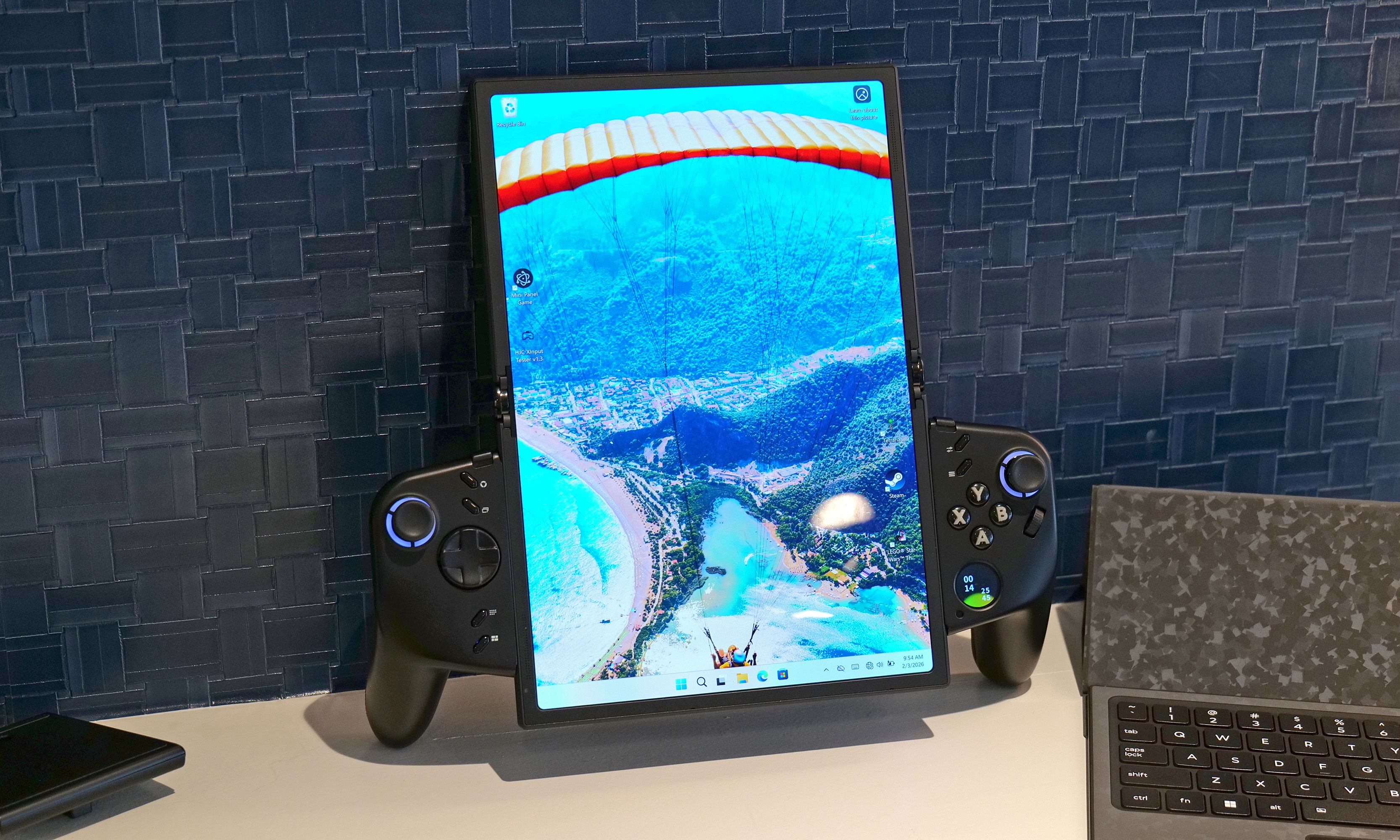
Lenovo pulled up to MWC with a bunch of new products and concepts, but if there's one thing everyone's going to be talking about, it's the Legion Go Fold. (Check out Sam Rutherford's coverage of the Legion Go Fold here). In short, the Legion Go Fold is a concept foldable gaming handheld with a flexible display that can unfurl to a massive 11.6 inches. Or, it can be folded in half to become a 7.7-inch display. It has detachable controllers, and there are multiple mounting points along the tablet so you can switch things up between landscape and portrait mode. The left and right gamepads can also be combined into one controller with an accessory, and the display can be propped up kickstand-style with the folio cover.
You think we're done here? We're not. The Legion Go Fold can go laptop mode too, with a strip of pogo pins where a wireless keyboard can be connected. Its right gamepad can serve as a mouse, thanks to the inclusion of a little scroll wheel and a hidden sensor. That gamepad also features a tiny circular OLED display below the buttons, which can both show widgets such as the time and be used as a touchpad.
It is a concept, though, so don't get your hopes up too much about this one going into production. And if it does ever become a real, buyable product, it'll no doubt be expensive.
The Lenovo Modular AI PC concept is an ambitious mashup between a traditional clamshell and a dual-screen notebook with hot swappable ports.
Sam Rutherford for Engadget
Lenovo also announced its Modular AI PC concept — a laptop with two displays and a detachable keyboard. As Sam Rutherford, who got a chance to check it out in person, explained, "This allows you to move its keyboard and secondary display around at will, so the system can better adjust to its environment or workload." Perhaps even more exciting is that it has hot swappable ports. Lenovo demonstrated it with USB-C, USB-A and HDMI connectors, but said others could be possible too.
Still, while everything looked pretty polished in the demo, Lenovo says this one will remain a concept.
The Lenovo Yoga 9i 2-in-1 Aura Edition Gen 11
Lenovo
It hasn't all been concepts at MWC. Lenovo also refreshed some of its existing tablet and laptop lineups for 2026. The company introduced the Yoga 9i 2-in-1 Aura Edition Gen 11 (with the new Canvas Mode configuration), starting at $1,949, and the new 15.3-inch Yoga Pro 7a, which starts at $2,099. It's updated its more affordable IdeaPad Slim 5i Ultra laptop ($799) as well. All of those new laptops come with Copilot+ features. For students, Lenovo is launching the 13-inch Idea Tab Pro Gen 2, starting at $419, with its Quira AI assistant and AI tools. You can find all the specs and release dates for those here.
Upgrades are here for Lenovo's ThinkPads too, along with the Yoga-like ThinkBook 2-in-1. And, Lenovo announced a $499 industrial tablet, the ThinkPad X11.
Lenovo's 8.8-inch gaming tablet is getting a spec boost with the latest version announced at MWC 2026, the $849 Legion Tab Gen 5. The tablet has a Snapdragon 8 Gen 5 chipset, 16GB of RAM and up to 512GB storage. It also has a 9,000mAh battery to support longer gaming sessions, and two USB-C ports. The Legion Tab Gen 5 comes in three colors: Eclipse Black, Glacier White and the lime-green Surge. It launches in May. That'll be followed shortly after in July by the launch of the new 15-inch Legion 7a Gen 11 gaming laptop, starting at $2,299.
Lenovo AI Workmate Concept at MWC 2026
Image by Mat Smith for Engadget
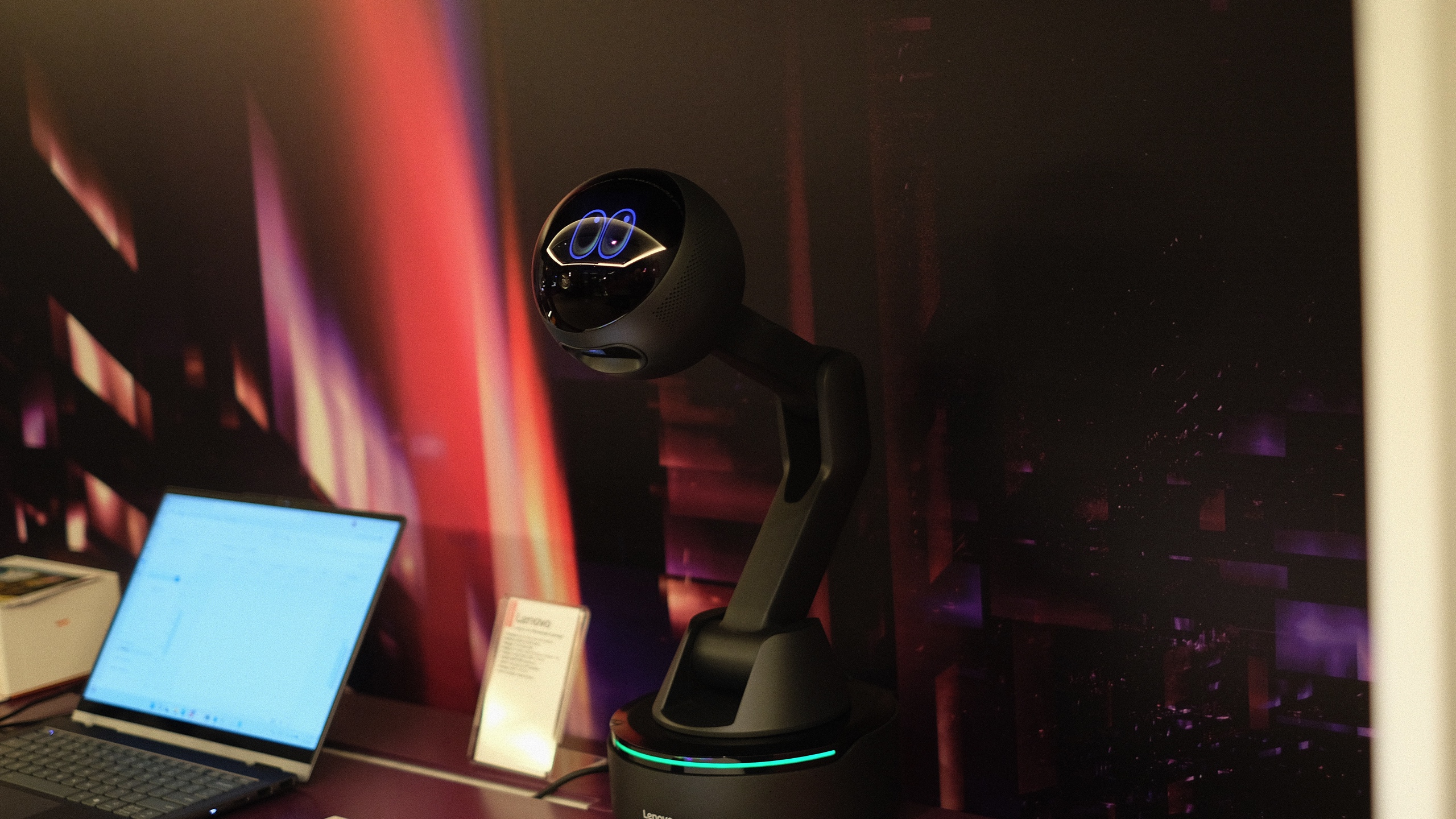
And we're back to the concepts. Lenovo showed off two work-oriented AI devices: the AI Workmate Concept, a desktop robot, and the AI Work Companion Concept, a clock/display that can sync tasks across devices and organize them into a daily plan. The robot has a cute little face, and its head doubles as a projector that can display images and documents on nearby surfaces.
Honor
The Robot Phone. (Image by Mat Smith for Engadget)
Honor teased its Robot Phone this past fall and we just finally got a proper look at it at MWC. And it's pretty freakin' cute. The phone is equipped with a camera that's mounted on a highly mobile 4-degrees-of-freedom gimbal, which tucks away into a compartment on the back when it's not in use (making for a pretty beefy camera bump). In a demo at MWC, the camera, which behaves like a little robot head, bobbed along to music and showed off some of its gesture skills, like cocking its “head” and nodding in agreement.
Honor didn't reveal too much spec-wise, but the company says the primary camera uses a 200-megapixel sensor. The gimbal will offer three-axis stabilization, which will be coupled with camera modes such as Super Steady Video and AI Object Tracking. The Robot Phone isn't quite ready for release at the moment, but the company says it will launch later this year.
Be sure to check out Mat Smith's writeup on the Robot Phone for a more in-depth look.
Honor's humanoid robot. (Image by Mat Smith for Engadget)
Image by Mat Smith
It's not a humanoid robot reveal without some backflips and a choreographed dance performance. Honor introduced its robot at MWC with all the spectacle we've come to expect (though the bot didn't do any talking). It’s simply called the Honor Robot, and the company has plans for it to be used in both industrial and domestic settings.
Honor Magic V6 (Honor)
The Robot Phone isn't the only phone Honor showed off at MWC. The company also announced its Magic V6 smartphone, which it says is the thinnest phone in its category, measuring 8.75mm folded and 4.0mm open in the white colorway. The other three colors — black, gold and red — are slightly thicker, at 9mm folded and 4.1mm open.
Not too much has changed from the V5, though, which only came out in August 2025. It does however have the Snapdragon 8 Elite Gen 5, with 16GB RAM and 512 GB storage. As for the cameras, there are two 50-megapixel lenses and a 64-megapixel telephoto, plus a 20-megapixel f/2.2 selfie lens on the cover and internal display.
The international version of the Magic V6 will have a 6,660mAh battery with 25 percent silicon content, while the version sold only in China will boast a battery with a rated capacity of more than 7,000mAh and 32 percent silicon content. Honor hasn't yet shared details about pricing and availability.
Honor MagicPad
Honor
Ahead of MWC, Honor also announced what it claims is the thinnest Android tablet in the world: the 4.8mm thick MagicPad 4. We're expecting to hear more about this at Honor's press conference on Sunday, but so far we know it features a 12.3-inch 165Hz OLED display and weighs just 450g. It comes with up to 16GB of RAM and 512GB of storage, and is powered by Qualcomm's Snapdragon 8 Gen 5 chipset. The thinness doesn't count the camera bump, Honor notes. The MagicPad 4 has 13MP rear and 9MP front cameras. It also boasts spatial audio, with eight speakers.
Just as the display is slightly smaller than the previous MagicPad, the MagicPad 4 has a smaller battery at 10,100 mAh. It comes with a 66W fast charger. The MagicPad 4 will run Honor's MagicOS 10. We don't yet know how much it will cost, but we'll update this after Honor's press conference (where we're also expecting to see the company's robot) with any new details.
Xiaomi x Leica
Mat Smith for Engadget
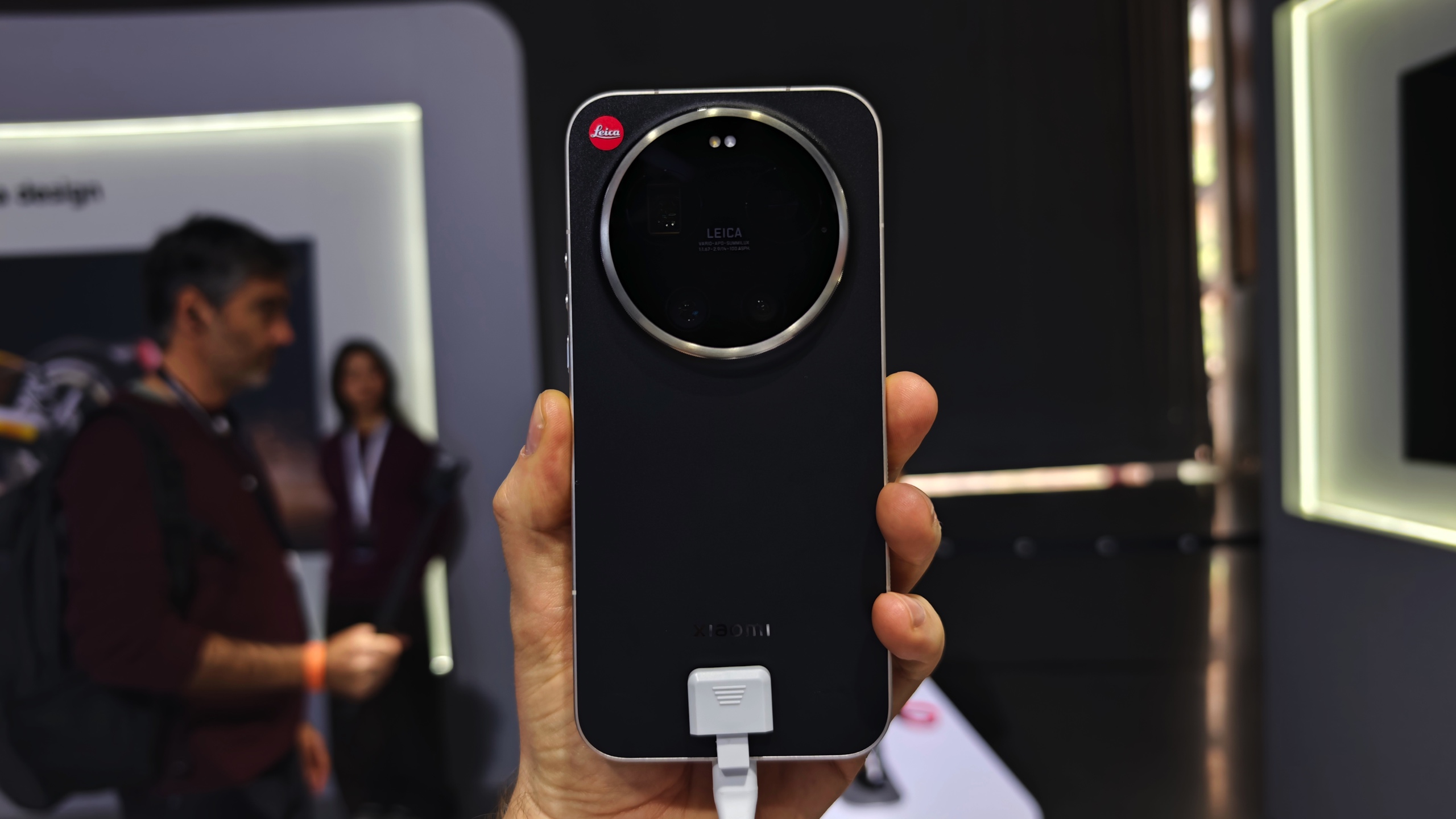
Xiaomi kicked off MWC this year by announcing the global launch of its 17 Ultra smartphone, which debuted first in China back in December. It's unclear if the phone will ever come to the US, but it's now rolling out in Europe. Xiaomi teamed up again with Leica to make a photography-focused smartphone, and the 17 Ultra sports a 1-inch 50-megapixel camera sensor with a f/1.67 lens, a telephoto setup with a 200MP 1/1.4-inch sensor, and a 50MP ultrawide camera. There's also a manual zoom ring around the camera.
Check out our hands on for our first impressions of what it's like shooting with the Xiaomi 17 Ultra. And there's more to it than just the camera. The 17 Ultra has a 6.9-inch OLED 120 Hz display that peaks at 3,500 nits of brightness, and a 6,000mAh silicon-carbon battery. The Xiaomi 17 Ultra starts at £1,299 (roughly $1,750).
Leica also announced a new phone made in partnership with Xiaomi at MWC. It looks a whole lot like Xiaomi's 17 Ultra, but isn't the 17 Ultra, exactly.
Leica Leitzphone by Xiaomi hands-on at MWC 2026
Image by Mat Smith for Engadget
Like the 17 Ultra, Leica's Leitzphone by Xiaomi has a 1-inch camera sensor and physical controls for zoom and other settings, using a mechanical ring around the camera unit. It features a Leica-designed intuitive camera interface with the option to show just the essentials when you're shooting, hiding all the modes and labels. There's a monochrome shooting mode and Leica filters.
The Leica branding is splashed all over it in design and wallpapers, but it's otherwise pretty similar to the 17 Ultra, with the same specs. Like the 17 Ultra, it has a Snapdragon 8 Elite Gen 5 chip and a 6.9-inch 120Hz display. This one's priced at €1,999 (roughly $2,362).
The Xiaomi Pad 8 Pro
Xiaomi
In addition to the 17 Ultra, Xiaomi announced two new tablets at MWC this year: the Xiaomi Pad 8 and Xiaomi Pad 8 Pro. There's nothing revolutionary here, but they're lightweight and thin, with both being 5.75mm thick and weighing 485g, and have a 9,200mAh battery. The Pro model is powered by a Snapdragon 8 Elite chip, while the regular Pad 8 uses the Snapdragon 8s Gen 4 chipset.
Xiaomi also unveiled a new 5,000mAh powerbank, the UltraThin Magnetic Power Bank 5000 15W. The 6mm thick power bank comes in three colors with an aluminum alloy shell: orange, silver and charcoal gray. Along with that, the company introduced the Xiaomi Tag, its own take on the Bluetooth item tracker. The Xiaomi Tag has a built-in hanging loop so it can be attached directly to a keyring, and the company says it will work with both Apple Find My and Google's Find Hub for Android.
Tecno
Tecno
We can always expect to see some wild phone concepts at MWC, and this year we're starting with one from Tecno. The company unveiled a modular concept smartphone design that can be as thin as 4.9mm in its base configuration. There’d be 10 modules to choose from based on the announcement, including various camera lenses, a gaming attachment and a power bank, relying on magnets to keep it all together — or Modular Magnetic Interconnection Technology, as Tecno is calling it.
This article originally appeared on Engadget at https://www.engadget.com/mobile/everything-announced-at-mwc-2026-lenovos-wild-foldable-gaming-handheld-honors-robot-phone-and-more-172442814.html?src=rss
How much would you pay for a good night's sleep? This is a question I've asked myself repeatedly over the last few weeks as I've been testing the Dreamie, a $250 alarm clock and "bedside companion" that I couldn't stop thinking about after I first encountered it at CES.
Ambient's Dreamie offers many of the conveniences of a smartphone-connected device — highly customizable alarm schedules, a library of soundscapes and noise masks, Bluetooth so you can connect earbuds and podcasts (soon). But it is phone-free every step of the way, with all controls and features built-in so you don't end up getting sucked into a doomscroll while you're trying to wind down. It also has a light ring for ambient lighting modes and sunrise wakeups. This spring, it's expected to start providing sleep insights as well for users who opt-in, using its microphone and motion sensors to get a reading on their nightly habits.
All of that's meant to work together to, according to the website, "help you sleep better and break free from your phone," a goal I was eager to explore. This may be one of the least unique problems to have as an adult in today's world, but sleep has become a really complicated thing for me.
Falling asleep is hard because my brain is always racing, my quality of the sleep is trash and waking up every day feels like an act of torture. It's gotten so bad that at some point in the last couple of years, I started using three alarms to make sure I get out of bed in time for work: a dedicated sunrise alarm clock, my smartwatch and my phone as the final, 11th hour save in case the other two methods don't do the trick. As you might imagine, my partner, who is forced to also endure this horrid morning ritual, hates it.
So if there's a device that can help fix this mess, I'm open to it. And after some time with the Dreamie, I think I've found a promising contender.
Getting into a sleep routine
There's no companion app with the Dreamie and no subscription service you need to sign up for, which feels like a breath of fresh air in 2026. (I'm so tired of subscriptions, free us from this hell!) Your one-time purchase gives you access to everything it offers now and the updates that are in the pipeline.
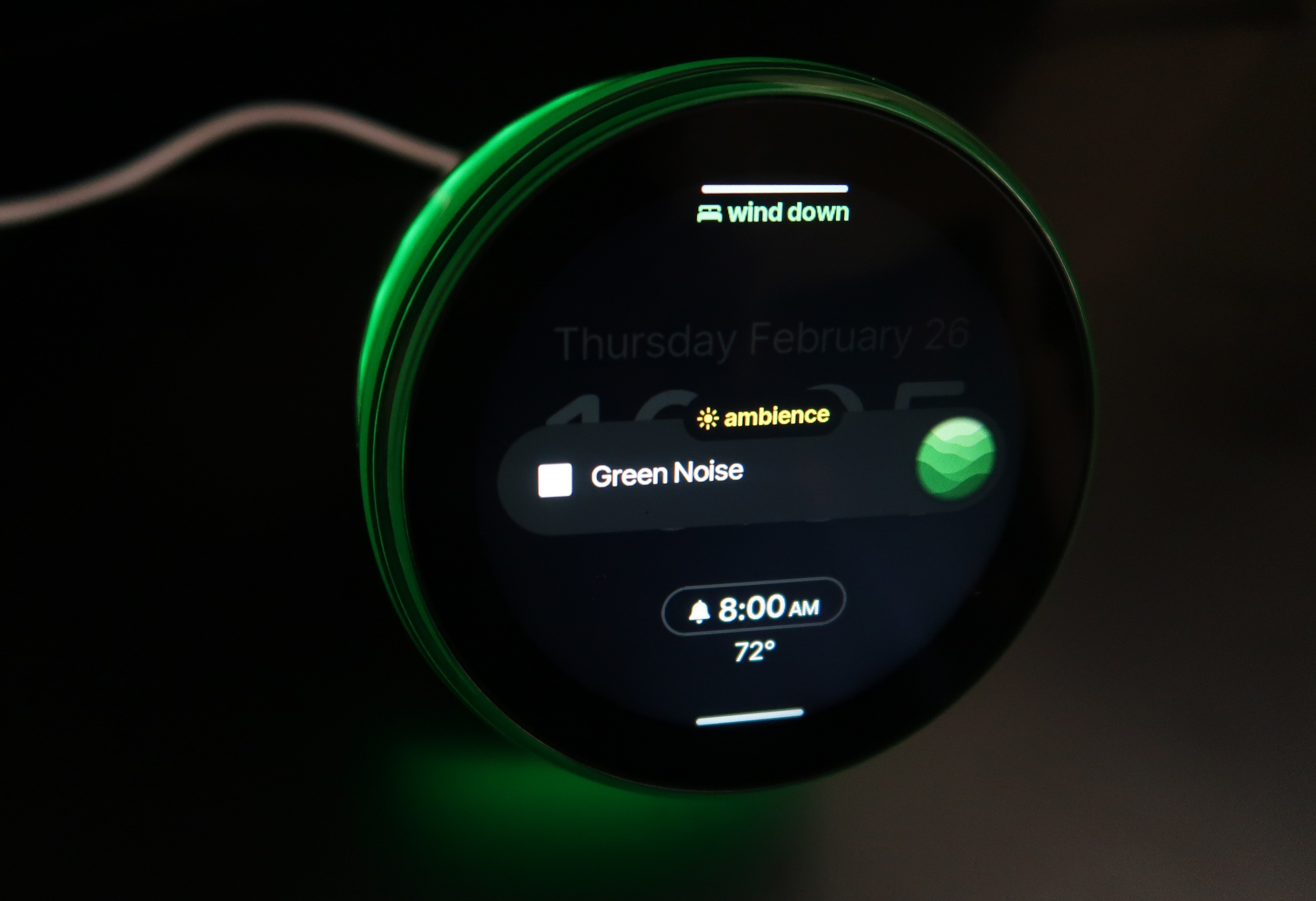
After taking it out of the box and plugging it in, you'll have to connect to your home Wi-Fi. Then, the Dreamie presents you with a tutorial to walk you through navigating its menus and physical controls. There's a touch strip on the top of the device to turn on the lamp and adjust its brightness, as well as the brightness of any ambient color "scene" that's active. By dragging the dot at the center of the lamp screen, you can throw the light in any particular direction. Volume is adjusted by turning the dial that's around the clockface. To access the menu for alarms and other settings, swipe up. To cycle through the different content modes — ambient, wind down and noise mask — just swipe down from the top of the screen. Easy peasy.
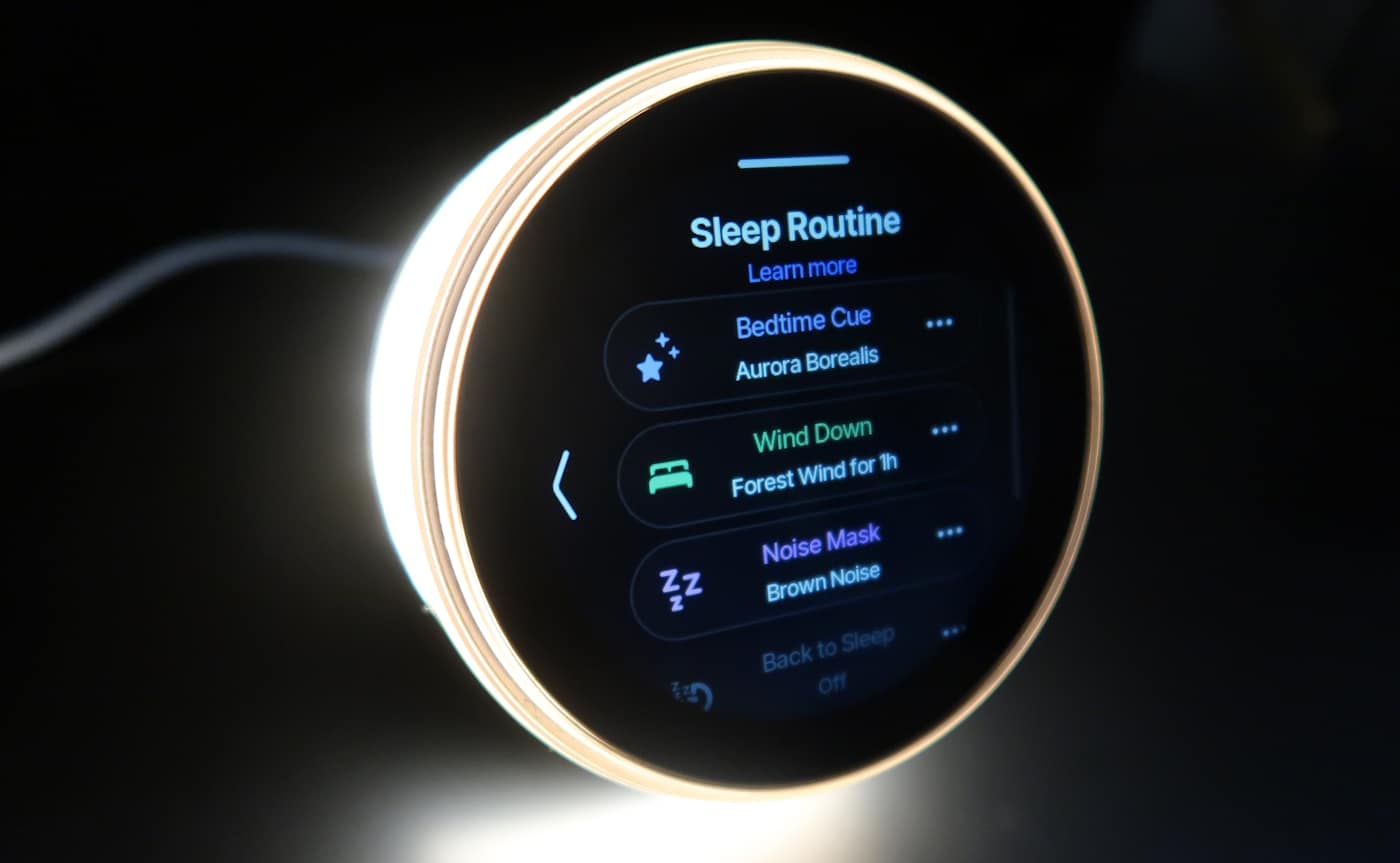
Setting up your actual Sleep Routine takes a little more time and intention. A Dreamie Sleep Routine consists of multiple steps, which you can use all, some or none of for your custom routine. Those include the Bedtime Cue, which lets you know it's the time to start getting ready for bed (you designate this time); the Wind Down, or the sounds you'll fall asleep to; and the Noise Mask, the sounds that keep you asleep. If you wake up in the middle of the night, there's a Back To Sleep option too.
You can choose different sounds from Dreamie's library for each category. Some options come with ambient lighting effects, too. There's a decent selection of soundscapes, from the dramatic Aurora Borealis and the sounds of storms and rivers to different "colors" of noise.
Some noise masks, like Green Noise, coming with lighting effects.
Cheyenne MacDonald for Engadget
The quality of the Dreamie's sound is what initially sold me during my demo at CES, and it holds up in daily use. The Dreamie has a 50 millimeter speaker inside, and the 360-degree grille on the bottom of the device makes it so the sound seems to come from everywhere. (My cats were extremely confused when I first turned it on). It really fills a room, and you don't have to crank it up to achieve that. When Bedtime Cue comes on, I typically turn it down to about 25, and then raise it back up to 45 when I flip it to Wind Down mode. I've never once set it higher than 50, and the alarm in the morning has still been loud enough to wake me up.
After taking a few days to tweak my choices and figure out what I like best, I've settled into a really nice routine: Aurora Borealis as the Bedtime Cue, an hour of Forest Wind as my Wind Down and a Noise Mask of Brown Noise to play throughout the night. I love how easy it is to set the nighttime routine in motion once it's established. When I hear the Aurora Borealis come on, I start making my preparations for bed. Brush teeth, take meds, lights out and, crucially (I'm trying really hard to be disciplined, here), my phone goes face-down on the nightstand until morning. If I want to stay up late that night and ignore the Bedtime Cue, I can just hit the little stop button on the display. But once I'm ready to actually try to fall asleep, all I need to do is swipe down on the display to initiate the Wind Down, and Forest Wind will start playing.
I have my Wind Down set for one hour, after which the Noise Mask begins. And man, that Forest Wind knocks me out. So far, I haven't found myself still up and staring at the ceiling by the time Brown Noise comes on. I've only been able to confirm that it is indeed working and switching to the Noise Mask because my cats regularly wake me up in the middle of the night, and it's been on each time that's happened. But aside from those instances where my head is being used as a springboard by the creatures that share my home, I've been sleeping pretty well through the night.
To minimize distractions when you're trying to sleep, the Dreamie's display will dim in response to the surrounding darkness. There's also a Redshift toggle to make the nighttime display easier on the eyes, a Dark Mode with a simplified appearance and the option to have the display turn off completely when you've been inactive for a while. I set the Dreamie on my nightstand close to where my face is at night, and I haven't had any problems with light from the display keeping me up.
Waking up with Dreamie
In the morning, the light begins to come on 20 minutes before I want to be awake, followed by the gradually increasing sound of the alarm. There are only a handful of alarm sounds at the moment, but the options are all fine. There are no jarring, grating alarms here — even the bird calls option sounds rich and natural, rather than the too-shrill, piercing recordings I've grown used to avoiding on other alarm clocks and sound machines.
You can set multiple alarms with different bedtimes and wakeup times, which is really handy if your schedule is all over the place or you want to allow yourself to sleep in more on certain days. My only real complaint so far is that the sunrise feature isn't quite as strong as I want it to be. The Dreamie's sunrise goes from a warm glow to a bright blue-white, but it never gets big enough to wash over me in the way I expect a sunrise alarm to. Having the light on is helpful for orienting yourself when you're groggy and half-asleep, but it doesn't feel like it's having much effect on my actual wakeup process.
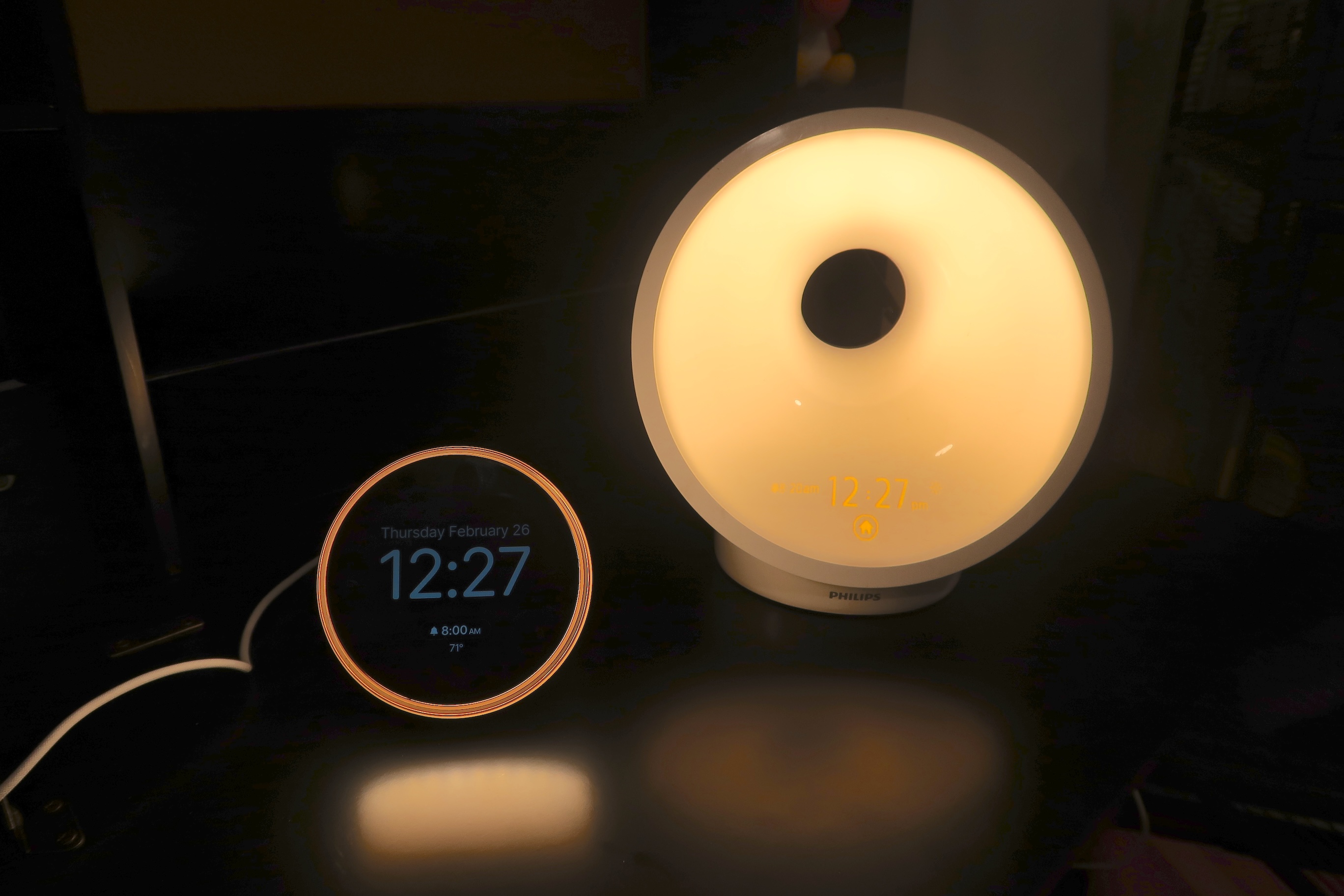
Dreamie next to a Philips Wake-Up Light.
Cheyenne MacDonald for Engadget
Part of the problem may be that none of the light is really directed forward and at the sleeper's face. Even the Dreamie's lamp mode at maximum brightness seems to have more reach than the sunrise feature. (And a note on the lamp, while it's decently bright, it's still a bit too dim for reading in bed unless I'm huddled up to it.)
Still, I've been sleeping well enough that I've been waking up alright most days even without being bathed in artificial sunlight. Don't get me wrong, I'm still hitting snooze a few times before dragging myself out of bed, but there's been a noticeable improvement in both the quality of my sleep and how miserable I feel come morning. I'm even down to using just two alarms: the Dreamie as my primary alarm, which is getting me up on its own for the most part, and my watch as a backup. At this point, I'm kind of attached to this thing.
The Dreamie is refreshingly compact, too. It takes up significantly less real estate on my nightstand than the Philips Wake-Up Light I've been using forever, or something like a Hatch Restore. The smaller footprint is something I appreciate as a person always battling cluttered surfaces. That also makes it better for travel. Since podcasts and sleep insights aren't available yet, I haven't been able to test those out, but they're non-critical features for me. The company has shared an estimated timeline of Q1-Q2 for these features to arrive, with podcasts likely coming first. They'll be nice to have, podcasts especially, but the Dreamie is more than able to do its main job of creating an environment that supports better sleep without those things.
Wrap-up
All of this brings me back to the question that's been haunting me since discovering the Dreamie: Is it ridiculous to spend $250 on an alarm clock/noise machine? At a different time in my life, I would have said yes without hesitation. But the current version of me, who knows what it's like to move through each day like a zombie because I'm sleeping so terribly, would begrudgingly disagree. As I pack up this review unit to ship it back, I'll also be putting in an order for my own so I can keep my cherished new sleep routine going.
This article originally appeared on Engadget at https://www.engadget.com/home/ambient-dreamie-bedside-companion-review-the-best-sleep-ive-had-in-years-184019430.html?src=rss
Need something new for your reading list? Here are two titles we think are worth checking out. This week, we read Aoife Josie Clements' deeply unsettling Persona, and the first issue of Bleeding Hearts, from the relaunch of the DC imprint, Vertigo.
This article originally appeared on Engadget at https://www.engadget.com/entertainment/what-to-read-this-weekend-the-unsettling-new-horror-novel-persona-185152256.html?src=rss
Every once in a while, a product comes along that sparks a bit of joy in our jaded hearts. This is what happened with the Kodak Charmera, a $30 tiny toy camera that was nearly impossible to get ahold of in the first couple of months after its release, selling out immediately over waves of blind box restocks. Despite the gimmick of it all, the Charmera was just too cute for some of us to resist, and we sprang when they finally started becoming more readily available.
A few of us on the Engadget team have one now, and even with all of its shortcomings, we kind of love this thing. Here's what two of our writers think about it.
Lately, it feels like a chore to carry around a full-frame mirrorless camera. My Nikon definitely feels like the right tool to precisely capture a moment in time with fast autofocus and plenty of image resolution. Other times, that perfect moment is more casual, like catching up with friends over dim sum or killing time while you're snowed in at a cabin in Vermont. In these cases, there's no reason to carry around a hulking camera and lens to snap a flawless photo that I have to edit later. Instead, something light, discreet and playful feels like the right tool for the occasion.
Jackson Chen for Engadget
That's where the Kodak Charmera comes in. It's a toy camera with a 35mm lens with a fixed f/2.4 aperture and a 1/4-inch sensor. In other words, the photos this thing takes are about equivalent to what you would get with a crappy flip phone from the 2000s that also plays Snake.
Kodak is clearly trying to wring out the longing for nostalgia within all of us, and has nailed it with the Charmera, which is even inspired by its old-school disposable Fling cameras. It's definitely not as good as the smartphone in your pocket, but there's something disarming about snapping a quick shot with a tiny block of plastic that's lighter than your keys.
Playing around with the Charmera for a few weeks gave me a healthy reminder that the sillier and more transient parts of life don't need the technical prowess of an expensive camera. Obviously, the Chamera produces photos of terrible quality at 1.6 megapixels and can't really capture anything fast-moving or in low light, but it's undeniably fun and hard to resist shooting with. And sometimes, you and your friends are just doing wildly unserious things and you want a camera that matches that energy.
— Jackson Chen, Contributing Reporter
Every time I pull out the Kodak Charmera in public to snap a few pictures, I'm immediately met with a barrage of questions and squeals of delight from full-grown adults: "What is that?"; "Is that a camera?"; "Does it really take pictures?"; "Can I see it?" It is the kind of accessory that doubles as a conversation starter, an effect that's turned out to be as joyous as taking pictures with the camera itself. I've been trying really hard to spend less time on social media and my phone in general lately, and having a two-inch camera clipped to me has made for a pretty fun shift in how I document the day-to-day.
As the resurgence of compact digital cameras has shown us, a lot of people are yearning for a time of simpler tech — when we had personal devices that could do useful things, like take decent photos and connect us to our friends, but didn't consume our lives entirely. Companies like Camp Snap have shaped their entire brands around recapturing that magic, and some consumers have shown that they're willing to sacrifice in areas like image quality in exchange for a taste of it, too. The Kodak Charmera isn't the kind of product you go into purchasing with high expectations. It is clearly a toy that is only going to be capable of so much.
Cheyenne MacDonald for Engadget
As Jackson noted, the low-resolution 1,440 x 1,080 pictures look about on par with those you'd have taken on a flip phone 15 or 20 years ago. In the right lighting conditions with a clearly defined subject, they're not so bad. But selfies, portraits and nature photos will generally look washed out. It can record videos too — and you should set similarly low expectations for these.
Despite all that, I've been pleasantly surprised by how much I'm enjoying the Charmera experience. Its crunchy photos are just good enough to feel like they're successfully preserving a moment in time. And being so tiny, it's really convenient to bring everywhere. It even came with me to CES. The Charmera takes a microSD card (sold separately), allowing for tons of storage and easy transferring. There are a bunch of built-in filters you can apply, too, which have been fun to play around with.
If I want high-quality photos, this isn't the camera I'm going to reach for. But it's great for low-stakes situations when all I care about is taking some pictures I can look back on fondly later. Consider me charmed. — Cheyenne MacDonald, Weekend Editor
This article originally appeared on Engadget at https://www.engadget.com/cameras/the-ridiculously-tiny-kodak-charmera-captured-our-hearts-and-lots-of-shoddy-pictures-140000245.html?src=rss
On Friday, New York State Senators Liz Krueger and Kristen Gonzales introduced a bill that would stop the issuance of permits for new data centers for at least three years and ninety days to give time for impact assessments and to update regulations. The bill would require the Department of Environmental Conservation and Public Service Commissions to issue impact statements and reports during the pause, along with any new orders or regulations that they deem necessary to minimize data centers' impacts on the environment and consumers in New York.
The bill would require these departments to study data centers' water, electricity and gas usage, and their impact on the rates of these resources, among other things. The bill, citing a Bloomberg analysis, notes that, "Nationally, household electricity rates increased 13 percent in 2025, largely driven by the development of data centers." New York is the sixth state this year to introduce a bill aiming to put the brakes on data centers, following in the footsteps of Georgia, Maryland, Oklahoma, Vermont and Virginia, according to Wired. It's still very much in the early stages, and is now with the Senate Environmental Conservation Committee for consideration.
This article originally appeared on Engadget at https://www.engadget.com/big-tech/new-york-lawmakers-introduce-bill-that-aims-to-halt-data-center-development-for-three-years-224005266.html?src=rss
 Anmelden