Cash App, the banking and payments app run by Block, has added support for parent-managed kids accounts. The new accounts include key benefits from the service's normal account, with an eye towards teaching financial literacy to younger users ages 6 to 12. Cash App first allowed teenage users on its platform in 2021.
As part of the "expanded Cash App Families experience," eligible legal guardians and parents can create managed accounts that offer "a dedicated place on the platform to send allowances, set aside savings, and track spending for their child, kickstarting their path to financial independence," Cash App says. Adults managing these accounts will be able to set up recurring transfers, see how their child is spending and do things like lock their child's account to prevent transactions. Kids will get a custom debit card and the ability to receive payments from up to five trusted accounts, though notably they won't be able to access Cash App itself.
Today, we're launching Cash App accounts for kids age 6-12. Parents manage the accounts. Kids get to learn about safety, start saving for goals, and design and use their own debit card.
Cash App says managed accounts are designed for kids 6 through 12. Once those kids turn 13, Cash App says parents will be able to choose to convert their account to a "sponsored account" to unlock more features, like the ability to send and receive payments, invest in stocks or trade crypto. Those sponsored accounts are technically still monitored and controlled by a parent or legal guardian, but they do give 13-year-olds more control over how they use their money.
A parent-managed account for kids is not a new idea in the fintech space, though Cash App is trying to reach a younger audience than some of its competitors. Venmo rolled out access to its payment platform to teens between the ages of 13 to 17 in 2023. Separately, both Apple and Google also offer their own kids accounts in Google Wallet and Apple Cash Family.
This article originally appeared on Engadget at https://www.engadget.com/apps/cash-app-now-supports-accounts-for-kids-6-12-210651025.html?src=rss
Florida Attorney General James Ulthmeier has announced that the state's Office of Statewide Prosecution has opened a criminal investigation into OpenAI and ChatGPT. The investigation was opened because the suspect in a mass shooting at Florida State University in 2025 reportedly used ChatGPT in the lead up to the shooting.
Per Uthmeier, "Florida law states that anyone who aids, abets, or counsels someone in the commission of a crime, and that crime is committed or attempted, may be considered a principal to the crime." That means that the responses provided by ChatGPT to the shooter could be interpreted as the AI assistant aiding and abetting his actions. Or at least that's what Florida seems interested in arguing.
OpenAI provided the following statement when asked to comment on the Florida investigation:
Last year's mass shooting at Florida State University was a tragedy, but ChatGPT is not responsible for this terrible crime. After learning of the incident, we identified a ChatGPT account believed to be associated with the suspect and proactively shared this information with law enforcement. We continue to cooperate with authorities. In this case, ChatGPT provided factual responses to questions with information that could be found broadly across public sources on the internet, and it did not encourage or promote illegal or harmful activity. ChatGPT is a general-purpose tool used by hundreds of millions of people every day for legitimate purposes. We work continuously to strengthen our safeguards to detect harmful intent, limit misuse, and respond appropriately when safety risks arise.
As part of the investigation, Florida has subpoenaed OpenAI for information on "all policies and internal training materials" related to how the company handles things like users threatening to harm others, threatening to harm themselves and how OpenAI responds to law enforcement. The state is also asking OpenAI to share its organizational chart and any publicly released statements on the shooting.
"Florida is leading the way in cracking down on AI's use in criminal behavior, and if ChatGPT were a person, it would be facing charges for murder," Attorney General James Uthmeier said. "This criminal investigation will determine whether OpenAI bears criminal responsibility for ChatGPT's actions in the shooting at Florida State University last year."
Florida’s investigation isn’t the first time OpenAI has been connected to a mass shooting. Canadian regulators called for OpenAI to change how it approaches threats of harm following a Wall Street Journal report that claimed the company flagged the account of a Canadian shooting suspect in 2025 but failed to bring their threats to law enforcement. The company agreed to new policies around how it works with Canadian law enforcement in March. Separately, OpenAI is still in the midst of a wrongful death lawsuit from 2025 for the role it may have played in the suicide of a teenage user.
This article originally appeared on Engadget at https://www.engadget.com/ai/florida-ag-opens-criminal-investigation-into-openai-and-chatgpt-190200227.html?src=rss
The James Bond franchise has a long history of getting pop stars to record its theme songs (perhaps most memorably with Live and Let Die), and it looks like that tradition will now extend to video game adaptations about the fictional spy. IO Interactive has announced that Lana Del Rey co-wrote and performed the theme for 007 First Light, the developer's playable James Bond origin story.
"First Light" is written and performed by Lana Del Rey and composer David Arnold, and like the moody and abstract opening credits released alongside the song, could vaguely gesture at the themes of the game. IO Interactive has previously said that its game focuses on a young, inexperienced and more reckless Bond, before he developed his trademark cool. The developer is also integrating the stealth mechanics it perfected in Hitman into the upcoming game.
Del Rey's personal gaming experience may begin and end with her hit "Video Games," which was apparently written about a former boyfriend's love of World of Warcraft, but the artist does know how to write a song with Bond in mind. Lana Del Rey shared in 2024 that her song "24" from the album Honeymoon was originally written for 2017's Spectre, one of several songs that were cast aside in favor of Sam Smith's "Writing's on the Wall."
007 First Light is coming to Xbox Series X/S, PlayStation 5 and PC on May 27, 2026. A Nintendo Switch 2 version of the game is now coming out this summer.
This article originally appeared on Engadget at https://www.engadget.com/gaming/15-years-after-video-games-lana-del-rey-has-an-actual-video-game-song-221925735.html?src=rss
The crew of NASA's Artemis II mission have safely returned to Earth, but if your Moon fever has yet to break, or you're curious to get a big picture view of how the second of a planned five Moon missions was pulled off, PBS has a new documentaryyou'll want to watch. The hour-long Return to the Moon was produced for PBS' NOVA and aired on TV on April 15, but you can view the episode in its entirety on YouTube right now.
Return to the Moon covers the history of NASA's Artemis program, and specifically the planning and preparation that went into Artemis II. Per the documentary's official description:
Follow the four members of the Artemis II crew as they embark on a perilous 10-day journey to orbit the Moon, venturing beyond Earth orbit for the first time since Apollo and farther into the Solar System than any humans have gone before. And get an inside look at the preparations needed to overcome the extreme engineering challenges of human-crewed spaceflight, all the way from launch to splashdown.
The last Apollo mission was in 1972, so Artemis II getting a group of four astronauts anywhere near the Moon has naturally generated a lot of excitement. The crew flew further away from Earth than anyone has gone so far, captured some stunning photos of both the Moon and our home planet and managed to make everyone feel better about their dislike of Microsoft Outlook. Few Moon missions have been as well-documented or relatable.
This article originally appeared on Engadget at https://www.engadget.com/science/the-pbs-artemis-ii-documentary-is-streaming-on-youtube-210347406.html?src=rss
The specter of price hikes caused by the current AI-driven demand for memory and storage appears to have convinced a fair share of people to buy a new computer. According to data analyzed by Counterpoint Research, global PC shipments grew around 3.2 percent year-over-year in Q1 2026, "driven by pre-emptive buying before memory-led price increases hit the retail level" and Microsoft forcing some customers to upgrade by ending support for Windows 10 last year.
Sales hit 63.3 million units during the first quarter, Counterpoint says, and were particularly concentrated in five high-end PC makers: Lenovo, ASUS, Apple, HP and Dell. Of the five, Lenovo commands the most PC market share at 26 percent, but sales increased for almost all of the companies, save for HP, whose year-over-year sales technically declined by 5 percent. Of particular note, Apple's PC sales grew by 11 percent, likely on the strength of the M5 updates it made to the MacBook Pro and MacBook Air, and the introduction of the affordable $600 MacBook Neo. Counterpoint suggests the updates could drive even further sales growth next quarter.
Even with positive sales, the PC industry as a whole is by no means out of the woods. "The aggressive expansion in AI infrastructure investment is driving up overall component costs, which will likely impact the pricing of CPUs and other key components in [PCs]," Counterpoint Senior Analyst Minsoo Kang says. "Ultimately, the sustained upward pressure on costs and the resulting hike in retail prices are expected to have a significant negative impact on the PC market’s growth in 2026."
A general sense that the worst is yet to come is consistent with what other analysts have warned about the current shortages of RAM and storage. In December 2025, IDC predicted that PC shipments could drop as much as 8.9 percent in 2026 in response to the price of RAM, and later revised its prediction to 11.6 percent this past March. Even if consumers aren't feeling the worst of these price hikes just yet, new announcements of price increases seem to arrive like clockwork every few weeks — for example, this week, Meta raised the price of its Quest headsets — which means if they aren't feeling them now, they will soon.
This article originally appeared on Engadget at https://www.engadget.com/computing/a-lot-of-you-panic-bought-pcs-to-avoid-ramaggedon-2026-200237204.html?src=rss
TCL introduced its new flagship X11L SQD-Mini LED TV at CES 2026, and now a few months later, the company is ready to expand its lineup with more SQD-Mini LED models and its first RGB-Mini LED TV. All sizes of the TCL QM8L SQD-Mini LED TV are available now. Meanwhile, both the TCL QM7L SQD-Mini LED TVs and the RM9L RGB-Mini LED TVs are available to pre-order.
SQD-Mini LED panels are TCL's latest iteration of its Mini LED display technology, where "SQD" stands for "Super Quantum Dot," a layer of tiny crystal dots that help filter the light from the LEDs in the company's panels. TCL claims its SQD-Mini LED screens are more color accurate than its previous models without losing out on HDR contrast. The TCL QM8L has an anti-reflective SQD-Mini LED panel, up to 4,000 discrete dimming zones, up to 6,000 nits of peak brightness and support for Dolby Vision 2 Max after a software update. The TCL QM7L also has an anti-reflective SQD-Mini LED panel, up to 2,100 discrete dimming zones, up to 3,000 nights of peak brightness and support for Dolby Vision IQ. Both TVs feature Audio by Bang & Olufsen and run the latest version of Google TV with support for Gemini.
TCL
Like other TV makers at CES 2026, TCL also capitalized on the growing trend of Micro RGB or RGB Mini LED panels. Rather than use a layer of white or blue LEDs that are transformed with quantum dots and color filters, TCL's RGB-Mini LED starts with discrete red, green and blue LEDs to produce richer color. The TCL RM9L features the company's new RGB-Mini LED display with an anti-reflective layer, over 3,800 discrete local dimming zones, up to 6,000 nits of peak brightness and support for Dolby Vision 2 after a software update. The TV also features Bang & Olufsen audio and Google TV with Gemini support.
TCL says the QM8L is available to order now starting at $2,500 for the 65-inch model, $3,000 for the 75-inch model, $4,000 for the 85-inch model and $6,000 for the 98-inch model. The TCL QM7L, meanwhile, is available to pre-order starting at $1,200 for the 55-inch model and goes as high as $4,000 for the 98-inch model. If you're curious about TCL's new RGB-Mini LED displays, the TCL RM9L is available to pre-order starting at $8,000 for the 85-inch model and up to an eye-popping $30,000 for a 115-inch model.
This article originally appeared on Engadget at https://www.engadget.com/home/home-theater/tcls-rgb-mini-led-tvs-will-start-at-8000-130000543.html?src=rss
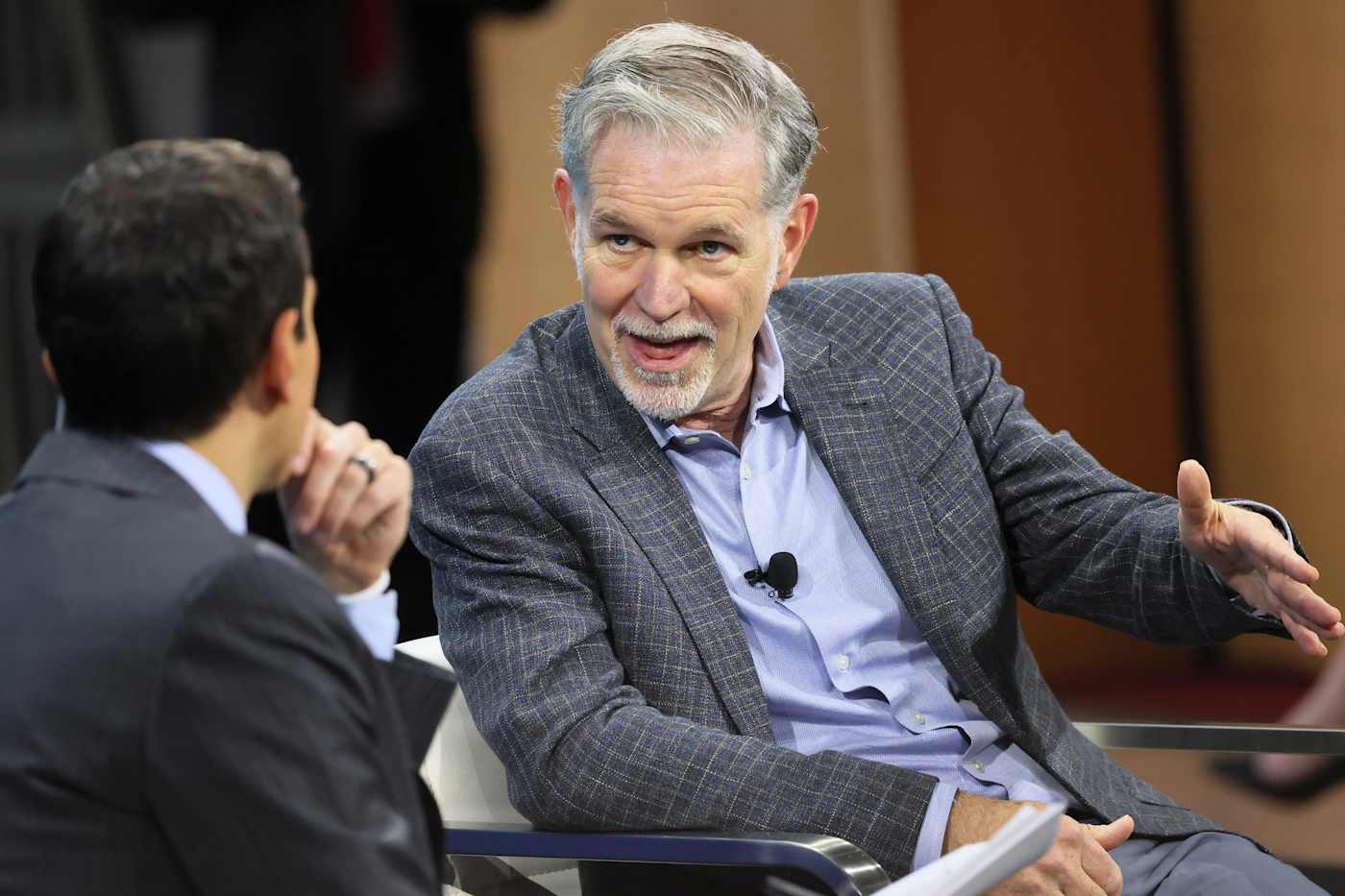
Netflix co-founder and current chairman Reed Hastings is leaving the streaming company’s board in June to focus on "his philanthropy and other pursuits," according to a shareholder letter released alongside Netflix's Q1 earnings. Hastings has served as chairman of Netflix's board since 2023, a role he assumed after stepping down as co-CEO and promoting Greg Peters in his place.
"Netflix changed my life in so many ways, and my all‑time favorite memory was January 2016, when we enabled nearly the entire planet to enjoy our service," Hastings said in a statement. "My real contribution at Netflix wasn’t a single decision; it was a focus on member joy, building a culture that others could inherit and improve, and building a company that could be both beloved by members and wildly successful for generations to come. A special thanks to Greg and Ted, whose commitment to Netflix’s greatness is so strong that I can now focus on new things."
Hastings founded Netflix in 1997 as a DVD-by-mail rental service with his co-founder and the company's first CEO Marc Randolph. In 1999, Hastings became CEO, and eventually led the company through its transformation into a streaming service in 2007. Netflix started producing its own television series and movies in 2013, and in 2020, the company's board named Ted Sarandos as Hasting's co-CEO, in part to oversee its growing production business. Hastings stepped down as co-CEO in 2023 to become Netflix’s executive chairman, as then COO Greg Peters was promoted to co-CEO. Among his other contributions, Hasting is also the architect of Netflix's infamous "culture memo," which codified the company's high-performance culture.
While he'll no longer be on Netflix's board, Hastings still has a seat on the board of AI startup Anthropic and media and financial software company Bloomberg. Netflix, for its part, is continuing to expand outside of the television and film business Hastings helped build, by offering a selection of curated party games, a growing library of video podcasts and live sports.
This article originally appeared on Engadget at https://www.engadget.com/entertainment/streaming/reed-hastings-is-leaving-netflix-after-29-years-213136444.html?src=rss
Your Google Photos library could soon influence the kind of images you can generate with Gemini. After letting users personalize the AI assistant's responses with data from Gmail, Search and YouTube, Google says it's bringing that same "Personal Intelligence" to Nano Banana 2 to make it easier for users to create personalized images with the AI model.
The goal is to have the data affiliated with your Google account — your YouTube history, emails, Google Photos, etc. — provide context to Nano Banana 2 so you don't have to. Rather than prompting Gemini's image generation model with information about you or photos of your belongings, a direction to "create a picture of my desert island essentials" should produce an image that includes the things you care about without any extra context. Similarly, if you use labels in Google Photos to identify people or pets, you can tell Gemini to "create a hand-drawn illustration of mom," and it should be able to use Google Photo's labels to find the right reference photo and create an image of the right person.
Google
If Gemini creates images that don't look right, you can still send a follow-up prompt to refine the result, or select a new source image from Google Photos with the "+" button. Google says you can also click the "Sources" button to view what images the AI referenced in the first place, or ask it directly for the attribution and sources used for a specific image.
Personalized user data is one of the unique advantages Google has over companies offering competing AI assistants, so expanding Personal Intelligence to an already popular feature like image generation is a natural way to build on that lead. For now, this more personalized version of Nano Banana 2 is available in the Gemini app for eligible AI Pro and AI Ultra subscribers. Google says the feature will come to Gemini in Chrome and other users "soon."
This article originally appeared on Engadget at https://www.engadget.com/ai/gemini-can-now-draw-on-your-google-data-to-personalize-the-images-it-generates-160000269.html?src=rss
A film adaptation of Metal Gear Solid is in the works again, this time from filmmakers Zach Lipovsky and Adam B. Stein, the directors of Final Destination: Bloodlines, according to The Hollywood Reporter. The duo are reviving the project at Columbia Pictures as part of a new first-look deal with Sony, the latest attempt in what's been multiple decades of work to turn the blockbuster stealth game into a blockbuster film.
"Metal Gear Solid was nothing short of a groundbreaking cinematic masterpiece that forever revolutionized video games," Lipovsky and Stein said in a statement. "We are thrilled and honored to bring Hideo Kojima's iconic characters and unforgettable world to life."
Lipovsky and Stein's horror bona fides helped make Bloodlinesa critical and commercial hit when it came out in 2025, and the directors have a variety of other IP-focused genre films in the works, including a sequel to Gremlins for Warner Bros. and an animated Venom movie for Sony. It remains to be seen how exactly the duo will translate Metal Gear Solid's unique quirks to film, though.
Metal Gear Solid is heavily indebted to director Hideo Kojima's own taste in action and spy cinema, while also being in conversation with video games themselves in a way that wouldn't naturally translate to film. And even if you removed those metatextual rough edges, can it really be Metal Gear Solid without Kojima's equal parts charming and awkward writing?
Attempts to create a film version of the game date back to 2006, when Kojima first shared that an adaptation was in the works. Columbia Pictures announced a new version of the film in 2012, with Avi Arad, former head of Marvel Studios, producing. In 2014, Jordan Vogt-Roberts, the director of Kong: Skull Island, was attached to direct that adaptation. And six years after that, Oscar Isaac was reportedly cast as Solid Snake. Arad and his son Ari Arad are still producing this latest take on the game, but with Lipovsky and Stein in charge, that older version of Metal Gear Solid is likely dead. Still, hope springs eternal that we’ll get to see a man hide in a cardboard box on the big screen someday.
This article originally appeared on Engadget at https://www.engadget.com/entertainment/tv-movies/the-metal-gear-solid-movie-is-back-on-with-final-destination-bloodlines-directors-in-charge-214914374.html?src=rss
You're only able to edit comments you left with your own account, and the process of actually doing so is easy. Just tap on the word "Edit" under your comment to pull up a text box where you can tweak, rework or embellish what you've written, and then press the blue check mark to save it. Meta says comments can be edited as many times as you want in that 15 minute window, so if you need to make more changes, you have that option.
Comments can show up in multiple ways across Instagram — including Stories, as of 2024 — so offering a way to edit them is a welcome addition. The new option is just the latest in a series of changes Meta has introduced to the social app in the last month. Earlier in March, the company announced that it was removing end-to-end encryption from Instagram DMs. At the end of the month, Meta also began testing Instagram Plus, a subscription service that unlocks new features for the app's Stories feature.
This article originally appeared on Engadget at https://www.engadget.com/social-media/instagram-comments-can-now-be-edited-within-15-minutes-195000640.html?src=rss
Developer Klei Entertainment has announced a follow-up to Don't Starve that adds a new sense of depth to the popular survival game. And that's in a literal sense: Don't Starve Elsewhere translates the game's resource gathering and sanity management to a world with three-dimensional terrain at different elevations, a first for the traditionally flat series.
Don't Starve Elsewhere doesn't quite seem like the Super Mario 64 to Don't Starve's Super Mario Bros. but based on the trailer, having actual mountains, cliffs and plateaus does offer plenty of new opportunities to have your world rocked by an unfriendly goat. The game also incorporates new biomes, what looks like plenty of new animals, enemies and bosses and several features that were first introduced as DLC for the first Don't Starve.
Klei released the original Tim Burton-inspired Don't Starve all the way back in 2013, and has been remarkably consistent in supporting it with paid DLC introducing new characters, mechanics and biomes over the last 13 years. Additions like multiplayer support, from standalone expansion Don't Starve Together, and dynamic weather patterns, introduced in Don't Starve: Shipwrecked, appear to be built into the new game from the start. A mobile spin-off created by Tencent, Don’t Starve: Newhome, was announced in 2020 and appears to still be in active development.
Klei hasn’t announced a release date for Don’t Starve Elsewhere, but if the game is anything like the developer’s previous games, it will be released in early access on PC before it makes its way to a full release on other platforms.
This article originally appeared on Engadget at https://www.engadget.com/gaming/another-dont-starve-game-is-on-the-way-184400774.html?src=rss
DoorDash and Wing have announced a new partnership that will allow users in metro Atlanta to have food delivered by drone. Besides working with DoorDash in select regions of Virginia, North Carolina and Texas, Wing, Alphabet's drone delivery subsidiary, also recently expanded its agreement to make deliveries for Walmart.
Eligible customers near Tanger Outlets Locust Grove will be able to order food for drone delivery and receive it in "as little as 20 minutes," according to DoorDash. Orders are limited to a selection of restaurants including Molinos Mexican Grill, Koji Japanese Steakhouse and Sabrosos Mexican Restaurant, and eligibility for drone delivery will depend on the size and weight of the order and whether a customer lives close enough for delivery. To check, Wing offers a website where you can enter your address to see if you're in range. Anyone who doesn't live close enough for a drone delivery can enter their information to be notified if the delivery area expands.
DoorDash, like plenty of other gig work platforms, is no stranger to experimenting with automation and robotics. The company offers its own delivery robot called Dot, and has partnered with companies like Coco Robotics to offer deliveries in cities like Miami, Los Angeles and Chicago. Wing, for its part, has also been working to expand the kinds of things it can deliver. The company introduced a new drone design in 2024 that can carry payloads that weigh up to 5 lbs, the exact kind of improvement that's likely allowed for the delivery partnerships it's pursuing now.
This article originally appeared on Engadget at https://www.engadget.com/transportation/doordash-and-wing-are-expanding-their-drone-delivery-partnership-to-atlanta-201133191.html?src=rss
Microsoft is testing giving users more control over what games appear in their Xbox achievements and tweaking how achievements look when they're earned. The changes are being introduced via the company's free-to-join Xbox Insiders program, and will presumably roll out to all Xbox owners at some point in the future.
Coming later in April, select Xbox Insiders will be able to hide games from their achievement list, whether they've completed them or not. Hidden games will still count towards users' Gamerscore, but the option should serve as another way to curate your public profile. Microsoft is also experimenting with changing how it displays achievements. Xbox Insiders will receive redesigned achievements with new animations and notifications that match the custom color they've chosen for their Xbox interface. Games where Insiders have earned 100 percent of the achievements will also be highlighted in their achievements list, and insiders will be able to filter their list to only view the games they've fully completed.
Being able to hide games from the achievement list has been "one of the most requested features" from Xbox Insiders, according to Microsoft. The company's March update that allowed users to selectively exclude games from the Xbox's Quick Resume feature was similarly long-requested. It would likely be wrong to characterize these changes as being downstream of new Microsoft Gaming CEO Asha Sharma's stated desire to "recommit" to the Xbox, but they don't hurt when it comes to winning over fans — especially if the company's continued presence in the console space ends up hinging on an expensive box that plays PC and Xbox games.
This article originally appeared on Engadget at https://www.engadget.com/gaming/xbox/youll-soon-be-able-to-hide-games-from-your-xbox-achievements-list-184719290.html?src=rss
X is rolling out an update to its in-app photo editor that gives users the ability to edit photos with xAI's Grok, blur faces and overlay text on images. The new editing features, in particular the addition of text-based edits via an AI assistant, bring it much closer in capabilities to dedicated photo apps like Google Photos.
As part of the update, users are able to prompt Grok to make edits to a photo just by typing out what they want to see. The example video shared by Nikita Bier, X's Head of Product, showed an image being edited so that it appeared to be hanging in a museum, but simpler tweaks are presumably possible, too. The feature is similar to the "conversational editing" Google added to Google Photos in September 2025, where users can prompt Gemini to adjust the background of an image or make other edits. X's new editor also includes tools for blurring or redacting parts of an image, drawing on images and overlaying text.
Ladies and gentlemen, we're launching a brand new Photo Editor in our post composer.
It has long-overdue features like drawing & text. But we also included special add-ons that are unique to X:
• Edit with words, powered by Grok • Add a blur to redact parts of the photo… pic.twitter.com/38Zaw8b5jl
X used to take a far more freewheeling approach to editing photos with Grok, by allowing any user to reply to a post tagging the AI assistant and requesting an edit. After users reportedly generated millions of sexualized images using the feature, including some of children, X limited Grok's image generating abilities to paying subscribers and removed the AI's ability to create images of real people in bikinis, underwear and other suggestive clothing.
xAI, the parent company of X, is currently the defendant in a class action lawsuit from three teenagers who allege their photos were used to create child exploitation material with Grok. X is also being investigated in the European Union over similar reports that its platform was used to create nonconsensual sexual images.
X’s updated photo editor is available on iOS now and coming to Android “soon,” according to the company.
This article originally appeared on Engadget at https://www.engadget.com/apps/x-has-a-slightly-more-functional-photo-editor-now-210825833.html?src=rss
Intel has announced that it will help Elon Musk design and build his proposed Terafab in Austin, Texas, a joint venture between Musk's companies like SpaceX, Tesla and xAI to manufacture the chips necessary to power various AI projects. Musk announced Terafab in March 2026 with the plan of eventually creating a terawatt of computing power each year.
While Tesla and SpaceX have experience manufacturing in the US, chip fabrication plants like the ones Intel runs are expensive and time-consuming to build. Offloading the task of actually building the Terafab from Musk's companies to Intel makes sense. "Our ability to design, fabricate, and package ultra-high-performance chips at scale will help accelerate Terafab’s aim to produce 1 TW/year of compute to power future advances in AI and robotics," Intel said in its announcement.
Intel is proud to join the Terafab project with @SpaceX, @xAI, and @Tesla to help refactor silicon fab technology.
Our ability to design, fabricate, and package ultra-high-performance chips at scale will help accelerate Terafab’s aim to produce 1 TW/year of compute to power… pic.twitter.com/2vUmXn0YhH
WWDC 2026, the latest version of Apple's yearly developer conference, runs from June 8-12, and by all appearances the company has some important updates to outline. In comparison to Liquid Glass, the design material Apple introduced last year and now uses across all its operating systems, the new features the company is rumored to announce might not be aesthetic, but they could make just as big of a splash. Namely because Apple might finally be ready to show off its second stab at an overhauled version of Siri.
If you're curious to see the company's new plans for yourself, you can watch Apple's WWDC 2026 keynote live on its website, YouTube channel or the Apple Developer Bilibili channel in China. Apple will also host its Platforms State of the Union stream and individual developer workshops on its developer website if you want to learn even more details about the software updates the company will release later this year. Luckily, we do have some sense of what Apple has in store, and it looks like stability improvements and AI are the company's big focuses for the updates coming to iOS, iPadOS, macOS, watchOS, visionOS and tvOS this fall.
A Snow Leopard-esque approach to stability and performance
Apple released Mac OS X Snow Leopard in 2009, primarily as a way to clean up the performance and refine the new features the company released with Mac OS X Leopard two years prior. The decision to essentially "take a year off" to focus on making everything about the company's desktop operating system feel better was well-received, and Apple is apparently planning to have iOS 27 serve a similar role.
Bloomberg reports that Apple's upcoming update will be "focused on improving the software’s quality and underlying performance" and that the company's "engineering teams are now combing through Apple's operating systems, hunting for bloat to cut, bugs to eliminate and any opportunity to meaningfully boost performance and overall quality." Those fixes will presumably extend to the company's other operating systems, too.
Some of this effort may also be focused on cleaning up the visual changes introduced in Apple's big switch to Liquid Glass. The design overhaul has been controversial among the company's diehard fans, and Apple has already introduced tweaks in updates that arrived after the release of iOS 26 to make Liquid Glass interfaces more legible. Bloomberg reports the company could go a step further in its next updates and add a system-wide slider that will allow users to adjust the intensity of Liquid Glass (visual effects like translucency and reflectivity) they want in the interface.
The chatbot-ification of Siri
While stability and performance improvements will be a major focus of this year's updates, Apple is also rumored to be making some major changes to Siri. When the company first introduced Apple Intelligence at WWDC 2024, it promised to launch an updated version of the voice assistant that could use your personal context (like the information securely stored on your iPhone) to act across apps. Apple delayed those features in March 2025 and then announced a partnership with Google in January 2026 to use Gemini models to presumably make them possible.
Those features might finally arrive in this year's updates, but Apple is reportedly also changing how users interact with Siri by making the assistant more like a chatbot, according to Bloomberg. This would make the assistant more interactive and natural to speak to, and could open up other possibilities, like letting users direct Siri to perform two actions at the same time. Developers will reportedly also be able to integrate their own AI assistants with Siri, much like OpenAI has with ChatGPT.
New places to talk to AI
The chatbot version of Siri will be accessible in the usual ways, but also reportedly through a standalone Siri app. The new app will let users prompt the assistant to take care of tasks on their device, search the web and even access news, not unlike current Gemini and ChatGPT apps. Bloomberg writes that the app will also be a way to review past conversations with Siri and receive suggestions of prompts to try with the new chatbot version of the assistant.
Users will also be able to interact with Siri inside Apple's other apps via a new feature called "Ask Siri." This may appear as an option in app menus, and allow you to ask the AI assistant questions about content in the app. It's not clear if this will be as in-depth or capable as Google's Ask Maps or Ask Photos features, but it at least seems like Apple's thinking along the same lines as its partner.
This article originally appeared on Engadget at https://www.engadget.com/big-tech/what-to-expect-from-wwdc-2026-110000086.html?src=rss
In a letter shared with Senator Ed Markey (D-Mass.), Tesla admitted that its robotaxis are sometimes driven remotely by human operators, Wired reports. Competing self-driving car companies sometimes rely on human operators to tell robotaxi software how to get itself unstuck, but letting operators actually drive those cars remotely is more unusual.
"As a redundancy measure in rare cases … [remote assistance operators] are authorized to temporarily assume direct vehicle control as the final escalation maneuver after all other available intervention actions have been exhausted,” Karen Steakley, Tesla’s director of public policy and business development, shared in a letter to Markey. In those situations, operators are reportedly able to take over Tesla's robotaxis when they're moving at speeds around 2mph or less, and then drive the car at up to 10mph if software permits it.
Engadget has contacted Tesla to confirm the details shared in Steakley's letter. We'll update the article if we hear back.
As Wired notes, that's a bit different than how other self-driving car companies handle human intervention. For example, Waymo's Driver software can call on human help — Waymo calls them "fleet response" — to offer context and answer questions to help it navigate complicated driving situations. The company claims these workers never drive the robotaxi themselves, but they are able to see the car's environment through its sensors to help it get unstuck. Self-driving car companies typically avoid remote operation, Wired writes, because technical limitations like latency and the limited perspective of a robotaxi’s sensors can make it hard to drive them easily and safely.
Tesla's approach to self-driving has always cut against the grain, though. Whereas competitors continue to rely on a mix of radar and other sensors to navigate, Tesla has exclusively focused on using cameras for its Full Self Driving (FSD) system. The company has also had to deal with a number of high-profile crashes related to FSD, which prompted a probe by the US National Highway Traffic Safety Administration in October 2025.
The company launched its robotaxi service in Austin, Texas in June 2025, in a limited capacity and with human safety drivers sitting in the driver's seat in case of emergency. Tesla is also reportedly testing rides without safety drivers in the same area, which might be why it has contingencies for remote operators to step in.
This article originally appeared on Engadget at https://www.engadget.com/transportation/teslas-robotaxis-are-reportedly-remotely-driven-by-humans-sometimes-200639550.html?src=rss
The White House has announced a new AI policy framework that calls for Congress to craft federal regulation that overrules state AI laws. The Trump administration has made multiple attempts to overrule more restrictive state-level AI regulation, but has failed so far, most notably in the passing of the “One Big Beautiful Bill.”
The framework focuses on a variety of topics, covering everything from child privacy to the use of AI in the workforce. “Importantly, this framework can succeed only if it is applied uniformly across the United States,” The White House writes. “A patchwork of conflicting state laws would undermine American innovation and our ability to lead in the global AI race.”
In terms of child privacy protections, the framework ask for Congress to require companies to provide tools like “screen time, content exposure and account controls” while also affirming that “existing child privacy protections apply to AI systems,” including limits on how data is collected and used for AI training. The framework also says carveout states should be allowed to enforce “their own generally applicable laws protecting children, such as prohibitions on child sexual abuse material, even where such material is generated by AI.”
The energy-use and environmental impact of AI infrastructure is a going concern, but the White House’s policy proposals are primarily worried about the cost of data centers. The framework suggests federal AI regulation should make sure that higher electricity costs aren’t passed on to people living near data centers, while streamlining the process for permitting AI infrastructure construction, so companies can pursue “on-site and behind-the-meter power generation.” The framework also calls for fewer restrictions on the software-side of AI development, proposing “regulatory sandboxes for AI applications” and asking Congress to “provide resources to make federal datasets accessible to industry and academia in AI-ready formats.”
While a recently AI bill from Senator Marsha Blackburn (R-Ten.) attempts to eliminate Section 230, a piece of a larger law that says platforms can’t be held responsible for the speech they host, the framework appears to propose the opposite. “Congress should prevent the United States government from coercing technology providers, including AI providers, to ban, compel or alter content based on partisan or ideological agendas,” the White House writes. The framework is similarly hands-off when it comes to copyright and the use of intellectual property to train AI. “Although the Administration believes that training of AI models on copyrighted material does not violate copyright laws,” the White House writes, it supports the issue being settled in court rather than by legislation. Though, the White House does think Congress should “consider enabling licensing frameworks” so IP holders can bargain for compensations from AI providers.
The clincher in the White House’s proposal is the idea that federal regulation should preempt state law, specifically so that states don’t “regulate AI development,” don’t “unduly burden American’s use of AI for activity that would be lawful if performed without AI” and don’t punish AI companies “for a third party’s unlawful conduct involving their models.” The idea that AI companies aren’t liable for the illegal or harmful uses of their products is particularly problematic because it lies at the heart of multiple intersecting issues with AI right now, including it being used to generate sexually explicit images of children and allegedly playing a role in the suicide of users.
Ultimately, though, the framework might be too contradictory to be useful, Samir Jain, the Vice President of Policy for the Center for Democracy and Technology, writes in a statement to Engadget:
The White House’s high-level AI framework contains some sound statements of principles, but its usefulness to lawmakers is limited by its internal contradictions and failure to grapple with key tensions between various approaches to important topics like kids’ online safety. It rightly says that the government should not coerce AI companies to ban or alter content based on ‘partisan or ideological agendas,’ yet the Administration’s ‘woke AI’ Executive Order this summer does exactly that. On preemption, the framework asserts that states should not be permitted to regulate AI development, but at the same time rightly notes that federal law should not undermine states’ traditional powers to enforce their own laws against AI developers. States are currently leading the fight to protect Americans from harms that AI systems can create, and Congress has twice correctly decided not to pursue broad preemption.
President Donald Trump has attempted to have an active role in how AI is developed and regulated in the US with mixed results, primarily because, as Jain notes, Congress has been unwilling to give up states’ right to regulate the technology on their own terms. Without that, its hard to say how much of the framework will actually make it into federal law.
This article originally appeared on Engadget at https://www.engadget.com/ai/the-white-house-proposes-new-ai-policy-framework-that-supersedes-state-laws-192251995.html?src=rss
The US Attorney's Office for the Southern District of New York has charged three people with illegally exporting NVIDIA GPUs to China in violation of the Export Control Reform Act. NVIDIA's chips have become a critical component in the rush to train and run increasingly complex artificial intelligence models, one the US has sought to manipulate with export controls and profit-sharing schemes with NVIDIA.
The three people, Yih-Shyan "Wally" Liaw, Ruei-Tsang "Steven" Chang and Ting-Wei "Willy" Sun, two employees and one contractor working for US IT company Super Micro Computer, allegedly circumvented export control laws via a multi-step scheme that involved creating fake orders for servers with NVIDIA chips from Southeast Asian companies, that were then secretly sent to China. The plan involved paying a logistics company to repackage the servers in Taiwan, staging dummy servers to be inspected by Super Micro Computer's compliance team and falsifying records so Liaw, Chang and Sun's employer was unaware where the servers were actually being sent.
The DOJ claims Liaw, Chang and Sun facilitated the illegal purchase of $2.5 billion worth of servers between 2024 and 2025 in direct violation of US export laws. Super Micro Computer is not named as a defendant in the US Attorney's indictment, but the company's stock price has been impacted by the scheme, CNBC writes. In a statement released on Thursday, Super Micro Computer announced that it's distancing itself from Liaw, Chang and Sun. "The individuals charged are Yih-Shyan "Wally" Liaw, Senior Vice President of Business Development and a member of the Company's Board of Directors; Ruei-Tsang "Steven" Chang, a sales manager in Taiwan; and Ting-Wei "Willy" Sun, a contractor," the company writes. "Supermicro has placed the two employees on administrative leave and terminated its relationship with the contractor, effective immediately."
This isn't the first time people have attempted to illegally smuggle NVIDIA's products out of the US, and it likely won't be the last time. Reportedly $1 billion worth of NVIDIA's AI chips were illegally sold in the three months after the Trump administration tightened export controls, and back in December 2025, Texas authorities seized more than $50 million worth of NVIDIA GPUs bound for China. As long as there's demand for AI, there'll be demand for the hardware that makes it possible.
This article originally appeared on Engadget at https://www.engadget.com/ai/three-people-have-been-charged-with-illegally-exporting-nvidia-gpus-to-china-184928430.html?src=rss
California, Massachusetts, Connecticut and New York are leading a group of 20 other states in suing the US Environmental Protection Agency for renouncing its ability to regulate greenhouse gas emissions, The New York Times reports. The lawsuit specifically argues that the EPA's decision to rescind a 2009 study that determined greenhouse gases are dangerous to public health was illegal. The study, which is the source of what's called the "Endangerment Finding," was one of several justifications — along with things like the Clean Air Act — for the agency's ability to regulate emissions.
Rescinding the finding nullified the EPA's evidence for things like emissions standards and a variety of other regulations that attempted to reduce the amount of greenhouse gases produced by the automotive, coal and oil industries. The Trump administration framed the rollback as a cost-saving measure, but it was also a major blow to the government's ability to fight climate change. Greenhouse gases, which include things like carbon dioxide, methane and nitrous oxide, collect in the atmosphere and warm the planet, upsetting weather patterns and negatively impacting the environment. Determining the changes caused by greenhouse gases posed a risk to public health gave the EPA the authority to regulate them under its existing mandate to address air pollution. An authority it could have again, depending on the result of this litigation.
Of course, winning a lawsuit isn't necessary to restore the EPA's role in fighting climate change. Congress could do that now by passing a new law. The legal route is just faster, and potentially riskier. The New York Times writes that this new lawsuit was filed in the US Court of Appeals for the District of Columbia, and could ultimately be combined with an existing lawsuit from environmental groups. Depending on how the case fairs in the lower court, it may eventually be appealed to the US Supreme Court, who could decide on an even more restrictive interpretation of the EPA's role.
This article originally appeared on Engadget at https://www.engadget.com/science/states-are-suing-the-epa-for-relinquishing-its-role-as-a-greenhouse-gas-emissions-regulator-221425064.html?src=rss

 Anmelden