❌

Normale Ansicht

What to expect from WWDC 2026

WWDC 2026, the latest version of Apple's yearly developer conference, runs from June 8-12, and by all appearances the company has some important updates to outline. In comparison to Liquid Glass, the design material Apple introduced last year and now uses across all its operating systems, the new features the company is rumored to announce might not be aesthetic, but they could make just as big of a splash. Namely because Apple might finally be ready to show off its second stab at an overhauled version of Siri.

If you're curious to see the company's new plans for yourself, you can watch Apple's WWDC 2026 keynote live on its website, YouTube channel or the Apple Developer Bilibili channel in China. Apple will also host its Platforms State of the Union stream and individual developer workshops on its developer website if you want to learn even more details about the software updates the company will release later this year. Luckily, we do have some sense of what Apple has in store, and it looks like stability improvements and AI are the company's big focuses for the updates coming to iOS, iPadOS, macOS, watchOS, visionOS and tvOS this fall.

A Snow Leopard-esque approach to stability and performance

Apple released Mac OS X Snow Leopard in 2009, primarily as a way to clean up the performance and refine the new features the company released with Mac OS X Leopard two years prior. The decision to essentially "take a year off" to focus on making everything about the company's desktop operating system feel better was well-received, and Apple is apparently planning to have iOS 27 serve a similar role.

Bloomberg reports that Apple's upcoming update will be "focused on improving the software’s quality and underlying performance" and that the company's "engineering teams are now combing through Apple's operating systems, hunting for bloat to cut, bugs to eliminate and any opportunity to meaningfully boost performance and overall quality." Those fixes will presumably extend to the company's other operating systems, too.

Some of this effort may also be focused on cleaning up the visual changes introduced in Apple's big switch to Liquid Glass. The design overhaul has been controversial among the company's diehard fans, and Apple has already introduced tweaks in updates that arrived after the release of iOS 26 to make Liquid Glass interfaces more legible. Bloomberg reports the company could go a step further in its next updates and add a system-wide slider that will allow users to adjust the intensity of Liquid Glass (visual effects like translucency and reflectivity) they want in the interface.

The chatbot-ification of Siri

While stability and performance improvements will be a major focus of this year's updates, Apple is also rumored to be making some major changes to Siri. When the company first introduced Apple Intelligence at WWDC 2024, it promised to launch an updated version of the voice assistant that could use your personal context (like the information securely stored on your iPhone) to act across apps. Apple delayed those features in March 2025 and then announced a partnership with Google in January 2026 to use Gemini models to presumably make them possible. 

Those features might finally arrive in this year's updates, but Apple is reportedly also changing how users interact with Siri by making the assistant more like a chatbot, according to Bloomberg. This would make the assistant more interactive and natural to speak to, and could open up other possibilities, like letting users direct Siri to perform two actions at the same time. Developers will reportedly also be able to integrate their own AI assistants with Siri, much like OpenAI has with ChatGPT.

New places to talk to AI

The chatbot version of Siri will be accessible in the usual ways, but also reportedly through a standalone Siri app. The new app will let users prompt the assistant to take care of tasks on their device, search the web and even access news, not unlike current Gemini and ChatGPT apps. Bloomberg writes that the app will also be a way to review past conversations with Siri and receive suggestions of prompts to try with the new chatbot version of the assistant.

Users will also be able to interact with Siri inside Apple's other apps via a new feature called "Ask Siri." This may appear as an option in app menus, and allow you to ask the AI assistant questions about content in the app. It's not clear if this will be as in-depth or capable as Google's Ask Maps or Ask Photos features, but it at least seems like Apple's thinking along the same lines as its partner.

This article originally appeared on Engadget at https://www.engadget.com/big-tech/what-to-expect-from-wwdc-2026-110000086.html?src=rss

©

  •  

Tesla's robotaxis are reportedly remotely driven by humans, sometimes

In a letter shared with Senator Ed Markey (D-Mass.), Tesla admitted that its robotaxis are sometimes driven remotely by human operators, Wired reports. Competing self-driving car companies sometimes rely on human operators to tell robotaxi software how to get itself unstuck, but letting operators actually drive those cars remotely is more unusual.

"​​As a redundancy measure in rare cases … [remote assistance operators] are authorized to temporarily assume direct vehicle control as the final escalation maneuver after all other available intervention actions have been exhausted,” Karen Steakley, Tesla’s director of public policy and business development, shared in a letter to Markey. In those situations, operators are reportedly able to take over Tesla's robotaxis when they're moving at speeds around 2mph or less, and then drive the car at up to 10mph if software permits it.

Engadget has contacted Tesla to confirm the details shared in Steakley's letter. We'll update the article if we hear back.

As Wired notes, that's a bit different than how other self-driving car companies handle human intervention. For example, Waymo's Driver software can call on human help — Waymo calls them "fleet response" — to offer context and answer questions to help it navigate complicated driving situations. The company claims these workers never drive the robotaxi themselves, but they are able to see the car's environment through its sensors to help it get unstuck. Self-driving car companies typically avoid remote operation, Wired writes, because technical limitations like latency and the limited perspective of a robotaxi’s sensors can make it hard to drive them easily and safely.

Tesla's approach to self-driving has always cut against the grain, though. Whereas competitors continue to rely on a mix of radar and other sensors to navigate, Tesla has exclusively focused on using cameras for its Full Self Driving (FSD) system. The company has also had to deal with a number of high-profile crashes related to FSD, which prompted a probe by the US National Highway Traffic Safety Administration in October 2025.

The company launched its robotaxi service in Austin, Texas in June 2025, in a limited capacity and with human safety drivers sitting in the driver's seat in case of emergency. Tesla is also reportedly testing rides without safety drivers in the same area, which might be why it has contingencies for remote operators to step in.

This article originally appeared on Engadget at https://www.engadget.com/transportation/teslas-robotaxis-are-reportedly-remotely-driven-by-humans-sometimes-200639550.html?src=rss

©

  •  

The White House proposes new AI policy framework that supersedes state laws

The White House has announced a new AI policy framework that calls for Congress to craft federal regulation that overrules state AI laws. The Trump administration has made multiple attempts to overrule more restrictive state-level AI regulation, but has failed so far, most notably in the passing of the “One Big Beautiful Bill.”

The framework focuses on a variety of topics, covering everything from child privacy to the use of AI in the workforce. “Importantly, this framework can succeed only if it is applied uniformly across the United States,” The White House writes. “A patchwork of conflicting state laws would undermine American innovation and our ability to lead in the global AI race.”

In terms of child privacy protections, the framework ask for Congress to require companies to provide tools like “screen time, content exposure and account controls” while also affirming that “existing child privacy protections apply to AI systems,” including limits on how data is collected and used for AI training. The framework also says carveout states should be allowed to enforce “their own generally applicable laws protecting children, such as prohibitions on child sexual abuse material, even where such material is generated by AI.”

The energy-use and environmental impact of AI infrastructure is a going concern, but the White House’s policy proposals are primarily worried about the cost of data centers. The framework suggests federal AI regulation should make sure that higher electricity costs aren’t passed on to people living near data centers, while streamlining the process for permitting AI infrastructure construction, so companies can pursue “on-site and behind-the-meter power generation.” The framework also calls for fewer restrictions on the software-side of AI development, proposing “regulatory sandboxes for AI applications” and asking Congress to “provide resources to make federal datasets accessible to industry and academia in AI-ready formats.”

While a recently AI bill from Senator Marsha Blackburn (R-Ten.) attempts to eliminate Section 230, a piece of a larger law that says platforms can’t be held responsible for the speech they host, the framework appears to propose the opposite. “Congress should prevent the United States government from coercing technology providers, including AI providers, to ban, compel or alter content based on partisan or ideological agendas,” the White House writes. The framework is similarly hands-off when it comes to copyright and the use of intellectual property to train AI. “Although the Administration believes that training of AI models on copyrighted material does not violate copyright laws,” the White House writes, it supports the issue being settled in court rather than by legislation. Though, the White House does think Congress should “consider enabling licensing frameworks” so IP holders can bargain for compensations from AI providers.

The clincher in the White House’s proposal is the idea that federal regulation should preempt state law, specifically so that states don’t “regulate AI development,” don’t “unduly burden American’s use of AI for activity that would be lawful if performed without AI” and don’t punish AI companies “for a third party’s unlawful conduct involving their models.” The idea that AI companies aren’t liable for the illegal or harmful uses of their products is particularly problematic because it lies at the heart of multiple intersecting issues with AI right now, including it being used to generate sexually explicit images of children and allegedly playing a role in the suicide of users.

Ultimately, though, the framework might be too contradictory to be useful, Samir Jain, the Vice President of Policy for the Center for Democracy and Technology, writes in a statement to Engadget:

The White House’s high-level AI framework contains some sound statements of principles, but its usefulness to lawmakers is limited by its internal contradictions and failure to grapple with key tensions between various approaches to important topics like kids’ online safety. It rightly says that the government should not coerce AI companies to ban or alter content based on ‘partisan or ideological agendas,’ yet the Administration’s ‘woke AI’ Executive Order this summer does exactly that. On preemption, the framework asserts that states should not be permitted to regulate AI development, but at the same time rightly notes that federal law should not undermine states’ traditional powers to enforce their own laws against AI developers. States are currently leading the fight to protect Americans from harms that AI systems can create, and Congress has twice correctly decided not to pursue broad preemption.

President Donald Trump has attempted to have an active role in how AI is developed and regulated in the US with mixed results, primarily because, as Jain notes, Congress has been unwilling to give up states’ right to regulate the technology on their own terms. Without that, its hard to say how much of the framework will actually make it into federal law.

This article originally appeared on Engadget at https://www.engadget.com/ai/the-white-house-proposes-new-ai-policy-framework-that-supersedes-state-laws-192251995.html?src=rss

©

  •  

Three people have been charged with illegally exporting NVIDIA GPUs to China

The US Attorney's Office for the Southern District of New York has charged three people with illegally exporting NVIDIA GPUs to China in violation of the Export Control Reform Act. NVIDIA's chips have become a critical component in the rush to train and run increasingly complex artificial intelligence models, one the US has sought to manipulate with export controls and profit-sharing schemes with NVIDIA.

The three people, Yih-Shyan "Wally" Liaw, Ruei-Tsang "Steven" Chang and Ting-Wei "Willy" Sun, two employees and one contractor working for US IT company Super Micro Computer, allegedly circumvented export control laws via a multi-step scheme that involved creating fake orders for servers with NVIDIA chips from Southeast Asian companies, that were then secretly sent to China. The plan involved paying a logistics company to repackage the servers in Taiwan, staging dummy servers to be inspected by Super Micro Computer's compliance team and falsifying records so Liaw, Chang and Sun's employer was unaware where the servers were actually being sent.

The DOJ claims Liaw, Chang and Sun facilitated the illegal purchase of $2.5 billion worth of servers between 2024 and 2025 in direct violation of US export laws. Super Micro Computer is not named as a defendant in the US Attorney's indictment, but the company's stock price has been impacted by the scheme, CNBC writes. In a statement released on Thursday, Super Micro Computer announced that it's distancing itself from Liaw, Chang and Sun. "The individuals charged are Yih-Shyan "Wally" Liaw, Senior Vice President of Business Development and a member of the Company's Board of Directors; Ruei-Tsang "Steven" Chang, a sales manager in Taiwan; and Ting-Wei "Willy" Sun, a contractor," the company writes. "Supermicro has placed the two employees on administrative leave and terminated its relationship with the contractor, effective immediately."

This isn't the first time people have attempted to illegally smuggle NVIDIA's products out of the US, and it likely won't be the last time. Reportedly $1 billion worth of NVIDIA's AI chips were illegally sold in the three months after the Trump administration tightened export controls, and back in December 2025, Texas authorities seized more than $50 million worth of NVIDIA GPUs bound for China. As long as there's demand for AI, there'll be demand for the hardware that makes it possible.

This article originally appeared on Engadget at https://www.engadget.com/ai/three-people-have-been-charged-with-illegally-exporting-nvidia-gpus-to-china-184928430.html?src=rss

©

  •  

States are suing the EPA for relinquishing its role as a greenhouse gas emissions regulator

California, Massachusetts, Connecticut and New York are leading a group of 20 other states in suing the US Environmental Protection Agency for renouncing its ability to regulate greenhouse gas emissions, The New York Times reports. The lawsuit specifically argues that the EPA's decision to rescind a 2009 study that determined greenhouse gases are dangerous to public health was illegal. The study, which is the source of what's called the "Endangerment Finding," was one of several justifications — along with things like the Clean Air Act — for the agency's ability to regulate emissions.

Rescinding the finding nullified the EPA's evidence for things like emissions standards and a variety of other regulations that attempted to reduce the amount of greenhouse gases produced by the automotive, coal and oil industries. The Trump administration framed the rollback as a cost-saving measure, but it was also a major blow to the government's ability to fight climate change. Greenhouse gases, which include things like carbon dioxide, methane and nitrous oxide, collect in the atmosphere and warm the planet, upsetting weather patterns and negatively impacting the environment. Determining the changes caused by greenhouse gases posed a risk to public health gave the EPA the authority to regulate them under its existing mandate to address air pollution. An authority it could have again, depending on the result of this litigation.

Of course, winning a lawsuit isn't necessary to restore the EPA's role in fighting climate change. Congress could do that now by passing a new law. The legal route is just faster, and potentially riskier. The New York Times writes that this new lawsuit was filed in the US Court of Appeals for the District of Columbia, and could ultimately be combined with an existing lawsuit from environmental groups. Depending on how the case fairs in the lower court, it may eventually be appealed to the US Supreme Court, who could decide on an even more restrictive interpretation of the EPA's role. 

Under President Donald Trump, the EPA has already rolled back clean water rules and attempted to stifle research. The Trump administration has separately tried to undermine the authority of independent agencies like the EPA and FTC, something the Supreme Court has yet to determine to be illegal.

This article originally appeared on Engadget at https://www.engadget.com/science/states-are-suing-the-epa-for-relinquishing-its-role-as-a-greenhouse-gas-emissions-regulator-221425064.html?src=rss

©

  •  

Google is reportedly testing a Gemini app for Mac

Google is testing a version of its Gemini app for macOS, Bloomberg reports. The app would bring the AI assistant to uncharted territory, and in more direct competition with OpenAI's ChatGPT and Anthropic's Claude, both of which offer standalone Mac apps.

Gemini remains accessible through the web, and it sounds like the macOS app offers the same set of features, with the ability to respond to prompts, search the web and generate text, images and code. The major differentiator of the Mac app could be a feature called "Desktop Intelligence," which gives Gemini a new source of information and context for its responses. According to a message in the app's code viewed by Bloomberg, "when you enable apps for Desktop Intelligence you are enabling Gemini to see what you see (such as screen context) and pull content directly from these apps to improve and personalize your experience only when Gemini is in use."

The ability to refer to information in apps and what's currently on your screen is offered by both the Claude and ChatGPT macOS apps, and something Gemini is capable of on mobile devices. It's not clear if Gemini for macOS will be able to actually take action in the apps it can view — like, for example, Anthropic's popular Claude Cowork feature — but Google has already started offering that experience in a limited form on smartphones, so who's to say that couldn't come to desktop operating systems, too.

Bloomberg reports that the Gemini app is being tested with non-Google employees, which could be a sign it's making its way to a public release. Thanks to Apple and Google's AI partnership, whether the app sees the light of day or not, some of the technology that makes Gemini possible will run on macOS in the future. Google and Apple announced in January that Google's Gemini models would power future versions of Apple Intelligence. Apple is also reportedly overhauling Siri into more of a chatbot, an experience likely made possible by Gemini.

This article originally appeared on Engadget at https://www.engadget.com/ai/google-is-reportedly-testing-a-gemini-app-for-mac-203703372.html?src=rss

©

  •  

Android will hide some app sideloading behind a new one-time security process

Google has detailed how users will be able to sideload apps from unverified developers once it implements its more restrictive policy towards downloading software on Android. The company originally planned to require all developers to be "verified" to distribute on Android, but softened its stance in November 2025 to allow carveouts for Android power-users and hobbyist developers.

For the average Android users, the ability to sideload apps will now be locked behind a multi-step one-time process. Users will first have to enable developer mode in settings, confirm they're not being coached into disabling security, restart their phone (to cut off any phone calls), then wait a day and confirm their identity with biometric authentication or a pin before installing any apps. Google says you can enable the ability to install apps from unverified developers for seven days or indefinitely, but regardless of what you'll choose, you'll still have to dismiss a warning telling you the app you're installing is from an unverified developer.

For hobbyist developers or students who want people to try their app but don't want to create a verified developer account, Google also plans to offer free "limited distributions accounts" that let you share apps without being verified. These accounts will let you share apps with up to 20 devices without having "to provide a government-issued ID or pay a registration fee."

Google is implementing its new verification process in the name of security, and has likened the requirements being asked of developers to "an ID check at the airport, which confirms a traveler's identity but is separate from the security screening of their bags." Neither the verification nor this new approach to sideloading entirely closes off getting apps from unverified developers onto your Android device, they just make it harder to download something dangerous directly from the internet onto your phone. 

Google appears to be trying to split the difference on Android, tightening up what apps can be distributed via verification, while cutting its own Play Store fees and changing its stance towards third-party app stores. Requiring verification to distribute software extends Google's influence outside of its own apps and app store, which is why some developers and digital rights organizations have publicly pushed back on the company's plan. 

Developers can sign-up for early access to the developer verification process now. Google says its new workflow for enabling sideloading and small distributions of apps will go live in August.

Correction, March 19, 2026, 3:44PM ET: The headline has been change to clarify that the new procedure does not apply to all app sideloading.

This article originally appeared on Engadget at https://www.engadget.com/apps/android-will-hide-app-sideloading-behind-a-new-one-time-security-process-184651171.html?src=rss

©

  •  

Hubble catches rare view of a comet crumbling

NASA and ESA have released new images from the Hubble Space Telescope of a comet breaking up as it exits the solar system, captured as part of study recently published in the journal Icarus. The images are notable not only because they offer a more detailed view of the inside of a comet, which could offer new information about the early days of the universe, but also because they were taken by accident.

Photographing K1, or "Comet C/2025 K1" as it's officially known, wasn't the original intention of the study. "This comet [was] observed because our original comet was not viewable due to some new technical constraints after we won our proposal," John Noonan, a research professor in the Department of Physics at Auburn University in Alabama said. "We had to find a new target — and right when we observed it, it happened to break apart, which is the slimmest of slim chances."

The comet broke up over a period of days into "at least four pieces," each with a "fuzzy envelope of gas and dust" around them, with Hubble specifically capturing the disassembly from November 8 through November 10, 2025. K1 was interesting before it started to crumble because at "around 8 kilometers across" (about 5 miles), it's larger than the average comet, and having footage of it shattering will likely offer new insights into the physics of comets in general. Additionally, the lack of carbon in the gases released by the comet as it broke is apparently "chemically very strange," which suggests the composition of K1 could bear scientific fruit, too.

Hubble has tracked comets of different sizes and compositions for years. Studying them remains a focus because comets are frequently made of ice and rock from the primordial period when solar systems were first forming. The ESA hopes to dramatically expand our understanding of that period with its "Comet Interceptor" mission, which is supposed to launch in 2028 or 2029, and aims to use photos captured from multiple angles to create a 3D model of a comet.

This article originally appeared on Engadget at https://www.engadget.com/science/space/hubble-catches-rare-view-of-a-comet-crumbling-185817544.html?src=rss

©

  •  

Meta will shut down VR Horizon Worlds access in June

Horizon Worlds, Meta's first pass at a metaverse, will be inaccessible via virtual reality headset after June 15, 2026. The company shared plans to separate Horizon Worlds from Quest VR platform and focus exclusively on the smartphone version of the app in February, and now in a new post on its community forums, Meta detailed when the VR version of Horizon Worlds will be deprecated.

By March 31, Meta says individual Horizon Worlds and Events will no longer be listed in the Quest's Store and headset owners will be unable to visit worlds like "Horizon Central, Events Arena, Kaiju and Bobber Bay." Then, after June 15, the app will be removed from Quest headsets and worlds will be completely unavailable to visit in VR. From that point on, the easiest place to visit Horizon Worlds will be in the Meta Horizon app for iOS and Android.

Additionally, Hyperscape Capture, a recently added beta feature that allows Quest headset owners to capture, share and visit each other in detailed 3D scans of real-life locations, is also being removed from Horizon Worlds. Meta says users will still be able to capture and view Hyperscapes, "but sharing, inviting, and co-experiencing Hyperscapes with others will no longer be supported."

While Meta's original blog detailing its 2026 VR strategy left open the possibility that a committed Quest owner might still be able to access some part of Meta's original VR metaverse, that apparently was never the company's plan. Meta saw enough "positive momentum" focusing on supporting the mobile version of Horizon Worlds in 2025 that it made sense to completely abandon the VR one in 2026. While that seems to run contrary to Meta’s positioning as a "metaverse company," it does reflect where the company is spending the most money and seeing the most (relative) success: AI and smart glasses.

This article originally appeared on Engadget at https://www.engadget.com/ar-vr/meta-will-shut-down-vr-horizon-worlds-access-in-june-222028919.html?src=rss

©

  •  

Spotify rolls out 'bit-perfect' playback in Windows app

Spotify is introducing a way for subscribers to get bit-perfect playback of songs if they listen on Windows. The company's newly announced "Exclusive Mode" gives the music streaming app complete control of audio processing on your PC so you can listen to songs exactly as they were mastered.

"Without Exclusive Mode turned on, your computer may alter audio before it reaches your DAC by resampling it, mixing other system sounds in, and changing the volume," Spotify writes. With the mode enabled, all other sounds from your computer are disabled so Spotify can deliver the highest quality and most accurate version of a song possible. Exclusive Mode will help maintain fidelity while you’re playing a song, but to make sure you're not losing quality anywhere else in the chain, you'll still want to listen with wired headphones connected to a DAC or digital-to-analog converter, and opt to use Spotify’s lossless streaming option.

Exclusive Mode is only available on Windows for now, but Spotify says it'll come to the macOS version of the Spotify app "in a future release." Provided you're a Spotify Premium subscriber, enabling the feature is fairly simple:

  1. Open Spotify.

  2. Click on Settings.

  3. Scroll down to Playback.

  4. Toggle Exclusive Mode to "On" under the Output section.

Spotify launched its Lossless streaming option as a perk for Premium subscribers in September 2025. The company was rumored to be working on the feature as far back as 2017 and even formally announced it as Spotify HiFi in 2021, opening up the possibility it could be a more expensive add-on to a normal subscription. Now both lossless audio and “bit-perfect” playback are included as part of the same $13 per month you pay for a Premium subscription.

This article originally appeared on Engadget at https://www.engadget.com/entertainment/music/spotify-rolls-out-bit-perfect-playback-in-windows-app-211036176.html?src=rss

©

  •  

Epic is increasing the price of Fortnite's V-Bucks currency

The real world price of impulse-buying Fortnite skins is going up, Epic has announced. Not because skins themselves are getting more expensive on paper, but because V-Bucks, Fortnite's digital currency, is. The same prices you paid for bundles of V-Bucks in February will now effectively earn you fewer bucks starting on March 19, along with several other Fortnite-related pricing changes.

Epic will still offer bundles of V-Bucks starting at $8.99 and running all the way to $89.99, but with a new "conversion rate.” The new bundle prices breakdown as follows:

  • $8.99 will get you 800 V-Bucks, down from 1,000 V-Bucks

  • $22.99 will get you 2,400 V-Bucks, down from 2,800 V-Bucks

  • $36.99 will get you 4,500 V-Bucks, down from 5,000 V-Bucks

  • $89.99 will get you 12,500 V-Bucks, down from 13,500 V-Bucks

On top of those changes, the cost of Epic's "Exact Amount Pack," which lets you buy the exact amount of V-Bucks necessary to complete a specific purchase, is changing from around $0.50 for 50 V-Bucks to $0.99 for 50 V-Bucks. 

These new prices for V-Bucks are US-specific and will vary in other regions. They're also not entirely representative of the value Epic is offering with each purchase. As part of the company's Epic Rewards program, you get 20 percent back on purchases made in Fortnite, Fall Guys and Rocket League when you use the Epic Games Store or Epic's payment system on Android, iOS, PC or the web. That means you can receive anywhere from $1.79 (for 800 V-Bucks) to $17.99 (for 12,500 V-Bucks) to spend in Fortnite or the Epic Games Store when you use the company's payment system.

Changes to the value of V-Bucks are also impacting Fortnite's various passes. The standard Battle Pass will now cost 800 V-Bucks and award 800 V-Bucks, down from its previous price of 1,000 V-Bucks. Meanwhile, the price of the OG Pass (for Fortnite's throwback game mode) is lowering from 1,000 V-Bucks to 800 V-Bucks, and both the Music and Lego Passes are going from costing 1,400 V-Bucks to 1,200 V-Bucks. For any subscribers to Fortnite Crew, Fortnite's monthly subscription service, your monthly stipend of the digital currency is also shrinking from 1,000 V-Bucks to 800 V-Bucks.

Epic claims that it's making all of these changes because "the cost of running Fortnite has gone up a lot" and raising prices helps pay the bills, but the company is also in a much better position to make money on every transaction that happens in the game. In securing largely favorable outcomes in its lawsuits against Apple and Google, Epic now has a way to point users to its payment system on iOS and Android (all the better to avoid app store fees), and its won major concessions that seem poised to reshape how app store economies work.

This article originally appeared on Engadget at https://www.engadget.com/gaming/epic-is-increasing-the-price-of-fortnites-v-bucks-currency-185800744.html?src=rss

©

  •  

Valve doesn't sound confident the Steam Machine will ship in 2026

As part of a Year in Review blog detailing changes Valve made to Steam in 2025, the company shared a minor update on its hardware plans that doesn't sound good for anyone hoping to buy a Steam Machine, Steam Controller or Steam Frame in 2026. Specifically, the company is now opening up the possibility its new hardware won't ship this year at all.

In February, when Valve acknowledged the ongoing memory and storage shortage had delayed the launch of its hardware and could lead to higher prices, the company was still committing to a (fairly wide) window of when its hardware would ship: 

"Our goal of shipping all three products in the first half of the year has not changed. But we have work to do to land on concrete pricing and launch dates that we can confidently announce, being mindful of how quickly the circumstances around both of those things can change." 

As of the company's latest post, however, things somehow sound even less certain. "We hope to ship in 2026, but as we shared recently, memory and storage shortages have created challenges for us," Valve wrote in its Year in Review post. "We’ll share updates publicly when we finalize our plans!" 

While Valve's air of secrecy can make it easy to read too much into the limited information the company does share, moving from "the first half of the year" to "[hoping] to ship in 2026" certainly gives it wiggle room to not release new hardware this year. And considering the difficulties other companies are facing sourcing memory and storage, it wouldn't be all that surprising.

HP said in February that RAM accounts for a third of its PC costs, and industry analysts expect the RAM shortage could radically alter the PC landscape as companies are forced to raise prices. Valve's already struggling to keep the Steam Deck in stock due to its issues securing RAM, it stands to reason sourcing components for even more devices wouldn't make that process any easier. Then again, the company hasn’t updated its launch timing FAQ, so there’s still reason to hope the Steam Machine ships in 2026.

This article originally appeared on Engadget at https://www.engadget.com/gaming/pc/valve-doesnt-sound-confident-the-steam-machine-will-ship-in-2026-221709517.html?src=rss

©

  •  

Netflix's version of Overcooked lets you play as Huntr/x

Netflix's library of streamable party games is expanding today with a custom version of Overcooked! All You Can Eat. Netflix launched its cloud gaming program with games like Lego Party and Tetris Time Warp, but Overcooked feels a bit unique because it features a roster of Netflix-affiliated characters from KPop Demon Hunters and Stranger Things.

For the uninitiated, Overcooked plays like a more manic version of Diner Dash, where teams attempt to prepare food together in increasingly elaborate kitchens filled with obstacles. The original version of Overcooked! All You Can Eat was released in 2020, and includes DLC and stages from previous versions of the game. Netflix's version bundles in the same content, and "10 Netflix celebrity chefs" including "Dustin, Eleven, Lucas, and the Demogorgon from Stranger Things," and "half-dozen faces from KPop Demon Hunters," like "Mira, Rumi, Zoey, Jinu, Derpy and Sussie." Like Netflix's other streaming games, playing Overcooked also requires you to use a connected smartphone as a controller.

Offering a growing library of streaming games is part of Netflix's new strategy under Alan Tascan, a former executive from Epic Games. Tascan took over as Netflix's President of Games in 2024, and appeared to start revamping the company's plans not long after, cancelling the release of several mobile games and reportedly shutting down its AAA game studio. Netflix is also continuing to adapt video games into content for its platform. For example, A24 is reportedly developing a game show based on Overcooked for the streaming service.

This article originally appeared on Engadget at https://www.engadget.com/gaming/netflixs-version-of-overcooked-lets-you-play-as-huntrx-212515187.html?src=rss

©

  •  

Google ends its 30 percent app store fee and welcomes third-party app stores

Google is officially doing away with its 30 percent cut of Play Store transactions, and rolling out changes to how third-party app stores and alternate billing systems will be handled by Android. Some of these tweaks were proposed as part of the settlement the company reached with Epic in November 2025, but rather than wait for final judicial approval, Google is committing to revamping Android and the Play Store publicly.

The biggest change is to how Google will collect fees from developers publishing apps on Android. Rather than take its standard 30 percent cut of in-app purchases through the Play Store, Google is lowering its cut to 20 percent, and in some cases 15 percent for new installs of apps from developers participating in its new App Experience program or updated Google Play Games Level Up program. Those changes extend to subscriptions, too, where the company’s cut is lowering to 10 percent. For Google’s billing system, the company says developers in the UK, US, or European Economic Area (EEA) will now be charged a five percent fee and "a market-specific rate" in other regions. Of course, for anyone trying to avoid those fees, using alternatives to Google's billing system is getting easier.

Google says that developers will be able to offer alternative billing systems alongside its own or "guide users outside of their app to their own websites for purchases." The setup, as described by Google, appears to be more permissive than what Apple settled on in 2025. For iOS apps on the App Store, developers interested in avoiding Apple's fees can only direct customers to alternative payment methods on the web through in-app links. Allowing for these outside transactions is part of what prompted Epic to bring Fortnite back to the App Store in the US in May 2025. The developer added the app back to the Play Store in the US in December of that year, and Epic CEO Tim Sweeney shared alongside today's changes that Fortnite will soon be available in Google's app store globally.

Fortnite will return to Google Play Store worldwide soon. Epic Games Store continues supporting Android worldwide alongside Windows and Mac, and installation on Android will become much easier later in 2026.

— Tim Sweeney (@TimSweeneyEpic) March 4, 2026

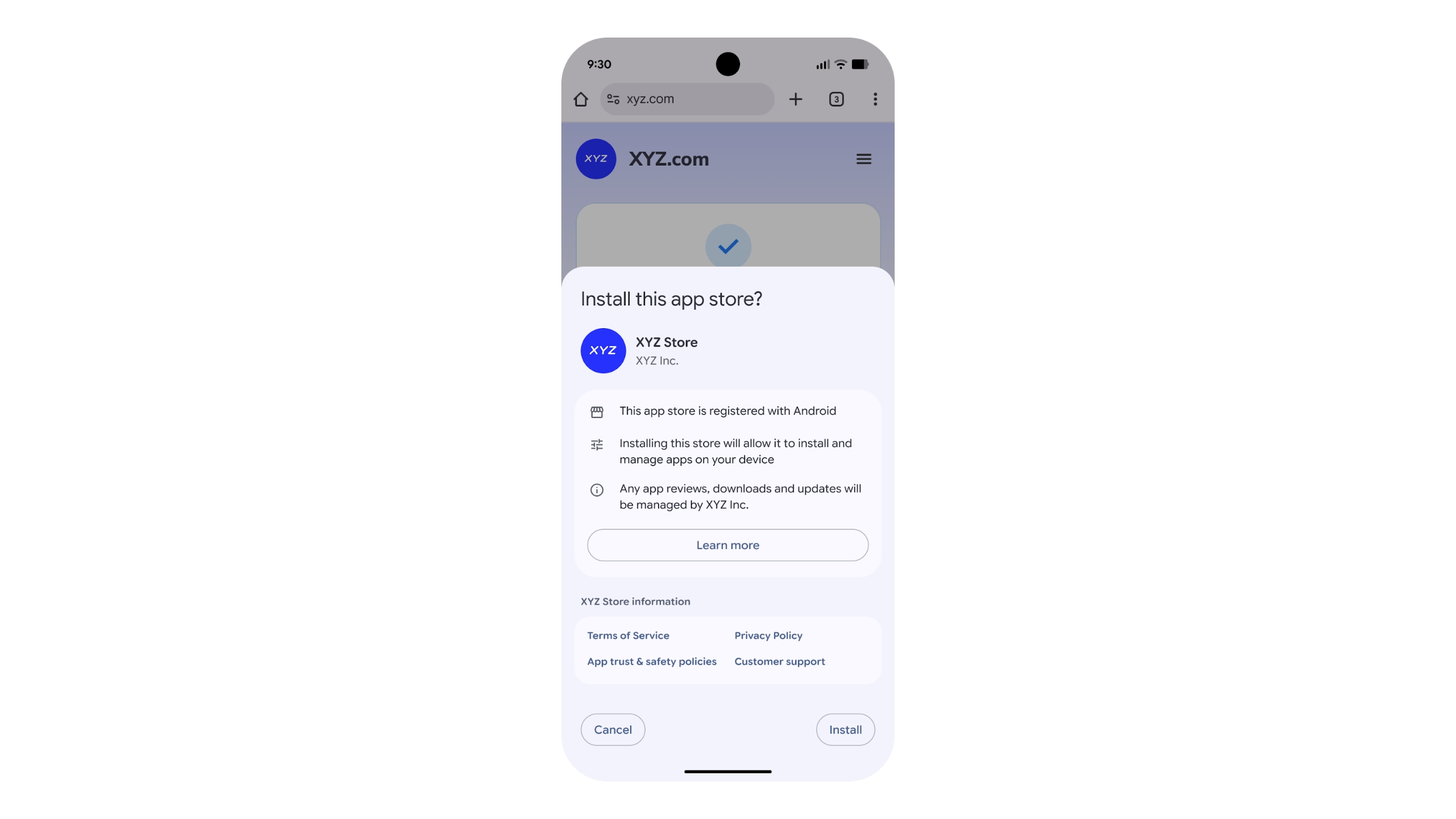
Epic is ultimately interested in getting people to use the mobile version of its Epic Games Store, and Google’s announcement also includes details on how third-party app stores can come to Android. Third-party app stores will be able to apply to the company's new "Registered App Stores" program to see if they meet "certain quality and safety benchmarks." If they do, they'll be able to take advantage of a streamlined installation interface in Android. Participating in the program is optional, and users will still be able to sideload alternative app stores that aren't part of the program, but Google clearly has a preference.  Changes the company plans to make to sideloading later in 2026 could deliberately make the process more difficult, which might force developers to apply to Google’s program.

The interface for installing "qualified" third-party app stores on Android.
App stores approved by the Registered App Stores program get a simpler installation interface.
Google

Given the scale of the changes, not all of Google's tweaks will be available everywhere at the same time. Google says that its updated fee structure will come to the EEA, the UK and the US by June 30, Australia by September 30, Korea and Japan by December 31 and the entire world by September 30, 2027. Meanwhile, the company's updated Google Play Games Level Up program and new App Experience program will launch in the EEA, the UK, the US and Australia on September 30, before hitting the remaining regions alongside the updated fee structure. For any developers interested in offering their own app store, Google says it'll launch its Registered App Stores program "with a version of a major Android release" before the end of the year. According to the company, the program will be available in other regions first before it comes to the US.

Google has made changes to how it collects app store fees in the past, the most significant being in 2021, when it lowered its cut to 15 percent on the first $1 million developers earn, and 15 percent on subscriptions. The difference here is that the regulatory scrutiny brought about by Epic's lawsuit against Google and Apple seems to be a key motivator for its changes. Well, that, and an entirely separate business deal the company made with Epic. Google and Epic's settlement served as the basis for these changes, but The Verge reported in January that the companies also agreed to an $800 million joint partnership around product development and Google using Epic's "core technology." Letting developers keep more of their money is ultimately good, but it's a business decision Google felt comfortable making, which likely means it has its own share of upsides. 

This article originally appeared on Engadget at https://www.engadget.com/apps/google-ends-its-30-percent-app-store-fee-and-welcomes-third-party-app-stores-185248647.html?src=rss

©

  •  

FCC approves the merger of cable giants Cox and Charter

The Federal Communications Commission has given the go ahead for two of the US' biggest cable providers, Charter Communications and Cox Communications, to merge. Charter announced its intention to acquire Cox for $34.5 billion in May 2025, with specific plans to inherit Cox's managed IT, commercial fiber and cloud businesses, while folding the company's residential cable service into a subsidiary.

“By approving this deal, the FCC ensures big wins for Americans," FCC Chairman Brendan Carr said in a statement. "This deal means that jobs are coming back to America that had been shipped overseas. It means that modern, high-speed networks will get built out in more communities across rural America. And it means that customers will get access to lower priced plans. On top of this, the deal enshrines protections against DEI discrimination."

The FCC claims that Charter plans to invest "billions" to upgrade its network following the closure of the deal, leading to "faster broadband and lower prices." The company's "Rural Construction Initiative" will also extend those improvements to rural states lacking in consistent internet service, a project the FCC was heavily invested in during the Biden administration, but has been pulling back from since President Donald Trump appointed Carr. The FCC also claims Charter will onshore jobs currently handled off-shore by Cox employees and commit to "new safeguards to protect against DEI discrimination," which essentially amounts to hiring, recruiting and promoting employees based on "skills, qualifications, and experience."

While Carr's FCC paints a rosy picture of Charter's acquisition, history has provided multiple examples of mergers having the opposite effect on jobs and pricing. For example, redundancies created when T-Mobile merged with Sprint in 2020 led to a wave of layoffs at the carrier. And funnily enough in 2018, not long after Charter's merger with Time Warner Cable was approved by the FCC, the company raised prices on its Spectrum service by over $91 a year. 

The FCC's obsession with diversity, equity and inclusion as part of the deal is stranger, if only because it appears to fall outside of the commission's purpose of maintaining fair competition in the telecommunications industry. It does fit with other mergers the FCC has approved under Carr, however. Skydance's acquisition of Paramount was approved in 2025 under the condition it wouldn't establish any DEI programs.

This article originally appeared on Engadget at https://www.engadget.com/big-tech/fcc-approves-the-merger-of-cable-giants-cox-and-charter-230258865.html?src=rss

©

  •  

Paramount agrees to buy Warner Bros. Discovery, pays Netflix $2.8 billion for breakup

Paramount Skydance and Warner Bros. Discovery are officially merging. The studio paid Netflix the $2.8 billion termination fee it was owed for breaking its original deal to buy Warner Bros. earlier today, and the historic film studio has now formally accepted Paramount’s offer.

Along with the deal, which values Warner Bros. Discovery at $31 per share, Paramount is making several commitments to assuage the fears of regulators and the entertainment community. Those include a guarantee that the new company will produce 30 theatrical films annually, that theatrical releases will have a minimum 45-day window in theaters before they’re brought to video on demand (something Netflix ultimately also agreed to) and that deal itself will close by Q3 2026.

This turnaround in Paramount's fortunes has happened quickly. Warner Bros. Discovery announced that Paramount's offer was superior to Netflix's on Thursday, and not long after the streaming service said that it wouldn't provide a counter offer, effectively abandoning its previous agreement.

Ultimately, Netflix and Paramount were vying for different parts of Warner Bros. Disocvery. Netflix was primarily interested in Warner Bros. proper, while Paramount Skydance wanted the whole company, cable networks and all. Either deal would need to be approved by regulators, which is the hurdle Paramount and Warner Bros. Discovery face now. The general assumption has been that the close relationship Paramount CEO David Ellison and his billionaire father Larry Ellison have with the Trump administration would smooth over any issues, but the deal will receive scrutiny abroad and likely also at the state level, based on a recent post from California Attorney General Rob Bonta.

Paramount Skydance has proven its willingness to comply with President Donald Trump, but delays in closing the deal could be costly. The company is on the hook to pay Warner Bros. Discovery "a daily ticking fee equal to $0.25 per share per quarter beginning after September 30, 2026." The company also has to pay $7 billion to Warner Bros. Discovery if the deal is terminated for regulatory reasons. Netflix lost the battle for Warner Bros. Discovery, but getting a competitor to potentially overpay for the studio might be its own reward.

This article originally appeared on Engadget at https://www.engadget.com/entertainment/paramount-agrees-to-buy-warner-bros-discovery-pays-netflix-28-billion-for-breakup-215936514.html?src=rss

©

  •  

The PS5 Pro is getting upgraded upscaling tech in March

After suggesting a version of AMD's FSR 4 could be ported to the PS5 Pro last year, it looks like Sony is finally rolling out an update with the upscaling tech in March. Mark Cerny, the lead architect of the PS4, PS5 and PS5 Pro, shared via a blog post that the PS5 Pro will be updated with a new version of the company's PSSR (PlayStation Spectral Super Resolution) upscaling tech next month, and Resident Evil Requiem is one of the first games to use it.

PSSR is "an AI library that analyzes game images pixel by pixel as it upscales them," Cerny says, which boosts the visual fidelity of games on the PS5 Pro, while running them at a less demanding resolution. The upgraded version of PSSR "takes a very different approach to not only the neural network but also the overall algorithm," and is now able to keep both framerate and image quality high when it's enabled.

Cerny's blog post includes comparison images if you're curious about the visual differences the new PSSR is able to achieve. Masaru Ijuin, a Senior Manager from Capcom's Engine Development Support Section R&D Foundational Technology Department, also provided comments on how the new upscaling tech improves Resident Evil Requiem:

With Resident Evil Requiem, we focused on enhancing the presentation quality of the protagonist through an upgraded version of RE Engine to deepen the player’s immersion in horror. For example, each individual strand of hair and beard is rendered as a polygon, allowing it to move realistically in response to body motion and wind. The way light passes through his hair changes depending on how the strands of hair are overlapped as well. This detailed expression of texture is one of the many details that we would especially love for our fans to see.

The upgraded PSSR has allowed us to elevate our expressiveness by successfully processing these details and textural particularities, which are traditionally difficult to upscale because of their intricacy. We hope you will experience this unprecedented level of horror and visual fidelity, and the new gameplay feel it delivers.

Sony and AMD formally announced "Project Amethyst," their collaboration to develop machine-learning technology to improve graphics and gameplay, in 2024. The partnership has already benefitted both companies: Cerny says Sony contributed to the development of AMD's FSR 4 and similar improvements are now trickling back to the PS5 Pro. Both companies' plans to improve everything from upscaling performance to energy efficiency could also pay further dividends in future consoles and GPUs. 

The new toggle for the upgraded version of PSSR that's coming to PS5 Pro consoles.
Sony Interactive Entertainment

The upgraded PSSR will roll out to PS5 Pro owners as part of a software update in March, and will be able to be toggled on and off in the console's settings, according to Cerny. Around the same time, multiple PS5 games are also supposed to be updated to support the upscaling tech. While the graphical improvements are still incremental over a normal PS5, the fact that Sony's still squeezing more performance out of its console should at least be reassuring to anyone who spent $700 (or now $750) on a PS5 Pro.

This article originally appeared on Engadget at https://www.engadget.com/gaming/playstation/the-ps5-pro-is-getting-upgraded-upscaling-tech-in-march-200105816.html?src=rss

©

  •  

iFi's new GO Link 2 DAC is a cheap way to reap the lossless benefits of your Spotify plan

Audio company iFi just introduced a new DAC (digital-to-analogue converter) that's both smaller and lighter than its previous model, and only costs $59. The iFi GO Link 2 connects to a smartphone or other audio-playing device over USB-C and can instantly improve the listening experience on wired headphones.

Wireless earbuds and music streaming services have normalized listening to your favorite songs at a lower quality. For anyone who doesn't consider themselves an audiophile, that might not matter, but now that several streaming services offer higher sample rates and lossless audio, you might consider other ways of listening. In order to experience all the benefits of high-res or lossless audio, you need wired headphones, something that's increasingly difficult when most smartphones only have a USB-C port. That's where the iFi GO Link 2 comes in. The dongle plugs into a USB-C port and lets you connect a pair of wired earbuds while preserving your high quality audio at the same time.

An iFi GO Link 2 DAC laid flat on a white background.
iFi

iFi's new DAC is eight percent smaller than the previous GO Link and 29 percent lighter, approaching the size of Apple's USB-C to 3.5mm Headphone Jack dongle. The GO Link 2's built-in ESS Sabre DAC chipset is supposed to add "6dB of dynamic range between the loudest and quietest moments" and reduce distortion for clearer sound by up to 62 percent when compared to the original GO Link.

Via iFi's companion Nexis app on Android, the GO Link 2 can also be updated on the go and further customized with digital filters. The GO Link 2 supports two digital filters — one hybrid and one linear — so that you can adjust things to your preferred sound profile. You can also use the Nexis app to set volume limits when you're listening with the DAC attached.

The previous GO Link made it on Engadget's list of the best DACs for Apple Music Lossless, and at the same price, the GO Link 2 seems like it could, too. The iFi GO Link 2 is available to purchase now for $59.

This article originally appeared on Engadget at https://www.engadget.com/audio/ifis-new-go-link-2-dac-is-a-cheap-way-to-reap-the-lossless-benefits-of-your-spotify-plan-231535369.html?src=rss

©

  •  

Guitar Hero vets RedOctane reveal their new music game

RedOctane Games, a relaunched version of one of the studios behind the very first Guitar Hero, has shared a first trailer for its new music game, Stage Tour. The original RedOctane was shut down by Activision in 2010, and only recently reformed under Embracer Freemode to create a new music game franchise in August 2025.

Stage Tour is playable solo or with other players in a band, according to RedOctane, and supports inputs from a keyboard and mouse on top of the expected guitar, drums and microphone accessories. The studio plans to primarily offer the game digitally, but hopes to also sell a bundle with a guitar controller and a download code because "that just feels right." As far as ongoing support goes, whereas games like Guitar Hero or Rock Band included a set tracklist and support for song DLC, it sounds like RedOctane could be taking an approach more inspired by Epic's regular updates to Fortnite. "The plan is regular special events that are more than just music drops," RedOctane writes. "Real moments. Real themes. Real updates. We want to evolve the game alongside the fans who support it. Improve it. Expand it. Keep it alive." 

RedOctane and Harmonix created the first Guitar Hero in 2006, before RedOctane was acquired by Activision to continue the franchise in 2006, and Harmonix went on to start the Rock Band series. Development of Stage Tour is currently being led by RedOctane, with Eidos Montréal helping with motion capture and QA, and Third Kind Games providing additional development support. Conveniently, RedOctane’s owner Embracer Freemode also already owns CRKD, a video game accessory maker that has experience building controllers for rhythm games.

Sign-ups to play an alpha of Stage Tour will open soon, and RedOctane plans to "kick off closed alpha testing late spring/early summer." We're long past the peak popularity of games like Guitar Hero, but rhythm and music games never went away. Players have had Clone Hero and more official experiences like Fortnite Festival to get their Guitar Hero or Rock Band fix, but Stage Tour could be a more than welcome third option when it launches later this year.

This article originally appeared on Engadget at https://www.engadget.com/gaming/guitar-hero-vets-redoctane-reveal-their-new-music-game-220809719.html?src=rss

©

  •  

An AI-generated Resident Evil Requiem review briefly made it on Metacritic

Review aggregator Metacritic has removed a review of Resident Evil Requiem because it was AI-generated, Kotaku reports. The review was published by UK gaming site VideoGamer, but appears to be "written" by a fake AI journalist rather than a real person.

While it's unfortunately difficult to confirm with 100 percent accuracy whether a piece of text is AI-generated, you don't have to read VideoGamer's review for long to notice all the ways it feels off. The biggest giveaway, beyond heavy use of contrived metaphors, is a striking lack of detail beyond what you could glean from a trailer for the game. Embargoes covering what parts of a video game can come up in a pre-release review can be strict, but a good critic usually finds a way to describe their experience without being vague. VideoGamer's review, written by one "Brian Merrygold," really doesn't.

It's bleak. I was reading some RE Requiem reviews and found this thing published by videogamer. Can't find anything about the writer, everything about it reeks AI (dead giveaway being the image). Low effort, gargabe.

Mind you, this review made its way to Metacritic. https://t.co/4STN8DjAwe pic.twitter.com/awk26P9wSA

— Andrés (@Andrew_east) February 26, 2026

As at least one user on X has pointed out, it’s worth` being suspicious of Merrygold, too. The author's profile on VideoGamer is just as awkwardly written as the review, and the profile picture of the account appears to be AI-generated. When you try to save the image locally, its file name, "ChatGPT-Image-Oct-20-2025-11_57_34-AM-300x300," also seems like a dead giveaway. Kotaku looked at the X accounts of several other recent bylines at VideoGamer and found similar results. All their profile pictures appear to be AI-generated, and all the accounts were created around the same time in October 2025.

Metacritic relies on reviews written by real publications to create a score representing the overall critical sentiment towards a game or movie, not unlike Rotten Tomatoes. While there's disagreement whether it's a good thing that a popular site strips out the nuance of written reviews to make a number people can argue over, everyone can probably agree that Metacritic incorporating fake, AI-generated reviews is a bad idea.

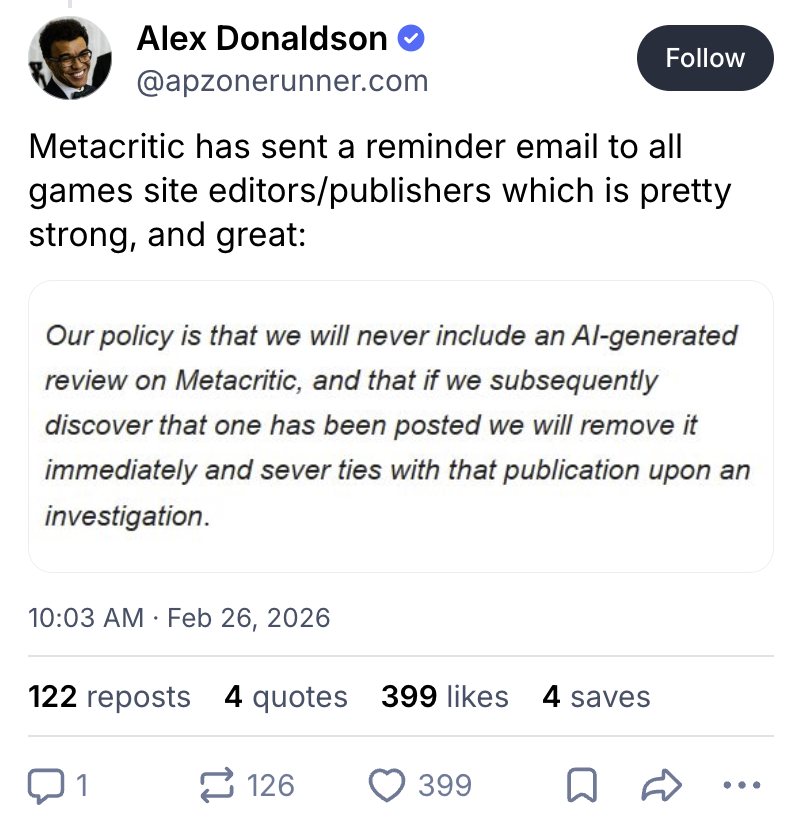
In response to the discovery that VideoGamer's review is likely AI-generated, Metacritic has removed it from its Resident Evil Requiem page. "The RE Requiem review and a handful of other VideoGamer reviews from 2026 have been removed from Metacritic,” Marc Doyle, Metacritic's co-founder, told Kotaku. Metacritic has also emailed all games sites and publishers that it aggregates with information on its policy towards AI-generated reviews, according to Alex Donaldson, founder and publisher of RPG Site.

A Bluesky post from Alex Donaldson sharing Metacritic's email to publishers on how it will handle AI-generated reviews.
Alex Donaldson

“Our policy is that we will never include an AI-generated review on Metacritic,” the aggregator says, “and that if we subsequently discover that one has been posted we will remove it immediately and sever ties with that publication upon an investigation.”

A news site publishing an AI-written review is just as dire as Metacritic aggregating it, and that appears to be what VideoGamer is doing. ClickOut Media, the company that owns VideoGamer and a collection of other publications, reportedly laid off the staff of its gaming sites earlier this month to pivot to AI-generated content. Sifting through AI slop, whether on social media or Pinterest, is increasingly necessary online. Now apparently Metacritic is another place where readers should have their guard up.

Update, February 26, 2:58PM ET: Added information about Metacritic’s email to publishers on its policy for AI-generated reviews.

This article originally appeared on Engadget at https://www.engadget.com/ai/an-ai-generated-resident-evil-requiem-review-briefly-made-it-on-metacritic-194414929.html?src=rss

©

  •  
❌