Twitter is officially 20 years old. In another reality, that might make me kind of nostalgic. I've been lurking and scrolling and tweeting for 16 years; most of my adult life. There was a time when Twitter was a place where some internet strangers became my IRL friends, when I was excited to "live-tweet". When my infinitely more well-adjusted friends would send me memes, I would smugly say "I saw that on Twitter days ago."
Twitter stopped being that place a long time ago, but I don't have any nostalgia for it. I don't really feel anything at all, actually.
Because I can already hear the comments: Yes, I'm still on X. I don't spend as much time there as I did a decade ago, but it's still quite a lot of time, an unhealthy amount, if I'm being honest. My job is to report on social media companies, so I keep (doom)scrolling. That's what I tell myself anyway.
A few of my favorite posters are still around. Dril's still got it. The memes are still, occasionally, good, even though X's recommendation algorithm seems to prefer pointing me toward endless AI slop, boring hot takes from thirsty mid-tier tech execs and blatant engagement bait. X's algorithm — what little we can learn about it, anyway — now relies on Grok's predictions about what you'll like.The same Holocaust-loving Grok that has spewed racism and referred to itself as MechaHitler and declared Elon Musk "the single greatest person in modern history." The same Grok that allegedly generated thousands of images of child abuse material. Hey @grok is that true?
X is not Twitter but it's also not not-Twitter. Last year, an online marketplace startup bought the 560-pound Twitter bird that once adorned the company's San Francisco office and blew it up in a Nevada desert surrounded by Tesla CyberTrucks as part of an elaborate publicity stunt. Dumb? Yes. But also a somehow fitting adieu for "Larry."
It's been 20 years since Jack Dorsey sent the first-ever tweet, which was never even a good tweet anyway. It's been five years, by the way, since he turned that tweet into an NFT (remember NFTs??) and auctioned it for nearly $3 million. It's now functionally worthless. Another chapter in Dorsey's confusing, complicated legacy.
This article originally appeared on Engadget at https://www.engadget.com/social-media/twitter-turned-20-and-i-feel-nothing-140000602.html?src=rss
A group of former Twitter investors have prevailed at a federal civil trial over Elon Musk's actions amid his $44 billion acquisition of the social platform in 2022. A jury in San Francisco found Friday that tweets made by Musk about fake accounts on the platform had defrauded investors in the company. The jury sided with Musk on other allegations in the case.
It's not yet clear how much Musk will owe in damages as a result of the case but, as the Associated Press reports, it could amount to billions of dollars. Jurors calculated that shareholders should get "between about $3 and $8 per stock per day."
The class action lawsuit, one of several brought against Musk in the months following his takeover of the company, cited Musk’s tweets about fake accounts on the platform. Facing a sinking Tesla share price in the days after announcing he would buy Twitter for $54.20 a share, the suit said Musk made tweets and statements that were intentionally meant to drive down Twitter's share price in an attempt to renegotiate or exit the deal.
The suit called out Musk's May 13, 2022, tweet that claimed the Twitter deal was "temporarily on hold" due to the number of fake accounts and bots on the platform, as well as one a few days later that suggested fake accounts might account for more than 20 percent of users. Twitter's stock dropped significantly following the May 13 tweet.
During the trial, Musk said the tweets were him "speaking his mind" and maintained that Twitter executives had "lied" about the number of bots on the platform, according toKQED. Former Twitter shareholders, on the other hand, said "they sold shares at deflated prices amid Musk’s public waffling."
Musk faced several lawsuits during and after his $44 billion takeover of the company. That includes other shareholder lawsuits related to his delay in disclosing his stake in the company, as well as one from former executives related to unpaid severance benefits (Musk later settled those claims). He also narrowly avoided a trial over his attempts to back out of the deal.
This article originally appeared on Engadget at https://www.engadget.com/social-media/elon-musk-misled-investors-during-his-twitter-takeover-jury-finds-232033028.html?src=rss
Pinterest's CEO has thrown his support behind an Australia measure banning social media for younger teens and is calling for governments around the world to implement similar bans. "Social media, as it’s configured today, is not safe for young people under 16," Ready writes in a piece published byTime. "We need a clear standard: no social media for teens under 16, backed by real enforcement, and accountability for mobile phone operating systems and the apps that run on them."
Ready is one of the highest-profile tech CEOs to come out in favor of a broad ban on social media for teens. That may also seem like a bold stance for someone who runs a platform with a user base that's more than 50 percent Gen Z, but Ready doesn't think that ban should apply to Pinterest. Pinterest, as he notes, already bars teens under 16 from accessing messaging features and other social features. It also makes teen accounts private by default.
A spokesperson for Pinterest confirmed the company has no plans to change its own policies regarding users under 16, and said Pinterest considers itself a "visual search platform" not social media. Pinterest, like most social media and social media-adjacent companies, doesn't allow users under 13 to sign up.
Social media or not, Pinterest has encountered child safety-related issues in the past. In 2023, NBC Newsreported that Pinterest's recommendation algorithm was surfacing photos and videos of young girls to adults who were "seeking" such content. Some of those users had created Pinterest boards featuring images of young girls with titles like "sexy little girls," their investigation found. The company made profiles for teens under 16 private and "not discoverable" six months later.
According to Ready, Pinterest's popularity with younger users is proof its policies are also good for the company's business. "Our experience shows that prioritizing safety and well-being doesn’t push young people away; it builds trust," he writes.
This article originally appeared on Engadget at https://www.engadget.com/social-media/pinterest-ceo-says-teens-under-16-should-be-banned-from-social-media-but-not-pinterest-211630443.html?src=rss
A little more than a year after ditching third-party fact checkers and rolling back much of its proactive content moderation, the company says it will further "transform" its approach by drastically reducing the number of human moderators in favor of AI-based systems. The company says the change will happen "over the next few years," and will allow the company to catch more issues faster than its current approach.
Meta didn't say how much of its contract workforce might be cut as it makes this transition. The company employs thousands of contractors around the world to review content flagged by its AI systems and user reports among other tasks. The company said that as it shifts its approach humans will "play a key role" in "critical decisions" and aid in training and other tasks.
"Experts will design, train, oversee, and evaluate our AI systems, measuring performance and making the most complex, high‑impact decisions," Meta said in an update. "For example, people will continue to play a key role in how we make the highest risk and most critical decisions, such as appeals of account disablement or reports to law enforcement."
The company has been testing LLM-based systems for content moderation for a while and says that early tests have had "promising" results. Another advantage is that its AI can handle languages used by "98% of people online," compared with the 80 languages currently supported by its moderation capabilities.
While Meta says its underlying rules aren't changing, the new approach could dramatically change users' perception of how Meta enforces its policies. The company already relies heavily on AI for certain rules, and many users believe that these systems make too many mistakes and make it difficult for their appeals to reach a set of human eyes. On the other hand, Meta, which stands to save a lot of money if it significantly downsizes its contract workforce, says its new systems make "fewer over-enforcement mistakes" and catch more of the most "severe" violations.
In the nearer term, Meta is introducing an AI powered "support assistant" that will help users with certain types of account issues. The chatbot, which is rolling out now in the Facebook and Instagram app, will be able to help users report content and manage appeals, reset passwords and manage other account settings. It will also be able to help people who get locked out of their accounts "starting with select cases in the US and Canada."
This article originally appeared on Engadget at https://www.engadget.com/social-media/meta-will-move-away-from-human-content-moderators-in-favor-of-more-ai-183000435.html?src=rss
Meta is backtracking on its plans to shut down the VR version of its metaverse. The company now plans to support Horizon Worlds in VR for the "foreseeable future," though users shouldn't expect new games, CTO Andrew Bosworth said in an update.
"We will keep Horizon Worlds working in VR for existing games, to support the fans who've reached out," Bosworth said in a post on Instagram. "For people who already have games they like that they're using in Horizon Worlds, [they] will be able to download the Horizon Worlds app and use it in VR for the foreseeable future."
The reversal comes after Meta said earlier this week that Horizon Worlds in VR would no longer be accessible after June 15 as the company pivots its metaverse experiences to mobile. Though Horizon never gained mass appeal, even among VR enthusiasts, Meta's move to shut it down was just the latest sign of how the company has pivoted away from its metaverse ambitions as it chases AI "superintelligence."
In his post on Instagram, Bosworth said there was "a lot of misinformation" about the company's plans. "We announced, 'hey, we're moving away from Horizon Worlds in VR,' and the headline is that Horizon is dead," he said. "It's not. And likewise, VR is not dead. We're continuing to invest tremendously." The company laid off more than 1,000 employees from its metaverse division and shut down three VR studios earlier this year. Bosworth said that the company is still working on its next two generations of VR headsets.
He described the metaverse as a "misunderstood concept" that was never meant to only encompass virtual reality. He said that AR is also part of the vision and that even people scrolling their phones could be part of the metaverse. "When somebody is using their phone and you're physically with them, they're at the dinner table with you, and yet when you talk to them, they hear nothing because they've transported themselves through the glowing rectangle into a digital space," he said. "Maybe that they're scrolling media, maybe that they're in the text world, but like they have transported themselves. So we've always had this internally — at least me and Mark — this very expansive construct of the metaverse."
This article originally appeared on Engadget at https://www.engadget.com/ar-vr/meta-isnt-shutting-down-its-vr-metaverse-after-all-165520696.html?src=rss
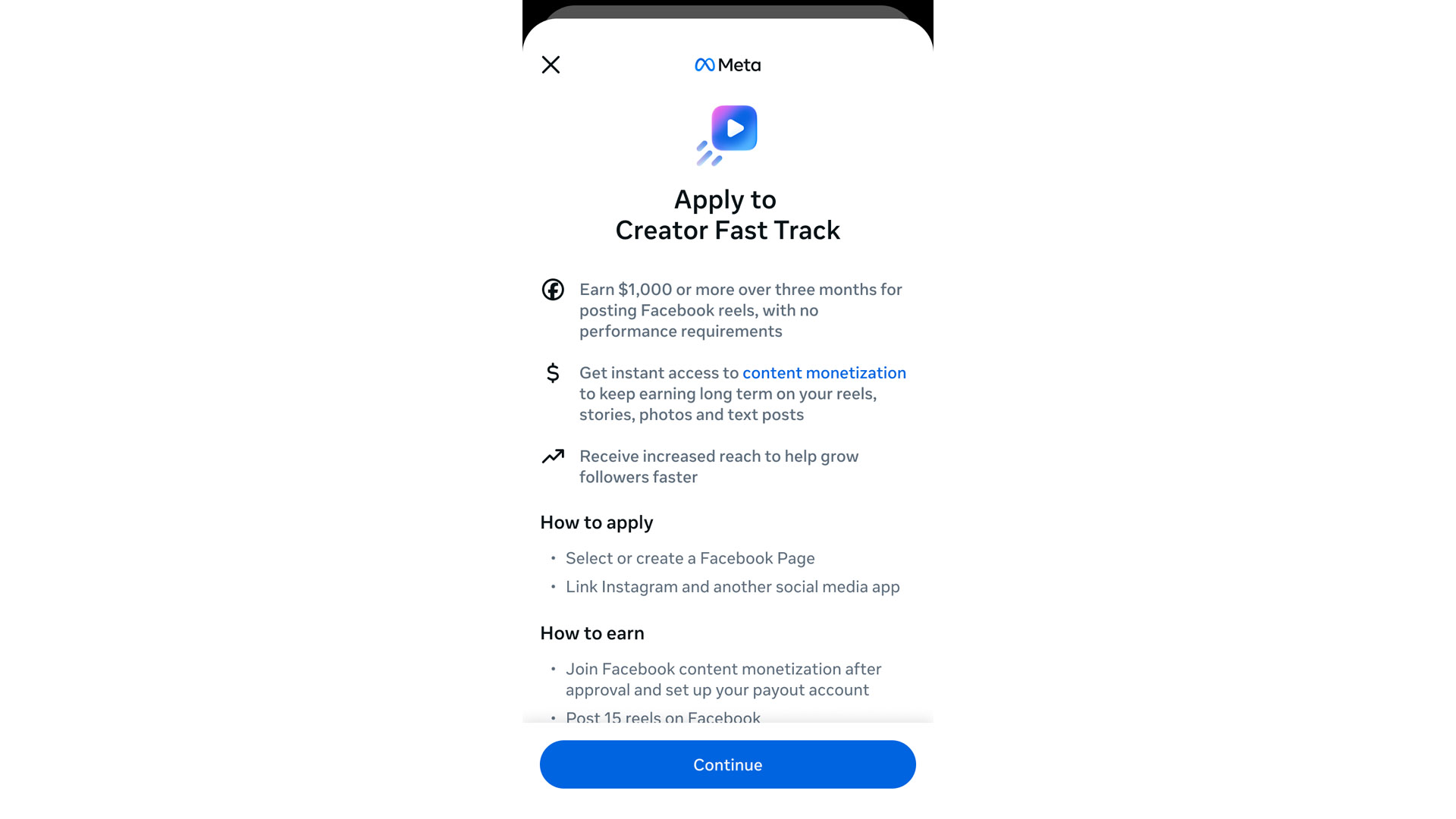
Stop me if you've heard this before: Meta has a new program to lure top creator talent to Facebook and it comes with hefty bonus payments. The company is launching a new initiative aimed at popular creators who already have large followings on TikTok, YouTube or Instagram and offering them bonuses up to $3,000 a month just for posting on Facebook.
Meta's goal is to draw more top talent to its Content Monetization program, which pays creators based on views and other engagement metrics across Stories, Reels and posts. The new bonuses will be part of an initiative Meta has dubbed "Creator Fast Track," which is meant to make the onboarding process easier — and more enticing — to Facebook newcomers.
Under the new "Fast Track" program, Meta is offering monthly bonuses of $1,000 to creators who have at least 100,000 followers on another platform and $3,000 for those that have a million or more. Creators who join will need to post a minimum number of Reels per month to earn the bonuses, but aren't required to meet engagement targets or post exclusive content to earn. They also aren't limited to video content as Facebook also rewards text and photo posts, as well as Stories.
That may sound like a pretty good deal (it is), but it's also a limited one. The fast track bonuses will only last for three months. Creators should think of the bonuses as payment "for the hassle of starting on a new platform," not the central part of the program, Meta's VP of Product for Creators, Yair Livne, tells Engadget. "Our hope is that within a few months … the earnings that you see from Facebook Content Monetization will become the more important thing." He also notes that Meta will boost the reach of creators it fast-tracks, which should help them speed up their earning potential.
Creators can apply for the new program in Facebook's app.
Meta
It's far from the first time Facebook has sought to lure big names with big checks. It promised publishers big payouts when it launched Facebook Watch nearly a decade ago. It once courted game streamers for its (now defunct) Twitch competitor. A year after launching Reels to take on TikTok, it invested $1 billion in a bonus program that offered creators as much as $35,000 a month only to pull the plug in 2023.
Livne acknowledged that it "took us a long time to find our path" to a more sustainable creator program. "We don't have a pool structure so you're not competing with other creators for dollars. It really is based on your performance."
There are already signs that the Facebook Content Monetization program, which it introduced in the fall of 2024, is working — at least for some. Meta says it paid Facebook creators nearly $3 billion in 2025, a new high for the social network. Creators have also reported that the new streamlined program is paying off.
One political news creator told the newsletter Chaotic Era that they made $250,000 from Facebook in January alone. Publishers told Digiday last year that they expected to make "between six and seven figures" in 2025 thanks to the program. There are numerous recent posts in Reddit's r/passiveincome forum where users report making five figures a month from the program, which is still invitation only.
Livne agrees that Facebook's monetization program has been something of a "well kept secret" in the creator community. "We're trying to make it less well kept and less of a secret."
Are you in Facebook's Content Monetization Program, Creator Fast Track or another creator program at Meta? You can reach Karissa by email, on X, Bluesky, Threads, or send a message to @karissabe.51 to chat confidentially on Signal.
This article originally appeared on Engadget at https://www.engadget.com/social-media/metas-latest-creator-push-comes-with-3000-bonuses-for-posting-on-facebook-160000283.html?src=rss
xAI, which is already facing multiple investigations around the world over widespread reports that Grok repeatedly created sexualized images of children, is now facing a class action lawsuit. Three teenagers, who allege that photos of them were used by Grok to generate child exploitation material, have filed a class action lawsuit against xAI in California.
According to the lawsuit, one of the teens was alerted last December that someone was sharing AI-generated images and videos of her and other minors "in settings with which she was familiar, but morphed into sexually explicit poses." The images and videos were allegedly shared on Discord, Telegram and other platforms and used "as a bartering tool" for other CSAM imagery. Law enforcement officials who investigated the images told the girls' parents they were created with xAi's Grok, the lawsuit says.
The three teens, all of whom live in Tennessee and are identified as Jane Doe 1, Jane Doe 2 and Jane Doe 3, have "suffered severe emotional distress," the filing says. "Their lives have been shattered by the devastating loss of privacy, dignity, and personal safety that the production and dissemination of this CSAM have caused," lawyers for the teens write in the complaint, which was provided to Engadget. "xAI’s financial gain through the increased use of its image- and video-making product came at their expense and wellbeing. Plaintiffs will have to spend the rest of their lives knowing that their CSAM images and videos may continue to be trafficked and traded online by child sex predators."
Though the lawsuit currently names three individuals, the complaint says that it could cover "at least thousands of minors" who have also had their photos manipulated by Grok into sexualized images. The lawsuit claims xAI has violated multiple laws, including laws barring the production and distribution of child abuse material.
xAI didn't immediately respond to a request for comment on the lawsuit. The company is also facing multiple investigations in the US and Europe over Grok's alleged generation of nonconsensual nudity. Researchers at the Center for Countering Digital Hate estimated in January that Grok had produced millions of sexualized images, including 23,000 that appeared to show children.
xAI CEO Elon Musk, who previously promoted Grok's "spicy" abilities, has claimed that he was "not aware of any naked underage images generated by Grok." xAI announced in January it would stop allowing people to use Grok to edit images of real people into bikinis and limit Grok's image-generation feature to paid subscribers.
This article originally appeared on Engadget at https://www.engadget.com/social-media/xai-is-being-sued-by-teens-who-say-grok-created-csam-using-their-photos-200102733.html?src=rss
The Oversight Board is once again urging Meta to overhaul its rules around AI-generated content. This time, the board says Meta should create a separate rule for AI content that's independent of its misinformation policy, invest in more reliable detection tools and make better use of digital watermarks among other changes.
The group's recommendations stem from an AI-generated video shared last year that claimed to show damaged buildings in the Israeli city of Haifa during the Israel-Iran conflict in 2025. The clip, which racked up more than 700,000 views, was posted by an account that claimed to be a news outlet but was actually run by someone in the Philippines.
After the video was reported to Meta, the company declined to remove it or add a "high risk" AI label that would have clearly indicated the content had been created or manipulated with AI. The board overturned Meta's decision not to add the "high risk" label and says the case shines a light on several areas where the company's current AI rules are falling short.
"Meta must do more to address the proliferation of deceptive AI- generated content on its platforms, including by inauthentic or abusive networks of accounts and pages, particularly on matters of public interest, so that users can distinguish between what is real and fake," the board wrote in its decision. Meta eventually disabled three accounts linked to the page after the board flagged "obvious signals of deception."
One of the board's top recommendations is that Meta create a dedicated rule for AI-generated content that's separate from its misinformation policy. The rule, according to the board, should include specifics about how and when users are required to label AI content as well as information about how Meta penalizes those who break the rule.
The board was also highly critical of how Meta uses its current "AI Info" labels, noting that the way they are applied is "neither robust nor comprehensive enough to contend with the scale and velocity of AI-generated content,” especially in times of conflict or crisis. “A system overly dependent on self-disclosure of AI usage and escalated review (which occurs infrequently) to properly label this output cannot meet the challenges posed in the current environment.”
Meta, the board said, also needs to invest in more sophisticated detection technology that can reliably label AI media, including audio and video. The group added that it was "concerned" about reports that the company is "inconsistently implementing" digital watermarks on AI content created by its own AI tools.
In a statement, Meta said it “welcomed” the decision and that it would also take action “on content that is identical and in the same context” when “it is technically and operationally possible to do so.” The company has 60 days to formally respond to its recommendations.
The decision isn't the first time the board has been critical of Meta's handling of AI content. The group has described the company's manipulated media rules as "incoherent" on twoother occasions, and has criticized it for relying on third-parties, including fact checking organizations, to flag problematic content. Meta's reliance on fact checkers and other "trusted partners" was again raised in this case, with the board saying that it had heard from these groups that Meta "is less responsive to outreach and concerns, in part due to a significant reduction in capacities for Meta’s internal teams." Meta, the board writes, "should be capable of conducting such assessments of harm itself, rather than rely solely on partners reaching out to them during an armed conflict."
While the Oversight Board's decision relates to a post from last year, the issue of AI-generated content during armed conflicts has taken on a new urgency during the latest conflict in the Middle East. Since the start of the US and Israel's strikes on Iran earlier this month, there has been a sharp rise in viral AI-generated misinformation across social media. The board, which has previously hinted that it would like to work with generative AI companies, included a suggestion that would seem to apply to not just Meta.
"The industry needs coherence in helping users distinguish deceptive AI-generated content and platforms should address abusive accounts and pages sharing such output," it wrote.
Update, March 10, 10:53AM ET: This story was updated to reflect Meta’s response to the Oversight Board.
This article originally appeared on Engadget at https://www.engadget.com/social-media/the-oversight-board-says-meta-needs-new-rules-for-ai-generated-content-100000268.html?src=rss
Bluesky CEO Jay Graber, who has led the upstart social platform since 2021, is stepping down from her role as its top executive. Toni Schneider, who has been an advisor and investor in Bluesky, will take over the job temporarily while Graber stays on as Chief Innovation Officer.
"As Bluesky matures, the company needs a seasoned operator focused on scaling and execution, while I return to what I do best: building new things," Graber wrote in a blog post. Schneider, who was previously CEO at Wordpress parent Automattic, will be that "experienced operator and leader" while Blueksy's board searches for a permanent CEO, she said.
Graber's history with Bluesky dates back to its early days as a side project at Jack Dorsey's Twitter. She was officially brought on as CEO in 2021 as Bluesky spun off into an independent company (it officially ended its association with Twitter in 2022 and Dorsey cut ties with Bluesky in 2024). She led the company through its launch and early viral success as it grew from an invitation-only platform to the 43 million-user service it is today. During that time, she's become known as an advocate for decentralized social media and for trolling Mark Zuckerberg's t-shirt choices.
Nearly three years since it launched publicly, Bluesky has carved out a small but influential niche in the post-Twitter social landscape. The platform is less than a third of the size of Meta's competitor, Threads, which has also copied some of Bluesky's signature features. Bluesky also has yet to roll out any meaningful monetization features, though it has teased a premium subscription service in the past.
As Chief Innovation Officer, Graber will presumably still be an influential voice at the company going forward. And, as Wiredpoints out, she still has a seat on Bluesky's board so she will get some say in who steps into the role permanently. Until then, Schneider, who is also a partner at VC firm Tre Ventures, will lead the company. "I deeply believe in what this team has built and the open social web they're fighting for," he wrote in a post on Bluesky.
This article originally appeared on Engadget at https://www.engadget.com/social-media/blueskys-ceo-is-stepping-down-after-nearly-5-years-201900960.html?src=rss
Jurors in a New Mexico child safety trial heard testimony from Meta CEO Mark Zuckerberg today. During pre-recorded testimony, Zuckerberg was repeatedly asked about the company's understanding of social media addiction and other issues that had been studied by its researchers.
During the deposition, which was recorded last March, Zuckerberg was asked about numerous findings from researchers at Meta who studied how the company's apps affect users and teens. The CEO downplayed the significance of many of these documents.
Early in the testimony, which was viewed by Engadget on Courtroom View Network, Zuckerberg was questioned about a document on the effect of feedback on Facebook users. The document stated that "contributors on Facebook are likely to learn to associate the act of posting with feedback" which will "lead contributors to seek rewards by visiting the site more often.” Zuckerberg said he wasn’t “sure if that's actually how it works in practice, but I agree that you're summarizing what they appear to be saying.”
Later, the CEO was questioned about a document that graphed the proportion of 11 and 12-year-olds who were monthly active users on Instagram. The chart indicated that at the time, around 20 percent of 11-year-olds were monthly users of the service. "I agree that the graph says that, I am not familiar with what methodology we were using to estimate this," Zuckerberg said. "I assume that if we had direct knowledge that any given person was under the age of 13, that we would have them removed from our services."
New Mexico's attorney general sued the company in 2023 for alleged lapses in child safety, including facilitating predators' access to minors and building features it knew were addictive. In court, Meta's lawyers and executives have disputed the idea that social media should be considered an "addiction." In public statements, the company has said that lawsuits have relied on "cherry-picked quotes and snippets of conversations taken out of context" and that it "has consistently put teen safety ahead of growth for over a decade."
As with his recent testimony in a separate trial over social media addiction in Los Angeles, Zuckerberg repeatedly rejected the "characterization" of questions that were posed to him. And he said that Meta's goal was to make its apps "useful" rather than to increase the amount of time people spend with them.
Zuckerberg was also questioned about a document written by a company researcher that stated "there is increasing scientific evidence, particularly in the US, … that the average net effect of Facebook on people's well being is slightly negative." The CEO said that "my understanding is that the general consensus view is not that."
It's not the first time a Meta executive has tried to downplay the significance of internal research. The company used a similar strategy in 2021 after former employee turned whistleblower Frances Haugen disclosed documents showing that Facebook's researchers had found that Instagram made some teen girls feel worse about themselves.
Zuckerberg's testimony was played one day after jurors heard recorded testimony from Instagram chief Adam Mosseri. The exec was also asked about Haugen's disclosures and Meta's response to them. Some of those disclosures were based on "problematic research," he said. "Most research is surveys. We run hundreds of surveys every month."
This article originally appeared on Engadget at https://www.engadget.com/social-media/mark-zuckerberg-downplays-metas-own-research-in-new-mexico-child-safety-trial-222924340.html?src=rss
Meta has sued the people and groups behind three scam operations that used images and deepfakes of celebrities to lure users to scam websites. According to the company, the three entities were based in China and Brazil and targeted people in the US, Japan and other countries. The ads promoted fraudulent investment schemes and fake health products.
Meta said that it had filed lawsuits against several people in Brazil who promoted fake or unapproved healthcare products and online courses promoting them. The company also sued a China-based entity it says used ads featuring celebrities "as part of a larger fraud scheme that lured people into joining so-called investment groups." The company didn't provide details on how many ads these groups had run on Facebook, how many social media users had seen or interacted with the ads or how long the scammers had been operating on the platform.
So-called "celeb bait" ads have been a long-running issue for the company. Engadget has previously documented celeb bait scams on Facebook, including ones that frequently use Elon Musk and Fox News personalities to hawk fake cures for diabetes. The Oversight Board has also criticized the company for not doing enough to combat such scams. In its update, Meta says that "because scam ads are designed to look real, they’re not always easy to detect." The company also noted that it has now enrolled "more than 500,000" celebrities and public figures into its facial recognition system that's meant to automatically detect scam ads using the faces of famous people.
Meta's handling of scammy advertisers has come under increased scrutiny in recent months after Reutersreported that researchers at the company at one point estimated that as much as 10 percent of its ad revenue could be coming from scams and banned products. The fact that Meta has made billions of dollars from problematic advertisers has also caused the company to be slow to take action against repeat offenders.
In addition to the groups behind the celeb bait ads, Meta says that it's upgraded its ability to detect scam ads that use cloaking, which has at times hindered its internal review systems. The company also sued a Vietnam-based advertiser it says used scam ads to hawk "deeply discounted items from well-known brands," including Longchamp.
Meta also took legal action against eight former "Meta Business Partners," who promoted services that would "un-ban" or other "account restoration services." The company says it will "consider taking additional legal action, including litigation, if they don’t comply" with cease and desist orders.
Update, February 26, 2026, 1:16PM PT: This story was updated to specify that Meta’s internal estimates around ad revenue included scams and banned products.
This article originally appeared on Engadget at https://www.engadget.com/social-media/meta-sues-advertisers-in-brazil-and-china-over-celeb-bait-scams-190000268.html?src=rss
Mark Zuckerberg took the stand Wednesday in a high-profile jury trial over social media addiction. In an appearance that was described byNBC News as "combative," the Facebook founder reportedly said that Meta's goal was to make Instagram "useful" not increase the time users are spending in the app.
On the stand, Zuckerberg was questioned about a company document that said improving engagement was among "company goals," according to CNBC. But Zuckerberg claimed that the company had "made the conscious decision to move away from those goals, focusing instead on utility," according to The Associated Press. "If something is valuable, people will use it more because it’s useful to them,” he said.
The trial stems from a lawsuit brought by a California woman identified as "KGM" in court documents. The now 20-year-old alleges that she was harmed as a child by addictive features in Instagram, YouTube, Snapchat and TikTok. TikTok and Snap opted to settle before the case went to trial.
Zuckerberg was also asked about previous public statements, including his remarks on Joe Rogan's podcast last year that he can't be fired by Meta's board because he controls a majority of the voting power. According to The New York Times, Zuckerberg accused the plaintiffs' lawyer of "mischaracterizing" his past comments more than a dozen times.
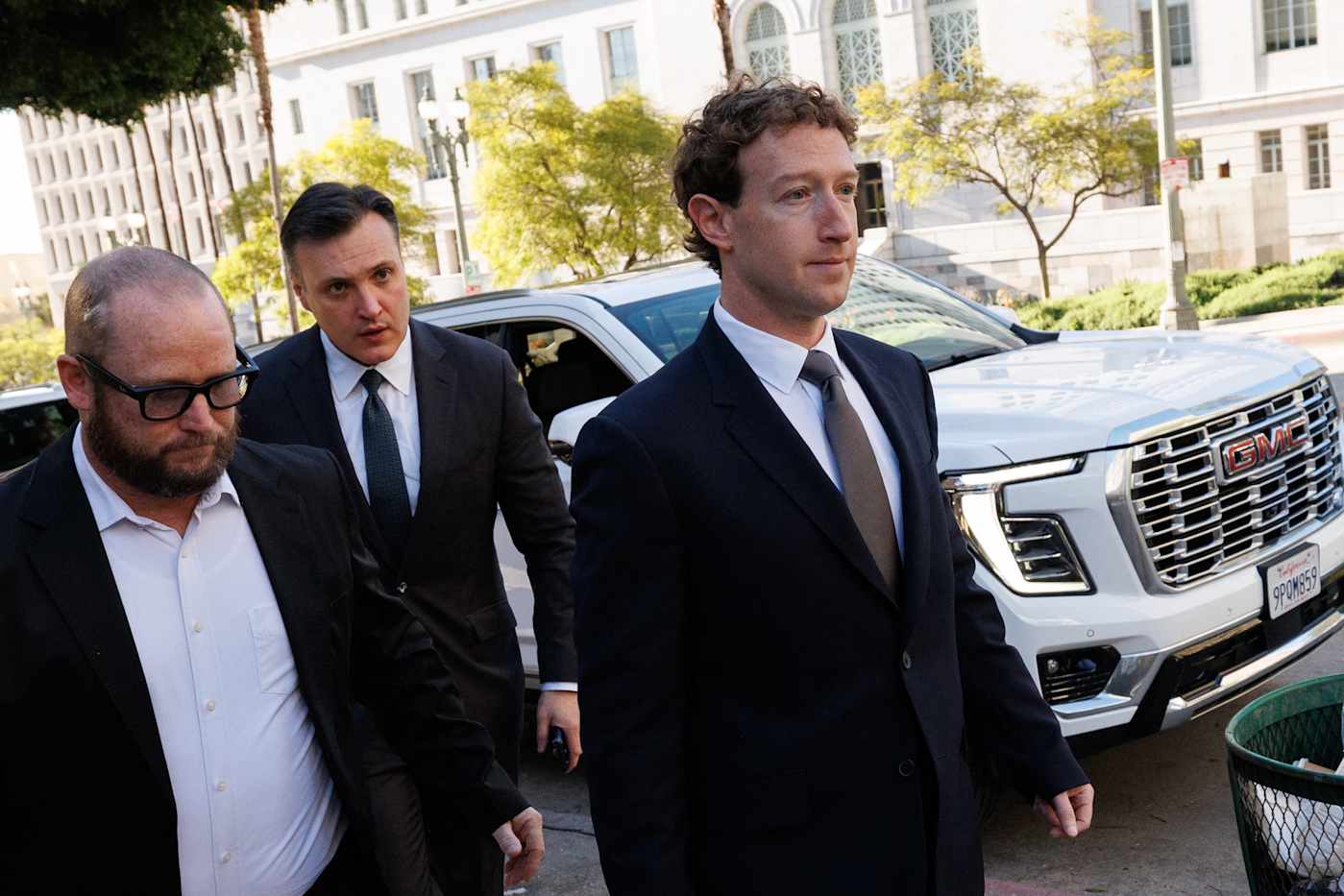
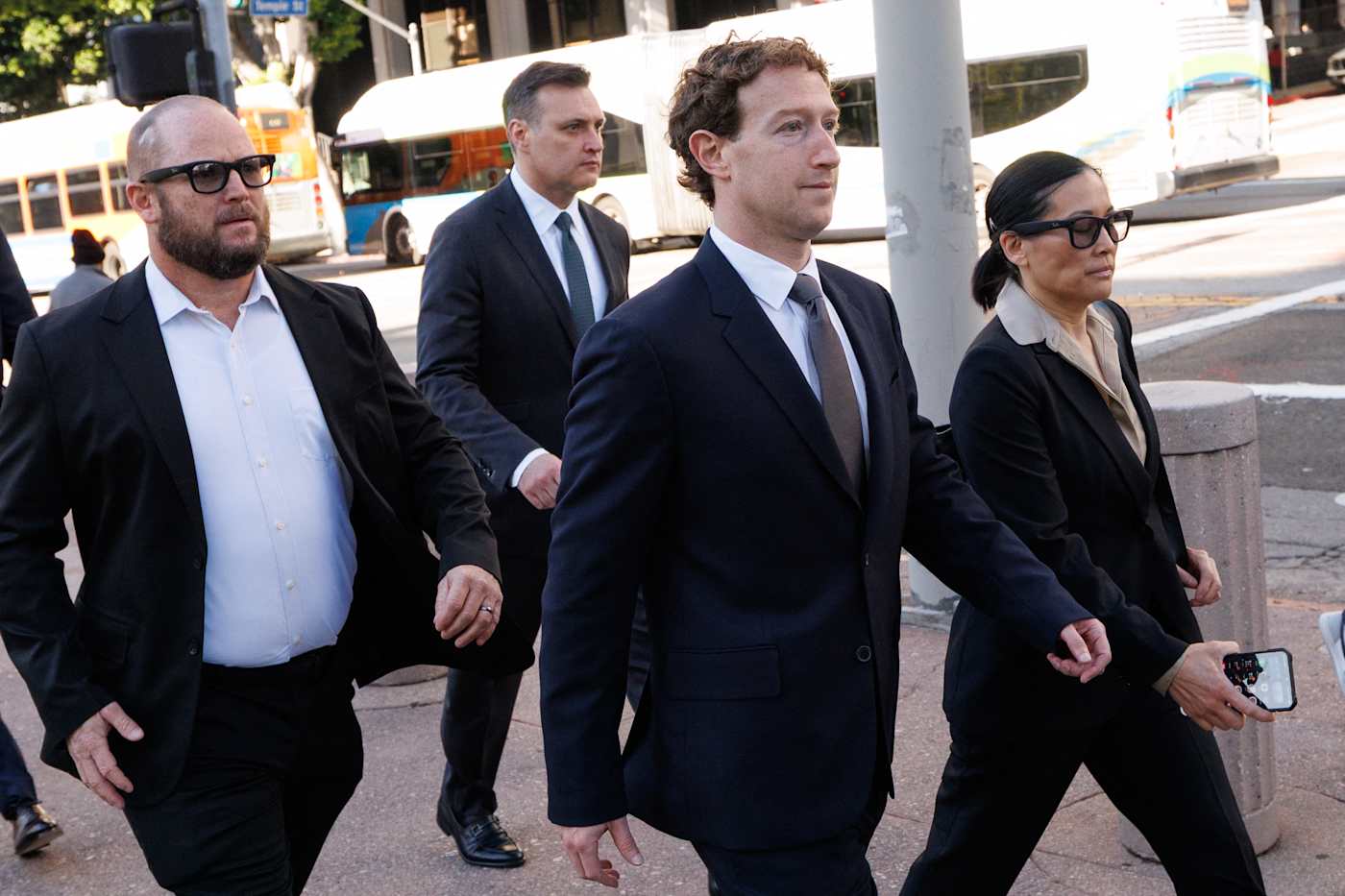
Zuckerberg's appearance in court also apparently prompted the judge to warn people in the courtroom not to record the proceedings using AI glasses. As CNBC notes, members of Zuckerberg's entourage were spotted wearing Meta's smart glasses as the CEO was escorted into the courthouse. It's unclear if anyone was actually using the glasses in court, but legal affairs journalist Meghann Cuniff reported that the judge was particularly concerned about the possibility of jurors being recorded or subjected to facial recognition. (Meta's smart glasses do not currently have native facial recognition abilities, but recent reports suggest the company is considering adding such features.)
The Los Angeles trial has been closely watched not just because it marked a rare in-court appearance for Zuckerberg. It's among the first of several cases where Meta will face allegations that its platforms have harmed children. In this case and in a separate proceeding in New Mexico, Meta's lawyers have cast doubt on the idea that social media should be considered a real addiction. Instagram chief Adam Mosseri previously testified in the same Los Angeles trial that Instagram isn't "clinically addictive."
This article originally appeared on Engadget at https://www.engadget.com/social-media/mark-zuckerberg-testifies-in-social-media-addiction-trial-that-meta-just-wants-instagram-to-be-useful-234332316.html?src=rss
Meta went to court this week in two major trials over alleged harms facilitated by its platform. In New Mexico, the state's attorney general has accused the company of facilitating child exploitation and harming children through addictive features. In a separate case in Los Angeles, a California woman sued the company over mental health harms she says she suffered as the result of addictive design choices from Meta and others.
In both cases, Meta has disputed the idea that social media should be considered an "addiction." On the stand this week, Instagram chief Adam Mosseri said that social media isn't "clinically addictive," comparing it to being "addicted" to a Netflix show.
In opening statements in the New Mexico trial, Meta's lawyer Kevin Huff went further. He told the jury that "social media addiction is not a thing" because it's not in the Diagnostic and Statistical Manual of Mental Disorders (DSM), the handbook used by mental health professionals in the US.
"According to the American Psychiatric Association, they don't recognize the concept of social media addiction in the same way as addiction to drugs and alcohol," Huff said during opening arguments that were broadcast by Courtroom View Network. "What you see on the screen is what's called the DSM, which is basically the official manual for recognized mental disorders. The American Psychiatric Association studied this and decided that social media addiction is not a thing."
But the American Psychiatric Association (APA) has never said that social media addiction doesn't exist. The organization provides information and resources about social media addiction on its website. "Social media addiction is not currently listed as a diagnosis in the DSM-5-TR—but that does not mean it doesn’t exist," the APA said in a statement to Engadget.
Dr. Tania Moretta, a clinical pyschophysiology researcher who has studied social media addiction, agrees. "The absence of a DSM classification does not mean that a behavior cannot be addictive, maladaptive or clinically significant," she told Engadget. That argument, she said, "reflects a misunderstanding" of how psychiatry professionals define and classify conditions. "Diagnostic manuals formalize scientific consensus; they do not define the boundaries of legitimate scientific inquiry. Many maladaptive behaviors and clinically significant symptom patterns are studied and treated well before receiving official classification."
Meta's critics have long claimed that the company has profited from addictive features that hook children and teens. The trials in Los Angeles and New Mexico are just the start of several court battles over the issue. The social media company is also facing a high-profile trial with school districts in June, and lawsuits from 41 state attorneys general.
Moretta said that social media addiction is a field that requires more study, but that there is already evidence that it can have harmful effects on some people. "At present, from a scientific perspective, there is documented evidence that social media use disorder is associated with both psychophysiological alterations, including changes in reward/motivational and inhibitory/regulatory systems, and clinically significant negative impacts on functioning (e.g., sleep disturbances, psychological distress, impairment in social, academic, or occupational domains)," she said. "The key question is not whether all social media use is addictive, but whether a subset of users exhibits patterns consistent with behavioral addiction models and whether specific platform design features may exacerbate vulnerability in predisposed individuals."
Both trials are ongoing and expected to last the next several weeks. In New Mexico, jurors have already heard from former employee turned whistleblower Arturo Bejar and former exec Brian Boland, both of whom have publicly criticized the company for not prioritizing safety. In Los Angeles, Mosseri's testimony has wrapped up, but Meta CEO Mark Zuckerberg is expected to testify next week. The trials will also feature extensive internal documents from Meta, including details about the company's own research into the mental health impacts of its platform on young people.
This article originally appeared on Engadget at https://www.engadget.com/social-media/meta-really-wants-you-to-believe-social-media-addiction-is-not-a-real-thing-130000257.html?src=rss
Threads users have been complaining about its recommendation algorithm pretty much since the beginning of the platform. At some point, this turned into a meme, with users writing posts jokingly addressed to the algorithm in which they requested to see more posts about the topics they're actually interested in.
Now, Meta is turning those "Dear algorithm" posts into an official feature that it says will allow Threads users to tune their recommendations in real time. With the change, users can write a post that begins with "dear algo" to adjust their preferences. For example, you could write "dear algo, show me more posts about cute cats." You can also ask to see fewer posts about topics you don't want to see, like "dear algo, stop showing me posts about sick pets."
You can track your requests to the algorithm in the app's settings in order to revisit them or remove them. You can also retweet other users' "dear algo" posts to have those topics reflected in your feed. Importantly, "dear algo" requests are temporary and only last for three days at a time, which Meta says is meant to keep the algorithm feel fresher and more flexible.
The rollout of the feature follows a limited test late last year. Now, "dear algo" posts will work for Threads users in the US, UK, Australia and New Zealand with more countries coming "soon."
This article originally appeared on Engadget at https://www.engadget.com/social-media/meta-turned-threads-algorithm-complaints-into-an-official-feature-180000236.html?src=rss
X is experimenting with a new way for AI to write Community Notes. The company is testing a new "collaborative notes" feature that allows human writers to request an AI-written Community Note.
It's not the first time the platform has experimented with AI in Community Notes. The company started a pilot program last year to allow developers to create dedicated AI note writers. X’s Keith Coleman tells me that AI writers are “prolific” and that one has contributed more than 1,000 notes that were rates as helpful by other contributors. But the latest experiment sounds like a more streamlined process.
According to the company, when an existing Community Note contributor requests a note on a post, the request "now also kicks off creation of a Collaborative Note." Contributors can then rate the note or suggest improvements. "Collaborative Notes can update over time as suggestions and ratings come in," X says. "When considering an update, the system reviews new input from contributors to make the note as helpful as possible, then decides whether the new version is a meaningful improvement."
The idea: when you request a note, AI drafts one — then the community refines it together through ratings and suggestions. You can watch it get better in real time.
According to Coleman, who oversees Community Notes, the AI writer for collaborative notes will be Grok. That would be in-line with how a lot of X users currently invoke the AI on threads with replies like "@grok is this true?" But Coleman says that “if it works well, it could make sense to bring the suggestion-feedback loop to the AI note writer API as well.”
Community Notes has often been criticized for moving too slowly so adding AI into the mix could help speed up the process of getting notes published. Cleman also noted that the update also provides "a new way to make models smarter in the process (continuous learning from community feedback)." On the other hand, we don't have to look very far to find examples of Grok losing touch with reality or worse.
According to X, only Community Note Contributors with a "top writer" status will be able to initiate a collaborative note to start, though it expects to expand availability "over time."
Update, February 5, 2026, 2:42PM PT: This post was updated to reflect additional information from X’s Keith Coleman.
This article originally appeared on Engadget at https://www.engadget.com/social-media/xs-latest-community-notes-experiment-allows-ai-to-write-the-first-draft-210605597.html?src=rss
Mark Zuckerberg says there's an end in sight to Reality Labs' years of multibillion-dollar losses following the company's layoffs to the metaverse division earlier this year. The CEO said he expects to "gradually reduce" how much money the company is losing as it doubles down on AI glasses and shifts away from virtual reality.
Speaking during Meta's fourth-quarter earnings call, Zuckerberg was clear that the changes won't happen soon, but sounded optimistic about the division that lost more than $19 billion in 2025 alone. "For Reality Labs, we are directing most of our investment towards glasses and wearables going forward, while focusing on making Horizon a massive success on mobile and making VR a profitable ecosystem over the coming years," he said. "I expect Reality Labs losses this year to be similar to last year, and this will likely be the peak, as we start to gradually reduce our losses going forward."
The company cut more than 1,000 employees from Reality Labs earlier this month, shut down three VR studios and announced plans to retire its app for VR meetings. Meta has also paused plans for third-party Horizon OS headsets. Instead, Meta is doubling down on its smart glasses and and wearables business, which tie in more neatly to Zuckerberg's vision for creating AI "superintelligence."
During the call, Zuckerberg noted that sales of Meta's smart glasses "more than tripled" in 2025, and hinted at bigger plans for AR glasses. "They [AI glasses] are going to be able to see what you see, hear what you hear, talk to you and help you as you go about your day and even show you information or generate custom UI right there in your vision," he said.
Zuckerberg has spent the last few years laying the groundwork for pivoting Meta's metaverse work into AI. He offered one example if what the means for Meta’s Horizon app.
"You can imagine … people being able to easily, through a prompt, create a world or create a game, and be able to share that with people who they care about. And you see it in your feed, and you can jump right into it, and you can engage in it. And there are 3D versions of that, and there are 2D versions of that. And Horizon, I think fits very well with the kind of immersive 3D version of that.
“But there's definitely a version of the future where, you know, any video that you see, you can, like, tap on and jump into it and, like, engage and kind of like, experience it in a more meaningful way. And I think that the investments that we've done in both a lot of the virtual reality software and Horizon … are actually going to pair well with these AI advances to be able to bring some of those experiences to hundreds of millions and billions of people through mobile."
One thing Zuckerberg didn’t mention, though: the word “metaverse.”
This article originally appeared on Engadget at https://www.engadget.com/social-media/mark-zuckerberg-says-reality-labs-will-eventually-stop-losing-so-much-money-222900157.html?src=rss
LinkedIn has long been a platform for showing off professional accomplishments. Now, the company is leaning into the rise of vibe coding by allowing users to show off their proficiency with various AI coding tools directly on their profiles.
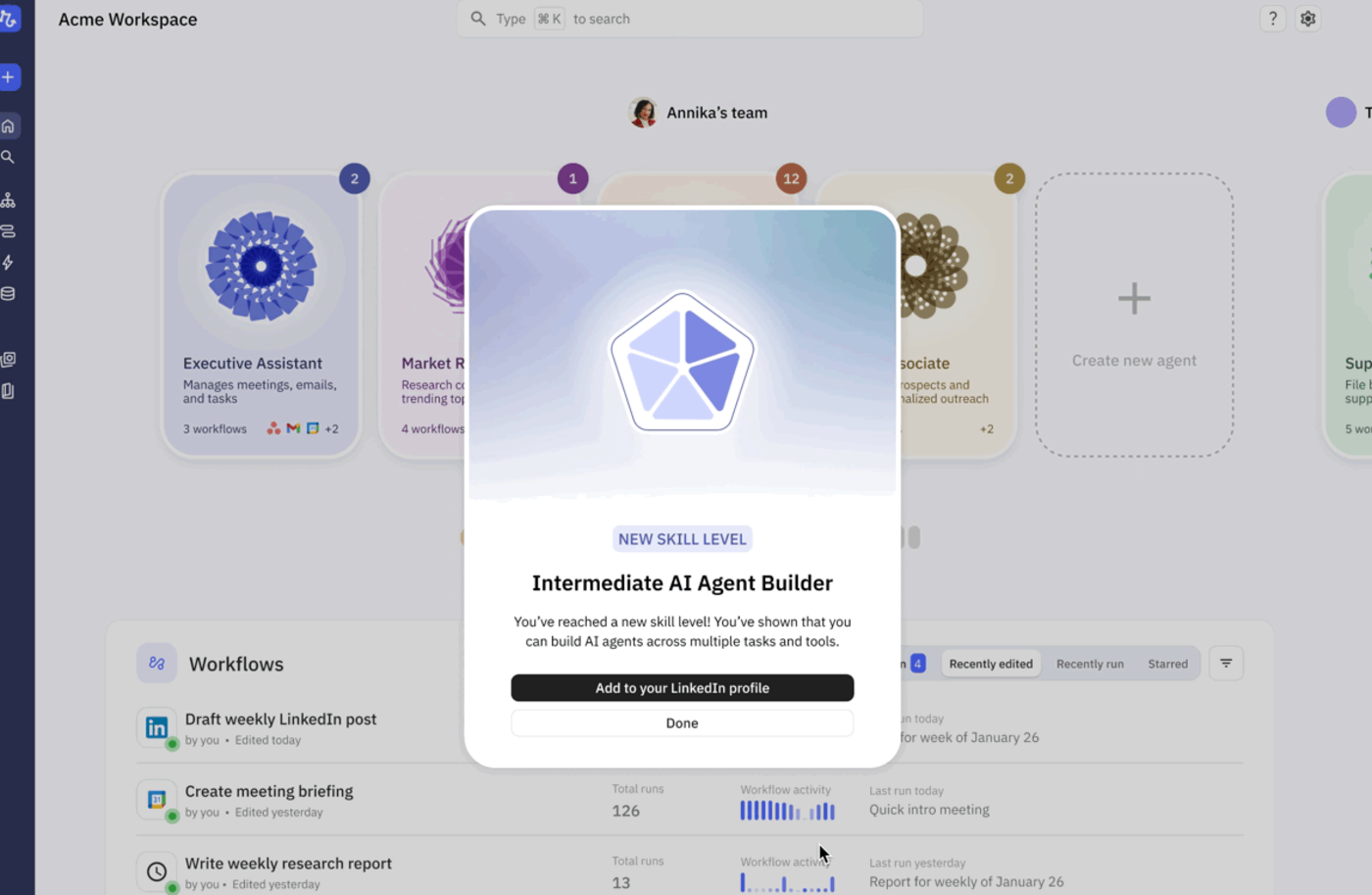
The company is partnering with Replit, Lovable, Descript and Relay.app on the feature and is working on integrations with fellow Microsoft-owned GitHub as well as Zapier. LinkedIn has always allowed users to add various skills and certifications to their profiles. But what makes the latest update a bit different is that users aren't self-reporting their own qualifications. Instead, LinkedIn is allowing the companies behind the AI tools to assess an individual's relative skill and assign a level of proficiency that goes directly to their profile.
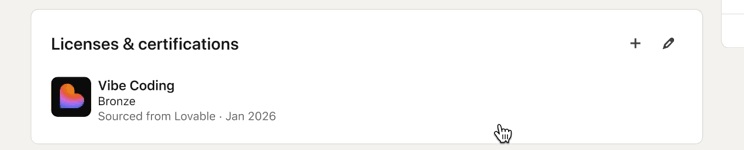
For example, AI app maker Lovable could award someone a "bronze" in "vibe coding," while the platform Replit uses numerical levels and Relay.app may determine that someone is an "intermediate" level "AI Agent Builder," according to screenshots shared by LinkedIn. These levels should dynamically update as people get more experience using the relevant tools, according to LinkedIn.
Lovable's vibe coding rating system.
LinkedIn
Of course, the update also comes at a time when companies have used these same kinds of AI tools to lay off thousands of workers. So while there's may be value in showing off your vibe coding skills, there are still many workers who likely aren't as excited about ceding more ground to AI. When I asked, LinkedIn's head of career products Pat Whealan about this he said that
AI-specific skills are an increasingly important signal to recruiters and the latest update will make it easier for them to assess candidates' skills. But he added that the intention isn't to make AI-specific skills the sole focus. "This is less about replacing any of those other existing signals, and more about showing new ways that people are doing work," he tells Engadget. "And how do we give a verifiable signal to both hirers and other people looking at their profile, that they actually are using these tools on a regular basis."
This article originally appeared on Engadget at https://www.engadget.com/ai/linkedin-will-let-you-show-off-your-vibe-coding-expertise-140000776.html?src=rss
Meta has started blocking links to ICE List, a website that compiles information about incidents involving Immigrations and Customs Enforcement (ICE) and Border Patrol agents, and lists thousands of their employees' names. It seems that the latter detail is what caused Meta to take action in a move that was first reported byWired.
ICE List is a crowdsourced Wiki that describes itself as "an independently maintained public documentation project focused on immigration-enforcement activity" in the US. "Its purpose is to record, organize, and preserve verifiable information about enforcement actions, agents, facilities, vehicles, and related incidents that would otherwise remain fragmented, difficult to access, or undocumented," its website states.
Along with notable incidents, the website also lists the names of individual agents associated with ICE, CBP and other DHS agencies. According to Wired, the website's creators said much of that information had come from a "leak," though it appears to be based largely on public LinkedIn profiles. As Wired notes:
The site went viral earlier this month when it claimed to have uploaded a leaked list of 4,500 DHS employees to its site, but a WIRED analysis found that the list relied heavily on information the employees shared publicly about themselves on sites such as LinkedIn.
Links to ICE List have been spreading widely for several weeks, including on Meta's platforms. There are numerous links to the website on Threads, some of which go back several weeks. Now though, clicking on previously-shared links instead results in a message that the link can't be opened. Users who try to share new links on Threads or Facebook also see error messages. "Posts that look like spam according to our Community Guidelines are blocked on Facebook and can't be edited," the notice says.
When reached for comment, a Meta spokesperson pointed to the company's privacy policy barring the disclosure of personally identifiable information (PII). The company didn't address why it chose to start blocking the website after several weeks, or whether it considers public LinkedIn profiles to be in violation of its rules against doxxing.
It is, however, not the first time Meta has opted to remove users' posts tracking information about ICE actions. The social network previously took down a Facebook group that tracked ICE sightings in Chicago after pressure from the Justice Department.
Have a tip for Karissa? You can reach her by email, on X, Bluesky, Threads, or send a message to @karissabe.51 to chat confidentially on Signal.
This article originally appeared on Engadget at https://www.engadget.com/social-media/meta-blocks-links-to-ice-list-a-wiki-that-names-agents-231410653.html?src=rss
TikTok has reached a settlement in a closely-watched lawsuit over social media addiction, narrowly avoiding a trial that's scheduled to begin jury selection Tuesday. Terms of the deal, which was reported by The New York Times, weren't disclosed.
TikTok's settlement comes about one week after Snap reached a settlement in the same case. The trial is expected to move forward in Los Angeles with Meta and YouTube as the only defendants. Mark Lanier, a lawyer for the plaintiff, said in a statement to NYT that they were "pleased" with the settlement and that it was "a good resolution." TikTok didn't immediately respond to a request for comment.
The trial stems from a 2023 lawsuit brought by a California woman known in court documents as "K.G.M." She sued Meta, Snap, TikTok and YouTube and alleged that their platforms were addictive and had harmed her as a child. The judge in the case previously ordered the companies' executives, including Mark Zuckerberg and Adam Mosseri, to testify. YouTube's top exec, Neal Mohan, is also likely to testify, according to The New York Times.
The lawsuit is the first among several high-profile cases against social media companies to go to trial this year. Meta is expected to head to court in New Mexico in early February in a case brought by the state's attorney general, who has alleged that Facebook and Instagram have facilitated harm to children. TikTok and Snap are collectively facing more than a dozen other trials in California courts this year.
This article originally appeared on Engadget at https://www.engadget.com/social-media/tiktok-settles-to-avoid-major-social-media-addiction-lawsuit-183943927.html?src=rss
TikTok's newly formed US entity is off to a very bumpy start. As the app continues to face technical issues affecting the recommendation algorithm, view counts and other features, TikTok is also seeing a wave of frustrated users uninstalling it, according to new data.
Analytics firm Sensor Tower, which tracks downloads and other app store-related metrics, told CNBC that there has been a 150 percent rise in uninstalls of the TikTok app in the United States compared with the last three months. An analyst at Sensor Tower told Engadget that TikTok's US daily active users (DAUs) have increased about 2 percent in the same time period, and are flat week-over-week. TikTok has blamed a power outage at a data center for “multiple bugs,” including those affecting view counts and load times. The company hasn't said when users can expect a fix.
At the same time, an independent app called UpScrolled has seen a surge in interest over the last few days. The app is currently the ninth most-downloaded app in the US App Store and the second most popular social app (Meta's Threads is currently in the number one spot for social apps). The app has also reached the top five in the UK and Australian app stores. In the United States, its sudden popularity seems to be closely tied to recent changes at TikTok.
UpScrolled has seen 41,000 total downloads between Thursday (the day the US joint venture was formalized) and Saturday, according to estimates from App Figures. The app, which was first released last June, has been downloaded about 140,000 times between Apple and Google's app stores, according to App Figures. Prior to last Thursday, the app was averaging less than 500 downloads a day, according to the company. The rapid increase in downloads has apparently caused some issues for the company which asked users to "bear with us" on Monday.
Well, this is new... You showed up so fast our servers tapped out. Frustrating? Yes. Emotional? Also yes. We're a tiny team building what Big Tech stopped being. Right now we're scaling on caffeine to keep up with what YOU started. Bear with us. We're on it. pic.twitter.com/OAlYcN6t5q
Created by an Australian developer, UpScrolled looks a bit like Instagram. Users can share photos and shortform videos. The app defaults to a chronological "following" feed, though it does also recommend content to users. The app is "privately funded by its founder, Issam Hijazi, together with a small group of individual investors who share our mission and values," according to an FAQ on UpScrolled's website. It currently has no ads, though the company says it "probably" will in the future.
This isn't the first time turmoil at TikTok has benefitted a previously little-known app. Chinese app RedNote briefly became the top app in the United States early last year as TikTok faced a potential ban. RedNote's popularity proved to be short-lived, though, as the 2025 TikTok "ban" ended up lasting only a couple of hours.
But with new owners at TikTok and growing frustration over technical issues with the app, there could be an opportunity for a new shortform video service that's not controlled by a huge corporation. And that's what UpScrolled seems to be betting on. "Too often, users are left uncertain about whether their voices will be heard or quietly suppressed," the company writes on its website. "UpScrolled changes that by ensuring every post has a fair chance to be seen, creating an environment that is authentic, unfiltered, and equitable for all."
Update, January 26, 2026, 4:28PM PT: This post was updated to reflect the latest details from TikTok about the ongoing issues affecting the US version of the app.
This article originally appeared on Engadget at https://www.engadget.com/social-media/people-are-uninstalling-tiktok-and-downloading-an-indie-competitor-233345222.html?src=rss

 Anmelden