❌

Normale Ansicht

Apple acquires popular video editing software company MotionVFX

Apple's latest acquisition could be a hint towards improvements for Final Cut Pro. The tech giant acquired MotionVFX, as seen on the company's website and first reported by MacRumors, which is known for providing plugins, templates, visual effects and more to video editors. MotionVFX currently offers its software for a handful of video-editing apps, like DaVinci Resolve and Adobe Premiere, but is also listed as a trusted Apple partner and found in the Final Cut Pro ecosystem of third-party products.

Apple hasn't revealed an acquisition price nor details of the deal. On its website announcement, MotionVFX wrote that it's "thrilled to embrace" similar values seen with Apple products and that it's the "beginning of something wonderful."

Considering a lot of MotionVFX's tools are designed for Final Cut Pro and Apple's Motion app, we could see native integration of popular visual effects and templates into Apple's app interfaces. It's worth noting that MotionVFX already offers an extension that creates a panel directly in Final Cut Pro for users to browse, download and apply visual effects from its repository. The acquisition could also hint at Apple trying to make its Creator Studio more enticing in the future, since it includes both Final Cut Pro and Motion. However, there hasn't been any clarity on what will happen to MotionVFX's monthly or annual subscription plans, nor its support for competing products.

This article originally appeared on Engadget at https://www.engadget.com/apps/apple-acquires-popular-video-editing-software-company-motionvfx-175429480.html?src=rss

©

© MotionVFX

MotionVFX's dashboard on a MacBook
  •  

Encyclopedia Britannica sues OpenAI for copyright and trademark infringement

OpenAI has been hit with another lawsuit. This time, Encyclopedia Britannica took legal action against OpenAI, accusing the company of copyright and trademark infringements, as first reported by Reuters. More specifically, Britannica alleged that OpenAI illegally used its "copyrighted content at a massive scale" when training its AI models. Not just with training, the encyclopedia company claimed that ChatGPT's responses to user queries sometimes contain "full or partial verbatim reproductions of [Britannica's] copyright articles."

Along with claims of copyright violations, Britannica argued that OpenAI was also responsible for trademark infringement. According to the lawsuit, ChatGPT generates "made-up content or 'hallucinations' and falsely attributes them" to Encyclopedia Britannica. The lawsuit doesn't specify an amount for monetary damages, but Britannica is also seeking an injunction to prevent OpenAI from repeating these accusations.

When reached out for comment, a spokesperson for OpenAI told Engadget that, "ChatGPT helps enhance human creativity, advance scientific discovery and medical research, and enable hundreds of millions of people to improve their daily lives. Our models empower innovation, and are trained on publicly available data and grounded in fair use."

It's not the first time that Britannica has filed a lawsuit against an AI company. In September, the company, which owns Merriam-Webster, also sued Perplexity for similar reasons. On the other side, OpenAI is still embroiled in a legal battle with The New York Times, which also sued the AI giant for copyright infringement.

This article originally appeared on Engadget at https://www.engadget.com/ai/encyclopedia-britannica-sues-openai-for-copyright-and-trademark-infringement-164747991.html?src=rss

©

© Britannica

Britannica Group filed a lawsuit against OpenAI for copyright and trademark infringements.
  •  

Tech companies are teaming up to combat scammers

A coalition of Big Tech companies is working on a more comprehensive solution to combat online scams. As first reported by Axios, Google, Microsoft, LinkedIn, Meta, Amazon, OpenAI, Adobe, Levi Strauss & Co, Target, Pinterest and Match Group announced the signing of the Industry Accord Against Online Scams and Fraud. The new agreement is meant to put up a united industry-wide front against online fraud and scams, particularly those from sophisticated criminal networks that use multiple platforms.

According to the Axios report, the measures will include adding fraud detection tools, introducing new user security features, and requiring more robust verification for financial transactions. The agreement will also set up best practices for scam detection, prevention and reporting, while encouraging the sharing of information between companies and law enforcement. On the policy side, the coalition will call on the governments to "declare scam prevention a national priority," according to Axios. While these measures are extensive, the report noted that they're all voluntary since the accord doesn't mention any penalties if the companies don't follow through.

Many of the companies involved in the new accord already have experience in dealing with scams found on their own platforms. Earlier this month, Meta announced several new features across Facebook, Messenger and WhatsApp that would alert users about suspicious friend requests or accounts. Last year, LinkedIn introduced a new verification requirement for company recruiters or executives to address scams targeting job seekers on its platform.

Update, March 18, 2026, 9:40AM: This article has been updated to add additional members of the accord and to include its full name, the Industry Accord Against Online Scams and Fraud. 

This article originally appeared on Engadget at https://www.engadget.com/cybersecurity/tech-companies-are-teaming-up-to-combat-scammers-144616545.html?src=rss

©

© REUTERS / Reuters

FILE PHOTO: People pose for a photo in front of a sign of Meta, the new name for the company formerly known as Facebook, at its headquarters in Menlo Park, California, U.S. October 28, 2021. REUTERS/Nathan Frandino/File Photo
  •  

Arc Raiders replaced some of its AI-generated voice lines, using professional actors instead

In an unexpected twist, humans have taken some jobs back from AI. Embark Studios' CEO Patrick Söderlund recently told GamesIndustry.biz that the studio "re-recorded" some of the AI-generated voice lines in Arc Raiders with human voices, only after its successful launch in October.

"There is a quality difference," Söderlund told GamesIndustry.biz. "A real professional actor is better than AI; that's just how it is."

With Arc Raiders' player count peaking at nearly half a million users on Steam, the game's breakout success was still marred by its use of text-to-speech AI. While there was no generative AI used for the visuals of the extraction shooter, Embark Studios paid its actors for approval to license their voices for text-to-speech AI, according to Söderlund. Even though Söderlund said that the text-to-speech AI was reserved for lines "that aren't as essential to the immersion of the experience," many players weren't happy with this creative decision.

Responding to the criticism, Embark Studios is seemingly reversing course and relying more on its voice actors. Söderlund said that the studio pays its voice actors for their time in the recording booth and will "continue to bring many of them back as we carry on updating the game." However, it's important to note that Söderlund told GamesIndustry.biz that "some" of the AI-generated lines were replaced by voice actors, which could indicate that the studio isn't looking to completely ditch its text-to-speech AI anytime soon.

This article originally appeared on Engadget at https://www.engadget.com/gaming/arc-raiders-replaced-some-of-its-ai-generated-voice-lines-with-professional-actors-184915627.html?src=rss

©

© Embark Studios

Gameplay screenshot of Embark Studios' Arc Raiders extraction shooter.
  •  

Anthropic is doubling Claude's usage limits during off-peak hours for the next two weeks

To capitalize on Claude's recent spike in popularity, Anthropic is offering a limited-time promotion that doubles usage limits for anyone using its AI chatbot during off-peak hours. From March 13 to March 27, users on Free, Pro, Max, and Team plans will get double the usage limits in a five-hour window when using Claude outside weekday hours between 8 AM and 2 PM ET. According to Anthropic, the promotion is automatic, and users don't have to enable anything to get the benefits.

A small thank you to everyone using Claude: We’re doubling usage outside our peak hours for the next two weeks. pic.twitter.com/W7TEBPditq

— Claude (@claudeai) March 14, 2026

Anthropic said that this promotion applies to anyone using Claude on web, desktop or mobile, but also with Cowork, Claude Code, Claude for Excel and Claude for PowerPoint. Previously, Anthropic offered a similar event from December 25 to December 31, doubling usage limits for Pro, Max 5x or Max 20x subscribers. However, Anthropic is targeting an even wider audience with its latest promotion since only Enterprise users are excluded this time around.

Anthropic is marketing the promotion as a "small thank you to everyone using Claude," but it's likely tied to its ongoing battle with the Department of Defense. After refusing to remove certain AI safeguards for the Department of Defense, Anthropic was listed as a supply chain risk and lost its contract with the federal agency. In turn, OpenAI signed a deal with the Department of Defense, leading to many users deciding to boycott ChatGPT in favor of Claude and other AI chatbot options.

This article originally appeared on Engadget at https://www.engadget.com/ai/anthropic-is-doubling-claudes-usage-limits-during-off-peak-hours-for-the-next-two-weeks-163645928.html?src=rss

©

© Anthropic

Promotional image of Claude getting double usage limits for a limited time.
  •  

Spotify’s new Taste Profile feature lets users fine-tune their algorithm’s recommendations

You're responsible for your own Spotify algorithm now. On stage at SXSW, Spotify's co-CEO, Gustav Söderström, announced the Taste Profile feature, which allows users to personally customize exactly what they want to listen to, whether it's music, audiobooks or podcasts. This AI-powered feature is still in beta, and it will be available to Premium users in New Zealand in the coming weeks.

From its short video demo, Spotify's Taste Profile feature will show you a summary of your listening habits and offer a "Tell us more" prompt at the bottom. With the new prompt, users can inform the AI what they want to see more of or if they want to get rid of a genre that keeps popping up in their algorithm. Spotify said that the Taste Profile will take into consideration more ambiguous prompts, too, like if you're training for a marathon and want upbeat music or want to listen to news podcasts during your commute to work. Spotify added that Taste Profile is an optional feature, and unwilling users can "leave it and enjoy Spotify as usual."

With Taste Profile, Spotify is continuing its momentum of offering AI features, like the Prompted Playlist feature that was made available last month. Unlike the existing AI Playlist feature, Prompted Playlist lets you put in specific requests to generate a playlist, like only including songs from a specific TV show. Like Taste Profile, the Prompted Playlist feature saw beta testing in New Zealand first, before expanding to US and Canadian users a month later.

This article originally appeared on Engadget at https://www.engadget.com/entertainment/music/spotifys-new-taste-profile-feature-lets-users-fine-tune-their-algorithms-recommendations-191104626.html?src=rss

©

© Spotify

Spotify will let users edit their listening preferences for music, podcasts and audiobooks with the Taste Profile feature.
  •  

Trump administration will reportedly get $10 billion for brokering the TikTok deal

There may have been some extra incentive for the Trump administration to get the TikTok US deal done. According to a report from The Wall Street Journal, the Trump administration is set to receive a total of $10 billion in the deal that allowed TikTok to remain in the US. The new investors who acquired stakes in the US entity of TikTok already paid a $2.5 billion fee to the administration when the deal closed in January, but WSJ's latest report noted that the group of investors would continue to make payments until the total hits $10 billion.

After a group of investors, which includes Oracle along with the Silver Lake and MGX investment firms, acquired stakes in the US-based TikTok entity called TikTok USDS Joint Venture, the WSJ previously reported that the administration would receive a "multibillion-dollar fee" for its work on the deal. To better contextualize the recently-revealed $10 billion fee the Trump administration is receiving, the US entity of TikTok was valued at $14 billion by Vice President JD Vance.

The Trump administration has previously involved itself in major deals with other US corporations. Last year, the administration invested $8.9 billion into Intel and received a nearly 9 percent equity stake. In terms of unprecedented windfalls, the Trump administration also received a Boeing 747-8 as a gift from the Qatari government in May.

This article originally appeared on Engadget at https://www.engadget.com/big-tech/trump-administration-will-reportedly-get-10-billion-for-brokering-the-tiktok-deal-180954979.html?src=rss

©

© REUTERS / Reuters

TikTok logo is placed on a U.S. flag in this illustration taken September 24, 2025. REUTERS/Dado Ruvic/Illustration
  •  

Meta is reportedly planning to cut up to 20 percent of its staff in upcoming layoffs

Meta could be preparing for one of the largest layoffs in its history, according to a Reuters report. The tech giant is planning to cut about 20 percent of its workforce, according to the outlet's sources. According to the report, neither a date nor the exact number of layoffs has been finalized yet.

However, Reuters reported that Meta's top executives have told "other senior leaders" to start "planning how to pare back." In its latest financial report, the company's employee headcount was 78,865 as of December 31, 2025, while revenue reached nearly $60 billion for the fourth quarter and more than $200 billion for the entire year. A Meta spokesperson told Reuters that this was "speculative reporting about theoretical approaches."

Meta is no stranger to major layoffs. Earlier this year, Meta targeted about 1,000 employees in its layoffs with the Reality Labs division that's responsible for the company's virtual reality and metaverse efforts. Early last year, Meta laid off about five percent of its workforce, following a smaller round of firings that same month. Meanwhile, the company has been spending heavily to acquire AI startups, like Moltbook, a social network designed for AI agents, and Manus, a startup focused on AI agents for task automation.

This article originally appeared on Engadget at https://www.engadget.com/big-tech/meta-is-reportedly-planning-to-cut-up-to-20-percent-of-its-staff-in-upcoming-layoffs-160812304.html?src=rss

©

© Meta

Meta is planning to lay off 20 percent of its workforce.
  •  

Live Nation settlement avoids breakup with Ticketmaster

To keep Ticketmaster, Live Nation is going to have to make some major changes. As first reported by Politico, Live Nation reached a settlement with the Department of Justice in its antitrust case that accused the live entertainment giant of monopolistic practices. Live Nation will reportedly pay at least $200 million in damages to states that were part of the lawsuit filed in May 2024, but avoid selling off Ticketmaster.

Live Nation will also be required to make a few changes to its business practices. According to NBC News, Ticketmaster, a subsidiary of Live Nation, will be required to create a "standalone ticketing system" that allows third-party competitors like SeatGeek and Eventbrite to sell tickets on.

The settlement aims to loosen some of Live Nation's control over venues as well. 13 amphitheaters that Live Nation previously had exclusive booking arrangements with will move to an open booking model which will let other promotors book at the venues. The company is also prohibited from retaliating against venues that choose another ticket seller over Ticketmaster.

The settlement comes less than a week after the case went to trial. While the matter may be concluded with the Justice Department, many of the states' attorneys general who were part of the lawsuit will be continuing their legal action separately.

"The settlement recently announced with the U.S. Department of Justice fails to address the monopoly at the center of this case and would benefit Live Nation at the expense of consumers," New York State Attorney General Letitia James wrote in a press release. "We will continue our lawsuit to protect consumers and restore fair competition to the live entertainment industry." 26 other attorneys general signed onto continuing the lawsuit with James.

Update, March 10, 2026, 11:37AM ET: This story was updated to clarify that Live Nation moved to an open booking model with 13 venues that it previously had exclusive booking rights with. Those venues were not owned by Live Nation.

This article originally appeared on Engadget at https://www.engadget.com/entertainment/music/live-nation-settlement-avoids-breakup-with-ticketmaster-155031214.html?src=rss

©

© REUTERS / Reuters

FILE PHOTO: Live Nation Entertainment and Ticketmaster logos are seen in this illustration taken May 23, 2024. REUTERS/Dado Ruvic/Illustration//File Photo
  •  

EA laid off staffers across Battlefield studios to 'better align' its teams

EA axed an undisclosed number of employees across the game studios behind the Battlefield franchise. As first reported by IGN, EA told affected employees that the layoffs were part of a "realignment" across the Battlefield studios, which include Dice, Criterion, Ripple Effect and Motive Studios. When asked about the report, an EA spokesperson said in a statement that "we’ve made select changes within our Battlefield organization to better align our teams around what matters most to our community."

IGN reported that all the involved studios will remain operational, but the layoffs will affect multiple offices. The shake-up may come as a surprise to staffers, especially after Battlefield 6 racked up more than seven million copies sold in the first three days following its release in October. EA even called the latest Battlefield title the "best-selling shooter title of 2025" in its third quarter report for FY26, which disclosed the company's net revenue of more than $1.9 billion for the quarter.

"Battlefield remains one of our biggest priorities, and we’re continuing to invest in the franchise, guided by player feedback and insights from Battlefield Labs," an EA spokesperson also said in a statement.

Despite being one of EA's most popular franchises, Battlefield isn't the only one to suffer staffing cuts. Full Circle, the developer behind the skate. that's also owned by EA, also announced layoffs and "restructuring" in February. However, EA isn't the only company in the industry to look at downsizing its personnel. Ubisoft said it was planning to get rid of up to 200 jobs in its Paris office earlier this year and Microsoft announced it would cut thousands of jobs, including within its Gaming division, in July. 

This article originally appeared on Engadget at https://www.engadget.com/gaming/ea-laid-off-staffers-across-battlefield-studios-to-better-align-its-teams-173617672.html?src=rss

©

© EA

Promotional image of Battlefield 6's latest update with 5.11 gear.
  •  

NetEase is reportedly pulling funding for Yakuza creator's studio

The hype for Gang of Dragon, the debut game from Nagoshi Studio, may already be getting derailed. According to a Bloomberg report, Chinese tech giant NetEase is going to stop financing Nagoshi Studio starting in May. Bloomberg confirmed the news with the studio's employees and a NetEase spokesperson.

The report explained that NetEase decided to cut funding to Nagoshi Studio, which was founded in 2021 by Yakuza franchise creator Toshihiro Nagoshi, after finding out the studio needed $44.4 million to complete the project. Bloomberg reported that Nagoshi Studio is trying to find new sponsors but hasn't had any success so far. The report also added that the studio can continue the project on its own, but would be responsible for paying NetEase for any associated costs to hold onto the brand or assets.

While Nagoshi Studio may have been working on Gang of Dragon since the studio's creation, the general public got a better look at the title through a trailer announcement during The Game Awards 2025. The action-adventure game set in Tokyo would star Ma Dong-Seok, a South Korean actor who starred in Train to Busan and Marvel's Eternals. As of now, Nagoshi Studio might be at risk of joining other casualties stemming from NetEase's executive decisions, like when the tech giant decided to shut down Ouka Studio in 2024.

This article originally appeared on Engadget at https://www.engadget.com/gaming/netease-is-reportedly-pulling-funding-for-yakuza-creators-studio-182945690.html?src=rss

©

© Nagoshi Studio

Screenshot of gameplay in Gang of Dragon with protagonist punching someone
  •  

Apple is reportedly looking into 3D printing aluminum iPhones and Apple Watches

There could be even more 3D-printed Apple products coming in the future. According to Bloomberg's Mark Gurman, Apple is exploring ways to 3D print aluminum to make the manufacturing processes for iPhones and Apple Watches more efficient.

Gurman reported that this new production process could specifically change how Apple makes its watch casings as well as iPhone enclosures. It's not the first time Apple has tapped into 3D printing, since both the Apple Watch Ultra 3 and Series 11 were partially built with 3D-printed titanium that's 100 percent recycled. More recently, Apple used its 3D printing process to create the titanium USB-C port for the iPhone Air, which was touted as thinner, stronger and more environmentally friendly.

While Apple is reportedly only looking into 3D-printed aluminum right now, it could possibly result in an overall cheaper manufacturing process and lower starting prices for iPhones. Looking at Apple's just-announced MacBook Neo, the company introduced a new manufacturing process that saves on the amount of aluminum used, helping to achieve the $599 starting price for its latest entry-level laptop. Like the colorful MacBook Neo, Gurman also reported that Apple is planning to use a "refreshed color palette" for its iMac reveal later this year.

This article originally appeared on Engadget at https://www.engadget.com/mobile/smartphones/apple-is-reportedly-looking-into-3d-printing-aluminum-iphones-and-apple-watches-163721491.html?src=rss

©

© Apple

A screenshot showing Apple's 3D printing process for Apple Watches
  •  

OpenAI's robotics hardware lead resigns following deal with the Department of Defense

OpenAI's robotics hardware lead is out. Caitlin Kalinowski, who oversaw hardware within the robotics division of OpenAI, posted on X that she was resigning from her role, while criticizing the company's haste in partnering with the Department of Defense without investigating proper guardrails. OpenAI told Engadget that there are no plans to replace Kalinowski.

Kalinowski, who previously worked at Meta before leaving to join OpenAI in late 2024, wrote on X that "surveillance of Americans without judicial oversight and lethal autonomy without human authorization are lines that deserved more deliberation than they got." Responding to another post, the former OpenAI exec explained that "the announcement was rushed without the guardrails defined," adding that it was a "governance concern first and foremost."

OpenAI confirmed Kalinowski's resignation and said in a statement to Engadget that the company understands people have "strong views" about these issues and will continue to engage in discussions with relevant parties. The company also explained in the statement that it doesn't support the issues that Kalinowski brought up.

"We believe our agreement with the Pentagon creates a workable path for responsible national security uses of AI while making clear our red lines: no domestic surveillance and no autonomous weapons," the OpenAI statement read.

Kalinowski's resignation may be the most high-profile fallout from OpenAI's decision to sign a deal with the Department of Defense. The decision came just after Anthropic refused to comply with lifting certain AI guardrails around mass surveillance and developing fully autonomous weapons. However, even OpenAI's CEO, Sam Altman, said that he would amend the deal with the Department of Defense to prohibit spying on Americans.

Correction, March 8 2026, 10:30AM ET: This story has been updated to correct Kalinowski's role at OpenAI to "robotics hardware lead" instead of "head of robotics."

This article originally appeared on Engadget at https://www.engadget.com/ai/openais-robotics-hardware-lead-resigns-following-deal-with-the-department-of-defense-195918599.html?src=rss

©

© OpenAI

OpenAI's post on X about its agreement with Department of War
  •  

OpenAI is reportedly pushing back the launch of its 'adult mode' even further

Here comes another disappointment for ChatGPT users. As first reported by Sources' Alex Heath, OpenAI is yet again delaying its "adult mode" for ChatGPT. A company spokesperson told Heath that "we're pushing out the launch of adult mode so we can focus on work that is a higher priority for more users right now."

More specifically, OpenAI's spokesperson said that things like "gains in intelligence, personality improvements, personalization, and making the experience more proactive" were being prioritized instead. However, the company still wants to release an adult mode, but it would "take more time," according to the company spokesperson.

The reveal of ChatGPT's adult mode dates back to October, when OpenAI's CEO, Sam Altman, posted on X that the company would roll out more age-gating as part of its "treat adults like adults" principle, adding that this would include "erotica for verified adults." Altman originally said this adult mode would be available in December, but an OpenAI exec later said during a December briefing that it would instead debut in the first quarter of 2026. 

With Q1 almost coming to a close, we no longer have a timeframe for when ChatGPT's adult mode will release. However, OpenAI began rolling out its age prediction tool in January, which may go hand-in-hand with the upcoming adult mode.

This article originally appeared on Engadget at https://www.engadget.com/ai/openai-is-reportedly-pushing-back-the-launch-of-its-adult-mode-even-further-213013801.html?src=rss

©

© Reuters / Reuters

The ChatGPT app icon on a smartphone in this illustration taken October 27, 2025. REUTERS/Dado Ruvic/Illustration
  •  

Indonesia announces a social media ban for anyone under 16

Following in the footsteps of Australia, Indonesia will be the latest country to limit social media usage for children under 16. Meutya Hafid, Indonesia's communication and digital affairs minister, announced that a new government regulation will require "high-risk" platforms to delete any accounts from Indonesia that are under 16, starting on March 28.

Hafid said in the announcement that the implementation would be done in stages, starting with major platforms like YouTube, TikTok, Facebook, Instagram, Threads, X, Roblox and Bigo Live, a live-streaming platform based in Singapore. The minister added that all platforms will have to fulfill compliance obligations from the Indonesian government, but didn't specify what they were. In response to the ban, a Meta spokesperson told The New York Times that the company hasn't received an official regulation from the country yet and was awaiting details.

While Australia was the first country to implement such a sweeping ban on social media, many other countries are currently in the process of doing the same. Spain's Prime Minister Pedro Sanchez announced last month that the country is also ready to ban social media for users under 16, while Malaysia's cabinet approved a similar ban that will reportedly go into effect sometime this year.

This article originally appeared on Engadget at https://www.engadget.com/social-media/indonesia-announces-a-social-media-ban-for-anyone-under-16-174634956.html?src=rss

©

© Reuters / Reuters

FILE PHOTO: Instagram, TikTok, Snapchat, YouTube, Facebook, Twitch and Reddit applications are displayed on a mobile phone ahead of new law banning social media for users under 16 in Australia, in this picture illustration taken on December 9, 2025. REUTERS/Hollie Adams/Illustration//File Photo
  •  

Starlink's next-gen satellite network could provide 150 Mbps speeds by end of next year

Starlink is getting ready to launch its second generation of satellites, and it's expected to match the speeds of a traditional terrestrial network. During a keynote at Mobile World Congress, Starlink execs detailed the roadmap for the company's upgrade towards the next generation of satellites called V2.

"The goal of Starlink Mobile ... is to provide a terrestrial-like connectivity when you're connected to the satellite system," Michael Nicolls, SpaceX's senior vice president of Starlink engineering, said during the MWC keynote. "In the right conditions, it should look and feel like you're connected to a high-performing 5G terrestrial network."

Nicolls detailed that the V2 satellite constellation could offer download speeds up to 150 Mbps in ideal conditions, comparing it to a broadband experience. According to Starlink, next-gen satellites will offer 100 times the data density of its predecessors, which should help users with faster streaming and browsing as well as more reliable voice calls. Notably, Nicolls added that the V2 satellite constellation would offer better coverage to Earth's polar regions, which are known to have unreliable coverage with traditional networks.

Nicolls said that SpaceX is planning to send out more than 50 V2 satellites on each SpaceX launch starting in mid-2027, with a goal of building out a full constellation in six months. Outside its MWC presser, Starlink also announced a partnership with German telecommunications company Deutsche Telekom. The partnership would help Deutsche Telekom address internet coverage gaps in Europe using Starlink's constellation, starting in 2028.

This article originally appeared on Engadget at https://www.engadget.com/science/space/starlinks-next-gen-satellite-network-could-provide-150-mbps-speeds-by-end-of-next-year-192118368.html?src=rss

©

© Starlink

Starlink rendering showing V1 and V2 satellites.
  •  

The Supreme Court doesn't care if you want to copyright your AI-generated art

As AI-generated artwork becomes more commonplace, it still won't be able to be copyrighted, according to US courts. On Monday, the US Supreme Court declined to hear a case about whether an artwork generated with the help of AI can be copyrighted. The refusal means that a lower court's decision to reject the copyright request will stand.

The case dates back to 2018 when Stephen Thaler applied for a copyright of an artwork called A Recent Entrance to Paradise. Unlike using ChatGPT or Midjourney, Thaler, a computer scientist, created an AI system that generated the artwork in question. However, the US Copyright Office rejected his application in 2022 on the grounds that it wasn't made by a human author. Thaler sought appeals at higher courts, but ultimately had to escalate the case to the Supreme Court after both a federal judge in Washington and the US Court of Appeals ruled against him.

With a refusal from the highest court in the US, it's unlikely Thaler's case can continue. The US Supreme Court could always hear a related case in the future, but Thaler's lawyers said, "even ⁠if it later overturns the Copyright Office’s test in another case, it will be too late," adding that the decision will have negatively impacted the creative industry during "critically important years." It's worth noting that Thaler also filed applications to the US Patent and Trademark Office for AI-generated inventions, which were rejected for similar reasons.

This article originally appeared on Engadget at https://www.engadget.com/ai/the-supreme-court-doesnt-care-if-you-want-to-copyright-your-ai-generated-art-171849407.html?src=rss

©

© REUTERS / Reuters

The U.S. Supreme Court, where justices are expected to issue opinions in pending cases, in Washington, D.C., U.S., February 25, 2026. REUTERS/Kevin Lamarque TPX IMAGES OF THE DAY
  •  

Anthropic's Claude can now absorb your past conversations with other AI chatbots

Anthropic has made switching to its Claude AI chatbot easier than ever. The company announced a new memory import tool that can extract all of a competing AI chatbot's memories and context of you into a text prompt that can be fed into Claude.

With Anthropic's prompt, you can then copy and paste the output into Claude's memories, and the AI chatbot will pick up where you left off with another AI chatbot, whether it's ChatGPT, Gemini or Copilot. Anthropic said it'll take about 24 hours for Claude to assimilate the new context, but you'll be able to see the change by clicking on the "See what Claude learned about you" button. Claude users can even tweak what the AI chatbot remembers in the "Manage memory" section in the app's settings. Anthropic pointed out that Claude is meant to focus on "work-related topics to enhance its effectiveness as a collaborator," adding that it might not remember personal details that are unrelated to work.

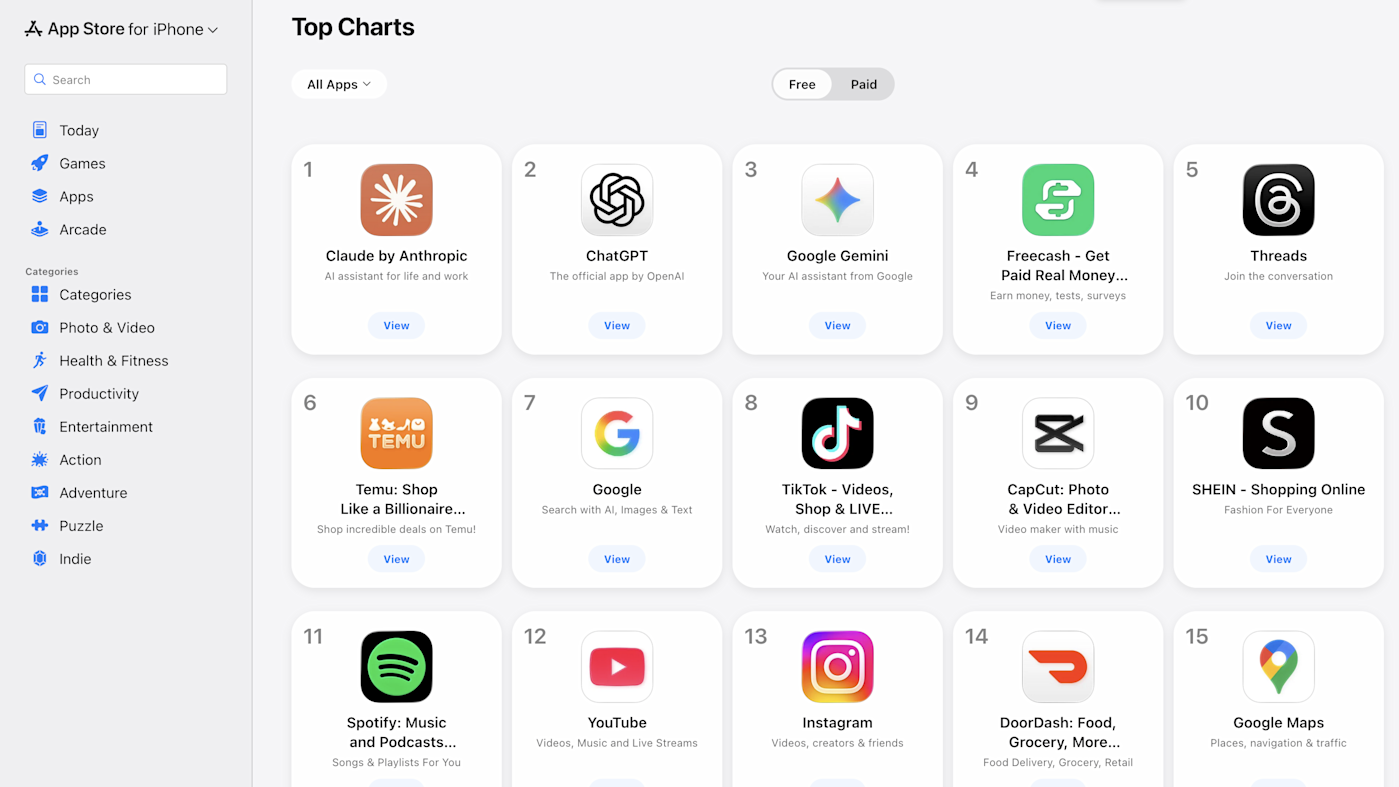
Anthropic's timing doesn't seem to be just a coincidence. Claude recently jumped to the number one spot in the App Store's free apps charts, dethroning ChatGPT in the process. The rise in popularity likely stems from its recent dispute with the Department of Defense, where Anthropic refused to budge on AI guardrails related to mass domestic surveillance and fully autonomous weapons. On the other hand, OpenAI will be taking Anthropic's vacated role with the Department of Defense, leading to a trend of users boycotting ChatGPT and canceling their subscriptions.

This article originally appeared on Engadget at https://www.engadget.com/ai/anthropics-claude-can-now-absorb-your-past-conversations-with-other-ai-chatbots-153201656.html?src=rss

©

© Anthropic

A screenshot of the importing memory process to Claude.
  •  

Anthropic's Claude grabs top spot in App Store after Trump's ban

Anthropic may have lost out on doing business with the US government, but it's gained enough popularity to earn the number one spot on the App Store's Top Free Apps leaderboard. At the top, Claude beat out both ChatGPT and Google Gemini, which respectively sit at the second and third spots on Apple's free apps charts.

The sudden surge in user downloads isn't random. It follows news that President Trump has barred any federal agency from using Anthropic's Claude or other AI tools after the AI company refused to concede on certain guardrails. After declining to have its AI models be used for mass domestic surveillance and fully autonomous weapons, Anthropic was also threatened with a "supply-chain risk" label by the Department of Defense Secretary Pete Hegseth. The very public spat led to a wave of user support that finally allowed Claude to dethrone OpenAI's ChatGPT on the App Store as the most downloaded free app.

While OpenAI has stepped into Anthropic's shoes after agreeing to a deal with the Department of Defense, the CEO still offered up some thoughts about the debacle during an AMA on X. Even though Claude is a competing model, Sam Altman said that Anthropic's supply-chain risk designation was "a very bad decision" that he's hoping gets reversed. On top of that, OpenAI's CEO called Anthropic's blacklisting "an extremely scary precedent," but he's "still hopeful for a much better resolution."

This article originally appeared on Engadget at https://www.engadget.com/big-tech/anthropics-claude-grabs-top-spot-in-app-store-after-trumps-ban-193610130.html?src=rss

©

© Apple

Claude by Anthropic in the top spot for free apps in the App Store.
  •  

The US reportedly used Anthropic's AI for its attack on Iran, just after banning it

In a lengthy post on Truth Social on February 27, President Trump ordered all federal agencies to "immediately cease all use of Anthropic's technology" following strong disagreements between the Department of Defense and the AI company. A few hours later, the US conducted a major air attack on Iran with the help of Anthropic's AI tools, according to a report from The Wall Street Journal.

The president noted in his post that there would be a "six-month phase-out period for agencies like the Department of War who are using Anthropic’s products," so federal agencies are still expected to eventually move away from using Claude or other Anthropic tech. It's also not the first time that the US used Anthropic's AI for a major military operation, as the WSJ previously reported that Claude was used in the capture of the now-removed Venezuelan president Nicolás Maduro.

Moving forward, the Department of Defense may begin transitioning towards other AI options, especially after reaching deals with both xAI and OpenAI to use their models within the federal agency's network. However, the WSJ reported that it would take months to replace Anthropic's Claude with other AI models.

This article originally appeared on Engadget at https://www.engadget.com/ai/the-us-reportedly-used-anthropics-ai-for-its-attack-on-iran-just-after-banning-it-172908929.html?src=rss

©

© Anthropic

Anthropic Claude on a scroll
  •  
❌