When NASA crashed a spacecraft into the asteroid moonlet Dimorphos in 2022, it altered both Dimorphos' orbit around its parent asteroid, Didymos, and the two objects' orbit around the sun, according to new research. NASA's Jet Propulsion Laboratory (JPL) said in a press release that this "marks the first time a human-made object has measurably altered the path of a celestial body around the Sun." It's a promising result as scientists work to find a feasible method of defending Earth from hazardous space objects.
The Double Asteroid Redirection Test (DART) mission was designed to demonstrate one possible way of deflecting such an object, targeting the non-threatening moonlet Dimorphos, which is about 560 feet wide. NASA quickly declared it a success after its initial analysis showed the planned collision shortened Dimorphos' orbit around Didymos, the larger of the two objects in the binary asteroid system. In a follow-up study published in 2024, a team at NASA's JPL reported that Dimorphos' orbital period had been trimmed by about 33 minutes, as its path was nudged roughly 120 feet closer to Didymos than before. The latest study now indicates that the whole binary system was affected, not just Dimorphos.
Didymos and Dimorphos have a 770-day orbital period around the sun, which lead author Rahil Makadia said has been changed by "about 11.7 microns per second, or 1.7 inches per hour." That might not sound like much, but according to Makadia, “Over time, such a small change in an asteroid’s motion can make the difference between a hazardous object hitting or missing our planet.”
This article originally appeared on Engadget at https://www.engadget.com/science/space/nasas-dart-spacecraft-changed-a-binary-asteroids-orbit-around-the-sun-in-a-first-for-a-human-made-object-210529924.html?src=rss
A product briefly posted on the Canadian Best Buy website this weekend suggests Sonos may soon announce a new portable speaker called the Sonos Play. The speaker offers Wi-Fi and Bluetooth connectivity, AirPlay 2 support, Trueplay to tune the sound based on wherever you've placed it and voice controls, according to a page that's since been removed. Best Buy Canada had it listed for $399.99 CAD (or a little under 300 US dollars), and put the release date at March 31.
The listing may have been taken down, but not before it was spotted and reposted on Reddit. The product page for the Sonos Play also showed that it comes in two colors, White and Black, and it has a little carrying strap for added convenience. It's IP67 rated dust- and waterproof. Sonos hasn't officially made any announcements about it yet, but we wouldn't be surprised to see one soon.
This article originally appeared on Engadget at https://www.engadget.com/audio/speakers/best-buy-canada-seemingly-just-leaked-sonos-next-portable-speaker-215601978.html?src=rss
MWC 2026 kicks off today, running from March 2 through March 5, but announcements were pouring in all weekend in the lead-up to its official start. We can always count on the annual tech event to bring tons of new phones, laptops and tablets, and we're expecting to see some robots and other gadgets too — plus plenty of AI news, of course. In addition to the announcements, MWC is our chance to get hands-on time with some of the most interesting new devices, like the Xiaomi 17 Ultra and Honor's Robot Phone, and concepts like the Legion Go Fold.
Engadget’s Mat Smith is on the ground in Barcelona, and we'll be updating this story as the week goes on to keep you in the loop on everything that caught our attention. Keep checking back here for the latest MWC news.
Lenovo
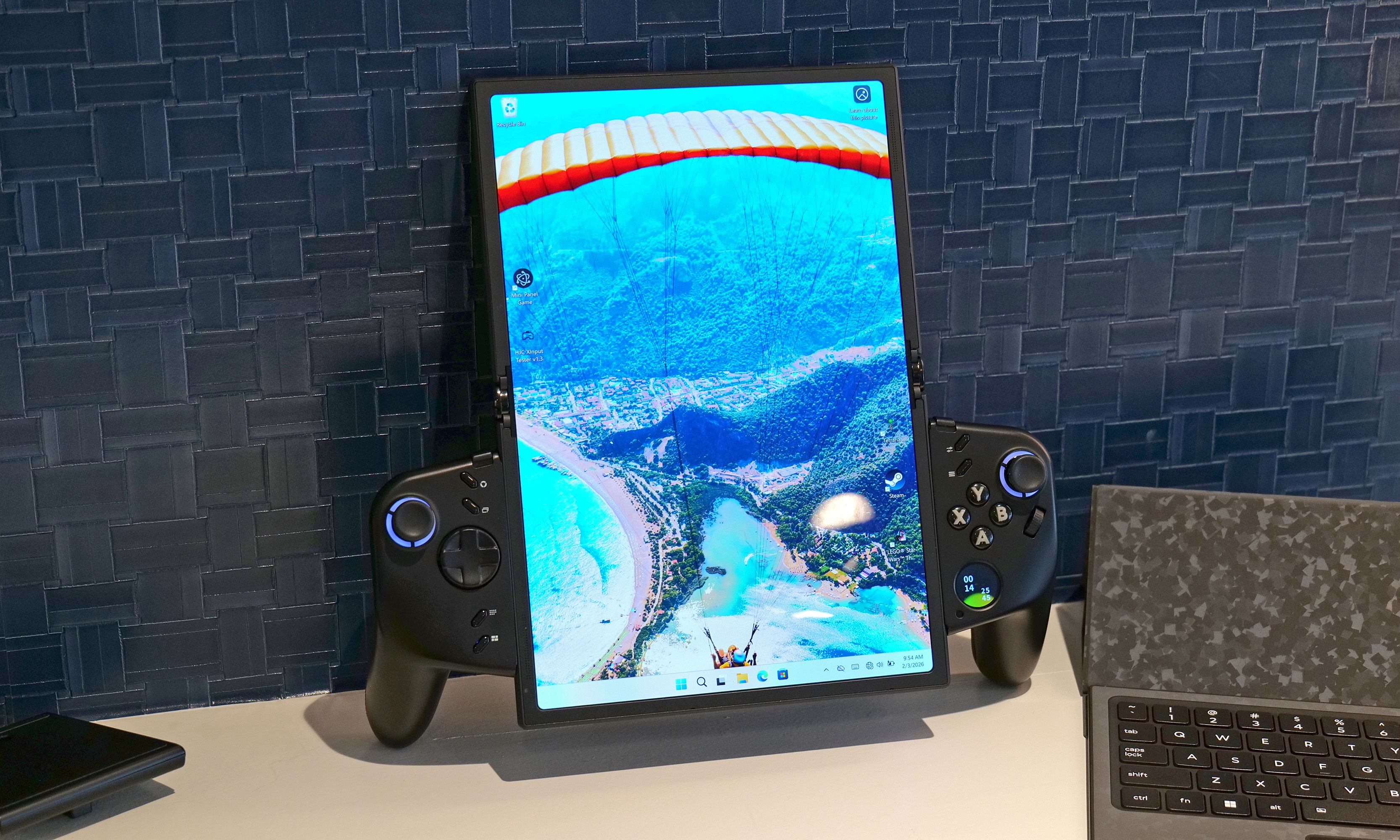
How silly does this look when its flexible display is fully extended in portrait mode?
Sam Rutherford for Engadget
Lenovo pulled up to MWC with a bunch of new products and concepts, but if there's one thing everyone's going to be talking about, it's the Legion Go Fold. (Check out Sam Rutherford's coverage of the Legion Go Fold here). In short, the Legion Go Fold is a concept foldable gaming handheld with a flexible display that can unfurl to a massive 11.6 inches. Or, it can be folded in half to become a 7.7-inch display. It has detachable controllers, and there are multiple mounting points along the tablet so you can switch things up between landscape and portrait mode. The left and right gamepads can also be combined into one controller with an accessory, and the display can be propped up kickstand-style with the folio cover.
You think we're done here? We're not. The Legion Go Fold can go laptop mode too, with a strip of pogo pins where a wireless keyboard can be connected. Its right gamepad can serve as a mouse, thanks to the inclusion of a little scroll wheel and a hidden sensor. That gamepad also features a tiny circular OLED display below the buttons, which can both show widgets such as the time and be used as a touchpad.
It is a concept, though, so don't get your hopes up too much about this one going into production. And if it does ever become a real, buyable product, it'll no doubt be expensive.
The Lenovo Modular AI PC concept is an ambitious mashup between a traditional clamshell and a dual-screen notebook with hot swappable ports.
Sam Rutherford for Engadget
Lenovo also announced its Modular AI PC concept — a laptop with two displays and a detachable keyboard. As Sam Rutherford, who got a chance to check it out in person, explained, "This allows you to move its keyboard and secondary display around at will, so the system can better adjust to its environment or workload." Perhaps even more exciting is that it has hot swappable ports. Lenovo demonstrated it with USB-C, USB-A and HDMI connectors, but said others could be possible too.
Still, while everything looked pretty polished in the demo, Lenovo says this one will remain a concept.
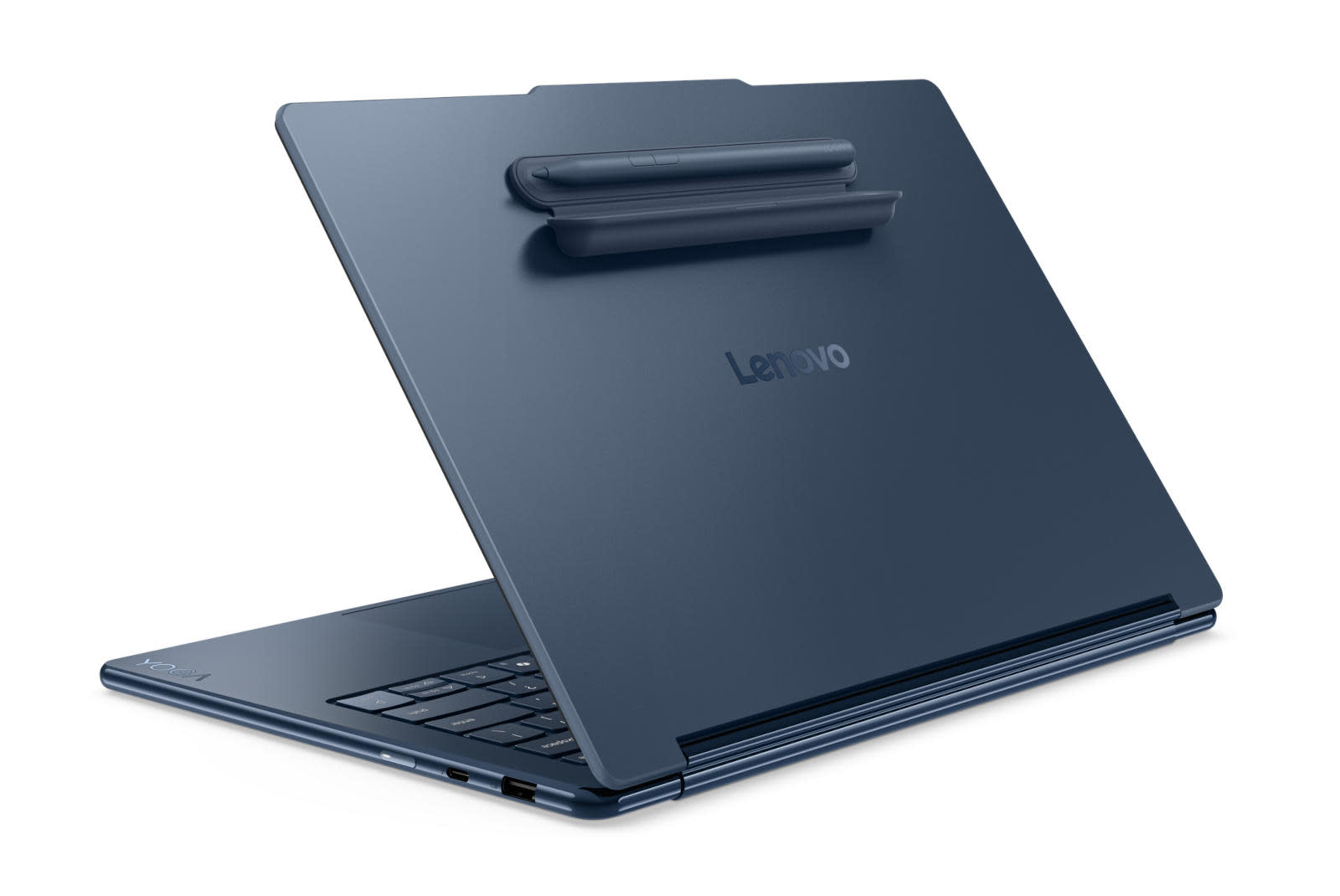
The Lenovo Yoga 9i 2-in-1 Aura Edition Gen 11
Lenovo
It hasn't all been concepts at MWC. Lenovo also refreshed some of its existing tablet and laptop lineups for 2026. The company introduced the Yoga 9i 2-in-1 Aura Edition Gen 11 (with the new Canvas Mode configuration), starting at $1,949, and the new 15.3-inch Yoga Pro 7a, which starts at $2,099. It's updated its more affordable IdeaPad Slim 5i Ultra laptop ($799) as well. All of those new laptops come with Copilot+ features. For students, Lenovo is launching the 13-inch Idea Tab Pro Gen 2, starting at $419, with its Quira AI assistant and AI tools. You can find all the specs and release dates for those here.
Upgrades are here for Lenovo's ThinkPads too, along with the Yoga-like ThinkBook 2-in-1. And, Lenovo announced a $499 industrial tablet, the ThinkPad X11.
Lenovo's 8.8-inch gaming tablet is getting a spec boost with the latest version announced at MWC 2026, the $849 Legion Tab Gen 5. The tablet has a Snapdragon 8 Gen 5 chipset, 16GB of RAM and up to 512GB storage. It also has a 9,000mAh battery to support longer gaming sessions, and two USB-C ports. The Legion Tab Gen 5 comes in three colors: Eclipse Black, Glacier White and the lime-green Surge. It launches in May. That'll be followed shortly after in July by the launch of the new 15-inch Legion 7a Gen 11 gaming laptop, starting at $2,299.
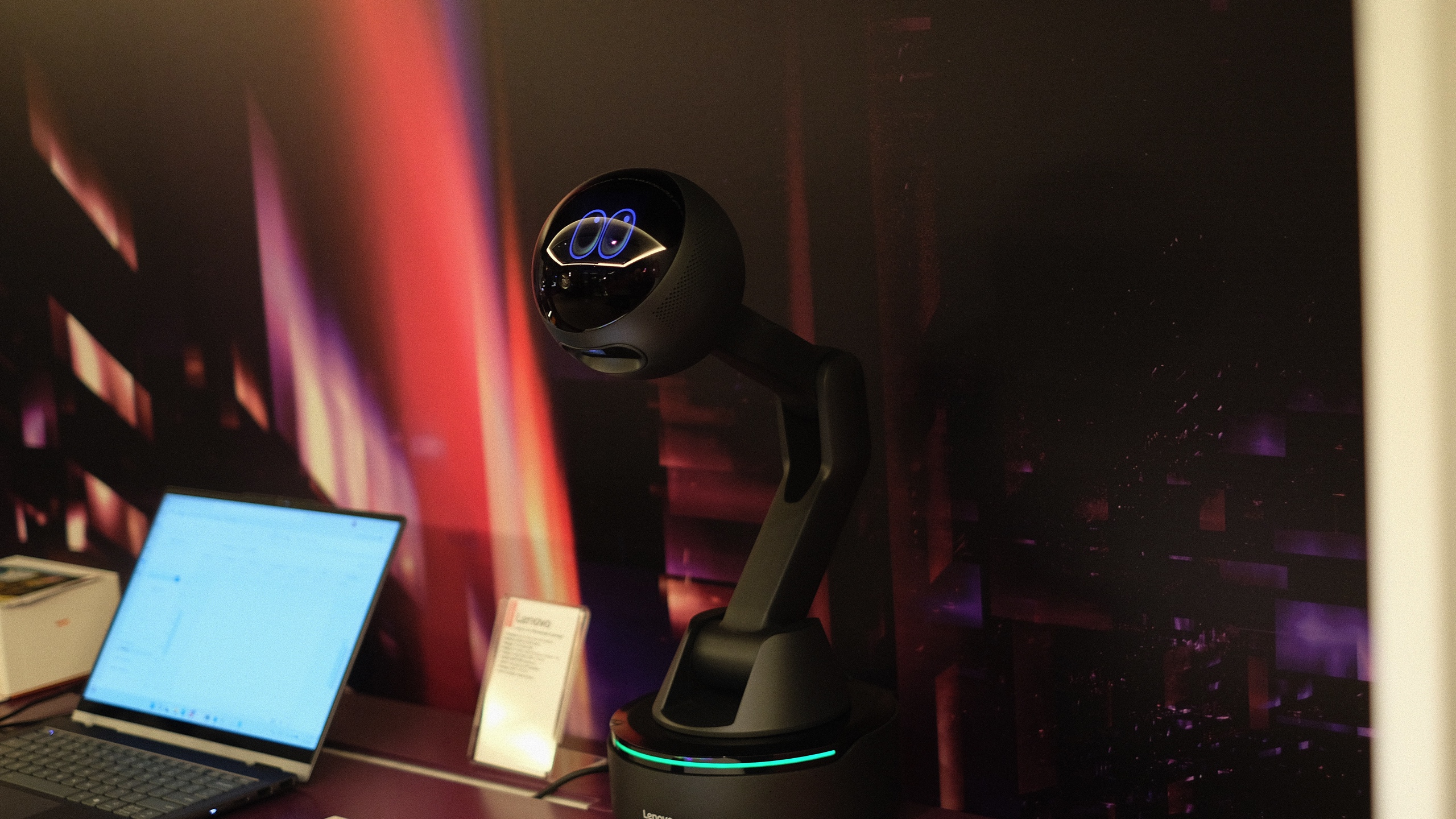
Lenovo AI Workmate Concept at MWC 2026
Image by Mat Smith for Engadget
And we're back to the concepts. Lenovo showed off two work-oriented AI devices: the AI Workmate Concept, a desktop robot, and the AI Work Companion Concept, a clock/display that can sync tasks across devices and organize them into a daily plan. The robot has a cute little face, and its head doubles as a projector that can display images and documents on nearby surfaces.
Honor
The Robot Phone. (Image by Mat Smith for Engadget)
Honor teased its Robot Phone this past fall and we just finally got a proper look at it at MWC. And it's pretty freakin' cute. The phone is equipped with a camera that's mounted on a highly mobile 4-degrees-of-freedom gimbal, which tucks away into a compartment on the back when it's not in use (making for a pretty beefy camera bump). In a demo at MWC, the camera, which behaves like a little robot head, bobbed along to music and showed off some of its gesture skills, like cocking its “head” and nodding in agreement.
Honor didn't reveal too much spec-wise, but the company says the primary camera uses a 200-megapixel sensor. The gimbal will offer three-axis stabilization, which will be coupled with camera modes such as Super Steady Video and AI Object Tracking. The Robot Phone isn't quite ready for release at the moment, but the company says it will launch later this year.
Be sure to check out Mat Smith's writeup on the Robot Phone for a more in-depth look.
Honor's humanoid robot. (Image by Mat Smith for Engadget)
Image by Mat Smith
It's not a humanoid robot reveal without some backflips and a choreographed dance performance. Honor introduced its robot at MWC with all the spectacle we've come to expect (though the bot didn't do any talking). It’s simply called the Honor Robot, and the company has plans for it to be used in both industrial and domestic settings.
Honor Magic V6 (Honor)
The Robot Phone isn't the only phone Honor showed off at MWC. The company also announced its Magic V6 smartphone, which it says is the thinnest phone in its category, measuring 8.75mm folded and 4.0mm open in the white colorway. The other three colors — black, gold and red — are slightly thicker, at 9mm folded and 4.1mm open.
Not too much has changed from the V5, though, which only came out in August 2025. It does however have the Snapdragon 8 Elite Gen 5, with 16GB RAM and 512 GB storage. As for the cameras, there are two 50-megapixel lenses and a 64-megapixel telephoto, plus a 20-megapixel f/2.2 selfie lens on the cover and internal display.
The international version of the Magic V6 will have a 6,660mAh battery with 25 percent silicon content, while the version sold only in China will boast a battery with a rated capacity of more than 7,000mAh and 32 percent silicon content. Honor hasn't yet shared details about pricing and availability.
Honor MagicPad
Honor
Ahead of MWC, Honor also announced what it claims is the thinnest Android tablet in the world: the 4.8mm thick MagicPad 4. We're expecting to hear more about this at Honor's press conference on Sunday, but so far we know it features a 12.3-inch 165Hz OLED display and weighs just 450g. It comes with up to 16GB of RAM and 512GB of storage, and is powered by Qualcomm's Snapdragon 8 Gen 5 chipset. The thinness doesn't count the camera bump, Honor notes. The MagicPad 4 has 13MP rear and 9MP front cameras. It also boasts spatial audio, with eight speakers.
Just as the display is slightly smaller than the previous MagicPad, the MagicPad 4 has a smaller battery at 10,100 mAh. It comes with a 66W fast charger. The MagicPad 4 will run Honor's MagicOS 10. We don't yet know how much it will cost, but we'll update this after Honor's press conference (where we're also expecting to see the company's robot) with any new details.
Xiaomi x Leica
Mat Smith for Engadget
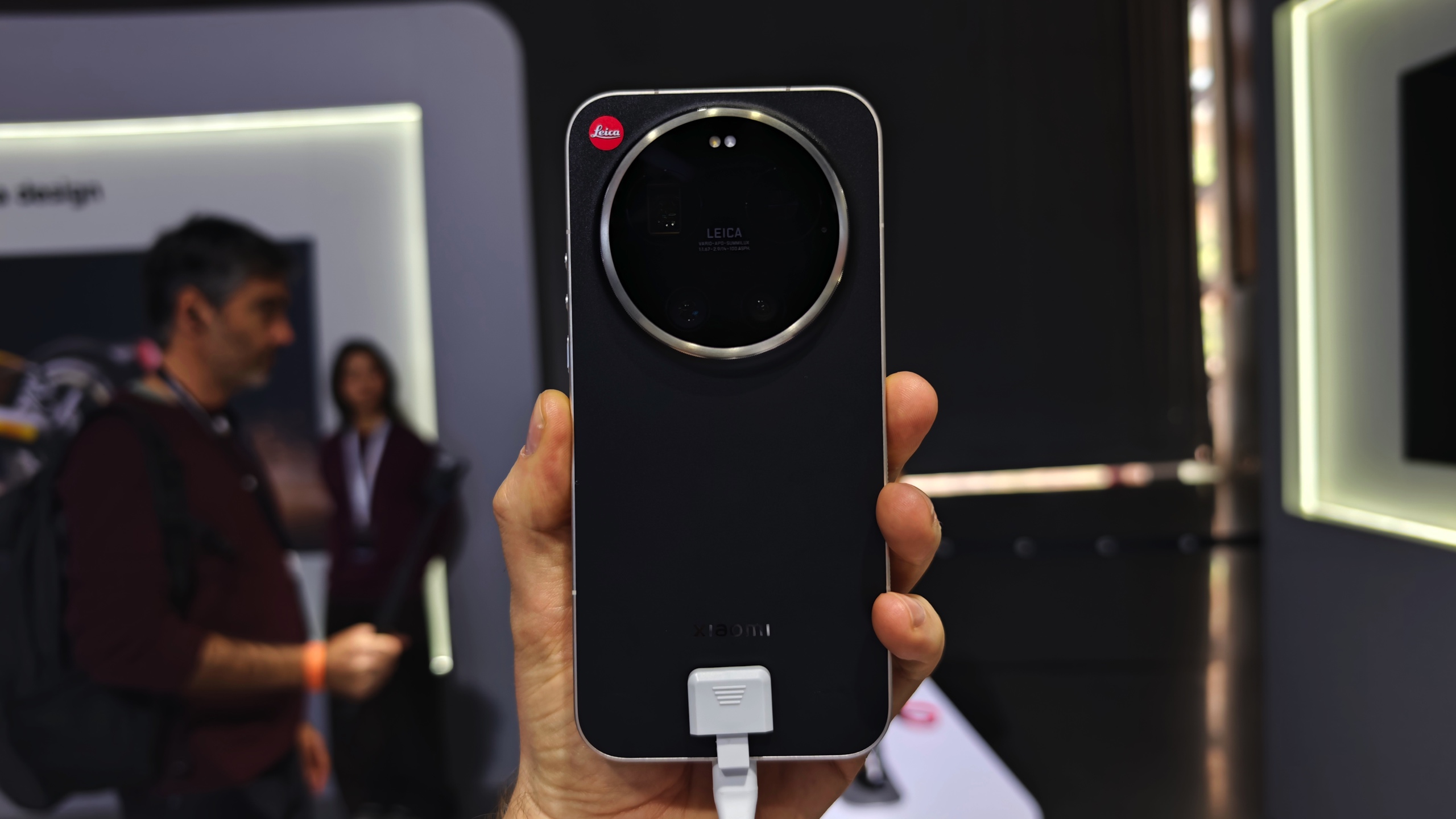
Xiaomi kicked off MWC this year by announcing the global launch of its 17 Ultra smartphone, which debuted first in China back in December. It's unclear if the phone will ever come to the US, but it's now rolling out in Europe. Xiaomi teamed up again with Leica to make a photography-focused smartphone, and the 17 Ultra sports a 1-inch 50-megapixel camera sensor with a f/1.67 lens, a telephoto setup with a 200MP 1/1.4-inch sensor, and a 50MP ultrawide camera. There's also a manual zoom ring around the camera.
Check out our hands on for our first impressions of what it's like shooting with the Xiaomi 17 Ultra. And there's more to it than just the camera. The 17 Ultra has a 6.9-inch OLED 120 Hz display that peaks at 3,500 nits of brightness, and a 6,000mAh silicon-carbon battery. The Xiaomi 17 Ultra starts at £1,299 (roughly $1,750).
Leica also announced a new phone made in partnership with Xiaomi at MWC. It looks a whole lot like Xiaomi's 17 Ultra, but isn't the 17 Ultra, exactly.
Leica Leitzphone by Xiaomi hands-on at MWC 2026
Image by Mat Smith for Engadget
Like the 17 Ultra, Leica's Leitzphone by Xiaomi has a 1-inch camera sensor and physical controls for zoom and other settings, using a mechanical ring around the camera unit. It features a Leica-designed intuitive camera interface with the option to show just the essentials when you're shooting, hiding all the modes and labels. There's a monochrome shooting mode and Leica filters.
The Leica branding is splashed all over it in design and wallpapers, but it's otherwise pretty similar to the 17 Ultra, with the same specs. Like the 17 Ultra, it has a Snapdragon 8 Elite Gen 5 chip and a 6.9-inch 120Hz display. This one's priced at €1,999 (roughly $2,362).
The Xiaomi Pad 8 Pro
Xiaomi
In addition to the 17 Ultra, Xiaomi announced two new tablets at MWC this year: the Xiaomi Pad 8 and Xiaomi Pad 8 Pro. There's nothing revolutionary here, but they're lightweight and thin, with both being 5.75mm thick and weighing 485g, and have a 9,200mAh battery. The Pro model is powered by a Snapdragon 8 Elite chip, while the regular Pad 8 uses the Snapdragon 8s Gen 4 chipset.
Xiaomi also unveiled a new 5,000mAh powerbank, the UltraThin Magnetic Power Bank 5000 15W. The 6mm thick power bank comes in three colors with an aluminum alloy shell: orange, silver and charcoal gray. Along with that, the company introduced the Xiaomi Tag, its own take on the Bluetooth item tracker. The Xiaomi Tag has a built-in hanging loop so it can be attached directly to a keyring, and the company says it will work with both Apple Find My and Google's Find Hub for Android.
Tecno
Tecno
We can always expect to see some wild phone concepts at MWC, and this year we're starting with one from Tecno. The company unveiled a modular concept smartphone design that can be as thin as 4.9mm in its base configuration. There’d be 10 modules to choose from based on the announcement, including various camera lenses, a gaming attachment and a power bank, relying on magnets to keep it all together — or Modular Magnetic Interconnection Technology, as Tecno is calling it.
This article originally appeared on Engadget at https://www.engadget.com/mobile/everything-announced-at-mwc-2026-lenovos-wild-foldable-gaming-handheld-honors-robot-phone-and-more-172442814.html?src=rss
How much would you pay for a good night's sleep? This is a question I've asked myself repeatedly over the last few weeks as I've been testing the Dreamie, a $250 alarm clock and "bedside companion" that I couldn't stop thinking about after I first encountered it at CES.
Ambient's Dreamie offers many of the conveniences of a smartphone-connected device — highly customizable alarm schedules, a library of soundscapes and noise masks, Bluetooth so you can connect earbuds and podcasts (soon). But it is phone-free every step of the way, with all controls and features built-in so you don't end up getting sucked into a doomscroll while you're trying to wind down. It also has a light ring for ambient lighting modes and sunrise wakeups. This spring, it's expected to start providing sleep insights as well for users who opt-in, using its microphone and motion sensors to get a reading on their nightly habits.
All of that's meant to work together to, according to the website, "help you sleep better and break free from your phone," a goal I was eager to explore. This may be one of the least unique problems to have as an adult in today's world, but sleep has become a really complicated thing for me.
Falling asleep is hard because my brain is always racing, my quality of the sleep is trash and waking up every day feels like an act of torture. It's gotten so bad that at some point in the last couple of years, I started using three alarms to make sure I get out of bed in time for work: a dedicated sunrise alarm clock, my smartwatch and my phone as the final, 11th hour save in case the other two methods don't do the trick. As you might imagine, my partner, who is forced to also endure this horrid morning ritual, hates it.
So if there's a device that can help fix this mess, I'm open to it. And after some time with the Dreamie, I think I've found a promising contender.
Getting into a sleep routine
There's no companion app with the Dreamie and no subscription service you need to sign up for, which feels like a breath of fresh air in 2026. (I'm so tired of subscriptions, free us from this hell!) Your one-time purchase gives you access to everything it offers now and the updates that are in the pipeline.
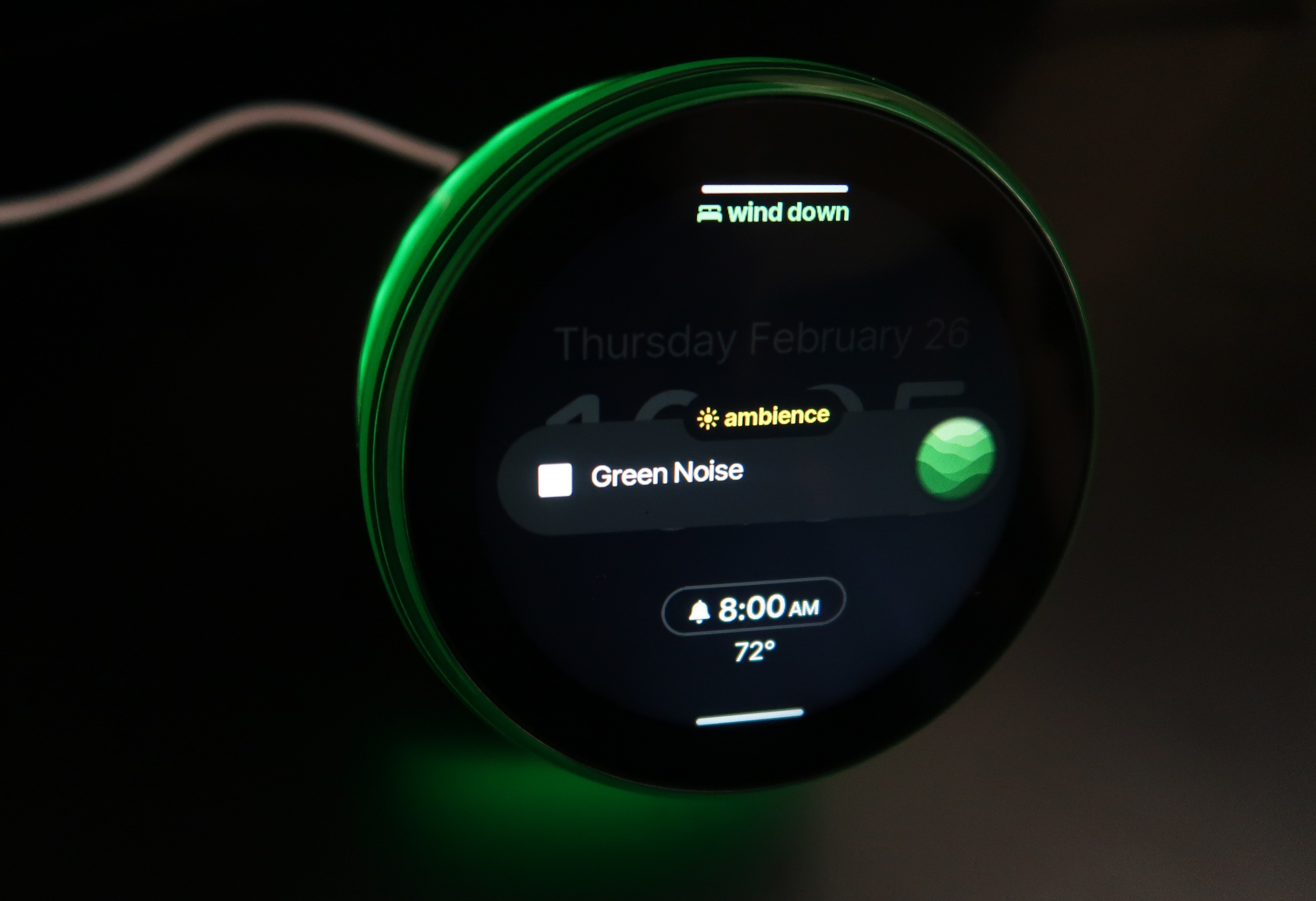
After taking it out of the box and plugging it in, you'll have to connect to your home Wi-Fi. Then, the Dreamie presents you with a tutorial to walk you through navigating its menus and physical controls. There's a touch strip on the top of the device to turn on the lamp and adjust its brightness, as well as the brightness of any ambient color "scene" that's active. By dragging the dot at the center of the lamp screen, you can throw the light in any particular direction. Volume is adjusted by turning the dial that's around the clockface. To access the menu for alarms and other settings, swipe up. To cycle through the different content modes — ambient, wind down and noise mask — just swipe down from the top of the screen. Easy peasy.
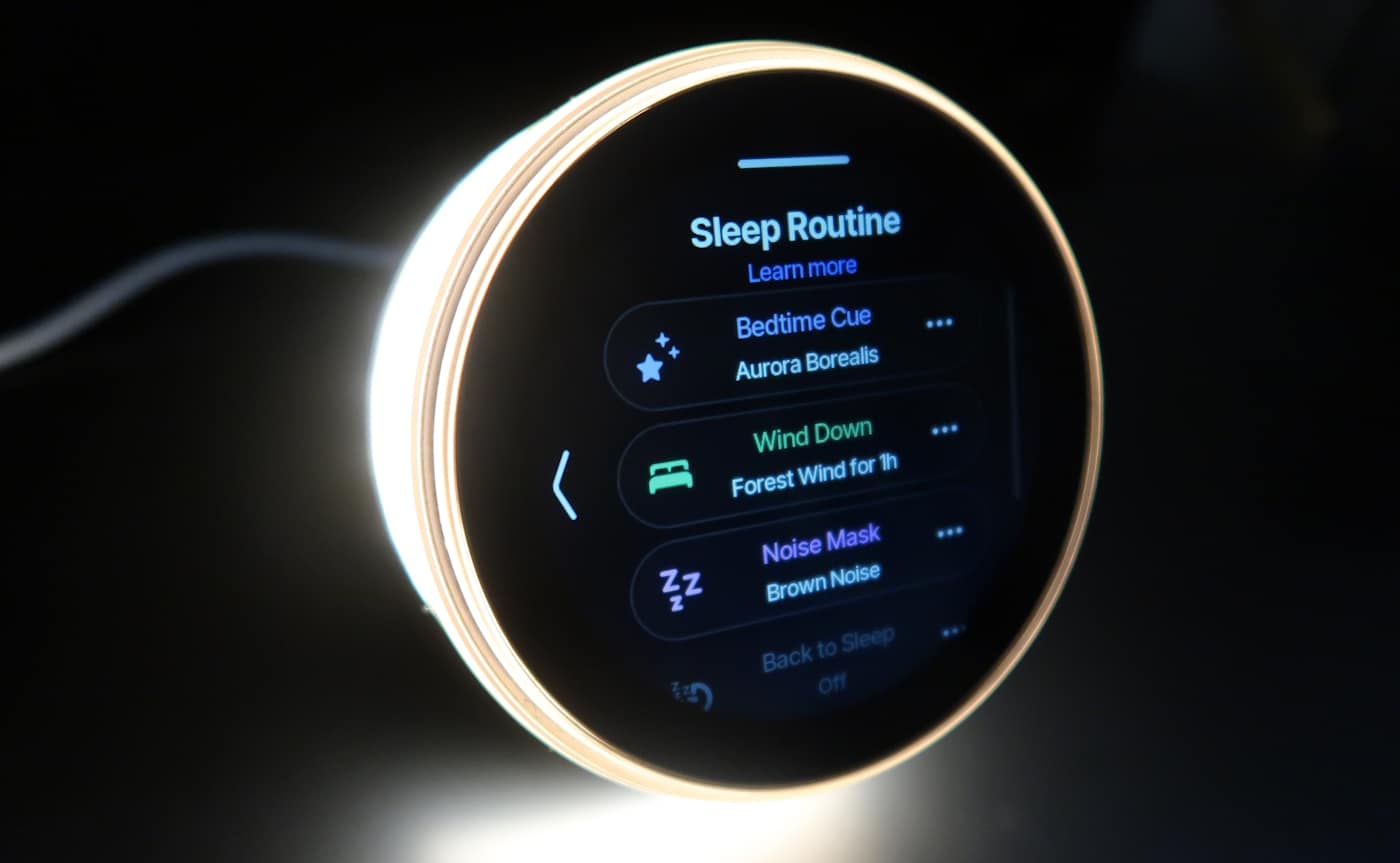
Setting up your actual Sleep Routine takes a little more time and intention. A Dreamie Sleep Routine consists of multiple steps, which you can use all, some or none of for your custom routine. Those include the Bedtime Cue, which lets you know it's the time to start getting ready for bed (you designate this time); the Wind Down, or the sounds you'll fall asleep to; and the Noise Mask, the sounds that keep you asleep. If you wake up in the middle of the night, there's a Back To Sleep option too.
You can choose different sounds from Dreamie's library for each category. Some options come with ambient lighting effects, too. There's a decent selection of soundscapes, from the dramatic Aurora Borealis and the sounds of storms and rivers to different "colors" of noise.
Some noise masks, like Green Noise, coming with lighting effects.
Cheyenne MacDonald for Engadget
The quality of the Dreamie's sound is what initially sold me during my demo at CES, and it holds up in daily use. The Dreamie has a 50 millimeter speaker inside, and the 360-degree grille on the bottom of the device makes it so the sound seems to come from everywhere. (My cats were extremely confused when I first turned it on). It really fills a room, and you don't have to crank it up to achieve that. When Bedtime Cue comes on, I typically turn it down to about 25, and then raise it back up to 45 when I flip it to Wind Down mode. I've never once set it higher than 50, and the alarm in the morning has still been loud enough to wake me up.
After taking a few days to tweak my choices and figure out what I like best, I've settled into a really nice routine: Aurora Borealis as the Bedtime Cue, an hour of Forest Wind as my Wind Down and a Noise Mask of Brown Noise to play throughout the night. I love how easy it is to set the nighttime routine in motion once it's established. When I hear the Aurora Borealis come on, I start making my preparations for bed. Brush teeth, take meds, lights out and, crucially (I'm trying really hard to be disciplined, here), my phone goes face-down on the nightstand until morning. If I want to stay up late that night and ignore the Bedtime Cue, I can just hit the little stop button on the display. But once I'm ready to actually try to fall asleep, all I need to do is swipe down on the display to initiate the Wind Down, and Forest Wind will start playing.
I have my Wind Down set for one hour, after which the Noise Mask begins. And man, that Forest Wind knocks me out. So far, I haven't found myself still up and staring at the ceiling by the time Brown Noise comes on. I've only been able to confirm that it is indeed working and switching to the Noise Mask because my cats regularly wake me up in the middle of the night, and it's been on each time that's happened. But aside from those instances where my head is being used as a springboard by the creatures that share my home, I've been sleeping pretty well through the night.
To minimize distractions when you're trying to sleep, the Dreamie's display will dim in response to the surrounding darkness. There's also a Redshift toggle to make the nighttime display easier on the eyes, a Dark Mode with a simplified appearance and the option to have the display turn off completely when you've been inactive for a while. I set the Dreamie on my nightstand close to where my face is at night, and I haven't had any problems with light from the display keeping me up.
Waking up with Dreamie
In the morning, the light begins to come on 20 minutes before I want to be awake, followed by the gradually increasing sound of the alarm. There are only a handful of alarm sounds at the moment, but the options are all fine. There are no jarring, grating alarms here — even the bird calls option sounds rich and natural, rather than the too-shrill, piercing recordings I've grown used to avoiding on other alarm clocks and sound machines.
You can set multiple alarms with different bedtimes and wakeup times, which is really handy if your schedule is all over the place or you want to allow yourself to sleep in more on certain days. My only real complaint so far is that the sunrise feature isn't quite as strong as I want it to be. The Dreamie's sunrise goes from a warm glow to a bright blue-white, but it never gets big enough to wash over me in the way I expect a sunrise alarm to. Having the light on is helpful for orienting yourself when you're groggy and half-asleep, but it doesn't feel like it's having much effect on my actual wakeup process.
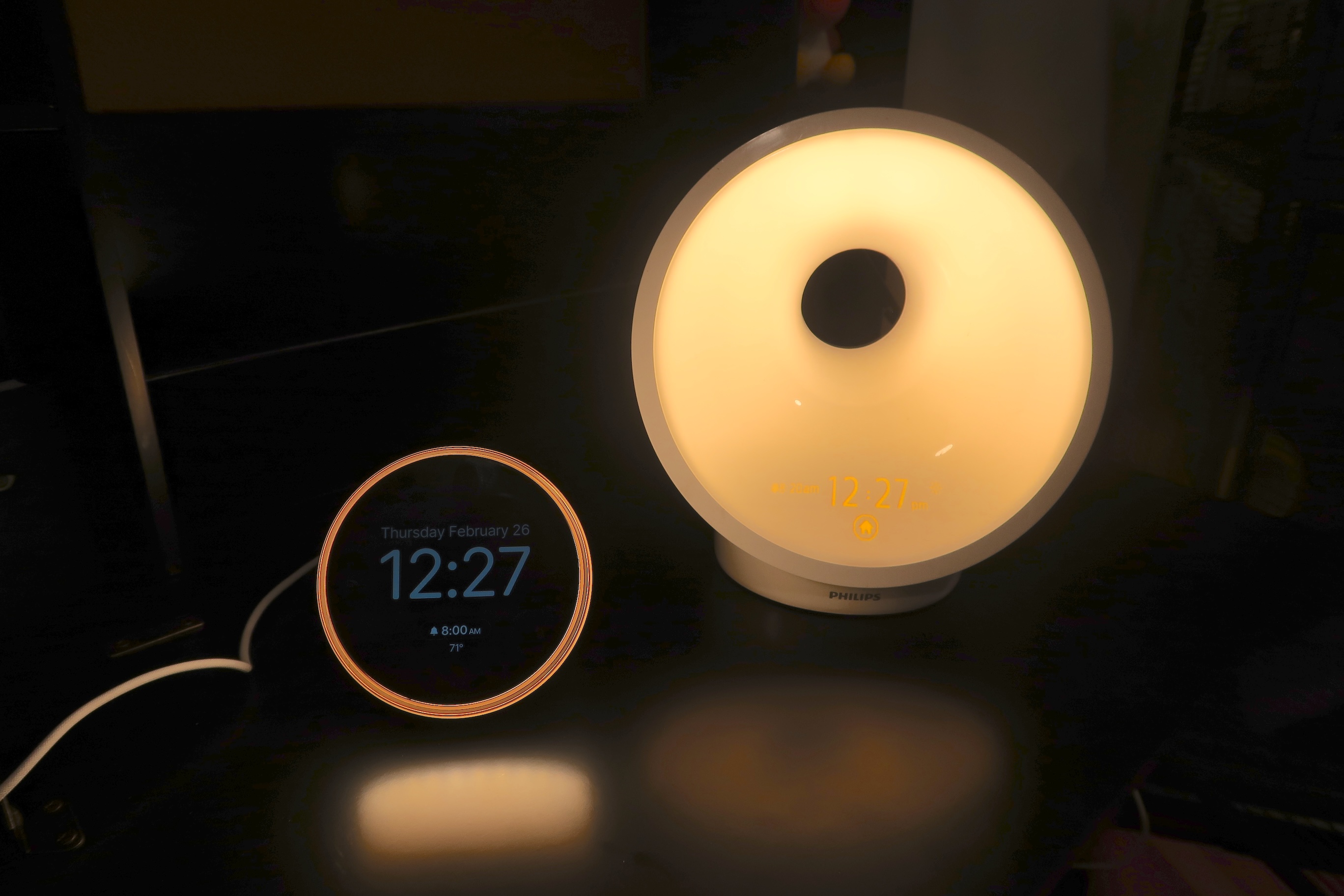
Dreamie next to a Philips Wake-Up Light.
Cheyenne MacDonald for Engadget
Part of the problem may be that none of the light is really directed forward and at the sleeper's face. Even the Dreamie's lamp mode at maximum brightness seems to have more reach than the sunrise feature. (And a note on the lamp, while it's decently bright, it's still a bit too dim for reading in bed unless I'm huddled up to it.)
Still, I've been sleeping well enough that I've been waking up alright most days even without being bathed in artificial sunlight. Don't get me wrong, I'm still hitting snooze a few times before dragging myself out of bed, but there's been a noticeable improvement in both the quality of my sleep and how miserable I feel come morning. I'm even down to using just two alarms: the Dreamie as my primary alarm, which is getting me up on its own for the most part, and my watch as a backup. At this point, I'm kind of attached to this thing.
The Dreamie is refreshingly compact, too. It takes up significantly less real estate on my nightstand than the Philips Wake-Up Light I've been using forever, or something like a Hatch Restore. The smaller footprint is something I appreciate as a person always battling cluttered surfaces. That also makes it better for travel. Since podcasts and sleep insights aren't available yet, I haven't been able to test those out, but they're non-critical features for me. The company has shared an estimated timeline of Q1-Q2 for these features to arrive, with podcasts likely coming first. They'll be nice to have, podcasts especially, but the Dreamie is more than able to do its main job of creating an environment that supports better sleep without those things.
Wrap-up
All of this brings me back to the question that's been haunting me since discovering the Dreamie: Is it ridiculous to spend $250 on an alarm clock/noise machine? At a different time in my life, I would have said yes without hesitation. But the current version of me, who knows what it's like to move through each day like a zombie because I'm sleeping so terribly, would begrudgingly disagree. As I pack up this review unit to ship it back, I'll also be putting in an order for my own so I can keep my cherished new sleep routine going.
This article originally appeared on Engadget at https://www.engadget.com/home/ambient-dreamie-bedside-companion-review-the-best-sleep-ive-had-in-years-184019430.html?src=rss
Need something new for your reading list? Here are two titles we think are worth checking out. This week, we read Aoife Josie Clements' deeply unsettling Persona, and the first issue of Bleeding Hearts, from the relaunch of the DC imprint, Vertigo.
This article originally appeared on Engadget at https://www.engadget.com/entertainment/what-to-read-this-weekend-the-unsettling-new-horror-novel-persona-185152256.html?src=rss
On Friday, New York State Senators Liz Krueger and Kristen Gonzales introduced a bill that would stop the issuance of permits for new data centers for at least three years and ninety days to give time for impact assessments and to update regulations. The bill would require the Department of Environmental Conservation and Public Service Commissions to issue impact statements and reports during the pause, along with any new orders or regulations that they deem necessary to minimize data centers' impacts on the environment and consumers in New York.
The bill would require these departments to study data centers' water, electricity and gas usage, and their impact on the rates of these resources, among other things. The bill, citing a Bloomberg analysis, notes that, "Nationally, household electricity rates increased 13 percent in 2025, largely driven by the development of data centers." New York is the sixth state this year to introduce a bill aiming to put the brakes on data centers, following in the footsteps of Georgia, Maryland, Oklahoma, Vermont and Virginia, according to Wired. It's still very much in the early stages, and is now with the Senate Environmental Conservation Committee for consideration.
This article originally appeared on Engadget at https://www.engadget.com/big-tech/new-york-lawmakers-introduce-bill-that-aims-to-halt-data-center-development-for-three-years-224005266.html?src=rss
The State Department is wiping the post history of its X accounts and making it so you'll have to file a Freedom of Information Act request if you want to access any of the content it removed, according to NPR. The publication reports that the State Department is removing all posts from before President Trump's current term — a move that affects several accounts associated with the department, including those for US embassies, and posts from the Biden and Obama administrations. Posts from Trump's first term will be taken down too.
Unlike how past administrations have handled the removal of social media content and the transition of accounts, these posts won't be kept in a public archive. A spokesperson for the State Department confirmed this to NPR, and said the move is meant "to limit confusion on U.S government policy and to speak with one voice to advance the President, Secretary, and Administration's goals and messaging. It will preserve history while promoting the present." The spokesperson also called the X accounts "one of our most powerful tools for advancing the America First goals."
The Trump administration has been purging information from government websites since he took office last year. Just this week, the CIA unexpectedly took down its World Factbook, a global reference guide that's been available on the internet since 1997.
This article originally appeared on Engadget at https://www.engadget.com/social-media/the-state-department-is-scrubbing-its-x-accounts-of-all-posts-from-before-trumps-second-term-205515745.html?src=rss
NVIDIA CEO Jensen Huang told reporters that the company will "invest a great deal of money" in OpenAI's latest funding round, according to Bloomberg, after The Wall Street Journal on Friday reported that the two companies were rethinking a previous $100 billion deal that hasn't "progressed beyond the early stages" of negotiations. Speaking to reporters in Taipei this weekend, Huang reportedly said it could be "the largest investment we've ever made."
NVIDIA and OpenAI jointly announced in September that NVIDIA would be investing up to $100 billion in OpenAI to build 10 gigawatts of AI data centers. The companies said then that they were targeting the second half of 2026 for the first phase of the project to go online. Citing sources familiar with the discussions, The Wall Street Journal reported that Huang has highlighted privately that the agreement was nonbinding and has criticized OpenAI's business approach as lacking discipline.
According to Bloomberg, however, Huang called the report's claims "nonsense," and told reporters on Saturday, "I believe in OpenAI. The work that they do is incredible. They’re one of the most consequential companies of our time.” But, Bloomberg reports, he said NVIDIA's investment in this funding round wouldn't come near $100 billion.
This article originally appeared on Engadget at https://www.engadget.com/ai/nvidia-is-still-planning-to-make-a-huge-investment-in-openai-ceo-says-205521528.html?src=rss
Your Gmail inbox should now be back to normal after Saturday’s hiccups. Google said in an update on X on Saturday night that the issue, which affected the automatic filters that keep Gmail users’ inboxes free from the clutter of promotional emails, non-urgent updates and spam, “is now fully resolved for all users.” On its Workspace status dashboard, it added that an investigation is underway, and an analysis will be published once complete.
Gmail users on Saturday reported that their inboxes were flooded with promotional emails that had not been properly sorted out of the main tab, and some said they were seeing notices that emails had not been scanned for spam. On social media and DownDetector, some Gmail users also reported delays in receiving messages, leading to issues with two-factor authentication logins. After confirming the issue, Google noted in an update on its Workspace dashboard that the problem resulted in the "misclassification of emails in their inbox and additional spam warnings," including a banner that says, “Be careful with this message. Gmail hasn't scanned this message for spam, unverified senders, or harmful software.”
In a statement to Engadget, a Google spokesperson echoed the message from its dashboard, saying, "We are actively working to resolve the issue. As always, we encourage users to follow standard best practices when engaging with messages from unknown senders."
Update, January 25 2026, 9:53AM ET: This story has been updated to reflect that the issue has been resolved.
This article originally appeared on Engadget at https://www.engadget.com/apps/google-says-its-working-to-fix-gmail-issue-thats-led-to-flooded-inboxes-and-increased-spam-warnings-183358654.html?src=rss
Six years after the announcement of plans to build Atari Hotels in eight cities across the US, including Las Vegas, only one now seems to be moving forward, in Phoenix, Arizona. The Las Vegas deal ultimately "didn't come to fruition," spokesperson Sara Collins toldLas Vegas Sun this week, and Atari Hotels is putting its focus into the Phoenix site "for the time being."
Phoenix was always meant to be the first site, followed by other hotels in Austin, Chicago, Denver, Las Vegas, San Francisco, San Jose and Seattle. But Las Vegas is now apparently off the table, and there haven't been any signs of life around the other planned locations. The FAQ on the Atari Hotels website notes, "Additional sites, including Denver, are being explored under separate development and licensing agreements." The Atari Hotel project was announced in 2020 just before the onset of the COVID-19 pandemic and consequently experienced development delays. Construction on the Phoenix hotel, which was supposed to break ground in 2020, is expected to begin late this year, with its opening now planned for 2028.
But maybe don't hold your breath. According to a December press release, the company is still trying to raise $35 million to $40 million to fund the "playable destination" for gamers in Phoenix.
This article originally appeared on Engadget at https://www.engadget.com/gaming/the-plan-for-a-gaming-themed-atari-hotel-in-las-vegas-has-reportedly-been-scrapped-214212269.html?src=rss
X may soon provide more insight into how its algorithm works. On Saturday, Elon Musk posted on the platform to say that the company "will make the new X algorithm, including all code used to determine what organic and advertising posts are recommended to users, open source in 7 days."
Elon Musk's X post about open-sourcing the algorithm.
Screenshot/X
Musk has been making promises of open-sourcing the algorithm since his takeover of Twitter, and in 2023 published the code for the site's "For You" feed on GitHub. But the code wasn't all that revealing, leaving out key details, according to analyses at the time. And it hasn't been kept up to date. Of the making the new algorithm open source, Musk said in his post, "This will be repeated every 4 weeks, with comprehensive developer notes, to help you understand what changed."
This article originally appeared on Engadget at https://www.engadget.com/big-tech/elon-musk-says-xs-new-algorithm-will-be-made-open-source-next-week-225721656.html?src=rss
There were no idle hands at Sharpa's CES booth. The company's humanoid may have been the busiest bot at show, autonomously playing ping-pong, dealing blackjack games and taking selfies with passersby. On display wasn't just the robot and its smarts, but also SharpaWave, a highly dexterous 1:1 scale human hand.
The hand has 22 active degrees of freedom, according to the company, allowing for precise and intricate finger movements. It mirrored my gestures as I wiggled my hand in front of its camera, getting everything mostly right, which was honestly pretty cool. Each fingertip contains a minicamera and over 1,000 tactile pixels so it can pick up objects with the appropriate amount of delicateness for the task at hand, like plucking a playing card from a deck and placing it gently on the table.
Sharpa's robot was a pretty good ping-pong player, too. We've seen ping-pong robots plenty of times before, but these typically come in the form of a disembodied robotic arm, not one that's humanoid from the waist up. The company's products are meant to be general-purpose, with the ability to handle a wide range of jobs, and its humanoid wore a lot of hats at CES to drive the point home.
This article originally appeared on Engadget at https://www.engadget.com/ai/sharpas-ping-pong-playing-blackjack-dealing-humanoid-is-working-overtime-at-ces-2026-150000488.html?src=rss
Cute, alien-inspired companion robots are a fixture at CES, but have I ever seen one with a furry telescoping neck that's also warm to the touch? No, I can't say I have before this year. OlloBot — which had possibly the cutest booth at CES 2026 — is a home robot and "cyber pet" that looks something like if you put ET's head on a penguin's body, plus a splash of fur and color.
Its face is essentially a large tablet that displays its expressions, pictures and videos, and allows it to communicate with people in the home. OlloBot speaks its own language, but will put text on the screen when it has a message that's meant to actually be understood. There's also a companion app where family members can message with the robot, see its diary updates and play games. Like other family-oriented robots, OlloBot is designed to capture special moments and "grow" with the people using it.
Based on the interactions, it will over time develop a personality based on the Meyers-Briggs personality types. The robot responds to voice and touch, and can do tasks like make calls and help find lost objects. It will be able to control Matter-compatible smart home devices, too. All data is stored locally in a heart-shaped removable module underneath one of its flapping arms. Not only is that intended to be a privacy move, but if the robot ever breaks, the family's cyber pet (along with its "memories") can be restored by putting the old heart into a new body.
OlloBot's heart
Cheyenne MacDonald for Engadget
According to a member of the OlloBot team, a Kickstarter campaign to fund the robot's production is planned for this summer. There will be two versions of OlloBot to choose from: a small one with a fixed, short neck that will cost around $1,000 and a more advanced model that can extend its neck by two feet or so (just eyeballing it) to see from different vantage points, which will run you about $2,000. At the booth, the team also showed off several outfits for OlloBot, including a plush giraffe suit and a sort of cottagecore apple and gingham outfit.
This article originally appeared on Engadget at https://www.engadget.com/home/smart-home/i-cant-get-over-this-goofy-long-necked-cyber-pet-robot-at-ces-175900062.html?src=rss
A startup called ReviMo has developed a robotic system that provides a way for people with limited mobility to lift and transfer themselves — like from a bed to a wheelchair, or to the toilet — without the assistance of a caregiver. ReviMo's Niko has two sets of arms: one that forms a "scooping seat" that slides underneath the person to lift them up, and the other encircling their torso and providing a backrest. It can be operated both by remote and using the controls on its dashboard. Niko in its current iteration can carry up to 250 pounds, but the team says it's working on a version that can support up to 400 pounds.
In addition to aiding in transfers, Niko can lift the rider to a standing level and offers retractable handlebars for support. It also has the potential to be a big help to caregivers, who in many cases assist with multiple transfers every day. Even in a situation where a person isn't able to operate it by themselves, Niko facilitates a transfer that requires much less physical exertion than today's common methods, like sling-based mechanical lift systems. At CES, founder Aleksandr Malaschenko gave a demonstration of its lifting capabilities, using it to scoop him up from a chair and bring him out into the aisle.
Niko is designed to work with most wheelchairs and be compact enough to navigate small bathrooms. It can position a person right above a toilet, and there are disposable seat covers. The goal is to help people with limited ability achieve more independence.
It is the kind of device that, if it delivers on its promises, could be a game-changer for people with limited mobility and paralysis, and their loved ones. My dad was diagnosed with ALS when I was a kid, and I learned how to operate a Hoyer lift by the time I was in middle school. This strikes me as something we would have really appreciated having around. Malaschenko has said the inspiration for the robotic system came from being a caregiver for his grandfather following a stroke.
Niko will cost about $15,000, though the team said it's working to get it covered by insurance. The company is also offering lower prices for customers who sign up for one of its premium waitlists, and there are options to rent it for those who would only need a lift and transfer system temporarily.
This article originally appeared on Engadget at https://www.engadget.com/transportation/niko-is-a-robotic-lift-for-people-with-limited-mobility-that-doesnt-require-a-caregivers-help-184500703.html?src=rss

 Anmelden