❌

Normale Ansicht

Google ends its 30 percent app store fee and welcomes third-party app stores

Google is officially doing away with its 30 percent cut of Play Store transactions, and rolling out changes to how third-party app stores and alternate billing systems will be handled by Android. Some of these tweaks were proposed as part of the settlement the company reached with Epic in November 2025, but rather than wait for final judicial approval, Google is committing to revamping Android and the Play Store publicly.

The biggest change is to how Google will collect fees from developers publishing apps on Android. Rather than take its standard 30 percent cut of in-app purchases through the Play Store, Google is lowering its cut to 20 percent, and in some cases 15 percent for new installs of apps from developers participating in its new App Experience program or updated Google Play Games Level Up program. Those changes extend to subscriptions, too, where the company’s cut is lowering to 10 percent. For Google’s billing system, the company says developers in the UK, US, or European Economic Area (EEA) will now be charged a five percent fee and "a market-specific rate" in other regions. Of course, for anyone trying to avoid those fees, using alternatives to Google's billing system is getting easier.

Google says that developers will be able to offer alternative billing systems alongside its own or "guide users outside of their app to their own websites for purchases." The setup, as described by Google, appears to be more permissive than what Apple settled on in 2025. For iOS apps on the App Store, developers interested in avoiding Apple's fees can only direct customers to alternative payment methods on the web through in-app links. Allowing for these outside transactions is part of what prompted Epic to bring Fortnite back to the App Store in the US in May 2025. The developer added the app back to the Play Store in the US in December of that year, and Epic CEO Tim Sweeney shared alongside today's changes that Fortnite will soon be available in Google's app store globally.

Fortnite will return to Google Play Store worldwide soon. Epic Games Store continues supporting Android worldwide alongside Windows and Mac, and installation on Android will become much easier later in 2026.

— Tim Sweeney (@TimSweeneyEpic) March 4, 2026

Epic is ultimately interested in getting people to use the mobile version of its Epic Games Store, and Google’s announcement also includes details on how third-party app stores can come to Android. Third-party app stores will be able to apply to the company's new "Registered App Stores" program to see if they meet "certain quality and safety benchmarks." If they do, they'll be able to take advantage of a streamlined installation interface in Android. Participating in the program is optional, and users will still be able to sideload alternative app stores that aren't part of the program, but Google clearly has a preference.  Changes the company plans to make to sideloading later in 2026 could deliberately make the process more difficult, which might force developers to apply to Google’s program.
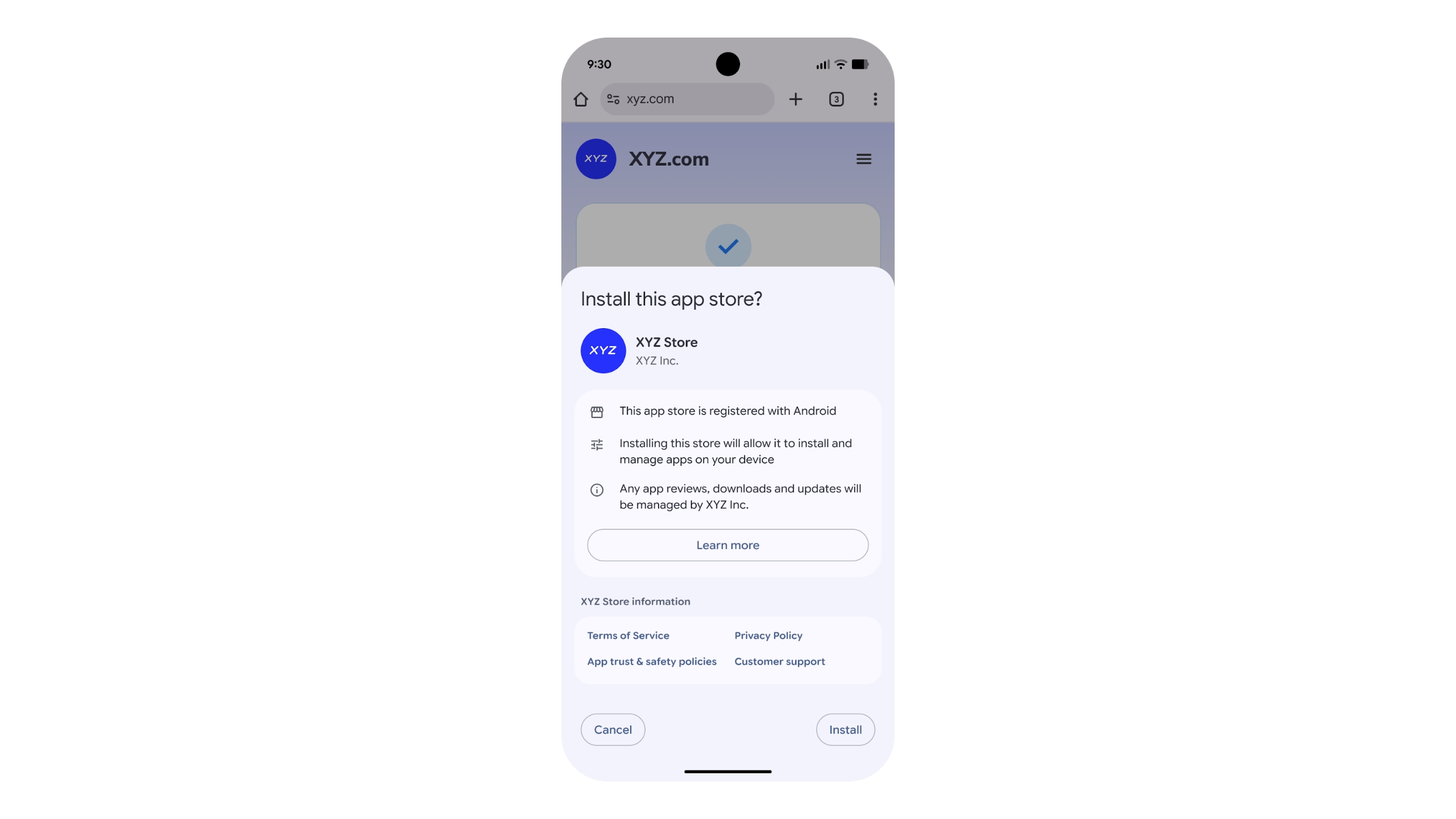
The interface for installing "qualified" third-party app stores on Android.
App stores approved by the Registered App Stores program get a simpler installation interface.
Google

Given the scale of the changes, not all of Google's tweaks will be available everywhere at the same time. Google says that its updated fee structure will come to the EEA, the UK and the US by June 30, Australia by September 30, Korea and Japan by December 31 and the entire world by September 30, 2027. Meanwhile, the company's updated Google Play Games Level Up program and new App Experience program will launch in the EEA, the UK, the US and Australia on September 30, before hitting the remaining regions alongside the updated fee structure. For any developers interested in offering their own app store, Google says it'll launch its Registered App Stores program "with a version of a major Android release" before the end of the year. According to the company, the program will be available in other regions first before it comes to the US.

Google has made changes to how it collects app store fees in the past, the most significant being in 2021, when it lowered its cut to 15 percent on the first $1 million developers earn, and 15 percent on subscriptions. The difference here is that the regulatory scrutiny brought about by Epic's lawsuit against Google and Apple seems to be a key motivator for its changes. Well, that, and an entirely separate business deal the company made with Epic. Google and Epic's settlement served as the basis for these changes, but The Verge reported in January that the companies also agreed to an $800 million joint partnership around product development and Google using Epic's "core technology." Letting developers keep more of their money is ultimately good, but it's a business decision Google felt comfortable making, which likely means it has its own share of upsides. 

This article originally appeared on Engadget at https://www.engadget.com/apps/google-ends-its-30-percent-app-store-fee-and-welcomes-third-party-app-stores-185248647.html?src=rss

©

  •  

FCC approves the merger of cable giants Cox and Charter

The Federal Communications Commission has given the go ahead for two of the US' biggest cable providers, Charter Communications and Cox Communications, to merge. Charter announced its intention to acquire Cox for $34.5 billion in May 2025, with specific plans to inherit Cox's managed IT, commercial fiber and cloud businesses, while folding the company's residential cable service into a subsidiary.

“By approving this deal, the FCC ensures big wins for Americans," FCC Chairman Brendan Carr said in a statement. "This deal means that jobs are coming back to America that had been shipped overseas. It means that modern, high-speed networks will get built out in more communities across rural America. And it means that customers will get access to lower priced plans. On top of this, the deal enshrines protections against DEI discrimination."

The FCC claims that Charter plans to invest "billions" to upgrade its network following the closure of the deal, leading to "faster broadband and lower prices." The company's "Rural Construction Initiative" will also extend those improvements to rural states lacking in consistent internet service, a project the FCC was heavily invested in during the Biden administration, but has been pulling back from since President Donald Trump appointed Carr. The FCC also claims Charter will onshore jobs currently handled off-shore by Cox employees and commit to "new safeguards to protect against DEI discrimination," which essentially amounts to hiring, recruiting and promoting employees based on "skills, qualifications, and experience."

While Carr's FCC paints a rosy picture of Charter's acquisition, history has provided multiple examples of mergers having the opposite effect on jobs and pricing. For example, redundancies created when T-Mobile merged with Sprint in 2020 led to a wave of layoffs at the carrier. And funnily enough in 2018, not long after Charter's merger with Time Warner Cable was approved by the FCC, the company raised prices on its Spectrum service by over $91 a year. 

The FCC's obsession with diversity, equity and inclusion as part of the deal is stranger, if only because it appears to fall outside of the commission's purpose of maintaining fair competition in the telecommunications industry. It does fit with other mergers the FCC has approved under Carr, however. Skydance's acquisition of Paramount was approved in 2025 under the condition it wouldn't establish any DEI programs.

This article originally appeared on Engadget at https://www.engadget.com/big-tech/fcc-approves-the-merger-of-cable-giants-cox-and-charter-230258865.html?src=rss

©

  •  

Paramount agrees to buy Warner Bros. Discovery, pays Netflix $2.8 billion for breakup

Paramount Skydance and Warner Bros. Discovery are officially merging. The studio paid Netflix the $2.8 billion termination fee it was owed for breaking its original deal to buy Warner Bros. earlier today, and the historic film studio has now formally accepted Paramount’s offer.

Along with the deal, which values Warner Bros. Discovery at $31 per share, Paramount is making several commitments to assuage the fears of regulators and the entertainment community. Those include a guarantee that the new company will produce 30 theatrical films annually, that theatrical releases will have a minimum 45-day window in theaters before they’re brought to video on demand (something Netflix ultimately also agreed to) and that deal itself will close by Q3 2026.

This turnaround in Paramount's fortunes has happened quickly. Warner Bros. Discovery announced that Paramount's offer was superior to Netflix's on Thursday, and not long after the streaming service said that it wouldn't provide a counter offer, effectively abandoning its previous agreement.

Ultimately, Netflix and Paramount were vying for different parts of Warner Bros. Disocvery. Netflix was primarily interested in Warner Bros. proper, while Paramount Skydance wanted the whole company, cable networks and all. Either deal would need to be approved by regulators, which is the hurdle Paramount and Warner Bros. Discovery face now. The general assumption has been that the close relationship Paramount CEO David Ellison and his billionaire father Larry Ellison have with the Trump administration would smooth over any issues, but the deal will receive scrutiny abroad and likely also at the state level, based on a recent post from California Attorney General Rob Bonta.

Paramount Skydance has proven its willingness to comply with President Donald Trump, but delays in closing the deal could be costly. The company is on the hook to pay Warner Bros. Discovery "a daily ticking fee equal to $0.25 per share per quarter beginning after September 30, 2026." The company also has to pay $7 billion to Warner Bros. Discovery if the deal is terminated for regulatory reasons. Netflix lost the battle for Warner Bros. Discovery, but getting a competitor to potentially overpay for the studio might be its own reward.

This article originally appeared on Engadget at https://www.engadget.com/entertainment/paramount-agrees-to-buy-warner-bros-discovery-pays-netflix-28-billion-for-breakup-215936514.html?src=rss

©

  •  

The PS5 Pro is getting upgraded upscaling tech in March

After suggesting a version of AMD's FSR 4 could be ported to the PS5 Pro last year, it looks like Sony is finally rolling out an update with the upscaling tech in March. Mark Cerny, the lead architect of the PS4, PS5 and PS5 Pro, shared via a blog post that the PS5 Pro will be updated with a new version of the company's PSSR (PlayStation Spectral Super Resolution) upscaling tech next month, and Resident Evil Requiem is one of the first games to use it.

PSSR is "an AI library that analyzes game images pixel by pixel as it upscales them," Cerny says, which boosts the visual fidelity of games on the PS5 Pro, while running them at a less demanding resolution. The upgraded version of PSSR "takes a very different approach to not only the neural network but also the overall algorithm," and is now able to keep both framerate and image quality high when it's enabled.

Cerny's blog post includes comparison images if you're curious about the visual differences the new PSSR is able to achieve. Masaru Ijuin, a Senior Manager from Capcom's Engine Development Support Section R&D Foundational Technology Department, also provided comments on how the new upscaling tech improves Resident Evil Requiem:

With Resident Evil Requiem, we focused on enhancing the presentation quality of the protagonist through an upgraded version of RE Engine to deepen the player’s immersion in horror. For example, each individual strand of hair and beard is rendered as a polygon, allowing it to move realistically in response to body motion and wind. The way light passes through his hair changes depending on how the strands of hair are overlapped as well. This detailed expression of texture is one of the many details that we would especially love for our fans to see.

The upgraded PSSR has allowed us to elevate our expressiveness by successfully processing these details and textural particularities, which are traditionally difficult to upscale because of their intricacy. We hope you will experience this unprecedented level of horror and visual fidelity, and the new gameplay feel it delivers.

Sony and AMD formally announced "Project Amethyst," their collaboration to develop machine-learning technology to improve graphics and gameplay, in 2024. The partnership has already benefitted both companies: Cerny says Sony contributed to the development of AMD's FSR 4 and similar improvements are now trickling back to the PS5 Pro. Both companies' plans to improve everything from upscaling performance to energy efficiency could also pay further dividends in future consoles and GPUs. 

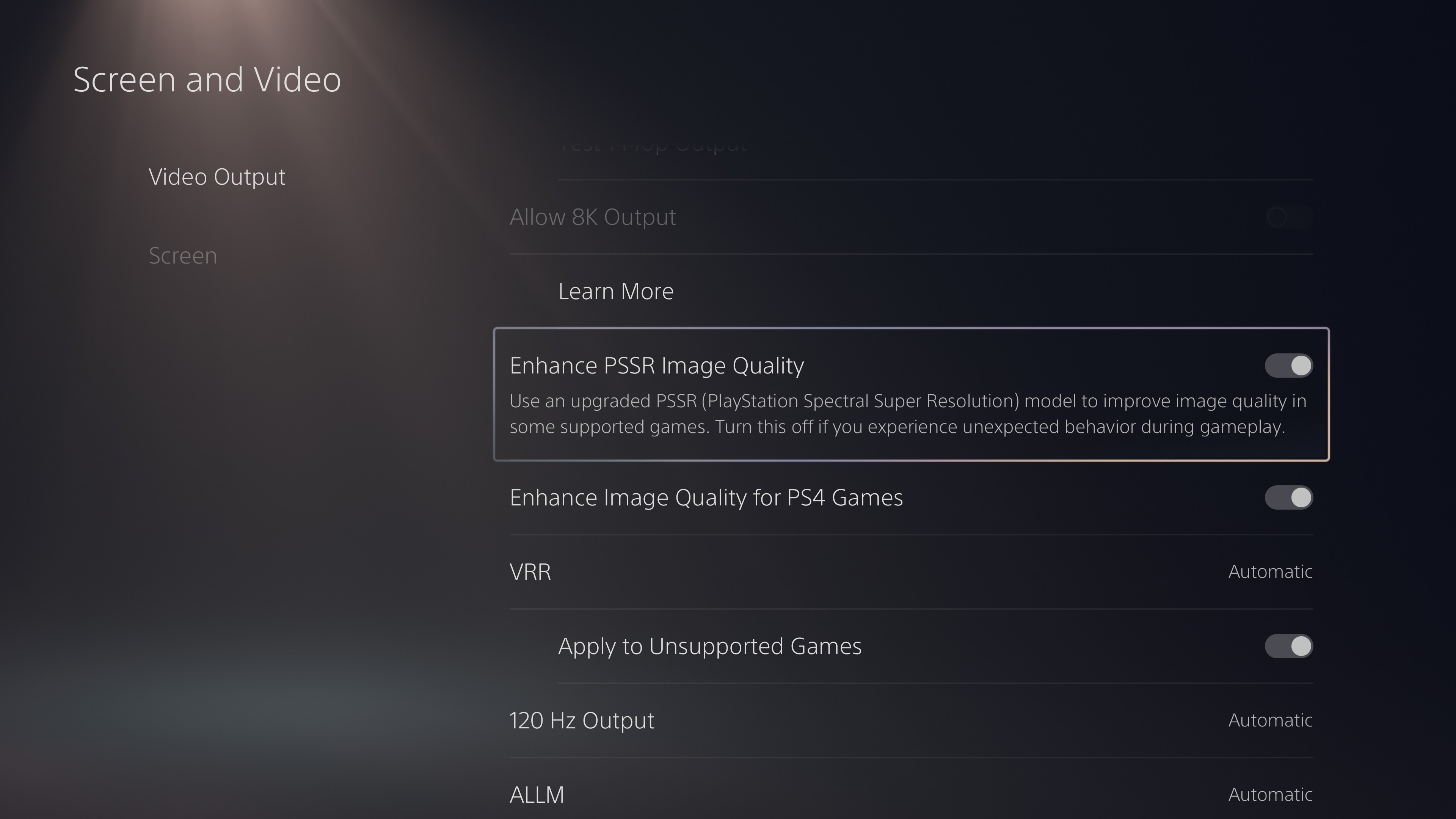
The new toggle for the upgraded version of PSSR that's coming to PS5 Pro consoles.
Sony Interactive Entertainment

The upgraded PSSR will roll out to PS5 Pro owners as part of a software update in March, and will be able to be toggled on and off in the console's settings, according to Cerny. Around the same time, multiple PS5 games are also supposed to be updated to support the upscaling tech. While the graphical improvements are still incremental over a normal PS5, the fact that Sony's still squeezing more performance out of its console should at least be reassuring to anyone who spent $700 (or now $750) on a PS5 Pro.

This article originally appeared on Engadget at https://www.engadget.com/gaming/playstation/the-ps5-pro-is-getting-upgraded-upscaling-tech-in-march-200105816.html?src=rss

©

  •  

iFi's new GO Link 2 DAC is a cheap way to reap the lossless benefits of your Spotify plan

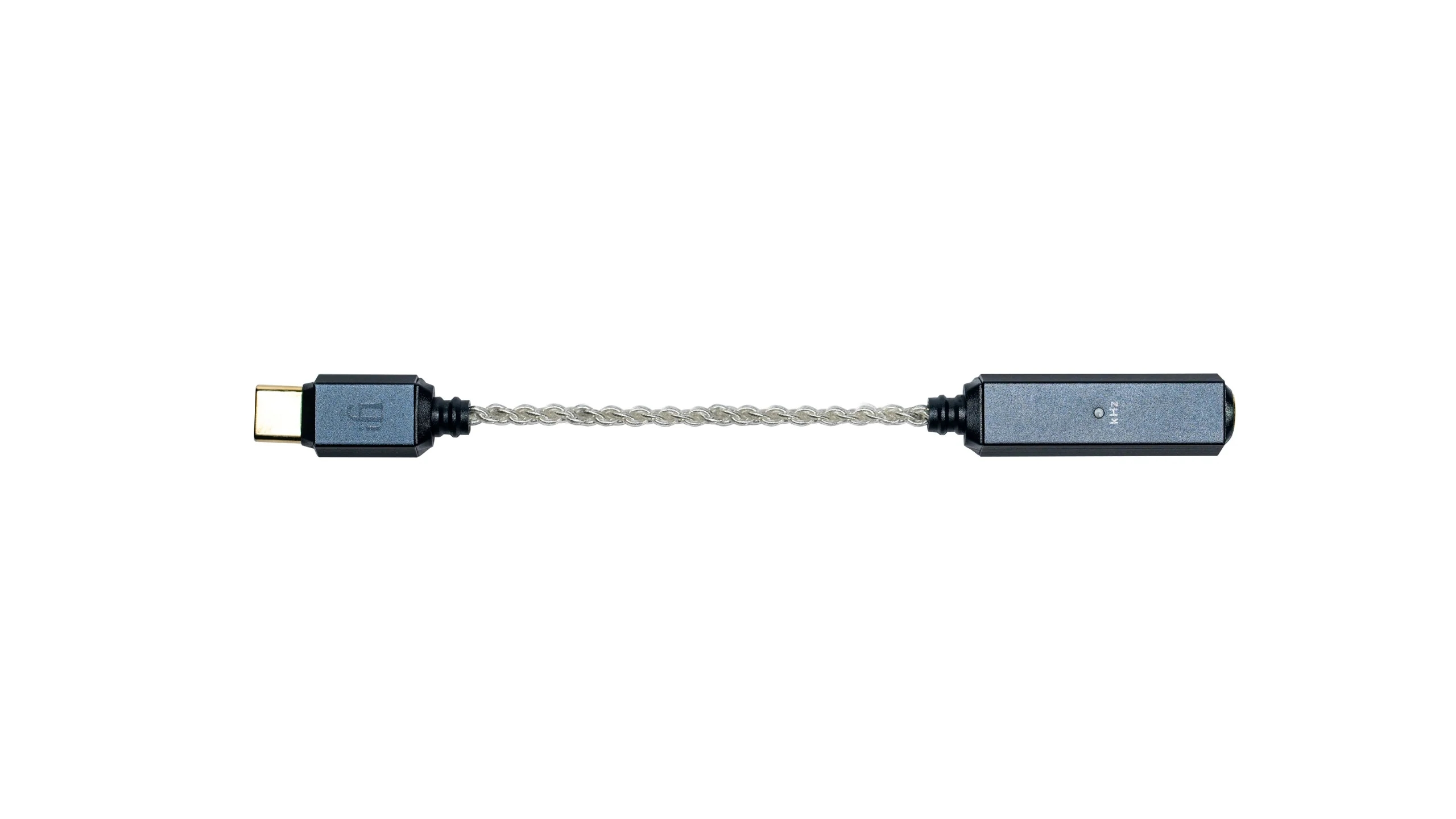
Audio company iFi just introduced a new DAC (digital-to-analogue converter) that's both smaller and lighter than its previous model, and only costs $59. The iFi GO Link 2 connects to a smartphone or other audio-playing device over USB-C and can instantly improve the listening experience on wired headphones.

Wireless earbuds and music streaming services have normalized listening to your favorite songs at a lower quality. For anyone who doesn't consider themselves an audiophile, that might not matter, but now that several streaming services offer higher sample rates and lossless audio, you might consider other ways of listening. In order to experience all the benefits of high-res or lossless audio, you need wired headphones, something that's increasingly difficult when most smartphones only have a USB-C port. That's where the iFi GO Link 2 comes in. The dongle plugs into a USB-C port and lets you connect a pair of wired earbuds while preserving your high quality audio at the same time.

An iFi GO Link 2 DAC laid flat on a white background.
iFi

iFi's new DAC is eight percent smaller than the previous GO Link and 29 percent lighter, approaching the size of Apple's USB-C to 3.5mm Headphone Jack dongle. The GO Link 2's built-in ESS Sabre DAC chipset is supposed to add "6dB of dynamic range between the loudest and quietest moments" and reduce distortion for clearer sound by up to 62 percent when compared to the original GO Link.

Via iFi's companion Nexis app on Android, the GO Link 2 can also be updated on the go and further customized with digital filters. The GO Link 2 supports two digital filters — one hybrid and one linear — so that you can adjust things to your preferred sound profile. You can also use the Nexis app to set volume limits when you're listening with the DAC attached.

The previous GO Link made it on Engadget's list of the best DACs for Apple Music Lossless, and at the same price, the GO Link 2 seems like it could, too. The iFi GO Link 2 is available to purchase now for $59.

This article originally appeared on Engadget at https://www.engadget.com/audio/ifis-new-go-link-2-dac-is-a-cheap-way-to-reap-the-lossless-benefits-of-your-spotify-plan-231535369.html?src=rss

©

  •  

Guitar Hero vets RedOctane reveal their new music game

RedOctane Games, a relaunched version of one of the studios behind the very first Guitar Hero, has shared a first trailer for its new music game, Stage Tour. The original RedOctane was shut down by Activision in 2010, and only recently reformed under Embracer Freemode to create a new music game franchise in August 2025.

Stage Tour is playable solo or with other players in a band, according to RedOctane, and supports inputs from a keyboard and mouse on top of the expected guitar, drums and microphone accessories. The studio plans to primarily offer the game digitally, but hopes to also sell a bundle with a guitar controller and a download code because "that just feels right." As far as ongoing support goes, whereas games like Guitar Hero or Rock Band included a set tracklist and support for song DLC, it sounds like RedOctane could be taking an approach more inspired by Epic's regular updates to Fortnite. "The plan is regular special events that are more than just music drops," RedOctane writes. "Real moments. Real themes. Real updates. We want to evolve the game alongside the fans who support it. Improve it. Expand it. Keep it alive." 

RedOctane and Harmonix created the first Guitar Hero in 2006, before RedOctane was acquired by Activision to continue the franchise in 2006, and Harmonix went on to start the Rock Band series. Development of Stage Tour is currently being led by RedOctane, with Eidos Montréal helping with motion capture and QA, and Third Kind Games providing additional development support. Conveniently, RedOctane’s owner Embracer Freemode also already owns CRKD, a video game accessory maker that has experience building controllers for rhythm games.

Sign-ups to play an alpha of Stage Tour will open soon, and RedOctane plans to "kick off closed alpha testing late spring/early summer." We're long past the peak popularity of games like Guitar Hero, but rhythm and music games never went away. Players have had Clone Hero and more official experiences like Fortnite Festival to get their Guitar Hero or Rock Band fix, but Stage Tour could be a more than welcome third option when it launches later this year.

This article originally appeared on Engadget at https://www.engadget.com/gaming/guitar-hero-vets-redoctane-reveal-their-new-music-game-220809719.html?src=rss

©

  •  

An AI-generated Resident Evil Requiem review briefly made it on Metacritic

Review aggregator Metacritic has removed a review of Resident Evil Requiem because it was AI-generated, Kotaku reports. The review was published by UK gaming site VideoGamer, but appears to be "written" by a fake AI journalist rather than a real person.

While it's unfortunately difficult to confirm with 100 percent accuracy whether a piece of text is AI-generated, you don't have to read VideoGamer's review for long to notice all the ways it feels off. The biggest giveaway, beyond heavy use of contrived metaphors, is a striking lack of detail beyond what you could glean from a trailer for the game. Embargoes covering what parts of a video game can come up in a pre-release review can be strict, but a good critic usually finds a way to describe their experience without being vague. VideoGamer's review, written by one "Brian Merrygold," really doesn't.

It's bleak. I was reading some RE Requiem reviews and found this thing published by videogamer. Can't find anything about the writer, everything about it reeks AI (dead giveaway being the image). Low effort, gargabe.

Mind you, this review made its way to Metacritic. https://t.co/4STN8DjAwe pic.twitter.com/awk26P9wSA

— Andrés (@Andrew_east) February 26, 2026

As at least one user on X has pointed out, it’s worth` being suspicious of Merrygold, too. The author's profile on VideoGamer is just as awkwardly written as the review, and the profile picture of the account appears to be AI-generated. When you try to save the image locally, its file name, "ChatGPT-Image-Oct-20-2025-11_57_34-AM-300x300," also seems like a dead giveaway. Kotaku looked at the X accounts of several other recent bylines at VideoGamer and found similar results. All their profile pictures appear to be AI-generated, and all the accounts were created around the same time in October 2025.

Metacritic relies on reviews written by real publications to create a score representing the overall critical sentiment towards a game or movie, not unlike Rotten Tomatoes. While there's disagreement whether it's a good thing that a popular site strips out the nuance of written reviews to make a number people can argue over, everyone can probably agree that Metacritic incorporating fake, AI-generated reviews is a bad idea.

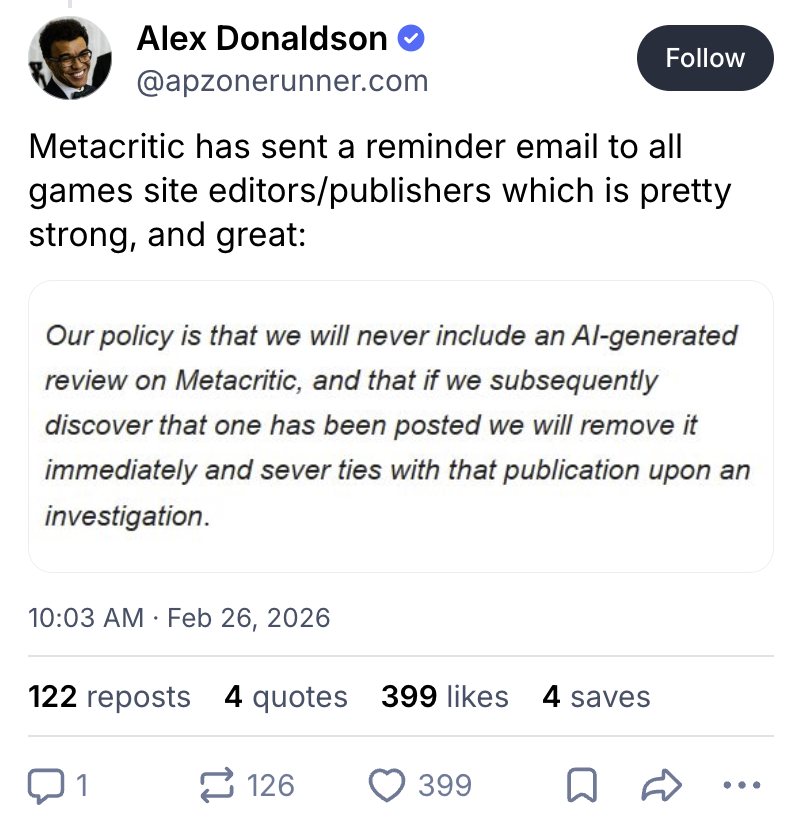
In response to the discovery that VideoGamer's review is likely AI-generated, Metacritic has removed it from its Resident Evil Requiem page. "The RE Requiem review and a handful of other VideoGamer reviews from 2026 have been removed from Metacritic,” Marc Doyle, Metacritic's co-founder, told Kotaku. Metacritic has also emailed all games sites and publishers that it aggregates with information on its policy towards AI-generated reviews, according to Alex Donaldson, founder and publisher of RPG Site.

A Bluesky post from Alex Donaldson sharing Metacritic's email to publishers on how it will handle AI-generated reviews.
Alex Donaldson

“Our policy is that we will never include an AI-generated review on Metacritic,” the aggregator says, “and that if we subsequently discover that one has been posted we will remove it immediately and sever ties with that publication upon an investigation.”

A news site publishing an AI-written review is just as dire as Metacritic aggregating it, and that appears to be what VideoGamer is doing. ClickOut Media, the company that owns VideoGamer and a collection of other publications, reportedly laid off the staff of its gaming sites earlier this month to pivot to AI-generated content. Sifting through AI slop, whether on social media or Pinterest, is increasingly necessary online. Now apparently Metacritic is another place where readers should have their guard up.

Update, February 26, 2:58PM ET: Added information about Metacritic’s email to publishers on its policy for AI-generated reviews.

This article originally appeared on Engadget at https://www.engadget.com/ai/an-ai-generated-resident-evil-requiem-review-briefly-made-it-on-metacritic-194414929.html?src=rss

©

  •  

Skate's developer is laying off staff before the game leaves early access

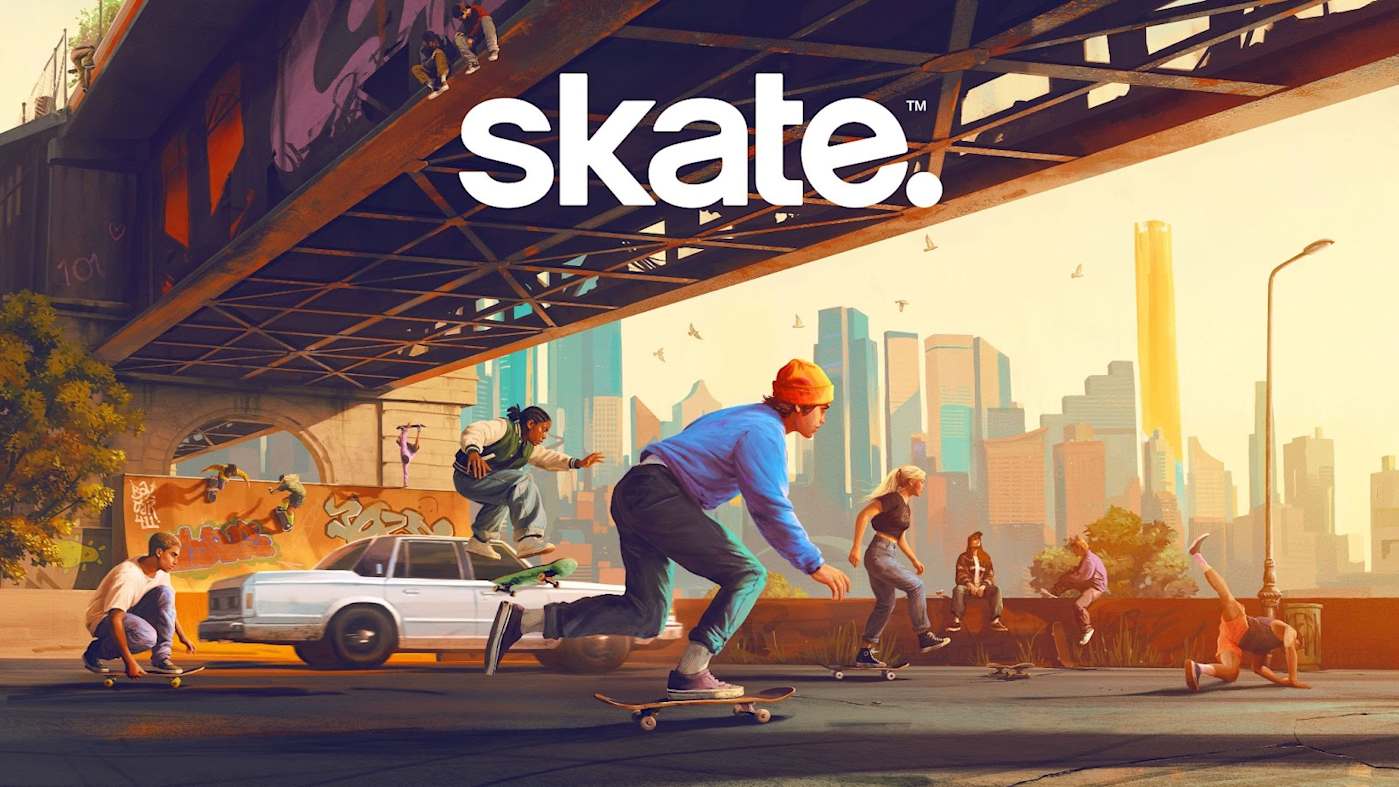
Full Circle, the developer behind the new Skate game, has announced that it is restructuring and laying off staff. It's not yet clear how many roles will be impacted by the changes, but the restructuring is happening less than six months after skate. launched in early access on September 15, 2025.

"We’re reshaping Full Circle to better support skate.’s long-term future," Full Circle says. "These shifts mean making changes to our team structure, and some roles will be impacted. The teammates affected are talented colleagues and friends who helped build the foundation of skate. Their creativity and dedication are deeply ingrained in what players experience today. This decision is not a reflection of their impact and we’re committed to supporting them through this transition."

Engadget has contacted Full Circle's owner EA for more information about the layoffs. We'll update this article if we hear back.

EA originally formed Full Circle in 2021 with a staff of development talent from the original Skate team. Skate was often positioned as a more realistic competitor to the Tony Hawk's Pro Skater series, but the new studio has ultimately taken the franchise in a slightly different direction than fans may have expected. Previous Skate games were paid experiences with single-player and multiplayer modes, while skate. is a free-to-play live-service game supported with microtransactions.

Recent history, both the failure of Concord and the ongoing struggles of Highguard, serves as a testament to how hard it is to launch a live service game in the 2020s. Full Circle's announcement notes the "tens of millions" of players that have tried the new game, but it's possible a struggle to keep players interested and spending on microtransactions could be why it's restructuring.

This article originally appeared on Engadget at https://www.engadget.com/gaming/skates-developer-is-laying-off-staff-before-the-game-leaves-early-access-220916797.html?src=rss

©

  •  

Xbox consoles now support 1440p streaming

Microsoft has announced that its rolling out support for streaming games at 1440p on Xbox consoles. Game streaming is a key benefit of paying for a Game Pass subscription, and as of 2025, now also includes games players own that aren't part of the larger Game Pass library.

The higher bitrate streaming option will let subscribers with an Xbox Series X or S, Xbox One X or Xbox One play their games at a higher resolution, provided the game and their display supports it. Microsoft previously only offered 1440p streams on select Fire TVs, LG TVs, Samsung TVs, web browsers and the Xbox PC app. At least for now, 1440p is only available to Game Pass Ultimate subscribers.

Beyond the new streaming option, Microsoft is also making improvements to the Xbox PC app and the Xbox experience on ROG Xbox Ally handhelds. On PC, the Xbox PC app now includes "navigation sounds" that play when you use the app's interface with a controller. These new sounds are supposed to make controller input feel more responsive and intuitive. On the ASUS ROG Xbox Ally and Xbox Ally X, meanwhile, Microsoft is making it even easier to format removable storage like microSD cards, and updating drivers to improve compatibility on select games.

The last week has been particularly tumultuous for Microsoft's gaming division. Former Microsoft Gaming CEO Phil Spencer announced his retirement on Friday, alongside the appointment of Asha Sharma, the President of Microsoft's CoreAI division, as his replacement. Opinions differ as to whether Sharma's new position will be good or bad for Xbox, but more changes are likely on the way.

This article originally appeared on Engadget at https://www.engadget.com/gaming/xbox/xbox-consoles-now-support-1440p-streaming-204115304.html?src=rss

©

  •  

Kalshi fined a MrBeast editor for insider trading

Kalshi, one of several online prediction markets that have exploded in popularity in the last few years, has suspended one of YouTube MrBeast's video editors for insider trading, NPR reports. Besides being suspended from the platform for two years, Kalshi says the editor will also be required to pay a financial penalty that's five times his initial trade size.

The editor, Artem Kaptur, traded in markets related to YouTube and specifically, MrBeast. Kalshi says his transactions were initially flagged because of his "near-perfect trading success on markets with low odds, which were statistically anomalous." Because trades are public on Kalshi, multiple users also flagged the trades as suspicious. Kalshi learned Kaptur was an employee of MrBeast during its investigation and determined he "likely had access to material non-public information connected to his trading." Perhaps unsurprisingly, trading with insider information violates Kalshi's rules.

Kalshi says that it reported the insider trading to the Commodity Futures Trading Commission (CFTC) and plans to donate the over $20,000 Kaptur has been fined to "a non-profit that provides consumer education on derivatives markets." In a statement provided to NPR, Beast Industries, MrBeast's production company, said it has a zero-tolerance policy for insider trading. "We have a longstanding policy in place against employees using proprietary company information in order to safeguard the highest standards and ethics throughout our organization," Beast Industries said. 

Separately, Kalshi has also suspended and fined a politician who was running to be Governor of California. "In May, our Surveillance Department saw an online video by a candidate for Governor of California that appeared to show him trading on his own candidacy," Kalshi says. "We immediately froze his account and opened an investigation. The candidate was initially cooperative and acknowledged that this violated the exchange rules. As a candidate in a race, you can (and probably should) follow and use Kalshi’s market forecast, but you should not trade on it."

Like other prediction markets, Kalshi lets users make trades based on a variety of different subjects and events. For example, you could participate in a market focused on the results of a basketball game, or something more unusual, like who'll win the current season of Survivor. Despite resembling gambling, online predictive markets aren't currently regulated by state gambling laws, and instead classify bets as a type of futures contract, placing them under the purview of the CFTC. That hasn't stopped states from trying to regulate prediction markets anyway. For example, Nevada sued Kalshi for operating a sports gambling market without a permit earlier in February.

This article originally appeared on Engadget at https://www.engadget.com/big-tech/kalshi-fined-a-mrbeast-editor-for-insider-trading-191027814.html?src=rss

©

  •  

Samsung's Galaxy S26 Ultra offers a subtle set of hardware improvements

Samsung has announced the latest version of its flagship smartphone, the Samsung Galaxy S26 Ultra, and just like last year, the high-end phone is where the company is making some of its biggest changes. The S26 Ultra includes a new processor, a new privacy-focused display technology, an improved camera system and like Samsung's other phones, a crop of new AI-powered software features.

On first blush, the Galaxy S26 Ultra isn't all that different from the Galaxy S25 Ultra. Samsung is still using a 6.9-inch QHD+ AMOLED screen, with an 120Hz refresh rate and support for an S Pen stylus. The S26 Ultra also features the same flat sides, utter lack of Qi2-compatible magnets and pronounced camera bump. Despite those similarities, the new flagship does have some differences: for one, it's ever so slightly thinner at  0.31-inches than the S25 Ultra was at 0.32-inches. It also comes with an aluminum frame rather than the titanium frame of the previous generation. For stylus fans, the new S Pen has a curved top that lets it better match the curves of the S26 Ultra. Biggest of all, Samsung's new phone includes "Privacy Display," a new technology that lets the phone limit how much of its screen is visible when you're not looking directly at it.

The bottom ports and stylus slot on a Galaxy S26 Ultra.
Sam Rutherford for Engadget

Inside, the Galaxy S26 Ultra uses Qualcomm's new Snapdragon 8 Elite Gen 5 for Galaxy chip, a modified version of the flagship mobile chip it debuted last year, and either 12 or 16GB of RAM. In terms of storage, the Galaxy S26 Ultra can come with either 256GB, 512GB or 1TB of memory. Regardless of which version you pick, you'll get a 5,000mAh battery with support for Samsung's wired and wireless fast charging, and Wireless PowerShare for topping up accessories like wireless earbuds.

The Galaxy S26 Ultra, just like the S25 Ultra before it, includes an array of four cameras on the back and one selfie camera on the front. The phone features a 200MP f/1.4 wide, 50MP f/1.9 ultra-wide, 10MP f/2.4 3x telephoto, 50MP f/2.9 periscope telephoto and 12MP f/2.2 selfie camera. If you were to just look at just the megapixel counts of the phone, they're identical to last year's model. Samsung's major tweaks are to the aperture of both the wide and periscope cameras, which should let them capture more light.

The four main colors of the Galaxy S26 Ultra: Sky Blue, Black, Cobalt Violet and White.
Sam Rutherford for Engadget

Of course, plenty of the flashiest parts of Samsung's new smartphone are software features. The improved photo and video performances of the Galaxy S26 Ultra's cameras is partially driven by software tweaks. Samsung is also adopting Perplexity as a second, system-level AI assistant. The AI can be called with a button press or "Hey Plex," powers improvements to Bixby and can act inside Samsung apps. That doesn't mean Gemini isn't still available, though. Google's AI will gain the ability to handle things like booking a rideshare or filling an online grocery cart in the background on the Galaxy S26 Ultra.

The Galaxy S26 Ultra starts at $1,300 and is available to pre-order today in a purple-ish "Cobalt Violet," light blue "Sky Blue," black, white and exclusively through Samsung's online store, "Silver Shadow" and "Pink Gold." The phone will become generally available on March 11.

This article originally appeared on Engadget at https://www.engadget.com/mobile/smartphones/samsungs-galaxy-s26-ultra-offers-a-subtle-set-of-hardware-improvements-180000725.html?src=rss

©

  •  

Apple's touchscreen MacBook will reportedly have a dynamic interface

Apple's plan to add touchscreens to its premium MacBook Pros is coming into focus. Bloomberg reports that when the new laptops launch this fall, they'll feature a Dynamic Island, not unlike Apple's iPhones, and an interface that changes depending on where you touch your Macbook's screen.

This "dynamic interface" is reportedly designed to make the transition between mouse input and touch input smoother on Apple's new laptops. Bloomberg says that if users touch an onscreen button, the version of macOS running on these new MacBook Pros will be able to pull up a contextual menu "that provides more relevant options for touch commands." Parts of the interface, like macOS' menu bar, will also be able to enlarge to make menu items easier to select with a finger. Those tweaks are on top of the expected features from touchscreen Apple products, like smooth scrolling and the ability to pinch and zoom into and out of images, files and web pages. The only thing missing from these increasingly iPad-like laptops, per Bloomberg, will be a touchscreen keyboard, because they'll already have a more comfortable physical keyboard attached.

To make these new laptops extra enticing, both the 14-inch and 16-inch touchscreen MacBook Pros will feature OLED screens for the first time, likely the reason Apple will be able to include a Dynamic Island-style webcam in the first place. Up until now, the company has offered OLED screens on its iPhones, Apple Watches and more recently the iPad Pro, but it hasn't brought the display technology to laptops. That could reportedly change with these new MacBook Pros.

Plenty of Windows laptops include touchscreens, and Microsoft and its partners have incorporated dynamic interface elements in the past to make these touchscreens more natural to use with Windows. Apple is late to the party in this respect, but it's also potentially set up to succeed. Much of modern macOS already looks touch-friendly, and Apple's has expended significant effort making it possible to port touch-based iPad apps to macOS and develop applications across platforms. That, paired with the right interface, could make the experience of using a touchscreen MacBook nicer out of the box, even if it doesn't get rid of the awkwardness of reaching over your keyboard to touch a screen.

This article originally appeared on Engadget at https://www.engadget.com/computing/laptops/apples-touchscreen-macbook-will-reportedly-have-a-dynamic-interface-231929456.html?src=rss

©

  •  

Here's the first teaser for A24's adaptation of The Backrooms

Three years after announcing plans to produce a film based on the viral YouTube short, The Backrooms (Found Footage) in 2023, A24 has released the first teaser for its adaptation. Backrooms, as the film is now called, is directed by the short's original creator, Kane Parsons, and will be released on May 29, 2026.

The teaser offers little to go on for anyone who hasn't watched the original short or the series of videos Parsons made after it, but it is replete with The Backrooms' hallmark: ominous liminal spaces. Layered over footage of stranger and stranger rooms (or perhaps one room becoming the platonic empty retail spaces popularized by short), the voice of Chiwetel Ejiofor tells the film's other star, Renate Reinsve, about a "place" he discovered that's full of rooms.

Parsons' original video is inspired by a creepypasta called "The Backrooms" that originated on the forum 4chan in 2019. The YouTube series expanded on the basic concept of a liminal space that exists outside reality with monsters and a mysterious company researching The Backrooms. It's unclear how much of that larger lore will be incorporated into the feature film adaptation, but since the teaser is missing the digital video filter that gave the YouTube short its distinct look, it seems possible Parsons could be going for something a bit different. Well that, and the fact the film stars two Oscar-nominated actors.

This article originally appeared on Engadget at https://www.engadget.com/entertainment/tv-movies/heres-the-first-teaser-for-a24s-adaptation-of-the-backrooms-194300513.html?src=rss

©

  •  

Meta's metaverse is going mobile-first

Meta is formally sectioning off Horizon Worlds, the closest thing it has to a metaverse, from its Quest VR platform, according to a new blog post from Samantha Ryan, Meta's VP of Content, Reality Labs. While the decision runs counter to Meta's original plan to own an immersive virtual world that could serve as the future home for all online interaction, it fits with the recent cuts it made to its costly Reality Labs division, and Mark Zuckerberg's public commitment to focus the company on AI hardware like smart glasses going forward. 

"We’re explicitly separating our Quest VR platform from our Worlds platform in order to create more space for both products to grow," Ryan writes in the blog post. "We’re doubling down on the VR developer ecosystem while shifting the focus of Worlds to be almost exclusively mobile. By breaking things down into two distinct platforms, we’ll be better able to clearly focus on each."

Meta has been developing mobile and web versions of Horizon Worlds in parallel with its VR app since at least 2023. Switching Worlds to being a mobile-first software platform isn't good for VR diehards, but it does make it a more natural competitor to something like Roblox or Fortnite, which also offer user-created and monetizable worlds and games. It's also a business Meta believes it can more easily scale because of its ability to connect games to "billions of people on the world’s biggest social networks."

While Meta shuttered several of its own VR game studios earlier this year, it still wants to support third-party developers publishing games on its platform. The company says new monetization tools, better discoverability, a "Deals" tab and more ways for developers to talk to their customers should help make a difference. Maintaining the Quest's library of games could also be critical going forward. Business Insider reported in December 2025 that Meta was working on a gaming-focused Quest headset, and Meta CTO Andrew Bosworth confirmed earlier this February that the company still had multiple Quest devices on its roadmap.

This article originally appeared on Engadget at https://www.engadget.com/ar-vr/metas-metaverse-is-going-mobile-first-233030532.html?src=rss

©

  •  

Sony is shutting down the studio behind the Demon's Souls remake

Sony is closing Bluepoint Games, the studio behind the Shadow of the Colossus and Demon's Souls remakes, Bloomberg reports. Bluepoint's last major project was God of War: Ragnarok from 2022, which it co-developed with Sony Santa Monica. 

According to Bloomberg, Sony decided to shut down the studio following "a recent business review." Around 70 employees will lose their jobs as part of the studio closure, which will officially happen in March. "Bluepoint Games is an incredibly talented team and their technical expertise has delivered exceptional experiences for the PlayStation community," Sony said in a statement to Bloomberg. "We thank them for their passion, creativity and craftmanship."

Following their work on Ragnarok, Bluepoint was reportedly tasked with developing a live-service game set in the God of War universe. That title was cancelled in 2025, alongside another game from Bend Studio. In the context of Sony's other live-service failures, the decision wasn't surprising. Sony shut down the servers for multiplayer shooter Concord just two weeks after its release. Not long after, it also closed Firewalk Studios, the developer behind the game.

Bluepoint Games was originally acquired by Sony in 2021, when it seemed like the studio's expertise in remaking and remastering classic PlayStation games could be a major asset going forward. Why that changed isn't entirely clear, but Sony's mismanagement of its pivot into and out of publishing premium online multiplayer games may have played a role. Some of Sony's studios are still experimenting with live-service mechanics. Guerilla Games recently announced an online co-op game set in its Horizon universe. Destiny 2 developer Bungie is also releasing its extraction shooter Marathon in March.

This article originally appeared on Engadget at https://www.engadget.com/gaming/playstation/sony-is-shutting-down-the-studio-behind-the-demons-souls-remake-195234213.html?src=rss

©

  •  

Gemini can now generate a 30-second approximation of what real music sounds like

Google has announced that using its newly incorporated Lyria 3 model, Gemini users will be able to generate 30-second music tracks based on a prompt, or remix an existing track to their liking. The new model builds on Gemini's pre-existing ability to generate text, images and video, and will also be available in YouTube's "Dream Track" feature, where it can be used to generate detailed backing tracks for Shorts.

Like some other music generation tools, prompting Gemini doesn't require a lot of detail to produce serviceable results. Google's example prompt is "a comical R&B slow jam about a sock finding their match," but after playing with Lyria 3, you can definitely get more granular about individual elements of a track — changing the tempo or the style of drumming, for example — if you want to. Outside of text, Gemini can also generate music based on a photo or video, and tracks can be paired with album art created by Google's Nano Banana image model.

Google says that Lyria 3 improves on its previous audio generation models in its ability to create more "realistic and musically complex" tracks, give prompters more control over individual components of a song and automatically generate lyrics. Gemini's outputs are limited to 30-second clips for now, but given how Google's promotional video shows off the feature, it's not hard to imagine those clips getting longer or the model getting incorporated into other apps, like Google Messages.

Like Gemini's other AI-generated outputs, songs made with Lyria 3 are also watermarked with Google's SynthID, so a Gemini clip can't as easily be passed off as a human one. Google started rolling out its SynthID Detector for identifying AI-generated content at Google I/O 2025. The sample tracks Google included alongside its announcement are convincing, but you might not need the company's tool to notice their machine-made qualities. The instrumental parts of Gemini’s clips often sound great, but the composition of the lyrics Lyria 3 produces sounds alternately corny and strange.

If you're curious to try Lyria 3 for yourself, Google says you can prompt tracks in Gemini starting today, provided you're 18 years or older and speak English, Spanish, German, French, Hindi, Japanese, Korean or Portuguese.

This article originally appeared on Engadget at https://www.engadget.com/ai/gemini-can-now-generate-a-30-second-approximation-of-what-real-music-sounds-like-204445903.html?src=rss

©

  •  

Texas AG sues TP-Link over purported connection to China

Texas is suing Wi-Fi router maker TP-Link for deceptively marketing the security of its products and allowing Chinese hacking groups to access Americans' devices, Attorney General Ken Paxton has announced. Paxton originally started looking into TP-Link in October 2025. Texas Governor Greg Abbott later prohibited state employees from using TP-Link products in January of this year.

TP-Link is no longer owned by a Chinese company and its products are assembled in Vietnam, but Paxton's lawsuit claims that because the company's "ownership and supply-chain are tied to China" it's subject to the country's data laws, which require companies to comply with requests from Chinese intelligence agencies. The lawsuit also says that firmware vulnerabilities in TP-Link's hardware have already "exposed millions of consumers to severe cybersecurity risks."

TP-Link provided the following statement to Engadget in response to the lawsuit:

The claims made by the Texas Attorney General’s office are without merit and will be proven false. TP-Link Systems Inc. is an independent American company. Neither the Chinese government nor the CCP exercises any form of ownership or control over TP-Link, its products, or its user data. TP-Link’s founder and CEO, Jeffrey Chao, resides in Irvine, CA, and is not and never has been a member of the CCP. To ensure the highest level of security, our core operations and infrastructure are located entirely within the United States, and all U.S. users' networking data is stored securely on Amazon Web Services servers. We will continue to vigorously defend our reputation as a trusted provider of secure connectivity for American families.

TP-Link was reportedly being investigated at the federal level in 2024 after its devices were connected to the massive "Salt Typhoon" hack that accessed data from multiple US telecom companies. Despite all signs pointing to the federal government getting ready to ban TP-Link in 2025, Reuters reports that the Trump administration paused plans to ban the company’s routers in early February, ahead of a meeting between President Donald Trump and President Xi Jinping.

Update, February 17, 3:38PM ET: Added statement from TP-Link.

This article originally appeared on Engadget at https://www.engadget.com/cybersecurity/texas-ag-sues-tp-link-over-purported-connection-to-china-193802258.html?src=rss

©

  •  

Silent Hill: Townfall takes the series' trademark fog to an eerie coastal community

Coming off the success of Slient Hill f, which moved the series’ psychological horror to the Japanese countryside, Konami, Annapurna Interactive and developer Screen Burn Interactive have chosen a foggy island as the setting for Silent Hill: Townfall.

The first gameplay trailer for Townfall, introduced during Sony’s latest State of Play, follows Simon Ordell, a man who keeps mysteriously waking up in the water off the coast of the empty island town of St. Amelia. In the trailer, Simon hides from monsters, peers at a portable television, swings a fire axe, and deals with the psychological turmoil typical of a Silent Hill protagonist, all in first person, one of the unique twists of this new game.

Silent Hill: Townfall was originally announced alongside Silent Hill f and the remake of Silent Hill 2 in 2022. The game is developed by Screen Burn Interactive (formerly known as No Code), the creators of Observation and Stories Untold. Konami will share more details about Townfall’s gameplay and story in an upcoming Silent Hill Transmission presentation later today.

Silent Hill: Townfall is coming to PlayStation 5 in 2026.

This article originally appeared on Engadget at https://www.engadget.com/gaming/playstation/silent-hill-townfall-takes-the-series-trademark-fog-to-an-eerie-coastal-community-233324897.html?src=rss

©

  •  

Kena: Scars of Kosmora is coming out later this year

When it launched in 2021, Kena: Bridge of Spirits was an early example of the graphical power of the PS5 thanks to its Pixar-adjacent animation and over-the-top effects. Based on a surprise trailer at Sony's latest State of Play, it seems like its sequel, Kena: Scars of Kosmora, could up the ante when it launches later this year.

Scars of Kosmora follows spirit guide Kena to a mysterious island called Kosmora, where a powerful spirit breaks her staff and forces her to embrace a new style of spirit guiding (and presumably a collection of new game mechanics). Like the first game, Scars of Kosmora looks to be filled with lush visuals and cute Spirit Companions, but also a surprising amount of boss battles. Developer Ember Lab's new trailer heavily emphasizes the game's updated combat, which seems like it'll play a big role in the sequel.

According to a post on the PlayStation Blog, it sounds like manipulating the elements will also be a major focus. "We’ve added new elemental gameplay to bring strategy and depth when facing the threats of Kosmora," developer Ember Lab says. "These new combat skills, elemental infusions and use of your Spirit Companions will be key to overcoming challenging encounters and epic boss fights."

Kena: Scars of Kosmora is coming to PlayStation 5 and PC in 2026.

This article originally appeared on Engadget at https://www.engadget.com/gaming/playstation/kena-scars-of-kosmora-is-coming-out-later-this-year-224006963.html?src=rss

©

  •  

EU reportedly opens another probe into Google's ads pricing

The European Commission has opened a new probe into Google, this time focused on the company's massive online advertising business, Bloomberg reports. European Union regulators have already fined Google billions for violating the Digital Markets Act, and being found guilty of anticompetitive behavior in online advertising could add to that total.

While the Commission has yet to announce a formal investigation, Bloomberg writes that it has started contacting Google's customers and competitors for information about its dominance across multiple online advertising markets. Regulators are particularly concerned that Google could be "artificially increasing the clearing price" of ad auctions "to the detriment of advertisers." If the company is found to be violating the EU's competition rules, Google could be fined 10 percent of its global annual sales.

Google's approach to advertising to minors was reportedly already under investigation by the EU as of December 2024, and besides fines, regulators have ordered the company to open up Android to competing AI assistants and share search data with rivals. In the US, there's also precedent for finding Google's approach to online advertising anticompetitive.

A US federal judge found that Google is a monopolist in online advertising in April 2025, the conclusion of a legal battle that started with a Department of Justice lawsuit accusing the company of dominating the ad market and using its control to charge more and keep a larger portion of ad sales. The DOJ ultimately wants Google to sell its ad tech business, but a final decision hasn't been reached as to how the company's anticompetitive behavior should be remedied.

This article originally appeared on Engadget at https://www.engadget.com/big-tech/eu-reportedly-opens-another-probe-into-googles-ads-pricing-194435095.html?src=rss

©

  •  
❌