The UK government has backtracked on a plan to require all workers to have a digital ID following a backlash. It will no longer be mandatory to register with the digital ID program to prove one has the right to work in the country, as the BBC reports.
The government announced the now-scrapped digital ID requirement in September. "You will not be able to work in the United Kingdom if you do not have digital ID," Prime Minister Sir Keir Starmer said at the time. "It's as simple as that."
The government still plans to fully transition to digital right-to-work checks by 2029, using the likes of biometric passports, as it seeks to do away with paper-based systems. Those are "open to fraud and abuse," a government spokesperson said.
Officials have still not explained exactly how the digital ID program will work. The government originally framed digital IDs as a way to make it easier to identify immigrants who are working in the country without having the legal right to do so. It is now said to be focusing more on pressing home the message that digital IDs will help people access public services.
A service called One Login will be part of the digital ID system — this currently can be used for things like applying for a veteran card and canceling a lost passport. More than 12 million people have signed up so far. Another service called Wallet will let people store their digital ID on their phone. This would contain their name, date of birth, nationality, residence status and a photo.
Almost 3 million people signed an official parliamentary petition to protest the introduction of digital IDs. "We think this would be a step towards mass surveillance and digital control, and that no one should be forced to register with a state-controlled ID system," the petition states. "We oppose the creation of any national ID system."
This article originally appeared on Engadget at https://www.engadget.com/cybersecurity/uk-scraps-digital-id-requirement-for-workers-105740207.html?src=rss
The Senate has passed the Disrupt Explicit Forged Images and Non-Consensual Edits (DEFIANCE ) Act with unanimous consent, according to the bill’s co-sponsor Senator Dick Durbin (D-IL). The bill lets the subjects of nonconsensual, sexually explicit deepfakes take civil action against the people who create and host them.
Deepfakes are a known issue online, but without the proper protections, easy access to AI-powered image and video generation tools has made it possible for anyone to create compromising content using another person's likeness. This has become a particular problem on X, where the integration of Grok, the AI assistant created by X's parent company xAI, makes it possible for anyone to turn the content of another person's post into an image-generating prompt. Over the last month, that's allowed users to create sexually explicit images of children, just by replying to a post with @grok and a request.
In response, Ofcom, the UK's media regulator, has already opened an investigation into X for potentially violating the Online Safety Act. The chatbot has also been outright blocked in Malaysia and Indonesia. The DEFIANCE Act won't prevent Grok or other AI tools from generating nonconsensual deepfakes, but it would make creating or hosting that content potentially very expensive for anyone on the receiving end of a lawsuit.
The Senate passed an earlier version of the DEFIANCE Act in 2024, but it stalled in the House. Given the urgency of Grok's deepfake problem, the hope is this new version of the bill won't see the same resistance. Congress passed an earlier piece of deepfake regulation last year, the Take It Down Act, with bipartisan support. That bill was focused on the companies who host nonconsensual, sexually explicit content, rather than the people exploited by it.
This article originally appeared on Engadget at https://www.engadget.com/ai/senate-passes-defiance-act-for-a-second-time-to-address-grok-deepfakes-212151712.html?src=rss
Waymo, Alphabet's self-driving car company, tested its autonomous vehicles in New York City in 2025, and as part of proposed legislation from New York Governor Kathy Hochul, the company could soon offer its services across the state, Wired reports.
Governor Hochul's proposed legislation was formally announced during a State of the State address covering policy proposals for the upcoming year. The new law, if passed, would loosen the state's restrictions on self-driving car companies by forming a pilot program that would allow for "the limited deployment of commercial for-hire autonomous passenger vehicles outside New York City." Applicants to the pilot program would need to demonstrate that they have "local support for [autonomous vehicle] deployment" and prove their "adherence to the highest possible safety standards" to be considered.
As a company with presumably good odds of being approved, Waymo supports the legislation. "Governor Hochul’s proposal to legalize fully autonomous vehicles is a transformative moment for New York's transportation system," Waymo's Head of Global Public Policy Justin Kintz said in a statement. "With the Governor’s leadership, New York has the opportunity to pair its investments in slower speeds, better traffic enforcement, and first-in-the-nation congestion management strategies with Waymo’s demonstrably safe technology, creating a future where living in New York is safer, easier, and more accessible."
Waymo already has commercial robotaxi services in select cities in California, Texas and Georgia, offered on its own or in partnership with Uber. The company announced plans to expand in Texas and Florida late last year, and is already committed to offering service in Las Vegas, San Diego and Detroit in 2026. Wired reports Waymo spent over $370,000 lobbying regulators in New York about telecommunications and transportation issues in 2025, and based on today's announcement, it appears those efforts are paying off.
This article originally appeared on Engadget at https://www.engadget.com/transportation/proposed-legislation-opens-the-door-to-robotaxi-services-in-new-york-193804671.html?src=rss
India is considering new smartphone security rules that would require device makers to allow government access to source code for “vulnerability analysis.” It would also require companies to notify the government of major software updates and security patches before rollout, according to Reuters.
This is the latest in a raft of unprecedented proposals by the Indian government under the guise of security, as it weighs making a package of 83 security standards drafted in 2023 legally binding in the world’s second-largest smartphone market with nearly 750 million smartphones.
Under the proposals, any source code review would be analyzed and potentially tested at designated labs in India. Major phone manufacturers have reportedly warned the Indian government that such a move risks revealing proprietary information.
The source code proposal comes alongside a series of additional recommendations such as restrictions on background permissions for apps and the option to remove all preinstalled apps. Reuters also reports the package would mandate periodic malware scanning and require phones to store system logs for at least 12 months, requirements that industry groups told the publication would drain battery life, run into storage limits and slow the rollout of necessary security updates.
The nation’s IT ministry told Reuters it "refutes the statement" that it is proposing manufacturers hand over their source code. This was despite a review of internal government and industry documents as part of the reporting. Government officials and industry executives are reportedly due to meet Tuesday for more discussions.
Last month, India was set to require a state-owned cybersecurity app be preinstalled on every smartphone in the nation before backpedaling after intense backlash. Just two days later, there was reportedly a proposal to require that smartphones keep location services on at all times with no way to turn them off.
This article originally appeared on Engadget at https://www.engadget.com/cybersecurity/india-is-proposing-another-far-reaching-security-rule-for-smartphones-155204829.html?src=rss
NEW DELHI, INDIA - OCTOBER 17: Union Minister of Communications and Development of North Eastern Region Jyotiraditya M. Scindia with Sukanta Majumdar and others address media person at National Media Centre, Raisina Road on October 17, 2025 in New Delhi, India. (Photo by Sonu Mehta/Hindustan Times via Getty Images)
That became impossible to ignore on Wednesday, when ICE agent Jonathan Ross killed 37-year-old Renee Nicole Good in cold blood. By now, you don't need me to recount her brutal last moments. But the footage (graphic and disturbing as it is) is out there, and we can see the Trump administration's propaganda about the event for what it is.
What changed this week was, arguably, that the victim wasn’t a brown-skinned person. ICE claimed the life of a white American citizen, one who, according to her wife, was a kind, loving mom and a Christian. Unfortunately, the US has a dark history of shrugging off violence as long as it’s directed towards a marginalized group. That wasn’t possible for mainstream newsreaders here.
LOS ANGELES, CA - JANUARY 8, 2026 Dozens, holding photos of Renee Nicole Good, protest her death a day after an ICE agent killed Good in Minneapolis, in front of the Federal Building in downtown Los Angeles on January 8, 2026. (Genaro Molina/Los Angeles Times via Getty Images)
Genaro Molina via Getty Images
On Thursday, Vice President JD Vance smeared Good baselessly, insisting the mother was part of a "left-wing network." He also claimed ICE holds "absolute immunity" when it comes to doing things like killing Americans in broad daylight. Meanwhile, White House press secretary Karoline Leavitt framed the deadly incident as the "result of a larger, sinister left-wing movement that has spread across our country." And the FBI has blocked Minnesota's criminal investigation bureau from accessing evidence to complete a thorough examination of the homicide.
In short, an agency with the full backing of the federal government killed an innocent citizen. And while there are tools to inform the public about the likely locations that agency may be acting in, Apple has chosen to keep them from us.
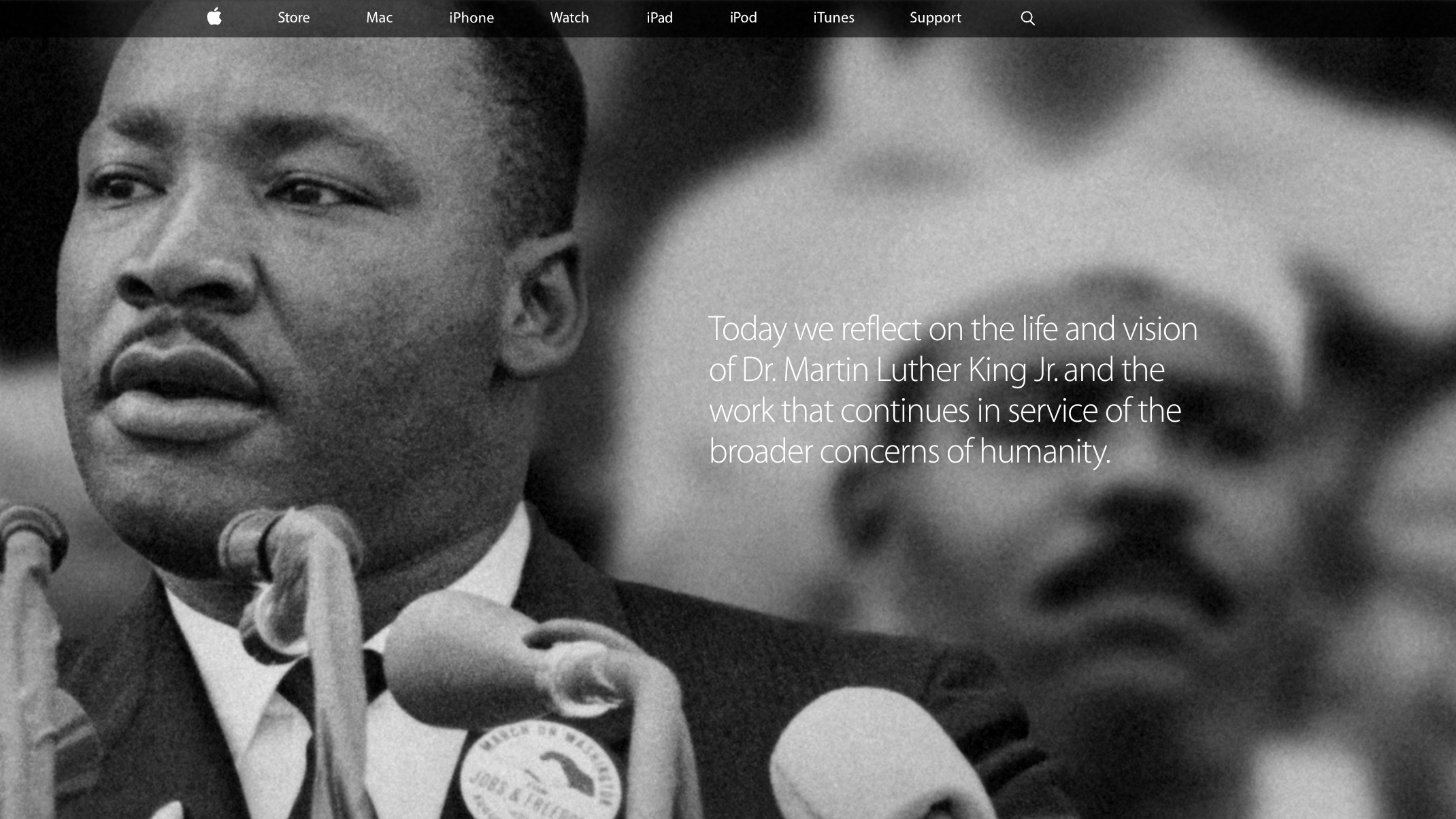
Apple has a history of presenting itself as a safer, socially progressive alternative within Big Tech. Its keynotes are replete with heartfelt testimony about iPhone and Apple Watch features saving lives. It releases Pride-themed accessories to celebrate the LGBTQ+ community, and the company has (so far) resisted government pressure to eliminate its DEI programs. Hell, its modern era was kicked off by the “Here’s to the crazy ones” TV ad, which intercut images of Dr. Martin Luther King Jr., John Lennon and Gandhi — explicitly cloaking its corporate image in civil disobedience and social justice.
A photo of Dr. Martin Luther King Jr. on Apple's homepage (2015)
Apple / The Internet Archive
But the company also wields that progressive image for selfish reasons, wrapping business priorities in the guise of conscientiousness. For example, when government regulations push for openness or interoperability, Apple warns of the security and privacy risks for its users. When Apple tightly controls where you can buy apps, it’s about keeping porn away from the kids. And Apple has decided that the theoretical safety of ICE officers is more valuable than the very real threat they pose to the communities they harass.
ICEBlock's availability on the App Store may not have changed the outcome of Wednesday's events. But it could resume its job as a community informer. It could make it easier to notify the public of where these masked thugs are congregating, perhaps even helping others avoid Good's fate.
Engadget has reached out to Apple for comment on reinstating ICEBlock; we’ll update if we receive a response.
This article originally appeared on Engadget at https://www.engadget.com/big-tech/its-time-for-apple-to-reinstate-iceblock-220802356.html?src=rss
In a new executive order, President Donald Trump has declared that the United States will withdraw from 66 international organizations and bodies, including several focused on tackling climate change. Trump made his disregard for climate change clear when he withdrew the US from the Paris climate agreement for a second time in early 2025, but these new withdrawals further confirm the second Trump administration is against global collaboration in general.
Among the organizations targeted, the US will no longer participate in the UN Framework Convention on Climate Change, the Intergovernmental Panel on Climate Change and organizations focused on trade, conservation, reproductive rights and immigration, like International Trade Centre, the International Union for the Conservation of Nature, the UN Population Fund and the Global Forum on Migration and Development. In the case of the United Nations-affiliated organizations, the US ending its participation also means withdrawing funding.
According to the White House, the organizations the US is leaving "promote radical climate policies, global governance and ideological programs that conflict with US sovereignty and economic strength." Withdrawing is supposed to save taxpayers money, though the White House's fact sheet on the executive order neglects to say how much will be saved or how that saved money will be spent now that it's not supporting the United Nations.
"By withdrawing from the IPCC, UNFCCC, and the other vital international partnerships, the Trump administration is undoing decades of hard-won diplomacy, attempting to undermine climate science and sowing distrust around the world," Former Vice President Al Gore said in a statement responding to the executive order.
While losing financial backing likely doesn't help anyone, the actual impact of the US'sdec withdrawals is a bit of an unknown, The Washington Post reports. For example, the US remains involved with the International Energy Agency, which works on global clean energy solutions. Also, many of the organizations the White House decided to exit were deliberative bodies, or ones that the US was only marginally involved in, according to a UN official The Post spoke to.
Directly pushing back against global organizations and regulation has been a consistent theme of the second Trump administration, particularly in regards to tech regulation. The US withdrew from trade talks with Canada in June 2025 over the country's digital services tax, and just last month the US banned former EU commissioner Thierry Breton from entering the US for his role in the creation of the Digital Services Act.
This article originally appeared on Engadget at https://www.engadget.com/big-tech/the-us-withdraws-from-dozens-of-international-bodies-including-climate-focused-organizations-195259578.html?src=rss

 Anmelden